
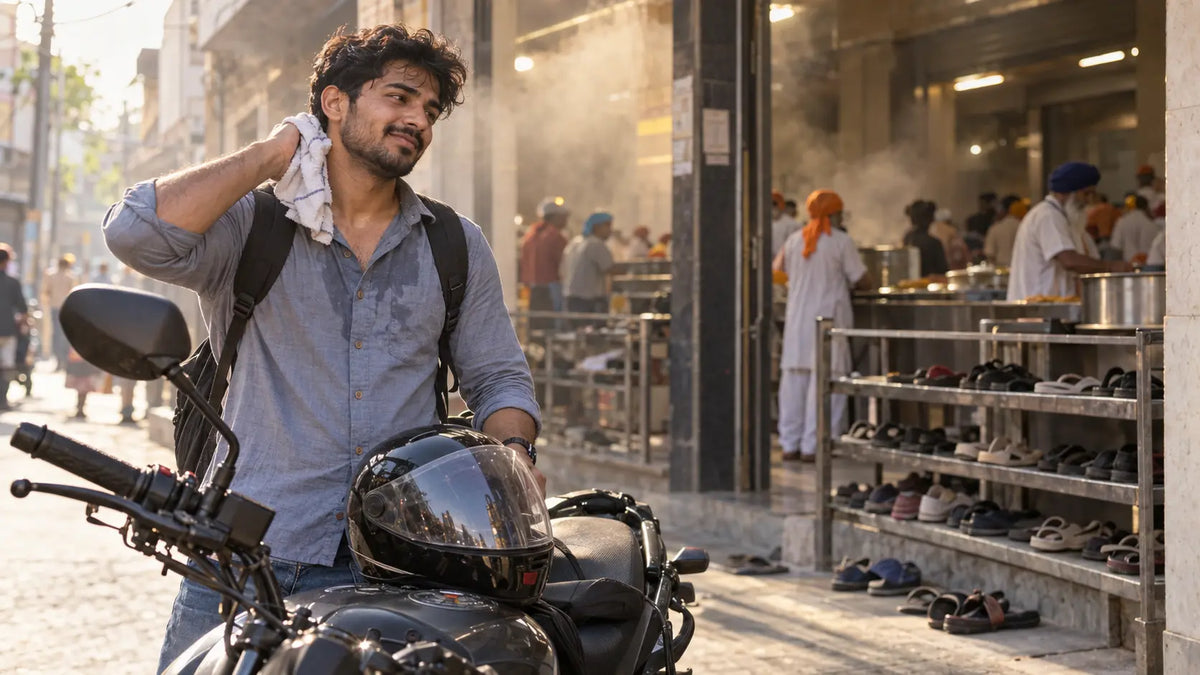
You've circled the Golden Temple's outer lanes twice, looking for parking. Your helmet's been on for 40 minutes, and you haven't started riding yet.
Amritsar riders know this wait. The Golden Temple welcomes over 1 lakh visitors every day, per Triveni Cabs. That number climbs to 1.5 lakh on special occasions, and every one of them needs somewhere to park a two-wheeler.
A helmet cleaner spray promises a quick fix. It doesn't touch what's actually growing inside your liner after a ride like that. This guide breaks down what Amritsar's traffic, heat, and crowds really do to your helmet, then what actually fixes it.
Rider Takeaways
- Amritsar added over 1.41 lakh two-wheelers in three years while its BRTS corridor sits stalled, per Tribune India. That means more helmet-on hours, not fewer.
- Amritsar's humidity climbs from 39% in May to 80% in August, per Climates to Travel. That's a 41-point swing that turns sweat into a bacterial breeding ground.
- 73.9% of tested motorcycle helmets showed bacterial growth and 65.2% showed fungal growth, per Sapkota et al., 2020.
- The Golden Temple welcomes over 1 lakh visitors daily, per Triveni Cabs. That means long parking searches and idle helmet-on time for local riders.
How Much Extra Helmet-On Time Does Amritsar's Traffic Really Add?
Amritsar riders aren't fighting helmet smell with new gear. They're just riding more, on more two-wheelers, into a road network that hasn't caught up.
Quick Fact:
Amritsar added over 1.41 lakh newly registered two-wheelers in the past three years, even as more than 100 BRTS buses sit idle at the city's stalled bus-transit terminal. Source: The Tribune, 2025 and a separate Tribune report.
Amritsar added over 1.41 lakh newly registered two-wheelers in the past three years, even as more than 100 BRTS buses sit idle at the city's stalled bus-transit terminal. Source: The Tribune, 2025 and a separate Tribune report.
With no functioning mass-transit alternative, riders get more helmet-on hours, not fewer, on roads that haven't grown.
Unique Insight
Our finding: Amritsar is unusual in this series because its helmet-on time isn't driven by long highway commutes. It's driven by short trips that take far longer than they should, thanks to pilgrim traffic and a transit system that never came online.

Why Does Amritsar's Summer-to-Monsoon Swing Hit Your Helmet So Hard?
Amritsar doesn't ease into monsoon. It goes from dry heat to heavy humidity in about six weeks. Your helmet liner feels every bit of that shift.
Quick Fact:
Amritsar's average relative humidity climbs from 39% in May to 80% in August, a 41-point jump, while June stays the hottest month with highs near 40°C. Source: Climates to Travel, 1991-2020 averages.
Amritsar's average relative humidity climbs from 39% in May to 80% in August, a 41-point jump, while June stays the hottest month with highs near 40°C. Source: Climates to Travel, 1991-2020 averages.
In May, sweat evaporates fast enough that you barely notice it. Once monsoon humidity sets in, that same sweat sits trapped against foam padding instead, with nowhere to go.
What's Actually Growing Inside Your Helmet?
Sweat itself doesn't smell. It's what feeds on that sweat inside a sealed, padded liner that does. Amritsar's humid stretch gives it exactly the conditions it needs.
Quick Fact:
73.9% of tested motorcycle helmets showed bacterial growth and 65.2% showed fungal growth, including Staphylococcus aureus and E. coli. Source: Sapkota et al., International Journal of Microbiology, 2020.
73.9% of tested motorcycle helmets showed bacterial growth and 65.2% showed fungal growth, including Staphylococcus aureus and E. coli. Source: Sapkota et al., International Journal of Microbiology, 2020.
A separate Lagos study found the same two species, Staphylococcus aureus and E. coli, on commercial motorcycle helmets, per Adamu et al., 2021. Different cities, same bacteria, same root cause: trapped sweat with nowhere to evaporate.
How Are Amritsar Riders Handling Golden Temple Crowds Today?
If you ride anywhere near the walled city on a weekend, you already know the answer: a lot. Parking runs, crawl-and-stop lanes, and idle waits near the parikrama are common. They keep your helmet sealed on your head far longer than the ride itself takes.
Quick Fact:
Amritsar's Golden Temple welcomes over 1 lakh visitors every single day, with the number climbing to 1.5 lakh during special occasions. Source: Triveni Cabs, 2026.
Amritsar's Golden Temple welcomes over 1 lakh visitors every single day, with the number climbing to 1.5 lakh during special occasions. Source: Triveni Cabs, 2026.
That volume doesn't stay inside the temple complex. It spills onto every lane, market road, and parking stretch nearby. Riders on two-wheelers absorb most of it, since they're the easiest way to get close.
Three groups feel it most: langar sewa volunteers, delivery shopkeepers, and daily commuters cutting through the old city. They all end up sitting in traffic with a helmet on, sweating, for far longer than the actual distance covered.
Unique Insight
Our finding: Amritsar's helmet-hygiene problem isn't really a distance problem. Most riders here cover short distances but spend disproportionate time stationary in crowds, which means more sweat build-up per kilometer ridden than almost any other city in this series.
Is a Helmet Cleaner Spray the Same as a Hygiene Spray?
No, and this mix-up is common. A cleaner removes visible dirt and grease. A hygiene spray goes after the bacteria you can't see, which is what actually causes the smell.
If your liner looks fine but still smells after an old-city ride, dirt was never the real problem.
| What it does | Helmet cleaner | Hygena hygiene spray |
|---|---|---|
| Removes dust, dirt, road grime | Yes | Not designed for this |
| Targets odor-causing bacteria | Not designed for this | Yes, bacteriostatic formula |
| Safe for daily use on skin-contact padding | Varies by product | Yes, dermatologically tested |
What Actually Works for Amritsar's Riding Conditions?
Once you know it's bacteria, not dirt, the fix changes. You need something that kills what's growing in the liner, and that survives repeated humid days without losing effect.
Hygena's bacteriostatic helmet deodorant spray targets odor-causing bacteria at the source, using tea tree extract, neem, and hydrogen peroxide. A few sprays after a langar-sewa shift or a slow crawl through the old city. Your liner isn't playing host to anything by the next ride.
It's built for riders who spend more time stationary than moving, which describes most helmet-on hours in this city.

Frequently Asked Questions
Does Amritsar's Golden Temple crowd really make helmet smell worse?
Yes. With over 1 lakh daily visitors per Triveni Cabs, riders near the complex face heavy footfall. Most of that time is spent idling, not actually riding, which means more sweat trapped against the liner per trip.
Is a helmet cleaner spray enough for Amritsar's monsoon humidity?
Not on its own. Once humidity crosses 75-80% in July-August, per Climates to Travel, sweat stops evaporating well. You need something that targets bacteria, not just surface grime.
How often should Amritsar riders clean their helmet liner?
Amritsar's long idle-time trips and humid stretch call for more than a weekly clean. Use a hygiene spray after every ride through crowded or monsoon-humid conditions.
Where can I buy helmet deodorant spray in Amritsar?
Hygena's helmet deodorant spray ships across India, including Amritsar, through hygena.in. No local storefront is needed since it's ordered online.
Conclusion
Amritsar's helmet problem isn't distance. It's a stalled transit system, a sharp humidity swing from May to August, and long waits near the Golden Temple.
A cleaner handles the dust. It won't touch the bacteria building up underneath. Hygena's bacteriostatic spray was built for exactly that gap. It fits into a langar-sewa shift or an old-city crawl without adding a step you'll skip. Check out our deep dive on helmet bacteria for the full science. Browse other City Rider Guides to see how riders in different Indian cities handle the same problem.
Sources
1. "With rising number of vehicles, city roads choked by congestion," The Tribune, 2025. Retrieved 2026-09-04.
2. "Open House: How can Amritsar address worsening traffic jams caused by stalled BRTS corridor?," The Tribune, 2025. Retrieved 2026-09-04.
3. "Amritsar climate: seasons, when to go, monthly averages," Climates to Travel, 1991-2020 averages. Retrieved 2026-09-04.
4. "Microbial Diversity and Antibiotic Susceptibility Pattern of Bacteria Associated with Motorcycle Helmets," Sapkota et al., International Journal of Microbiology, 2020. Retrieved 2026-09-04.
5. "Microorganisms Associated with Commercial Motorcycle Helmets in Lagos Metropolis," Adamu, Edeghagba, Olatomi, Ezeokoli & Elijah, 2021. Retrieved 2026-09-04.
6. "Golden Temple Amritsar Timings, Free Entry & Langar (2026)," Triveni Cabs, 2026. Retrieved 2026-09-04.
Share:
Helmet Cleaner Gwalior: What Heat and Dust Do to It
Motorcycle Helmet Smell Removal: Why It Won’t Go Away