
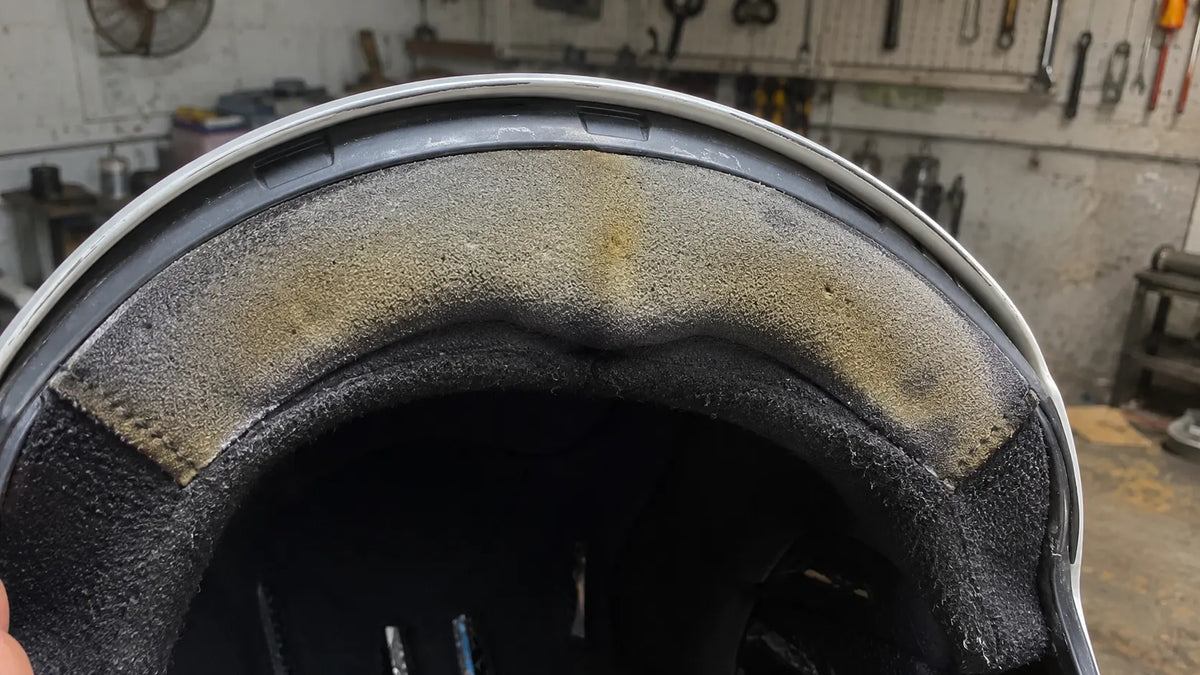
You washed the liner on Sunday. By Wednesday's commute, the smell is back. If anything, it's worse.
Most riders assume that means they didn't wash it well enough. That's not quite it. The smell isn't sweat sitting in fabric. It's bacteria feeding on that sweat, and washing the outer padding barely touches where they actually live.
This article breaks down what a 2020 microbiology study found growing inside real motorcycle helmets, why plain cleaning can't solve it, and what a dedicated bacteria control spray actually does differently.
Rider Takeaways
- A 2020 study of 130 motorcycle helmets recovered 392 bacterial and 346 fungal isolates, with Staphylococcus aureus as the top species (Sapkota et al., International Journal of Microbiology).
- Helmets showed bacterial growth in 73.9% to 80% of samples tested, regardless of rider gender.
- Washing the removable padding doesn't reach the foam underneath, which is where most of that bacterial load builds up.
- A bacteriostatic spray works by stopping bacteria from multiplying, not by masking the smell they're already producing.
Why Does Your Helmet Still Smell After You Wash the Padding?
In 2020, researchers publishing in the International Journal of Microbiology examined 130 motorcycle helmets and recovered 392 bacterial isolates plus 346 fungal isolates across seven genera. That's not a one-off dirty helmet. That's the norm for helmets in regular use.
Here's the part most cleaning guides skip: the removable liner is only the outer layer. Underneath it sits a foam shell that absorbs sweat every single ride and rarely gets washed at all. That foam is warm, damp, and dark. Exactly what bacteria need to multiply.
So when you wash the fabric liner and the smell comes back within days, phir bhi wahi smell aa jaati hai, right? That's because you cleaned the part that wasn't the main problem.
Quick Fact:
In a 2020 study of 130 motorcycle helmets, researchers found bacterial growth in 73.9% of samples from male riders and 80.0% from female riders, with fungal growth present in roughly two out of three helmets tested either way. Source: Sapkota et al., International Journal of Microbiology, 2020.
In a 2020 study of 130 motorcycle helmets, researchers found bacterial growth in 73.9% of samples from male riders and 80.0% from female riders, with fungal growth present in roughly two out of three helmets tested either way. Source: Sapkota et al., International Journal of Microbiology, 2020.
What's Actually Growing Inside an Unwashed Helmet?
In 2020, the same International Journal of Microbiology study identified Staphylococcus aureus as the single most common bacterial species recovered from helmets, at 22.7% of isolates, followed by S. epidermidis at 19.6% and E. coli at 13.8%.
Both staph species live on human skin normally. The problem is concentration. A helmet traps sweat, heat, and skin cells in a sealed space for hours, and that's exactly the environment these bacteria multiply fastest in.
E. coli showing up at all is the more uncomfortable finding. Its presence points to hands or surfaces that weren't clean before touching the liner. Not usually dangerous for a healthy rider, but not something you want sitting against your forehead for a two-hour ride either.
Unique Insight
Our finding: Almost every helmet-cleaning guide talks about washing the removable liner fabric. Almost none mention the foam shell underneath it, which never gets removed and rarely gets washed. That foam is the actual reservoir where most helmet bacteria build up over weeks of riding.
Can Helmet Bacteria Actually Harm Your Skin or Scalp?
In 2022, a study in the Asian Journal of Biological and Life Sciences described motorcycle helmets as potential fomites: objects that carry and transfer pathogenic microorganisms between uses. That's a fancier way of saying your helmet can pass bacteria to your skin, and to anyone else who wears it.
For most riders, this shows up as scalp itchiness, small breakouts along the forehead and jawline, or a persistent low-grade irritation that no shampoo seems to fix. Dermatologists call breakouts caused by friction and trapped sweat "acne mechanica," and a sealed, unwashed helmet is a textbook trigger.
Ever lent your helmet to a friend for a quick ride? That's a direct bacterial handoff, no different from sharing a towel.

Why Doesn't Febreze or Perfume Actually Fix It?
In 2024, researchers testing antimicrobial fabric treatments found that agents like tea tree oil, silver nitrate, and zinc chloride achieved up to a 99% bacteriostatic reduction rate on treated textile, measured using the standard AATCC 100 contact test.
Fragrance sprays don't do any of that. They add a stronger smell on top of the existing one, and once the fragrance fades, the underlying bacterial odor comes right back. Nothing about the bacterial population actually changes.
A bacteriostatic formula works differently. It doesn't kill every microbe outright, but it stops them from multiplying, which is what breaks the sweat-feeds-bacteria-produces-smell cycle at its source.
How Does a Bacteria Control Spray Actually Work?
This is where Hygena's helmet spray fits in. It's built as a bacteriostatic formula, using ingredients like tea tree extract and neem, designed to stop odor-causing bacteria from multiplying between washes rather than covering up what's already growing.
You spray it inside the liner and along the foam edges after a ride, let it sit for a few seconds, and you're done. No scrubbing, no waiting for the padding to air dry overnight.
Make this easier. Hygena takes 5 seconds after every ride, and your Sunday wash routine handles the rest.

Frequently Asked Questions
How often should I use a helmet bacteria control spray?
After every ride longer than 30 minutes is ideal, since sweat starts feeding bacteria within hours. Riders in hot, humid cities benefit most from daily use, per the 73.9-80% growth rates found by Sapkota et al. (2020).
What actually causes helmet odor?
Bacteria, not sweat alone. Sweat is just the fuel. Staphylococcus aureus and related species metabolize it into the volatile compounds that produce the smell, per the 2020 International Journal of Microbiology study.
Is helmet bacteria harmful to my scalp?
It can trigger itchiness, irritation, and acne mechanica breakouts along the forehead and jaw, especially with prolonged wear. A 2022 fomite study flagged helmets as a real transmission risk between uses.
Can I just wash the padding instead of using a spray?
Washing helps, but it only reaches the removable liner fabric, not the foam shell underneath where bacteria concentrate. A spray reaches both surfaces in seconds, between washes.
Conclusion
Your helmet doesn't smell because you're a bad cleaner. It smells because bacteria, not sweat, are doing the actual work, and fabric washing alone never reaches where they live.
A bacteriostatic spray closes that gap between wash days by stopping bacterial growth at the source instead of masking it. Keep one in your tank bag, use it after every ride, and the Sunday-smell surprise stops happening.
Ready to stop the cycle?
Sources
1. Sapkota, A. et al., "Microbial Diversity and Antibiotic Susceptibility Pattern of Bacteria Associated with Motorcycle Helmets," International Journal of Microbiology, 2020. Retrieved 2026-07-23.
2. "Motorcycle Helmets as Potential Fomites in Transmission of Pathogenic Micro-organisms and Antibacterial Activity of Helmet Disinfectant Spray," Asian Journal of Biological and Life Sciences, 2022. Retrieved 2026-07-23.
3. "Advancing Antimicrobial Textiles: A Comprehensive Study on Combating ESKAPE Pathogens and Ensuring User Safety," MDPI Materials / PMC, 2024. Retrieved 2026-07-23.
Share:
Puncture Repair on the Road: What Every Rider Must Know
Quick-Dry Riding Clothes for Touring: Never Run Out