
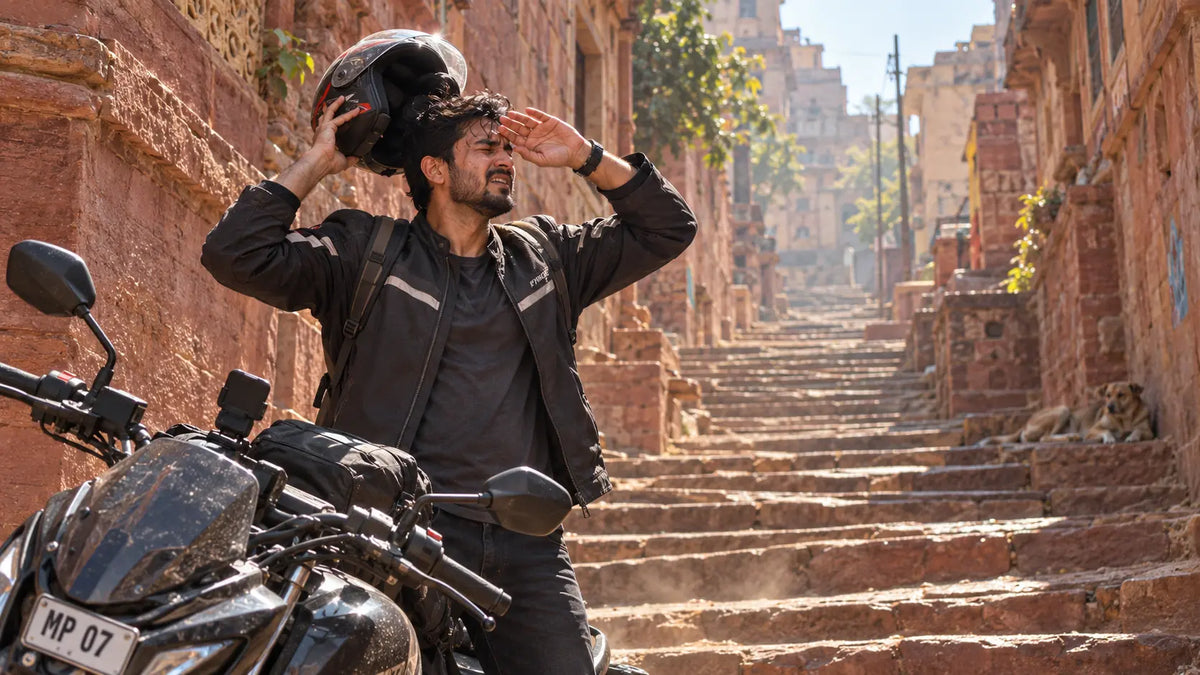
Forty-one degrees in May. Barely any moisture in the air. Your helmet feels bone-dry inside, so you assume it's clean.
Every helmet cleaner Gwalior riders reach for handles the dust from that dry heat well. It won't touch what's growing underneath once August arrives.
Gwalior's humidity climbs from a 25% low in April to 79% by August. That's a 54-point swing between the city's driest and wettest months. That same helmet, the one that felt fine three months earlier, starts smelling by the second ride of the week. The heat didn't change much. The moisture did, and moisture is what bacteria actually need.
This piece looks at why Gwalior's dry-to-humid swing matters more than the temperature number. It covers what a helmet cleaner spray can and can't fix. It also covers how to build a routine that survives both halves of the year.
Rider Takeaways
- Gwalior's humidity swings 25% (April) to 79% (August), a 54-point range that changes how fast bacteria multiply. Source: Climate-Data.org.
- Two-wheelers make up 56% to 70% of vehicle traffic on Gwalior's old-city roads, meaning long, stop-start helmet-on time most days.
- A 2025 study found bacteria on porous fabric survive far longer at high humidity than low. That's Gwalior's monsoon problem exactly.
- A helmet cleaner removes dust and grime. It doesn't kill the bacteria that cause odor, and Gwalior's dust season and bacteria season don't overlap.
How Much Helmet-On Time Does Gwalior's Traffic Actually Add?
A lot, because two-wheelers dominate Gwalior's roads. In the old-city Maharaja Bada area, two-wheelers make up 56% of traffic at Nai Sadak. That share climbs to 70% at Daulatganj Road, per a Shakti Sustainable Energy Foundation mobility study.
Quick Fact:
Daily traffic through Maharaja Bada ranges from roughly 32,857 to 55,178 vehicles, and two-wheelers form the largest single share of it. Citywide, 20% of all trips are made by two-wheeler and another 42% on foot, leaving narrow lanes packed with riders threading through pedestrians at walking pace for long stretches. Source: Shakti Sustainable Energy Foundation, Gwalior City Report
Daily traffic through Maharaja Bada ranges from roughly 32,857 to 55,178 vehicles, and two-wheelers form the largest single share of it. Citywide, 20% of all trips are made by two-wheeler and another 42% on foot, leaving narrow lanes packed with riders threading through pedestrians at walking pace for long stretches. Source: Shakti Sustainable Energy Foundation, Gwalior City Report
Stop-start traffic through narrow lanes means your helmet stays on longer per kilometre than on open roads. More sweat soaks into the same patch of padding, with less airflow to dry it out.
Unique Insight
Our finding: Gwalior riders lose the most drying time exactly where the city's mode-share data says traffic is worst, the old-city core, which is also where daily errands and market runs happen most. That's the same stretch where a helmet gets the least ventilation and the most start-stop wear.
Does Gwalior's Heat-to-Humidity Swing Actually Change Helmet Bacteria?
Yes, and the swing matters more than either extreme on its own. Gwalior's relative humidity averages 25% in April, the year's driest month. It climbs to 79% by August, per Climate-Data.org's 1991-2020 averages, a 54-percentage-point range across just four months.
Quick Fact:
May is Gwalior's hottest month, averaging a 41°C daily high. But April, the driest month at 25% humidity, sits right before it, and August's 79% humidity comes with a milder 31.3°C average high. The two stresses on your helmet, heat and moisture, don't peak together. Source: Climate-Data.org, Gwalior Climate
May is Gwalior's hottest month, averaging a 41°C daily high. But April, the driest month at 25% humidity, sits right before it, and August's 79% humidity comes with a milder 31.3°C average high. The two stresses on your helmet, heat and moisture, don't peak together. Source: Climate-Data.org, Gwalior Climate
April's dryness fools most riders. Sweat evaporates fast, so the padding feels dry within minutes of parking. Nothing looks wrong. But the moment monsoon humidity sets in around July and August, that same padding stops drying out between rides. That's when bacteria get the steady dampness they need to multiply.
Yeh seasonal shift is why a helmet that "never smelled" through April and May can suddenly start smelling. Aap ki riding routine wahi hai, lekin helmet ke andar ka mahaul badal jaata hai.

Why Does Humidity Matter More Than Sweat Alone?
Because bacteria need moisture to survive, and where that moisture sits changes everything. A 2025 study in Microbiology Spectrum by Cheng et al. tested bacterial survival on porous fabric surfaces, similar to a helmet's sweatband material, at different humidity levels.
Quick Fact:
On porous fabric, bacteria at low humidity (15% relative humidity) died off far faster than bacteria kept at high humidity (100% relative humidity), which barely declined. The researchers noted this humidity effect only showed up on porous materials like fabric, not on sealed, non-porous surfaces. Source: Cheng et al., Microbiology Spectrum, 2025
On porous fabric, bacteria at low humidity (15% relative humidity) died off far faster than bacteria kept at high humidity (100% relative humidity), which barely declined. The researchers noted this humidity effect only showed up on porous materials like fabric, not on sealed, non-porous surfaces. Source: Cheng et al., Microbiology Spectrum, 2025
Your helmet's foam padding and fabric liner are porous by design, so they hold moisture the same way. That explains why Gwalior's dry April feels odor-free. Its humid August turns the same helmet unpleasant within days, even with similar riding habits.
How Do Gwalior Riders Handle Helmet Smell Today?
Mostly by ignoring it until it's bad, or reaching for a spray that only masks the problem. Gwalior's riding culture runs on daily commutes and market trips through the old city, not just weekend touring. Helmets get worn far more hours per week than most riders realize.
The city is also home to the Tansen Samaroh, an annual classical-music festival honoring the legendary musician Tansen. It runs every December near his tomb, organized by the state's Ustad Alauddin Khan Kala Evam Sangeet Academy. The festival draws musicians and visitors from across India, many arriving by two-wheeler on the same narrow lanes covered above.
December's cooler, drier air makes helmet smell less obvious during the festival crowds. That's the same seasonal trap as April: comfortable weather hides a problem that comes roaring back once the humidity returns.
Is a Helmet Cleaner the Same Thing as a Helmet Hygiene Spray?
No. This mix-up is exactly why helmets keep smelling even after a "cleaning." A cleaner removes visible dirt, dust, and grime from a surface. It doesn't necessarily kill the bacteria living inside foam padding, which is what actually causes odor.
Gwalior's red-sandstone old city kicks up plenty of dust, especially through the dry months, so a wipe-down feels satisfying. But dust and bacteria are two separate problems, and they don't even peak at the same time of year here.
| Helmet Cleaner | Hygena Hygiene Spray |
|---|---|
| Removes visible dust and grime | Targets odor-causing bacteria directly |
| Best used after a dusty or muddy ride | Best used after every ride, dusty or not |
| Doesn't address padding odor at the source | Bacteriostatic formula, works on the padding itself |
You need both, at different times, for different reasons. One handles the visible mess. The other handles what you can't see.
The Fix: A Helmet Cleaner Gwalior Routine Can't Handle Alone
A helmet in Gwalior needs two habits running side by side, not one product doing double duty. Wipe down the shell and visor when the old city's dust builds up. Spray the interior with Hygena's bacteriostatic helmet spray after every ride, dry season or wet.

It holds up through a 90-minute crawl across Maharaja Bada in July's humidity. It holds up just as well through a dusty April ride past the old city walls. That's the point: one habit that doesn't need you to guess the season.
Frequently Asked Questions
Does Gwalior's dry heat mean I can skip helmet hygiene in summer?
No. April's low 25% humidity slows bacteria, but it doesn't stop sweat buildup. August's 79% humidity arrives fast once the monsoon starts, per Climate-Data.org.
Where can I buy a helmet hygiene spray in Gwalior?
Hygena's bacteriostatic helmet spray ships across India, including Gwalior, through hygena.in. It's built for exactly this kind of dry-to-humid seasonal swing.
How is a helmet cleaner different from a helmet deodorant spray?
A cleaner removes dirt and dust from the shell or padding surface. A deodorant or hygiene spray targets the bacteria causing odor at the source, inside the foam.
How often should I treat my helmet if I commute through Gwalior's old city daily?
After every ride is ideal, especially through the humid months. Daily stop-start traffic through Maharaja Bada means more helmet-on time and less drying between rides.
Can helmet smell come back even after I wash the padding?
Yes, if bacteria survive the wash. Cheng et al.'s 2025 study found bacteria on porous fabric persist strongly at high humidity, Gwalior's exact monsoon condition.
Conclusion
Gwalior's helmet problem isn't the heat. It's the 54-point humidity swing between April and August, and how differently bacteria behave across that range. A dusty helmet in April can look clean and still be building trouble for August.
Treat the dust with a cleaner when the old city's roads kick it up. Treat the bacteria with Hygena's bacteriostatic spray after every ride, whichever season it is. Riders who wait for the smell to show up are always one humid month behind. Start the habit before the swing catches you, not after.
Sources
1. "Gwalior Climate," Climate-Data.org, 1991-2020 averages. Retrieved 2026-09-04.
2. "City Report: Gwalior -- Supporting Sustainable Mobility under Smart City Mission," Shakti Sustainable Energy Foundation, 2019 (data from the 2011 City Development Plan and 2012-13 RTO registration figures). Retrieved 2026-09-04.
3. "Environmental factors and antimicrobial efficacy: the impact of temperature and humidity on material surfaces," Cheng et al., Microbiology Spectrum, 2025. Retrieved 2026-09-04.
4. "Tansen Samaroh," Wikipedia. Retrieved 2026-09-04.
Share:
Helmet Deodorizer Kozhikode: Why Your Helmet Never Dries
Helmet Cleaner Amritsar: The Golden Temple Crowd Problem