
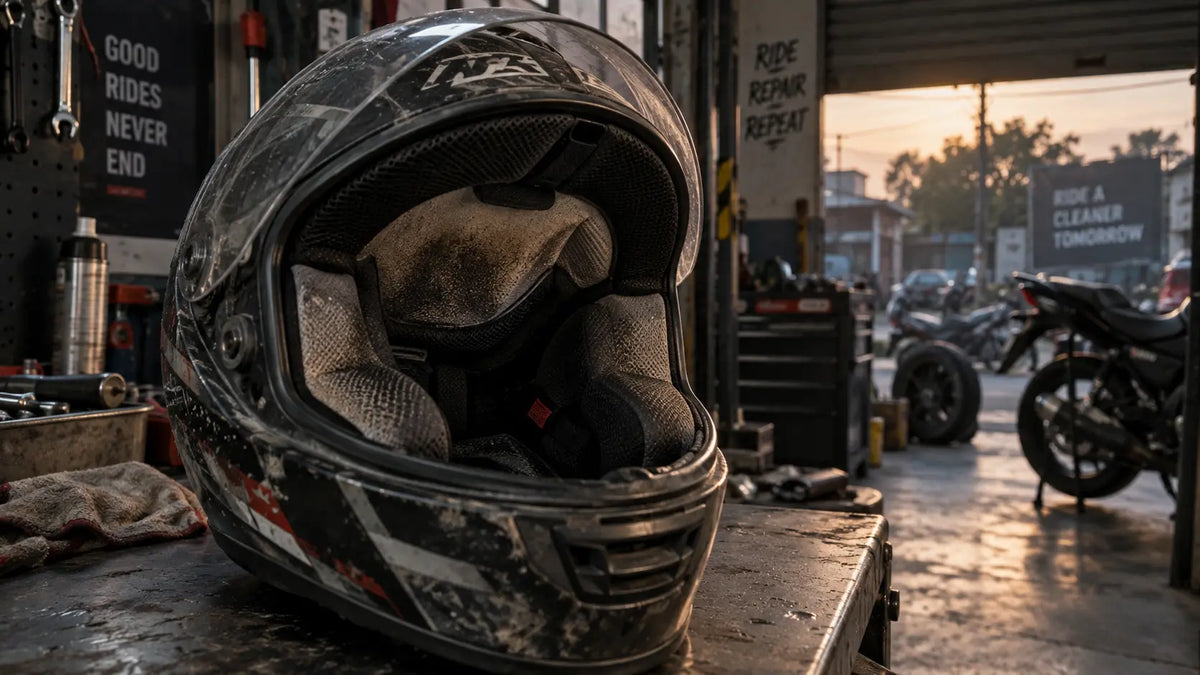
You take off your helmet after a ride, and there it is again. That smell.
Maybe you've washed the liner. Maybe you've left the helmet open overnight. Maybe you've even sprayed perfume inside it.
Still, the smell comes back.
That's because motorcycle helmet smell removal isn't only about removing sweat. Your helmet interior can collect sweat, skin oils and moisture. These conditions can support microorganisms that contribute to odor.
A 2020 study of 130 motorcycle helmets recovered 392 bacterial isolates and 346 fungal isolates.
So what's actually happening inside your helmet?
And why does the smell return even after cleaning?
Let's break it down.
Rider Takeaways
- A 2020 study found bacterial growth in 86.7% of helmets that had never been washed or disinfected.
- Sweat isn't the whole odor problem. Microorganisms can transform sweat components into odor-producing compounds.
- Washing removable padding matters, but it shouldn't be your only helmet hygiene habit.
- A suitable bacteriostatic treatment can help manage bacterial growth between deeper cleaning sessions.
Why does your motorcycle helmet smell?
Sweat creates the conditions, while microorganisms can help create the smell. In 2020, researchers examined 130 motorcycle helmets and recovered bacterial and fungal isolates from them. That matters because your helmet keeps sweat and moisture close to your skin during every ride.
Fresh sweat itself is generally odorless. A 2023 review of sweat and sportswear found that bacteria can break down sweat components and produce volatile compounds that create odor.
The effect can become more noticeable during hot riding.
A 2014 study of elite road motorcyclists racing in tropical conditions recorded sweat rates of 1.01 L/hour during practice and 0.90 L/hour during qualifying.
You don't need to race superbikes for the principle to matter.
A long summer commute can leave your helmet interior damp with sweat. The padding then holds moisture close to your scalp.
Add skin oils, shed skin cells and repeated use, and you've created better conditions for microbial activity.
That's why spraying fragrance over the smell doesn't solve the underlying problem.
Our finding: If your helmet smells fresh after washing but smells again after a few rides, the cleaning didn't necessarily fail. The same sweat-and-moisture cycle starts again with your next ride.
A 2020 study examined 130 motorcycle helmets and recovered 392 bacterial isolates and 346 fungal isolates. Staphylococcus aureus represented 22.7% of bacterial isolates, while Staphylococcus epidermidis represented 19.6%. Source: Sapkota et al., 2020.
In 2020, researchers examining 130 motorcycle helmets recovered 392 bacterial and 346 fungal isolates. Staphylococcus aureus accounted for 22.7% of bacterial isolates, followed by Staphylococcus epidermidis at 19.6%. Source: Sapkota et al., International Journal of Microbiology, 2020.
Why does the smell return after you clean your helmet?
Cleaning helps, but your helmet immediately starts another cycle of sweat and moisture once you ride again. In 2020, researchers found bacterial growth in 86.7% of helmets that had never been washed or disinfected. The figure was 57.1% among washed helmets and 20% among disinfected helmets.
That doesn't mean washing your liner is useless. Quite the opposite.
It shows why regular cleaning matters.
But it also shows why a rider who washes the liner occasionally can still experience recurring odor. Your helmet goes straight back into service after cleaning.
Every ride adds another round of sweat and moisture.
The same study found bacterial growth in 60% of helmets used for less than one year. The figure rose to 89.1% for helmets used for more than three years.
So a helmet that looks fine from the outside doesn't necessarily tell you much about its interior hygiene.
Manufacturers also recommend care that protects the helmet's materials. SHOEI advises washing removable interiors according to the helmet's instructions. Arai similarly recommends gentle hand washing for its removable comfort lining.
Your helmet is safety equipment first. Don't attack its liner with aggressive household chemicals because the smell is annoying.
In the 2020 helmet study, bacterial growth was 86.7% in helmets with no washing or disinfection, 57.1% in washed helmets and 20.0% in disinfected helmets. The findings support regular helmet hygiene, although they don't prove that every odor comes from the same organism.
The 2020 motorcycle helmet study found bacterial growth in 86.7% of helmets with no washing or disinfection. Washed helmets recorded 57.1%, while disinfected helmets recorded 20%. The results support regular interior hygiene while not establishing a universal odor-removal effect for one specific method.
What actually works for motorcycle helmet smell removal?
Start with the basics: clean what your helmet manufacturer says you can clean. Removable liners should be washed according to their specific care instructions. This removes accumulated sweat, oils and dirt from the padding.
If you're dealing with recurring odor, the next step is maintaining the interior between deeper cleaning sessions.
That's where a helmet hygiene routine matters.
For riders dealing with recurring smell, Hygena is designed for this gap between deeper cleaning sessions. Its formula uses Bacteriostasis® Technology, which inhibits the growth of odor-causing bacteria rather than relying on fragrance to cover the smell.
Hygena is designed for quick application. Spray 2–3 pumps across the interior padding, wait 10 seconds, then ride.
Hygena's science page states that its formula is pH 5.5 balanced and has undergone dermatological testing. The brand also documents clinical testing against odor-causing bacteria strains.
The distinction matters.
You're not replacing proper liner cleaning. You're adding a hygiene step that fits the way riders actually use their helmets.
The fix is simpler than you think. Keep your liner clean, let it dry properly, and add a quick hygiene step between deeper washes. That's where Hygena fits.
Hygena's documented application uses 2–3 pumps across the helmet's interior padding followed by a 10-second wait. Its Bacteriostasis® Technology is designed to inhibit odor-causing bacterial growth rather than rely on fragrance alone.
Ready to make helmet hygiene part of your riding routine?
Try Hygena for your next ride →
Our finding: The best helmet hygiene routine has to work between rides. A routine that requires a full liner wash every day won't fit most riders' habits.
Can you prevent helmet smell from coming back?
Yes. Prevention starts with breaking the sweat-and-moisture cycle. In 2020, bacterial growth appeared in 79.2% of shared helmets and 61.8% of non-shared helmets in the study of 130 motorcycle helmets.
First, don't put your helmet away wet if you can avoid it. Give the interior airflow after a ride.
Second, don't wait until the smell becomes unbearable. Odor is a late signal that tells you the interior has already been exposed to repeated sweat and moisture.
Third, clean the removable liner according to your helmet manufacturer's instructions.
Avoid solvents and aggressive chemicals. SHOEI specifically warns that its EPS liner can be vulnerable to solvents and heat.
Fourth, pay attention to the areas that touch your head most. The forehead, crown and cheek areas receive repeated sweat and skin contact.
Finally, build a small post-ride habit.
Open the helmet. Let it breathe. Treat the interior when needed. Clean the liner regularly.
That sounds almost too simple.
But the 2020 helmet study found differences in bacterial growth between helmets with different hygiene histories.
Our finding: Helmet hygiene works better as a routine than a rescue mission. Waiting for a helmet to smell creates a cycle of deep cleaning and repeat odor.
In a 2020 study of 130 motorcycle helmets, bacterial growth was reported in 60.0% of helmets used for less than one year and 89.1% of helmets used for more than three years. The result supports ongoing interior hygiene rather than judging helmet hygiene by exterior appearance.
In 2020, researchers found bacterial growth in 60.0% of helmets used for less than one year and 89.1% of helmets used for more than three years. The findings reinforce the value of ongoing interior hygiene, even when a helmet's exterior still looks clean.
Is washing the liner enough?
Washing is important, but it shouldn't be your entire strategy. A 2023 review found that fresh sweat is generally odorless while bacterial activity can transform sweat components into volatile odor compounds.
A washed liner removes accumulated sweat, oils, dirt and other material. But the moment you put the helmet back on, the interior begins its next exposure cycle.
Research on sportswear helps explain why this matters. Microorganisms and sweat can transfer to textiles during exercise.
Your helmet padding is a textile environment pressed directly against your head.
So think in two layers.
Deep hygiene: Clean the liner according to the helmet manufacturer's instructions.
Between-clean hygiene: Keep the interior dry and use a suitable helmet hygiene treatment when needed.
Hygena's approach sits in the second layer. Its Bacteriostasis® Technology is designed to inhibit bacterial growth rather than cover odor with stronger fragrance.
The formulation also contains neem extract and tea tree oil. Hygena documents the formula as pH 5.5 balanced and designed for helmet use.
Good helmet hygiene doesn't need exaggerated claims. It needs a routine you can actually follow.
If your helmet still smells after repeated cleaning, inspect the condition of the liner. A worn or damaged interior may need replacement according to the manufacturer's guidance.
A 2023 review found that fresh sweat is generally odorless and that bacterial activity can transform sweat components into volatile odor compounds. This helps explain why controlling the microbial environment matters alongside regular cleaning and drying.

Regular liner washing removes accumulated material, but sweat exposure starts again after the next ride. Research on sportswear shows that bacteria can transform sweat components into volatile odor compounds. A practical helmet hygiene routine combines manufacturer-approved cleaning with ongoing moisture and odor management.
Frequently asked questions
What causes motorcycle helmet smell?
Motorcycle helmet smell can develop when sweat, skin oils and moisture interact with microorganisms in the helmet interior. A 2020 study recovered bacteria and fungi from all 130 motorcycle helmets examined. Odor doesn't prove harmful contamination, but the findings support regular helmet hygiene.
How do you remove smell from a helmet?
Start with your manufacturer's cleaning instructions for the removable liner. Wash gently, rinse thoroughly and dry completely. Then maintain the interior between deeper washes. Avoid solvents or aggressive cleaners that can damage helmet materials.
Can you spray deodorizer inside a motorcycle helmet?
Use only a product intended for helmet interiors and follow its instructions. Hygena is formulated specifically for helmet hygiene. Its documented routine uses 2–3 pumps on the interior padding followed by a 10-second wait.
Does washing remove helmet bacteria?
Washing can reduce microbial contamination, but results depend on the cleaning method and helmet condition. In a 2020 study, bacterial growth was 57.1% among washed helmets compared with 86.7% among helmets with no washing or disinfection.
How often should you clean a helmet liner?
Follow your helmet manufacturer's care instructions and clean more often when the liner gets heavy sweat exposure. SHOEI and Arai both provide specific cleaning guidance for removable interiors, including gentle washing and proper drying.
Conclusion
If your helmet smells again a few days after cleaning, you're not imagining the problem.
Sweat starts the cycle. Moisture supports it. Microorganisms can turn sweat components into compounds your nose recognizes as odor.
That's why motorcycle helmet smell removal isn't about making your helmet smell like perfume.
Clean the liner properly. Let it dry. Protect the helmet's materials. Then build a small hygiene habit between deeper washes.
Hygena is designed for that everyday gap. Its Bacteriostasis® Technology helps inhibit odor-causing bacterial growth inside the helmet.
No elaborate routine.
Just a better one.
Your helmet protects your head every ride. Give the inside some attention too.
Make helmet hygiene part of your riding routine →
Sources
- Sapkota et al., Microbial Diversity and Antibiotic Susceptibility Pattern of Bacteria Associated with Motorcycle Helmets, International Journal of Microbiology, 2020.
- Sweat and odor in sportswear, review, 2023.
- Brearley et al., Responses of elite road motorcyclists to racing in tropical conditions, International Journal of Sports Physiology and Performance, 2014.
- SHOEI Worldwide, helmet maintenance guidance.
- Arai Helmet, SZ-R EVO Instructions for Use, 2023.
- Efficacy and safety of Melaleuca alternifolia tea tree oil for human health, systematic review, 2023.
- Hygena Science page, Bacteriostasis® Technology and formulation information.
- Hygena product page, application instructions and product information.
Share:
Helmet Cleaner Amritsar: The Golden Temple Crowd Problem
The Truth About Helmet Cleaner Sprays for Bhopal Riders