
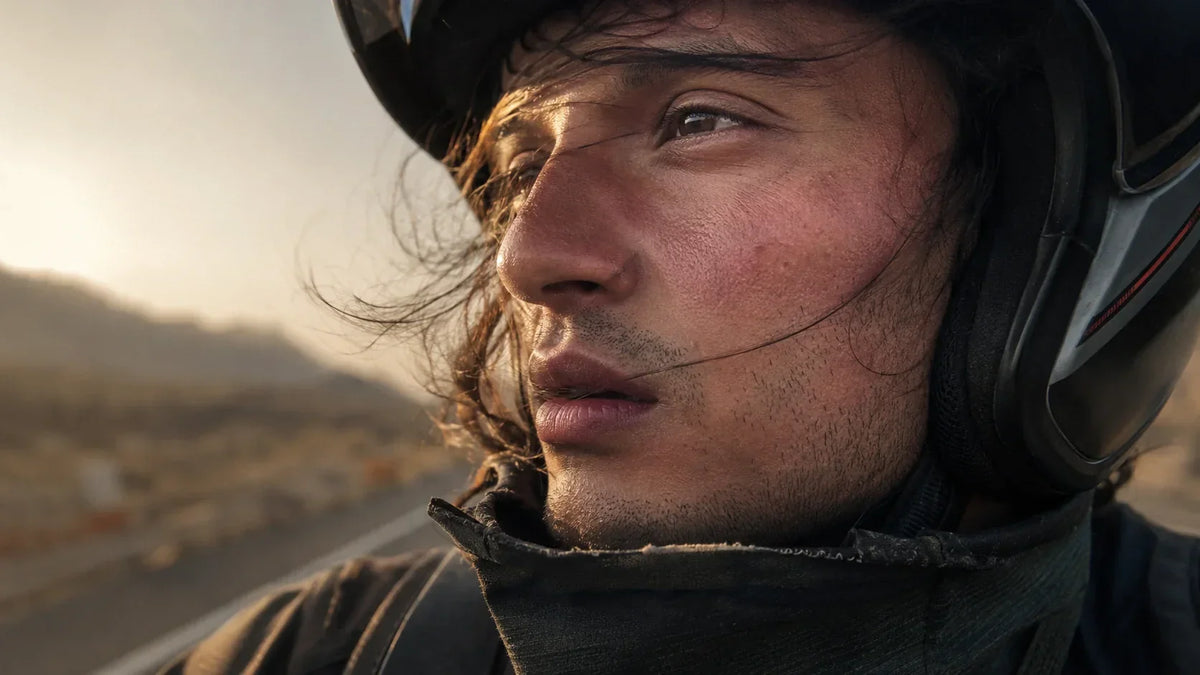
Your face feels raw after a three-hour motorcycle ride, even though you never once felt the sun.
That's not just dryness. Wind and sun are working on your skin together, and the wind makes the sun's damage worse, not less. Most riders treat a windburned face as a standalone problem, something a moisturizer fixes at home.
Here's what's actually happening under your visor line. The fix has to address both wind and UV at once.
Rider Takeaways
- Wind physically strips the skin's outer barrier, which lets more UV rays penetrate. A 2023 Skin Cancer Foundation review found this combination reduces natural UV-defense by up to 33%.
- Windburn and sunburn are so easy to confuse that dermatologists say misdiagnosis is common on windy, cloudy rides.
- SPF 30 blocks about 97% of UVB rays, per the American Academy of Dermatology. Wind can strip that sunscreen off your face before it's had time to work.
- The fix isn't just sunscreen. It's reapplication, coverage, and keeping the helmet surfaces that touch your skin clean.
Why Does Your Face Feel Raw After a Long Ride?
In 2023, dermatologists at the Skin Cancer Foundation described a pattern they see constantly. Riders show up with red, raw faces and swear they weren't out in strong sun. The real cause, in most cases, is wind acting on skin already exposed to UV rays.
Bikers, cyclists, skiers, and boaters show up with the same red-faced pattern. Doctors specifically call out long-distance motorcycle rides as a common trigger.
The confusing part is that wind cools your skin while it's damaging it. You don't feel the burn building the way you would on a still, hot day. That's what makes a windy ride more dangerous than a calm one. You stay out longer without noticing.

What's Actually Happening to Your Skin in the Wind?
In 2022, a systematic review found that environmental stress, including wind, disrupts the skin's outer barrier. Source: PMC, 2022. That disruption increases water loss through the barrier, your stratum corneum, the thin outermost layer of skin.
Wind physically dries this layer out. As it dries, dead skin cells fragment and flake off faster than usual. You lose part of the layer that's supposed to be protecting everything underneath it.
That's the itchy, tight, sandpapery feeling you get after a long ride without a full-face helmet or wind protection. Dehydration alone doesn't explain it. The real cause is a barrier that's been mechanically worn down.
Quick Fact:
Wind exposure increases transepidermal water loss by disrupting the stratum corneum, the skin's outermost protective layer. This barrier damage is what causes the dry, raw, "windburned" feeling riders get after long stretches with an exposed face. Source: PMC systematic review, 2022.
Wind exposure increases transepidermal water loss by disrupting the stratum corneum, the skin's outermost protective layer. This barrier damage is what causes the dry, raw, "windburned" feeling riders get after long stretches with an exposed face. Source: PMC systematic review, 2022.
How Wind Turns Off Your Skin's Sun Protection
Here's the part most riders never hear. In a 2023 review, Skin Cancer Foundation dermatologists explained that wind can reduce your skin's natural sun protection. That lets more UV rays penetrate and cause damage. Source: Skin Cancer Foundation, 2023.
Your stratum corneum contains urocanic acid, a natural compound that acts like a built-in low-level sunscreen. It's weak on its own, roughly SPF 1.5. A 2011 study in the Journal of Investigative Dermatology found something striking. That layer can cut UV-related DNA damage by as much as 33%.
Strip away the outer skin layer with wind, and you strip away that natural defense with it. More UV gets through. Your skin's own repair system also has a harder time catching damaged cells before they turn into a bigger problem.
This isn't a small effect. A 1977 study in the British Journal of Dermatology tested this on rats. Those exposed to UV radiation plus wind developed more skin tumors than rats exposed to UV alone. Wind wasn't a side note. It made the sun exposure worse.
Quick Fact:
Wind doesn't just dry out skin. It disables part of the skin's natural sun defense. A 2023 Skin Cancer Foundation review found that wind strips away the stratum corneum's urocanic acid. That's a natural compound that can otherwise cut UV-related DNA damage by up to 33%. Source: Skin Cancer Foundation, 2023, citing a 2011 Journal of Investigative Dermatology study.
Wind doesn't just dry out skin. It disables part of the skin's natural sun defense. A 2023 Skin Cancer Foundation review found that wind strips away the stratum corneum's urocanic acid. That's a natural compound that can otherwise cut UV-related DNA damage by up to 33%. Source: Skin Cancer Foundation, 2023, citing a 2011 Journal of Investigative Dermatology study.
Unique Insight
Our finding: The strip of skin that takes the most wind on a full-face helmet ride is your jaw and chin. It includes the base of your nose, just below the visor line. That's also the hardest part of your face to reach for sunscreen reapplication mid-ride. Wind-stripped, UV-vulnerable skin goes unprotected there the longest.
Why an Indian Summer Ride Hits Harder
India sits close to the equator across most of its geography. That means high UV exposure for a large part of the year. Add wind speed from riding at 60 to 80 km/h, and the wind-plus-sun effect compounds fast on a highway stretch.
A 2017 review in the Indian Journal of Dermatology, Venereology and Leprology looked at airborne pollutants. These are common on Indian highways and city routes. Source: IJDVL, 2017. It found they generate oxidative stress in skin already exposed to UV radiation. Polycyclic aromatic hydrocarbons from vehicle exhaust were specifically linked to pigmentation and premature aging.
So a rider on a Delhi–Manali highway or a Mumbai–Goa coastal run isn't just dealing with wind and sun. Dust, exhaust particulates, and humidity swings stack on top. Bhai, that's three stressors hitting the same exposed strip of skin, not one.
Ever notice your face feels tighter after city traffic than after the same distance on a clean highway? That's the pollution layer adding to the wind-and-sun effect, not your imagination.
Quick Fact:
Riders on Indian highways face three compounding stressors, not two. A 2017 IJDVL review found that airborne pollutants generate oxidative stress in skin. That stress piles on top of the wind-and-UV effect already stripping the skin's barrier. Source: IJDVL, 2017.
Riders on Indian highways face three compounding stressors, not two. A 2017 IJDVL review found that airborne pollutants generate oxidative stress in skin. That stress piles on top of the wind-and-UV effect already stripping the skin's barrier. Source: IJDVL, 2017.

How Do You Actually Break the Wind-Sun Combo?
SPF 30 sunscreen blocks about 97% of UVB rays. SPF 50 blocks about 98%, per the American Academy of Dermatology. That protection only holds if the sunscreen stays on your skin, and wind actively works against that.
A light lotion or dry spray sloughs off faster in strong wind. Dermatologists at the Skin Cancer Foundation recommend a rich cream or oil-based formula instead. Reapply it at least every two hours on a long ride. A full-face helmet with a sun shield cuts direct exposure the most.
Cover what you can. Full-face helmet, riding jacket collar up, gloves that reach your wrist. Every inch of skin you shield is one less inch losing its natural barrier to wind.
Unique Insight
Our finding: Windburned skin has a compromised barrier. That same skin sits against your helmet's chin strap and cheek padding for hours. A liner carrying bacteria adds friction and irritation exactly where your skin's defenses are already down. Helmet hygiene and skin protection aren't separate habits. They overlap at your jawline.
That overlap is worth taking seriously. A helmet liner that's gone weeks without attention builds up bacteria. That bacteria sits in the padding touching your jaw, cheeks, and forehead every ride. On skin that's already wind-stressed and barrier-compromised, that contact point is where irritation shows up first.
You can't control the wind on a highway. You can control what's touching your face for the rest of the ride. Keeping your liner fresh between washes is one less thing working against already-stressed skin. A few sprays after a ride, and that contact point stops being a problem.

Frequently Asked Questions
Is windburn on a motorcycle the same as sunburn?
No, but they're often confused. Windburn is barrier irritation from dry, moving air, while sunburn is UV damage. A 2023 Skin Cancer Foundation review notes dermatologists frequently see both together on riders with red faces. Source: Skin Cancer Foundation, 2023.
Does a full-face helmet stop windburn completely?
It reduces it significantly by blocking direct airflow to most of your face. Dermatologists specifically recommend a full-face helmet with a sun shield for motorcyclists to cut both wind and UV exposure. Source: Skin Cancer Foundation, 2023.
How often should I reapply sunscreen on a long ride?
At least every two hours, more often in strong wind. Wind speeds up sunscreen loss from your skin's surface. A rich cream or oil formula holds up better than a light lotion or spray. Source: Skin Cancer Foundation, 2023.
Can windburn make helmet acne worse?
It can. Windburned skin has a weakened barrier. Friction from a liner against already-irritated skin adds to breakouts along the jaw and cheeks. Keeping helmet padding clean removes one variable from that equation.
Conclusion
Windburn was never just a dryness problem. Wind strips the skin layer that's supposed to block UV rays. The same ride that leaves your face raw also leaves it more exposed to sun damage than you'd expect.
Sunscreen, reapplication, and full coverage handle the wind-and-sun side. Keeping the surfaces that touch your face, your helmet's liner and padding, clean handles the rest. Hygena takes care of that second half in a few seconds after every ride. That's one less thing working against your skin.
Next up: check how your current sunscreen actually holds up at riding speed. See what "helmet acne" has in common with windburn along your jawline.
Sources
1. Tang, J.C. and Hanke, C.W., "Against the Wind," The Skin Cancer Foundation, 2023 (updated 2026). Retrieved 2026-07-03.
2. "Transepidermal water loss (TEWL): Environment and pollution, a systematic review," PMC, 2022. Retrieved 2026-07-03.
3. Puri, P., Nandar, S.K., Kathuria, S., Ramesh, V., "Effects of air pollution on the skin: A review," Indian Journal of Dermatology, Venereology and Leprology, 2017. Retrieved 2026-07-03.
4. "Sunscreen FAQs," American Academy of Dermatology. Retrieved 2026-07-03.
Share:
Textile vs Leather Motorcycle Gear: Which Cleans Easier?
Budget Bike Trip India: How to Do It Under ₹20,000