
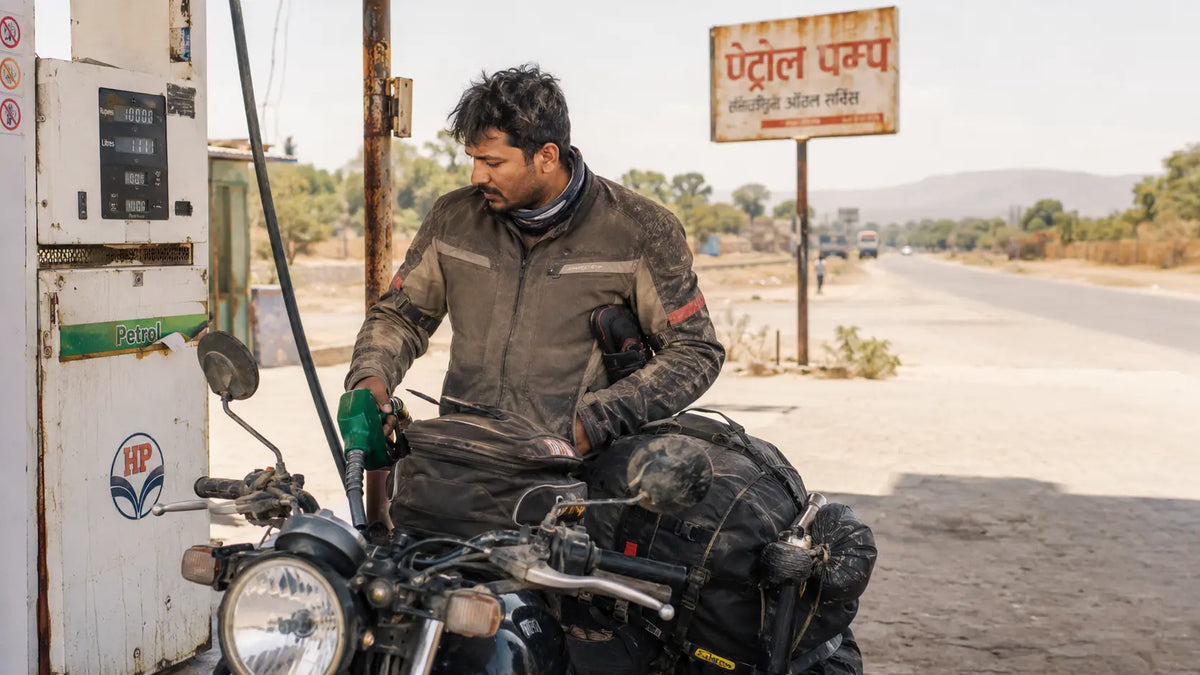
Twenty thousand rupees. Can that actually fund a proper motorcycle trip?
A budget bike trip in India under ₹20,000 is completely doable. Riders pull it off every season on routes through Spiti, coastal Goa, and the lower Himalayas.
Here's the part most riders get wrong. The fuel math and food budget are easy to nail by day one. What trips people up is the hygiene kit line they skip entirely. By day four, the helmet smells like a gym bag and the scalp starts itching under the strap.
This guide breaks down exactly where your ₹20,000 should go, day by day. It also explains the smallest line item in that budget. That one item decides whether you finish the trip feeling like a rider, or feeling wrecked.
Rider Takeaways
- A 10-day Manali-Spiti loop typically costs ₹15,000–₹20,000 total (Really Big Bike Ride, 2025).
- A 2020 study found bacteria in 73.9% to 80.0% of tested helmets (International Journal of Microbiology).
- Set aside ₹500–₹800 for a hygiene kit before budgeting anything else.
- Riders can sweat up to 1 liter an hour in Indian summer heat.
How Much Should You Actually Budget Per Day?
In 2025, Really Big Bike Ride documented full India motorcycle circuits running ₹1,500 to ₹2,000 a day. That covers fuel, food, and stays combined. Stretched across 10 to 12 days, that lands close to ₹20,000 total. It's tight, but workable if you split the budget before you leave.
Here's a realistic daily split for a 10-day trip. Fuel runs ₹550–₹650 a day at ₹50–₹70 per litre, depending on your bike's mileage. Budget stays cost ₹300–₹1,000 a night. Dhaba rooms and highway lodges sit at the lower end. Food at local eateries runs ₹200–₹500 a day if you're not eating at tourist-priced cafés.
That leaves a buffer of roughly ₹200–₹450 a day for permits and chai stops. It's also the one thing riders forget to line-item: staying clean. Bhai, that buffer isn't optional padding. It's where your hygiene kit lives.
Bike choice changes this math fast. A 150cc commuter can average 40–45 km per litre, while bigger tourers might drop closer to 25–30 km per litre. On a 1,500 km loop, that gap alone can shift your fuel bill by ₹1,500 or more.
Quick Fact:
Budget motorcycle trips across India in 2025 averaged ₹1,500–₹2,000 per rider per day. That covers fuel, food, and stays combined, based on route-cost data from Really Big Bike Ride. A 10-day trip on that average lands at ₹15,000–₹20,000, leaving little room for anything unplanned. Source: Really Big Bike Ride
Budget motorcycle trips across India in 2025 averaged ₹1,500–₹2,000 per rider per day. That covers fuel, food, and stays combined, based on route-cost data from Really Big Bike Ride. A 10-day trip on that average lands at ₹15,000–₹20,000, leaving little room for anything unplanned. Source: Really Big Bike Ride
Where Can You Actually Ride for Under ₹20,000?
In 2025, budget travelers completed Manali-Spiti and Shimla-Spiti circuits for ₹15,000–₹20,000. That covers 10 to 12 days, per multiple route-cost guides. That figure includes fuel, dhaba food, and basic guesthouse stays. No luxury camps, no private guides.
Coastal routes cost even less. A 3 to 5-day Goa loop runs ₹5,000–₹8,000 for most riders. That leaves room to stretch the same ₹20,000 further. Mix in a coastline run with a shorter hill stretch for 12 to 15 days total.
Ladakh is the trickier one. Full Leh-Manali circuits usually cost ₹25,000 and up. Budget guides show riders trimming that down near ₹20,000. Camping instead of guesthouses and splitting fuel costs with a group make the biggest difference.
Here's what a 10-day Spiti loop under ₹20,000 can look like. Days one and two cover Manali to Kaza, with a dhaba stay each night. Days three to seven explore the valley loop through Kibber, Langza, and Chandratal, riding short daily stretches. The final three days retrace the route back, with one buffer day built in for weather delays.
Why Do Riders Skip Hygiene on Budget Trips — And What Does That Actually Cost Them?
In 2020, a study in the International Journal of Microbiology tested 130 motorcycle helmets. Researchers found bacterial growth in 73.9% of helmets worn by men and 80.0% of those worn by women. Staphylococcus aureus, a bacteria linked to skin infections, was the most common species found.
So what's actually happening inside that helmet by day three? Now stretch it across a 10-day trip instead of a daily commute. Heat and sweat, with zero cleaning between rides, create exactly the environment bacteria needs to multiply. Riders can lose up to 1 liter of sweat per hour in Indian summer conditions. All of it soaks straight into the helmet padding.
Skip the hygiene kit to save ₹500, and the cost shows up later. Scalp itchiness creeps in by day three. By day five, breakouts start along the strap line. The helmet needs a full deep clean the moment you're home. That's not a saving. It's a delayed bill.
Unique Insight
Our finding: Riders who budget for hygiene before the trip, not as an afterthought at a highway store, report fewer mid-trip stops. Fewer skin irritation complaints. Fewer helmet odor complaints. Treat the ₹500 as trip insurance, not an add-on.
What Goes Into a ₹500 Rider Hygiene Kit?
A functional touring hygiene kit costs less than one night's guesthouse stay. Riders assembling one for a 10-day trip typically spend ₹500–₹800 total. That figure comes from budget touring guides that break down per-item costs for long-distance riders.
The essentials: a helmet deodorant spray for the liner, a small bar of antibacterial soap, and a microfiber towel. Add two spare pairs of socks and travel-size sunscreen. Skip anything that needs water you might not have access to at a highway dhaba.
Laundry adds up fast on a budget trip too. Most dhabas and highway lodges charge ₹50–₹100 per load, so pack two riding-appropriate outfits instead of five. Wash one set while wearing the other, and let the hygiene spray handle what laundry can't reach: the helmet liner.
This is where Hygena fits: a bacteriostatic helmet spray that keeps your liner bacteria-free for tomorrow's ride. It doesn't just mask the smell. At ₹599 for a bottle that lasts weeks of daily spraying, it's one line item, not a budget-breaker.
Quick Fact:
Dehydration of just 2% of body weight can measurably slow reaction time and cognitive function. That's a real risk on multi-day rides covering 300+ km a day in Indian heat. Pack electrolyte sachets alongside your hygiene kit, not just water. Source: New Motorcycle Riders
Dehydration of just 2% of body weight can measurably slow reaction time and cognitive function. That's a real risk on multi-day rides covering 300+ km a day in Indian heat. Pack electrolyte sachets alongside your hygiene kit, not just water. Source: New Motorcycle Riders

How Do You Actually Use a Hygiene Kit Mid-Ride?
The kit only works if it fits into stops you're already making. Think fuel stops and chai breaks. Each one gives you a 90-second window to spray the liner and wipe it down. Do that before the helmet goes back on.
Spray the liner at your last stop of the day, not just in the morning. Bacteria builds up fastest overnight in a helmet left zipped inside a pannier. Those warm, damp conditions are exactly what researchers found driving bacterial growth.
Make this easier: Hygena takes 5 seconds per application, shorter than the average chai order wait. No water needed, no rinsing. It won't take you off your route.

Frequently Asked Questions
How much does a budget bike trip in India actually cost per day?
Budget riders average ₹1,500–₹2,000 a day covering fuel, food, and stays, per Really Big Bike Ride's 2025 route data. A 10 to 12-day trip on that average totals ₹15,000–₹20,000, leaving little slack for anything unplanned.
What should I pack in a rider hygiene kit for a long tour?
A functional kit costs ₹500–₹800: helmet deodorant spray, antibacterial soap, a microfiber towel, spare socks, and travel sunscreen. Skip items needing running water you can't guarantee at highway stops.
Is helmet bacteria really a health risk on multi-day trips?
Yes. A 2020 study of 130 helmets found bacterial growth in 73.9% to 80.0% of samples. Staphylococcus aureus was the most common species, which can cause skin infections with prolonged contact (International Journal of Microbiology).
Can I do a Himalayan bike trip under ₹20,000?
Yes, on routes like Manali-Spiti or Shimla-Spiti. Budget guides price these at ₹15,000–₹20,000 for 10 to 12 days, including fuel, food, and stays. Full Leh-Manali circuits usually run higher, around ₹25,000+.
How can I stretch a small budget across a 10-day Himalayan trip?
Choose a fuel-efficient bike, camp or use dhaba stays, and pack a compact hygiene kit instead of five outfits. Riders combining these habits keep 10-day Spiti loops within ₹15,000–₹20,000 (Really Big Bike Ride, 2025).
Conclusion
A budget bike trip in India under ₹20,000 isn't a stretch. Riders do it every riding season. The trips that actually go well treat hygiene as a line item, not an afterthought.
Set aside ₹500–₹800 before you plan anything else. Pack a spray that kills bacteria instead of masking it. Your helmet, and your skin, will thank you by day ten. That's the whole fix, and it costs less than your fuel for one day.
Ready to plan the route? Check out our full guide on staying clean on long rides. You can also see everything that goes into a complete rider hygiene kit.
Sources
1. "How To Plan An All-India Motorbike Trip: Routes, Costs and Hard-Won Lessons," Really Big Bike Ride, 2025. Retrieved 2026-07-05.
2. Sapkota et al., "Microbial Diversity and Antibiotic Susceptibility Pattern of Bacteria Associated with Motorcycle Helmets," International Journal of Microbiology, 2020. Retrieved 2026-07-05.
3. "Ladakh Bike Trip Cost in 2025: Complete Budget Breakdown for Every Rider," ExploreUtLadakh, 2025. Retrieved 2026-07-05.
4. "Ladakh Bike Trip Under ₹20,000 – Budget Adventure Guide," Endeavor Ladakh. Retrieved 2026-07-05.
5. "The Hidden Dangers of Dehydration: Why Staying Hydrated is Essential for Every Motorcycle Rider," New Motorcycle Riders. Retrieved 2026-07-05.
Share:
Windburn Face: Why Wind and Sun Team Up on Motorcycle Rides
How Bikers Stay Fit and Healthy on Long Tours