
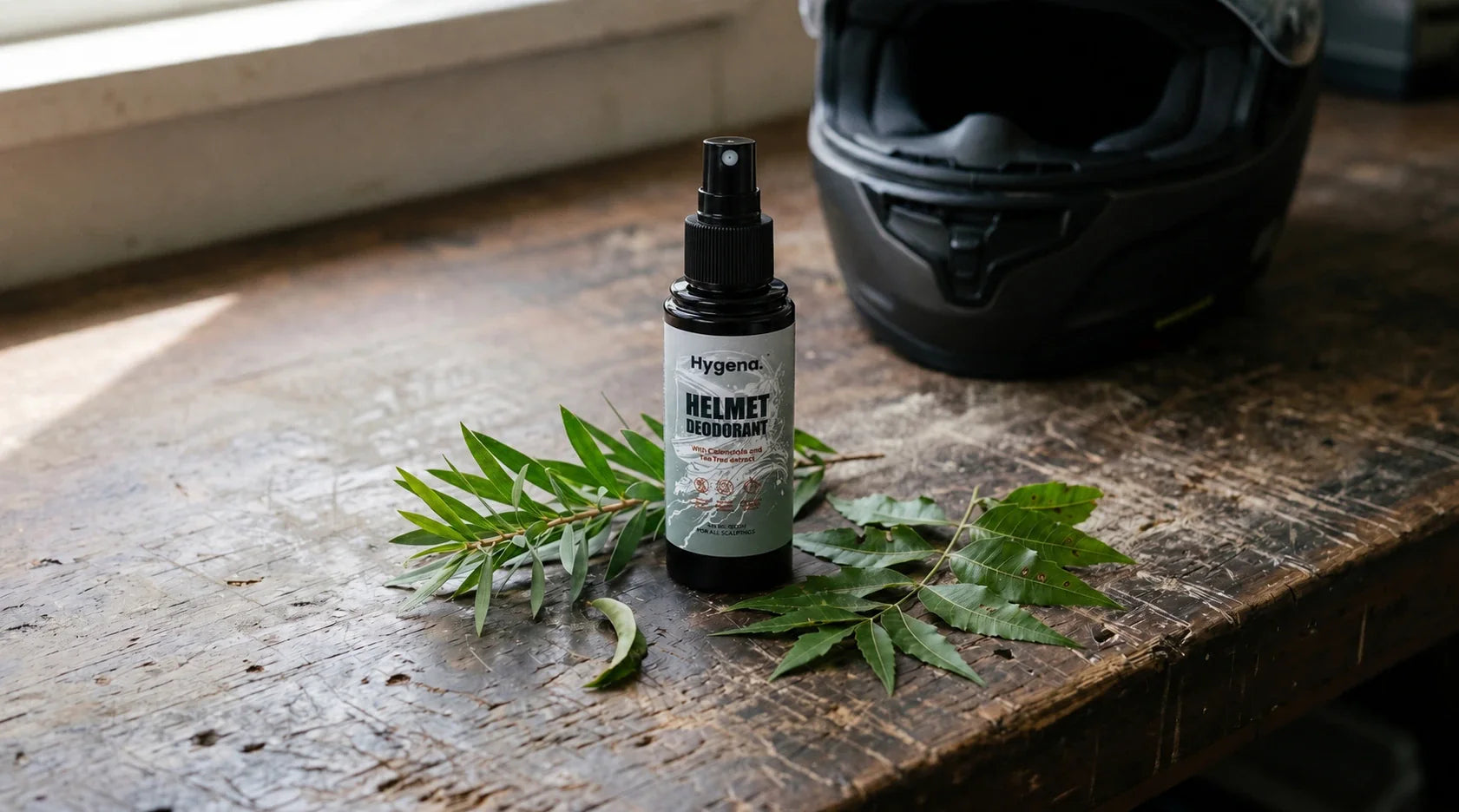
You unzip your helmet bag, and there it is. That sour, locked-in smell that no amount of airing out seems to fix. You've tried perfume on the padding. Maybe even Febreze. The smell fades for an hour, then comes back stronger.
So what's actually living in there? And can a helmet deodorant spray really fix it? This article breaks down what these sprays do, how they're different from the stuff in your bathroom, and whether your ride actually needs one.
Rider Takeaways
- A helmet deodorant spray kills odor-causing bacteria inside your liner instead of masking the smell.
- A 2020 study found Staphylococcus aureus in 22.7% of helmets tested (International Journal of Microbiology).
- Perfume and fabric sprays cover odor for an hour. A bacteriostatic spray stops it at the source.
- Daily commuters, tourers, and delivery riders in India's heat need one most.
What Is a Helmet Deodorant Spray, Exactly?
A helmet deodorant spray is a rider-specific hygiene product. It's built to kill the bacteria growing inside your helmet's liner. Unlike a perfume, it doesn't just cover the smell. The good ones use a bacteriostatic formula, which stops bacteria from multiplying between washes.
Think of it like this. Your helmet's foam and fabric soak up sweat every single ride. That damp, warm padding becomes food for bacteria. A deodorant spray targets that bacteria directly, so the smell never gets a chance to build.
It's not a cleaner for your visor. It's not a polish for the shell. It works on the one part most riders ignore: the inside that touches your skin and scalp every day.
Quick Fact:
A helmet deodorant spray is a bacteriostatic hygiene product made for the interior padding of a motorcycle helmet. Instead of masking odor with fragrance, it inhibits the growth of sweat-feeding bacteria like Staphylococcus, which are the actual source of helmet smell. Source: International Journal of Cosmetic Science, 2023.
A helmet deodorant spray is a bacteriostatic hygiene product made for the interior padding of a motorcycle helmet. Instead of masking odor with fragrance, it inhibits the growth of sweat-feeding bacteria like Staphylococcus, which are the actual source of helmet smell. Source: International Journal of Cosmetic Science, 2023.
Unique Insight
Our finding: Most riders treat helmet smell as a fragrance problem. It's actually a microbiology problem. Once you stop feeding the bacteria, the smell stops returning, and you spray far less often than you'd expect.
Why Does Your Helmet Smell in the First Place?
Your helmet doesn't smell because of sweat. It smells because of bacteria. In 2020, researchers tested 130 motorcycle helmets and recovered 392 bacteria across seven genera. Staphylococcus aureus turned up in 22.7% of samples, the most common of all. That data comes from the International Journal of Microbiology.
Here's the chain. You ride, you sweat, the liner absorbs it. That sweat is nearly odorless on its own. But skin bacteria feed on it and break it down into the compounds you can smell. The warmer and damper the liner, the faster they multiply.
Now add Indian weather. Ride through a Delhi summer or a Mumbai monsoon, and your liner stays warm and wet for hours. Bhai, that's not just sweat you're smelling. That's a bacterial colony at full speed.
Quick Fact:
In a 2020 study of 130 motorcycle helmets, scientists recovered 392 bacterial isolates across seven genera. Staphylococcus aureus was the most common at 22.7%, followed by S. epidermidis at 19.6%. Sweat feeds these bacteria, and their breakdown of that sweat is what produces helmet odor. Source: International Journal of Microbiology, 2020.
In a 2020 study of 130 motorcycle helmets, scientists recovered 392 bacterial isolates across seven genera. Staphylococcus aureus was the most common at 22.7%, followed by S. epidermidis at 19.6%. Sweat feeds these bacteria, and their breakdown of that sweat is what produces helmet odor. Source: International Journal of Microbiology, 2020.
How Is It Different From Perfume or Febreze?
Perfume and fabric sprays mask odor. A helmet deodorant spray removes its cause. A 2023 review in the International Journal of Cosmetic Science confirmed that sweat itself is almost odorless. Bacteria do the smelly work, so anything that only adds fragrance is fighting the wrong battle.
Spray perfume on a dirty liner and you get a strange mix. Floral notes on top, sour bacteria underneath. An hour later the fragrance fades and the smell wins. You're right back where you started.
Fabric sprays like Febreze aren't built for helmet foam either. They're made for sofas and curtains. They can leave residue on padding that sits against your forehead and scalp. A helmet-specific spray is formulated for that contact.

Do You Really Need a Helmet Deodorant Spray?
It depends on how you ride. If you commute daily, tour long distances, or deliver for a living, the answer is yes. The 2020 helmet study found that 39% of the bacteria recovered were multidrug-resistant. This isn't only a smell issue. It's a skin and scalp issue too.
A weekend rider who wears a helmet for two hours has a smaller problem. A delivery rider in a helmet for eight hours a day has a much bigger one. The longer the sweat sits, the more bacteria you carry against your scalp.
That contact has real consequences. Dermatologists in India report a pattern they call "helmet scalp," with oiliness, dandruff, and folliculitis in riders who sweat under a helmet daily. Keeping the liner cleaner is the simplest fix.
This is where Hygena fits. It's India's first deodorant built only for helmets. A few sprays after your ride, and the bacteriostatic formula keeps your liner fresh for tomorrow, instead of just hiding today's smell. The fix is simpler than you think.
Quick Fact:
The 2020 helmet study found that 39% of bacterial isolates were multidrug-resistant, and roughly a third of the Staphylococcus aureus samples were methicillin-resistant (MRSA). For riders wearing helmets several hours a day, regular interior hygiene is a skin-protection habit, not just an odor fix. Source: International Journal of Microbiology, 2020.
The 2020 helmet study found that 39% of bacterial isolates were multidrug-resistant, and roughly a third of the Staphylococcus aureus samples were methicillin-resistant (MRSA). For riders wearing helmets several hours a day, regular interior hygiene is a skin-protection habit, not just an odor fix. Source: International Journal of Microbiology, 2020.
What's Inside a Good Helmet Deodorant Spray?
Look for proven antimicrobials, not just fragrance. The active ingredients are what separate a real deodorant spray from a scented water bottle. Natural antibacterials like tea tree and neem have decades of lab evidence behind them.
Tea tree oil is the standout. A 1995 study in the Journal of Applied Bacteriology found it active against Staphylococcus aureus and S. epidermidis, the two top helmet bacteria. Later work showed it kills these microbes by breaking down their cell membranes.
Beyond the actives, check three things. Is it safe for foam and fabric? Does it dry without sticky residue? Is it non-staining on light liners? A good helmet deodorant spray ticks all three, so you can use it daily without second-guessing.
Unique Insight
Our finding: The ingredient list matters more than the scent. A spray that lists tea tree, neem, or a named bacteriostatic agent is working on the bacteria. One that lists only "fragrance" and "aqua" is just expensive perfume for your padding.
Frequently Asked Questions
How often should I use a helmet deodorant spray?
For daily riders, a few sprays after each ride works best. Bacteria multiply fastest in warm, damp padding, and a 2020 study found Staphylococcus in 22.7% of helmets. Frequent light use keeps colonies from building between deep cleans. Source: International Journal of Microbiology, 2020.
Can't I just wash my helmet liner instead?
You can, and you should occasionally. But most liners take a day to fully dry, and you can't wash after every ride. A deodorant spray handles the daily bacteria load between washes. Think of washing as monthly, spraying as daily.
Will a helmet deodorant spray damage my padding?
A helmet-specific spray won't. It's formulated for foam and fabric that touches your skin. The risk comes from using the wrong product, like a household fabric spray, which can leave residue on padding pressed against your forehead all day.
Is helmet bacteria actually harmful?
It can be. The 2020 helmet study found 39% of isolates were multidrug-resistant, and a third of the S. aureus was MRSA. Combined with daily sweat, this contributes to scalp folliculitis and acne in regular riders. Source: International Journal of Microbiology, 2020.
Does perfume work on a smelly helmet?
Only for an hour or two. Perfume masks odor but doesn't touch the bacteria causing it. A 2023 cosmetic science review confirmed sweat is nearly odorless, so the smell returns once the fragrance fades. Source: International Journal of Cosmetic Science, 2023.
Conclusion
Helmet smell isn't a sweat problem. It's a bacteria problem, and a helmet deodorant spray is the one tool built to solve it at the source.
If you ride daily through India's heat, this is the easiest hygiene habit you can start. Hygena takes five seconds after a ride and keeps your liner fresh for the next one. No washing, no waiting. Give your scalp the clean helmet it deserves.
Sources
1. "Microbial Diversity and Antibiotic Susceptibility Pattern of Bacteria Associated with Motorcycle Helmets," Sapkota et al., International Journal of Microbiology, 2020. Retrieved 2026-06-15.
2. "Deodorants and antiperspirants: New trends in their active agents and testing methods," Teerasumran et al., International Journal of Cosmetic Science, 2023. Retrieved 2026-06-15.
3. "Antimicrobial effects of tea-tree oil on Staphylococcus aureus, Staph. epidermidis and Propionibacterium acnes," Carson & Riley, Journal of Applied Bacteriology, 1995. Retrieved 2026-06-15.
4. "Tea Tree Essential Oil Kills Escherichia coli and Staphylococcus epidermidis Persisters," PMC, 2023. Retrieved 2026-06-15.
Share:
Royal Enfield Long Tour Preparation: Gear & Hygiene Guide
Best Riding Jacket for Indian Conditions - How to Choose