
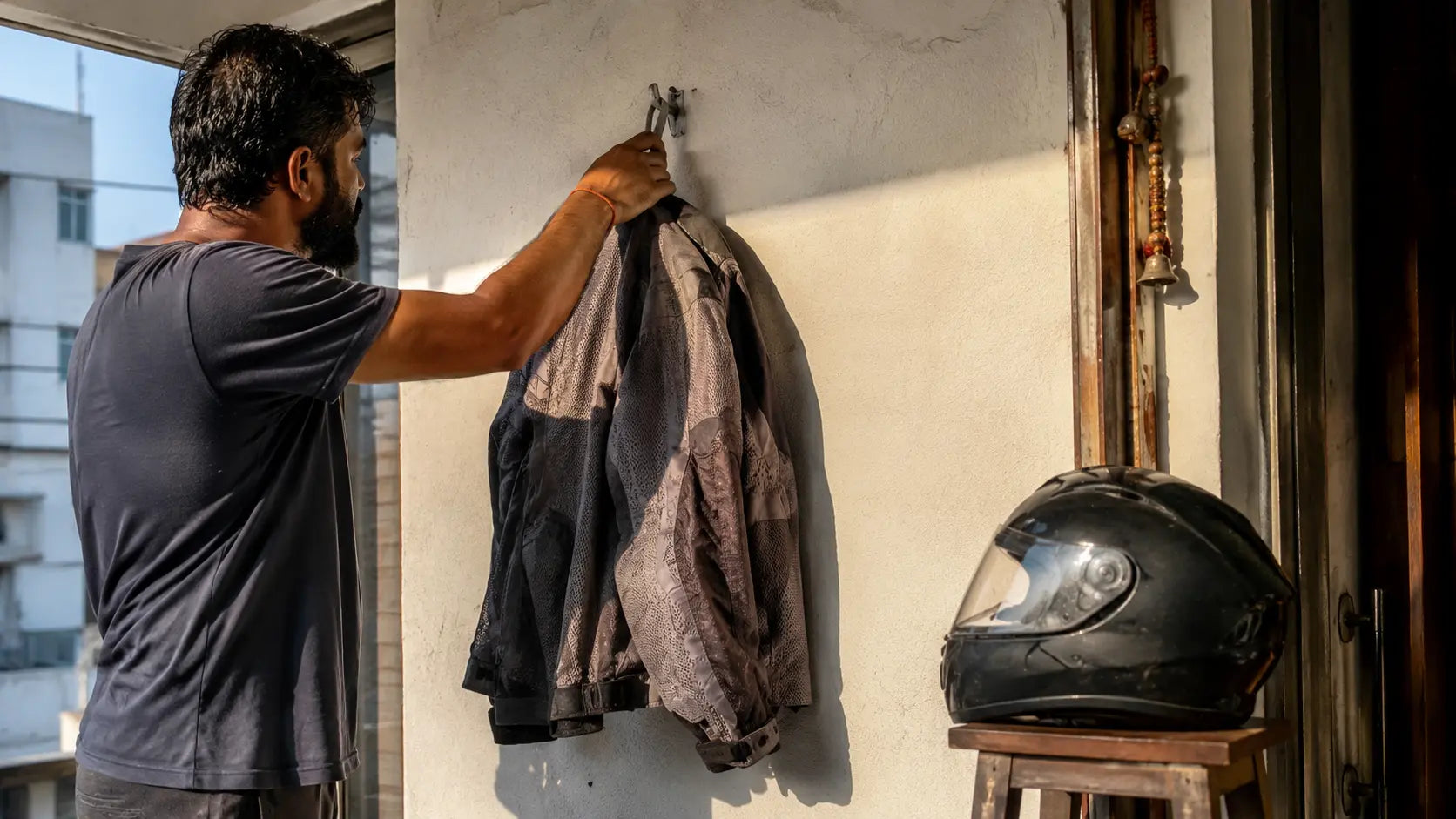
You bought the jacket for the armour. Three months in, it's the smell you notice first.
That's the part nobody warns you about. The best riding jacket in India isn't just the one that protects you in a crash. It's the one that handles 45°C heat, a sudden monsoon, road dust, and litres of your own sweat without turning into a portable bin. Most buying guides stop at armour ratings. This one goes further.
Here's how to choose a jacket built for Indian conditions, and how to keep it fresh long after the showroom shine wears off.
Rider Takeaways
- For Indian summers, prioritise airflow and CE Level 2 armour over looks. Mesh beats heavy textile in heat.
- That smell isn't sweat. It's bacteria feeding on sweat, and synthetic liners breed more of it (Applied and Environmental Microbiology, 2014).
- Buy for cleaning, not just riding. A removable, washable liner is the single most important anti-odour feature.
- Your jacket you can wash. Your helmet you can't, easily. That's where a habit like Hygena fits in.
What Makes a Riding Jacket Right for Indian Conditions?
In 2024, the India Meteorological Department recorded a peak of 50.5°C at Churu, Rajasthan, during one of the country's hottest summers on record. That's the real test for any jacket. Indian riding isn't one climate. It's heat, humidity, dust, and monsoon, often in a single week.
So the "best" jacket here means something different from Europe or the US. You're not fighting cold. You're fighting heat that doesn't quit and air that won't let your sweat dry.
Three things matter most for Indian conditions:
Airflow. Mesh panels and zip vents let air hit your body and carry sweat away. In humid cities, this is the difference between arriving fresh and arriving soaked.
Protection. Heat is no excuse to skip armour. Look for CE Level 2 protectors at the shoulders, elbows, and back. Good mesh jackets carry full armour without the heat trap of solid textile.
Adaptability. Removable thermal and waterproof liners let one jacket handle summer, monsoon, and a cold December morning in the hills.
Quick Fact:
In humid weather, sweat can't evaporate properly, so the body struggles to cool itself and heat stress rises. A 2024 IndiaSpend report explained how high humidity breaks the body's natural cooling system. For riders, this means a jacket's ventilation isn't a luxury in India. It's a safety feature. Source: IndiaSpend, 2024.
In humid weather, sweat can't evaporate properly, so the body struggles to cool itself and heat stress rises. A 2024 IndiaSpend report explained how high humidity breaks the body's natural cooling system. For riders, this means a jacket's ventilation isn't a luxury in India. It's a safety feature. Source: IndiaSpend, 2024.
Why Does Your Riding Jacket Start to Smell?
In 2014, a study in Applied and Environmental Microbiology found polyester clothing smelled significantly more intense and unpleasant than cotton after a workout. The researchers traced it to bacteria. Odour-producing micrococci were found almost only on the synthetic fabrics.
Read that again. The smell isn't the sweat. Sweat is nearly odourless when it leaves your skin.
The stink comes from bacteria eating that sweat and breaking it into sour, musty molecules. And here's the catch for riders. Almost every riding jacket liner is synthetic, because polyester and nylon are tough, light, and quick to make. The same fibres that survive a crash also give odour bacteria a perfect home.
Your jacket traps heat. It soaks sweat. Then it sits in a cupboard, warm and damp. That's a bacteria nursery, bhai.

Quick Fact:
A 2014 study in Applied and Environmental Microbiology compared polyester and cotton clothing after a fitness session. Polyester smelled more intense and more unpleasant, and odour-causing Micrococcus bacteria grew almost exclusively on the synthetic fibres. Most riding jacket liners are synthetic, which is why gear odour builds so fast. Source: Callewaert et al., AEM, 2014.
A 2014 study in Applied and Environmental Microbiology compared polyester and cotton clothing after a fitness session. Polyester smelled more intense and more unpleasant, and odour-causing Micrococcus bacteria grew almost exclusively on the synthetic fibres. Most riding jacket liners are synthetic, which is why gear odour builds so fast. Source: Callewaert et al., AEM, 2014.
How to Choose a Jacket You Can Actually Keep Fresh
Most riders pick a jacket by armour, fit, and price. Smart in India? Add one more filter. Buy for cleaning.
A jacket you can't clean easily will smell, full stop. The features that fight odour are the same ones that make a jacket comfortable in heat. So you lose nothing by prioritising them.
Look for these when you buy:
A removable, washable liner. This is the big one. If the inner liner zips out and goes in the machine, you can kill odour at the source. Fixed liners trap smell forever.
Real ventilation. Mesh panels and vents dry sweat faster. Less moisture means less bacteria. Airflow is odour prevention.
Quick-dry materials. After a monsoon ride, a jacket that dries fast doesn't ferment in your cupboard overnight.
Unique Insight
Our take: The features sold as "summer comfort" in India are really anti-odour features in disguise. Ventilation, removable liners, and quick-dry fabric all do the same job. They stop sweat from sitting still long enough to feed bacteria. Choose for airflow and you've already chosen for freshness.
How Do You Care for a Riding Jacket So Odour Never Sets In?
Choosing well is half the job. Care is the other half. The good news? It's simple, and it takes minutes a week.
Indian gear guides like Autocar India recommend a gentle approach. Strong detergents and fabric softeners damage waterproof membranes, so skip them.
Here's the routine that keeps a jacket fresh:
Air it out after every ride. Don't dump a sweaty jacket in the cupboard. Hang it. Let it breathe. Sunlight helps kill bacteria.
Wash the liner monthly. Remove the armour first. Use mild detergent on a cold, gentle cycle. Then air-dry on a hanger, never wrung.
Never store it damp. A wet jacket in a dark cupboard is how mould and stink start. Dry fully first.
When did you last actually clean your liner? Be honest.

Here's the part most riders miss. You can wash your jacket. You can't really wash your helmet liner the same way. Yet it's the same sweat, the same synthetic foam, the same bacteria. Your head sweats more than your torso.
That's exactly the gap Hygena fills. It's a bacteriostatic helmet deodorant that stops odour bacteria from multiplying inside your helmet between washes. Same science you're using on your jacket, for the gear you can't throw in the machine. A few sprays after a ride, and tomorrow's commute doesn't start with a stink.
Think of it as the same care habit, extended to the one piece of gear that needs it most. Keep your helmet as fresh as your freshly-washed jacket with Hygena.
Frequently Asked Questions
Which riding jacket is best for Indian summer?
A mesh jacket with CE Level 2 armour is the best all-round pick for Indian summers. Large mesh panels move air across your body, which matters when temperatures hit the 40s. India saw a peak of 50.5°C in 2024 (IMD). Add a waterproof liner for monsoon.
Why does my new riding jacket already smell?
Because the smell is bacteria, not sweat. A 2014 study in Applied and Environmental Microbiology found odour bacteria grow fast on synthetic fabrics, which most liners use. Even a new jacket smells within weeks if you never air or wash the liner.
Can I machine wash my motorcycle jacket?
Often yes, but check the label first. Remove all armour, use mild detergent on a cold gentle cycle, and skip fabric softener. Autocar India warns that strong detergents damage waterproof membranes. Always air-dry on a hanger, never in a dryer.
How often should I clean my riding jacket?
Air it out after every ride and wash the liner roughly once a month with regular use. Daily commuters in India's heat may need it more often. The goal is simple. Never let sweat sit long enough to feed bacteria.
Conclusion
The best riding jacket for Indian conditions protects you in a crash and survives the heat, dust, and monsoon without becoming a science experiment. Choose for airflow, a removable liner, and CE Level 2 armour. Those choices fight odour as much as they fight heat.
Care is the easy half. Air it out, wash the liner, never store it damp. And for the helmet you can't toss in the machine, a quick habit like Hygena keeps the bacteria in check. Start with your helmet today.
Sources
1. "Microbial Odor Profile of Polyester and Cotton Clothes after a Fitness Session," Applied and Environmental Microbiology, 2014. Retrieved 2026-06-17.
2. "How Humidity Is Breaking Your Body's Thermostat," IndiaSpend, 2024. Retrieved 2026-06-17.
3. "IMD Predicts a Scorching Summer for 2024," Down To Earth, 2024. Retrieved 2026-06-17.
4. "How to Correctly Clean Your Riding Gear," Autocar India. Retrieved 2026-06-17.
5. "Hot Weather Motorcycle Riding Gear for Summer Touring in India," ViaTerra Gear, 2025. Retrieved 2026-06-17.
Share:
What Is a Helmet Deodorant Spray (And Do You Need One)?
Hygena Helmet Deodorant: How It Works & Why Riders Love It