
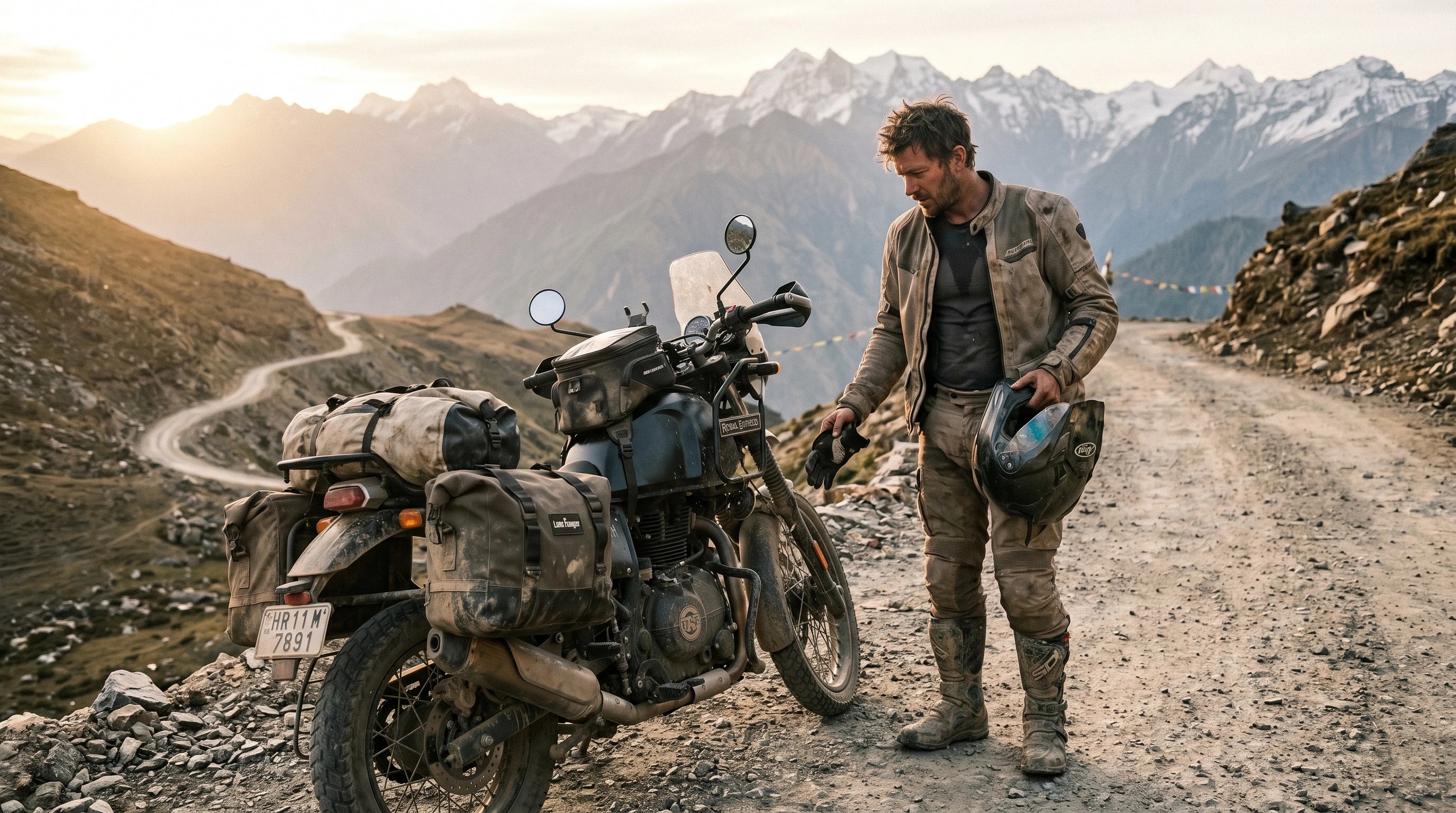
You've planned the route. You've booked the leave. But have you thought about day four, when your helmet smells like a gym bag?
Most riders obsess over chain tension and tyre pressure before a big tour. Then they pack the same sweaty gear they wore last summer. Royal Enfield long tour preparation isn't just about the bike. It's about the gear that keeps you safe and the hygiene that keeps you sane across days in the saddle.
This guide covers the RE-specific gear you actually need, plus the hygiene habits that stop a multi-day ride from turning grim. Let's get you ready.
Rider Takeaways
- A 2020 study of 130 helmets recovered 392 bacteria, with Staphylococcus aureus the most common at 22.7%, and 33.7% of it was MRSA (PMC, 2020).
- Pack gear in protection order: helmet, jacket, gloves, boots: ventilated and broken-in, never new on day one.
- Indian summer touring hits 42–47°C in places, so sweat management is gear, not vanity.
- Treat your helmet interior daily on tour. A quick spray beats a week of trapped bacteria.
What should you check on the bike first?
Before any gear talk, your Royal Enfield needs a pre-tour service. Royal Enfield's own Moto Himalaya rides build in a two-day acclimatization stop at 3,524 metres before riders even attempt high passes like Umling La at 19,024 feet. The lesson: high-altitude touring punishes an unprepared machine.
Cover the basics two weeks out, not the night before. Fresh engine oil, a new air filter, and a checked or replaced chain and sprocket set. Inspect brake pads, clutch and accelerator cables, and carry spares for both.
Tyres matter most. Check tread depth and pressure, and pack a tubeless repair kit or spare tube. Test every light and your horn. A loose battery terminal on a Bullet can strand you 200 km from the nearest mechanic.
Quick Fact:
Royal Enfield's organised Himalayan tours schedule two full days of acclimatization at 3,524 m (11,562 ft) before tackling passes such as Umling La (19,024 ft), the world's highest motorable road. Altitude affects both rider and engine performance. Source: [Royal Enfield, 2025]
Royal Enfield's organised Himalayan tours schedule two full days of acclimatization at 3,524 m (11,562 ft) before tackling passes such as Umling La (19,024 ft), the world's highest motorable road. Altitude affects both rider and engine performance. Source: [Royal Enfield, 2025]
How do you pick the right riding gear for a long Royal Enfield tour?
Pack gear in protection order: helmet, jacket, gloves, boots. That's the priority most touring guides agree on, and it holds even when summer heat tempts you to skip layers. Indian touring routes swing from 42–47°C dry heat in Rajasthan to freezing passes in Ladakh, so your gear has to breathe and protect.
Your helmet is non-negotiable. A well-fitting full-face or ADV helmet with a working visor and decent ventilation beats a cheap one every time. For the jacket, go mesh with armour. Big airflow panels keep you cool while CE protectors stay put.
Gloves should have knuckle protection and ventilation. Boots need ankle support and a grippy sole for unpredictable terrain. One hard rule: never tour in brand-new gear. Break in your boots and gloves on shorter rides first.

Quick Fact:
Indian summer touring routes range from 42–47°C dry heat across Rajasthan and the Deccan between May and July. Ventilated mesh gear with CE armour keeps riders cool without sacrificing crash protection, unlike non-vented leather in those temperatures. Source: [ViaTerra Gear, 2025]
Indian summer touring routes range from 42–47°C dry heat across Rajasthan and the Deccan between May and July. Ventilated mesh gear with CE armour keeps riders cool without sacrificing crash protection, unlike non-vented leather in those temperatures. Source: [ViaTerra Gear, 2025]
Why does your helmet become a hygiene problem on a long tour?
In 2020, a study of 130 motorcycle helmets recovered 392 bacteria and 346 fungi across seven genera. Staphylococcus aureus led at 22.7%, and 33.7% of those isolates were methicillin-resistant (MRSA). Published in the International Journal of Microbiology, it showed helmets act as fomites: surfaces that carry pathogens.
Now think about a tour. You're sweating into the same liner for six, eight, ten hours a day. The padding never fully dries overnight in a humid tent or a sticky hotel room. Heat plus trapped moisture plus skin oil is exactly what bacteria need to multiply.
That's why your helmet smells worse on day four than day one. It isn't only sweat. It's the colony feeding on it. And a dirty liner against a sweaty scalp can trigger itching, breakouts, or a rash that nags you for the rest of the ride.
Quick Fact:
A 2020 study in the International Journal of Microbiology sampled 130 helmets and found 39% of bacterial isolates were multi-drug resistant, while 33.7% of Staphylococcus aureus samples were MRSA. Helmets can transmit pathogens, so the study urged regular interior disinfection. Source: [PMC, 2020]
A 2020 study in the International Journal of Microbiology sampled 130 helmets and found 39% of bacterial isolates were multi-drug resistant, while 33.7% of Staphylococcus aureus samples were MRSA. Helmets can transmit pathogens, so the study urged regular interior disinfection. Source: [PMC, 2020]
Unique Insight
Our finding: Riders pack chain lube and a puncture kit for the bike, but almost nobody packs anything for the helmet interior. The one piece of gear that sits against your skin for 10 hours a day is the one piece nobody maintains on tour.
How do you stay clean and fresh on a multi-day ride?
Touring hygiene comes down to one rule: don't let sweat and bacteria sit. Cycling UK's touring guidance stresses drying off fully before dressing to avoid skin infections, and the same logic applies on a motorcycle. Salt and grime left on skin all day leads to rashes and saddle sores.
Build a small hygiene routine around your stops. Wet wipes for a quick clean when there's no shower. Dry, fresh socks every morning, kyunki gilay socks mean blisters by lunch. Take any shower you can find at a dhaba, petrol pump, or guesthouse.
Now the part riders skip: your helmet. You wouldn't sleep in the same shirt for a week, so why ride in the same bacteria-loaded liner? This is where Hygena earns its spot in your tank bag.
Hygena is a helmet deodorant built for exactly this. A few sprays inside the liner before bed, and its bacteriostatic formula goes after the bacteria causing the smell - not just masking it like perfume or a fabric spray. By morning your helmet's fresh, your scalp's happier, and you're not flinching every time you strap up.
On a long tour, helmet hygiene takes five seconds a day. Pack Hygena and ride fresh from day one to day ten.
What should go in your Royal Enfield tour hygiene kit?
Keep it small and waterproof: one pouch in the tank bag. The goal is daily freshness without packing your whole bathroom. A compact kit handles sweat, odor, and skin issues before they ruin a riding day.
The essentials worth carrying: a pack of body or face wipes, a travel deodorant, sunscreen, lip balm, and an anti-chafe cream for long saddle hours. Add a quick-dry towel and a small soap or body wash bar.
Then the rider-specific additions most kits miss: Hygena for your helmet interior, fresh socks for each day, and a spare buff or balaclava. The buff keeps sweat off your liner in the first place, so it does double duty.
Unique Insight
Our finding: A clean balaclava plus a helmet deodorant is a two-layer defence. The buff blocks sweat reaching the liner, and the spray handles what gets through. Together they keep a helmet ride-able for a full tour without a single wash.
Frequently Asked Questions
How early should I start prepping my Royal Enfield?
Start two weeks out. Service the bike, replace worn consumables, and test everything on a short ride. Royal Enfield's own Himalayan tours build in two days of acclimatization at 3,524 m, which shows how much margin altitude touring demands (Royal Enfield, 2025).
Can I clean my helmet instead of using a spray?
Washing the liner helps, but it isn't practical mid-tour and the padding rarely dries fully overnight. A 2020 study found 39% of helmet bacteria were multi-drug resistant, so daily prevention beats a weekly wash (PMC, 2020).
What gear matters most for a long ride?
Helmet first, then jacket, gloves, and boots. Touring guides from RevZilla and Bennetts (2025) agree on this order. In Indian heat of 42–47°C, choose ventilated mesh gear with CE armour so you stay protected without overheating.
How do I stop my helmet smelling on tour?
Spray a helmet deodorant inside the liner each night and wear a clean balaclava by day. Hygena's bacteriostatic formula targets odor-causing bacteria rather than masking it, keeping the liner fresh across a multi-day ride.
Conclusion
Royal Enfield long tour preparation is two jobs in one: a sorted machine and a sorted rider. Most riders nail the first and ignore the second until day four, when the gear smells and the scalp itches.
The fix is simpler than you think. Break in your gear, pack a small hygiene kit, and keep Hygena in the tank bag for your helmet. Five seconds a night, and you ride fresh the whole way. Ab nikalo - the road's waiting.

Sources
1. Sapkota, J. et al. "Microbial Diversity and Antibiotic Susceptibility Pattern of Bacteria Associated with Motorcycle Helmets," International Journal of Microbiology, 2020. Retrieved 2026-06-16.
2. "Himalayan Odyssey 2025 / Moto Himalaya Ladakh 2025," Royal Enfield, 2025. Retrieved 2026-06-16.
3. "Hot Weather Motorcycle Riding Gear for Summer Touring in India," ViaTerra Gear, 2025. Retrieved 2026-06-16.
4. "Personal Hygiene and Keeping Clean While Touring," Cycling UK, 2023. Retrieved 2026-06-16.
5. "Motorcycle Clothing for Hot Weather," Bennetts BikeSocial, 2025. Retrieved 2026-06-16.
Share:
Night Riding on Indian Highways: Tips Every Rider Needs
What Is a Helmet Deodorant Spray (And Do You Need One)?