
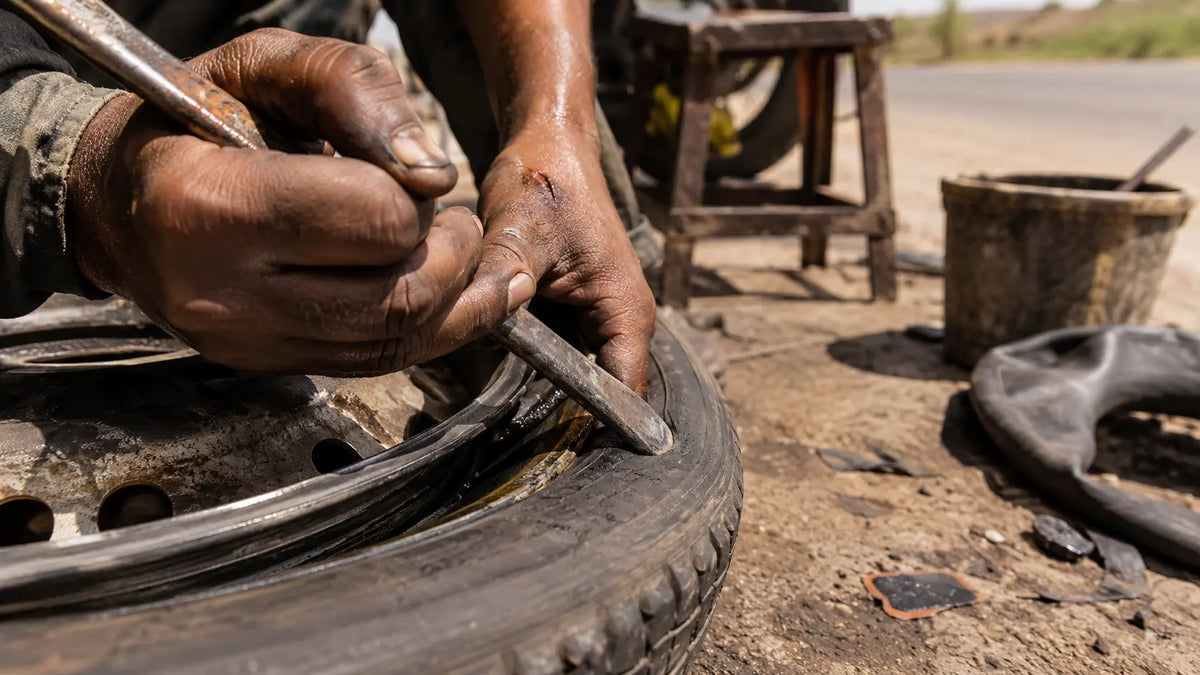
Your motorcycle goes flat forty kilometers from the nearest town.
A local puncture wala pulls out a rusted tire iron, patches your tube, and hands your wheel back covered in tar and grease. You wipe your palms on your jeans and keep riding. It's the most normal thing in the world for an Indian rider. Almost nobody thinks about what's actually on their hands afterward.
Here's what that grease and grime really carries, and the simple hygiene habit most riders skip before they touch their helmet, phone, or lunch.
Rider Takeaways
- A roadside puncture repair puts your hands on grease, road grime, and tools shared by every bike that stopped before you.
- In a 2024 Indian trauma study, 52% of road accident wounds grew infection-causing bacteria, mostly Klebsiella pneumoniae. Source: Access Microbiology, 2024.
- Alcohol-based wipes remove up to 90% of transient hand bacteria when there's no sink around, more effective than soap, gel, or spray.
- Clean your hands before you touch your helmet strap, not just before you eat.
What's Really on Your Hands After a Roadside Puncture Fix?
In 2021, a bioluminescence-based hygiene study found that hands need at least 20 seconds of soap and warm water to clear dirt and grease effectively. Source: International Journal of Environmental Research and Public Health, 2021. Roadside puncture repair leaves exactly that kind of residue on your skin.
Watch a puncture wala work and you'll see the same tire iron, bucket of water, and rag used for every bike that pulls up. Nobody disinfects between customers. That's just how roadside repair works in India, and it isn't a knock on the mechanic.
Your hands don't just pick up grease. They pick up whatever survived on that shared rag from the rider before you. Grease under the nails? Chalta hai, most riders think, and keep going.
Quick Fact:
Hands covered in grease and dirt need roughly 20 seconds of soap-and-water washing to be effectively cleaned, according to a 2021 bioluminescence-based hygiene study. Wiping hands on a cloth or jeans removes almost none of this residue. Source: Int. J. Environ. Res. Public Health, 2021.
Hands covered in grease and dirt need roughly 20 seconds of soap-and-water washing to be effectively cleaned, according to a 2021 bioluminescence-based hygiene study. Wiping hands on a cloth or jeans removes almost none of this residue. Source: Int. J. Environ. Res. Public Health, 2021.
Unique Insight
Our take: Most hygiene advice for riders focuses on sweat and heat. It skips this exact ten-minute window at a roadside puncture stop. That's one of the few moments your hands get dirtier than the road itself, right before they touch your helmet, phone, or a samosa.
Can a Roadside Puncture Repair Actually Make You Sick?
In 2024, doctors at a trauma centre in northern India swabbed 189 road accident wounds and found that 52% grew bacteria, mostly Klebsiella pneumoniae and Staphylococcus aureus. Source: Access Microbiology, 2024. A puncture stop rarely causes a wound like that, but the same roadside bacteria sit on the tools and ground around you.
The bigger, older risk is tetanus. In 2012, a ten-year review of 512 adult tetanus cases at a Mysore hospital found that cuts and lacerated injuries caused 29.4% of them, and 5.1% followed a road accident. Source: Journal of Clinical and Diagnostic Research, 2012.
A rusted tire iron or a sharp rim edge doesn't need to cause a dramatic injury. A small nick, left uncleaned, is enough. Ask yourself when you last had a tetanus booster. Most riders can't answer that question.
Do Wet Wipes Actually Work Without Soap and Water?
In 2018, a hand hygiene comparison presented at IDWeek found that alcohol-based wipes removed 90% of transient bacteria from hands, more than liquid soap (82%), gel (80%), foam (72%), or spray (71%). Source: IDWeek, 2018. For a roadside stop with no sink nearby, a proper alcohol wipe beats almost everything else you're carrying.
Not every wipe works the same way, though. Baby wipes and general cleaning wipes aren't built to kill bacteria. They mostly just move dirt around. The CDC doesn't recommend them as a hand-cleaning substitute.
Look for wipes labelled with at least 60% alcohol. That's the detail that separates a real hygiene fix from a piece of damp tissue.
Quick Fact:
Baby wipes and household cleaning wipes are not designed to remove germs from hands and are not recommended by the CDC as a substitute for handwashing. Alcohol-based wipes with 60%+ alcohol content are the roadside equivalent that actually reduces bacteria. Source: CDC, Clean Hands FAQ.
Baby wipes and household cleaning wipes are not designed to remove germs from hands and are not recommended by the CDC as a substitute for handwashing. Alcohol-based wipes with 60%+ alcohol content are the roadside equivalent that actually reduces bacteria. Source: CDC, Clean Hands FAQ.

What Should Be in Every Rider's Roadside Hygiene Kit?
Since a 2021 hygiene study found that a proper 20-second soap wash works best, and roadside stops almost never offer that, the practical answer is a compact kit that fits in a tank bag. It solves most of the problem in under 30 seconds.
A basic roadside hygiene kit doesn't need to be complicated. Keep it small enough that you'll actually carry it every ride, not just on tours.
- Alcohol-based hand wipes (60%+ alcohol), the fastest fix when there's no water nearby.
- A small bottle of hand sanitizer as backup, for when the wipes run out.
- A couple of adhesive bandages, for nicks from tools, spokes, or a rim edge.
- A travel-size antiseptic for any cut, before you bandage it.
- Your Hygena spray, to freshen up your helmet liner before you put it back on.
None of this needs to weigh more than a phone charger. Most riders already have room for it under the seat.
Your Helmet Remembers Every Puncture Stop Too
Every time you handle a tire iron or a greasy tube and then adjust your helmet strap, you transfer some of that same bacterial load onto the padding you breathe against for the rest of the ride. It's the same kind of residue a 2021 hygiene study measured on unwashed hands after dirty, hands-on tasks.
One puncture stop won't ruin a helmet. But add it up over months of rides, chain adjustments, and roadside repairs, and the liner is carrying more than sweat.
Unique Insight
Our take: Most helmet hygiene advice starts and ends with sweat and heat. It rarely mentions the hands that touch the helmet after a repair — a contamination source with nothing to do with how hot the ride was.
That's exactly the gap Hygena's helmet spray was built for. A few sprays inside the liner after a roadside stop keep bacteria from multiplying before your next ride — the fix is simpler than remembering to wash your helmet every week.

Frequently Asked Questions
How long should I wash my hands after fixing a puncture?
Aim for 20 seconds with soap and warm water, per a 2021 hygiene study. If there's no water nearby, an alcohol wipe with 60%+ alcohol is the next best option, cutting transient bacteria by around 90%.
Are baby wipes good enough after touching grease?
No. Baby wipes move dirt around rather than removing bacteria, and the CDC doesn't recommend them as a hand-cleaning substitute. Look for wipes labelled with at least 60% alcohol instead.
Can a rusty tire iron give me tetanus?
It's possible. A 2012 Indian hospital review found cuts and lacerated injuries caused 29.4% of adult tetanus cases. Any deep nick from a rusted tool deserves cleaning and, if you're overdue, a booster shot.
Should I clean my hands before touching my helmet again?
Yes. Grease and bacteria on your hands transfer straight onto the strap and liner. A quick wipe before you put your helmet back on protects both your hands and your padding.
What's the fastest roadside fix if I have nothing with me?
Use drinking water and a bit of soap if you're carrying any, even without a proper wash. At minimum, avoid touching your face, phone, or food until you can clean up properly.
Conclusion
A roadside puncture repair leaves more on your hands than grease — it leaves shared bacteria, and sometimes a small cut you didn't notice. None of it is dangerous if you treat the ten minutes after the fix as seriously as the fix itself.
Carry alcohol wipes, clean any nick before it closes over dirt, and give your helmet liner a spray of Hygena before you put it back on. It's a small habit that costs you thirty seconds and saves your next ride.
Sources
1. "Bacterial profile of wound site infections and evaluation of risk factors for sepsis among road traffic accident patients from Apex Trauma Centre, Northern India," Access Microbiology, 2024. Link. Retrieved 2026-07-10.
2. "Efficacy of Removing Bacteria and Organic Dirt from Hands—A Study Based on Bioluminescence Measurements for Evaluation of Hand Hygiene When Cooking," International Journal of Environmental Research and Public Health, 2021. Link. Retrieved 2026-07-10.
3. "The Efficacy of Alcohol Based Wipes, Gel, Foam, and Spray Compared With Liquid Soap in Eliminating Transient Hand Bacteria," IDWeek, 2018. Link. Retrieved 2026-07-10.
4. "A Ten Year Retrospective Study on Adult Tetanus at the Epidemic Disease (ED) Hospital, Mysore in Southern India: A Review of 512 Cases," Journal of Clinical and Diagnostic Research, 2012. Link. Retrieved 2026-07-10.
5. "Clean Hands FAQ," Centers for Disease Control and Prevention. Link. Retrieved 2026-07-10.
Share:
Motorcycle Chain Maintenance for Touring: What Riders Skip
The Bacteria Behind Helmet Odor (And How to Kill It)