
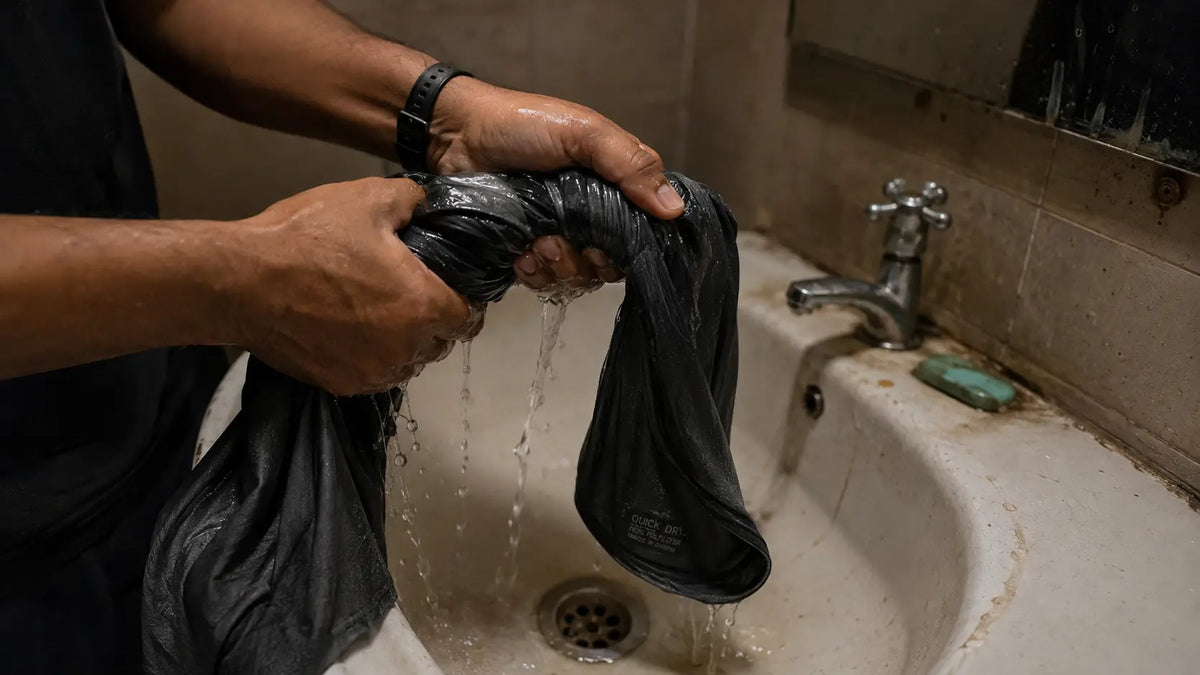
Day four of a ten-day tour. You're digging through a saddlebag for anything that doesn't smell like the last three rides.
Every rider touring on quick-dry riding clothes hits this wall eventually. You packed enough clothes for the trip length, not for how fast riding gear actually gets dirty. Sweat, road dust, and 8-hour riding days turn a fresh t-shirt into a problem by day two.
The fix isn't packing more. It's packing the right fabric, in the right number, with a wash routine that actually works on the road. Here's how to build a quick-dry kit that never runs dry, on a weekend loop or a two-week Himalayan run.
Rider Takeaways
- A 2014 AEM study found polyester's odor-bacteria growth outpaced cotton's by a full log after one ride.
- Pack 2 riding outfits for trips under a week, 3 for longer tours. A nightly wash-and-dry routine covers the rest.
- Merino wool holds 66% less body odor than polyester. It also holds 28% less than cotton, per wearer trials cited by the Woolmark Company.
- Your helmet can't go in a washing machine. Hygena handles the one piece of touring gear quick-dry fabric can't.
Why Does Your Riding Shirt Smell by Lunch?
In 2014, a study in Applied and Environmental Microbiology tested polyester and cotton after a single workout session. Polyester let Micrococcus bacteria grow a full log more than cotton. That's up to 1.72 × 10⁷ CFU per square centimeter.
That strain is the one behind musty, ammonia-like odor. Cotton showed almost no growth over the same three days.
Here's the catch. Synthetic fabric wicks sweat off your skin fast. That's exactly why riders reach for it on a hot commute or a Ladakh climb. But the same weave that pulls moisture away also gives bacteria more surface to grip onto.
Cotton dries slower and stays heavier in a saddlebag. It's just tougher for odor bacteria to colonize. Neither fabric wins on its own. The real fix is how many sets you carry and how you rotate them between rides.
Quick Fact:
A 2014 AEM study found polyester let odor-causing bacteria grow a full log more than cotton after one workout. Cotton showed practically no bacterial growth over three days. That's why a synthetic riding tee can smell worse by evening than a cotton one, even though it dried faster. Source: Applied and Environmental Microbiology, 2014
A 2014 AEM study found polyester let odor-causing bacteria grow a full log more than cotton after one workout. Cotton showed practically no bacterial growth over three days. That's why a synthetic riding tee can smell worse by evening than a cotton one, even though it dried faster. Source: Applied and Environmental Microbiology, 2014
What Actually Makes a Fabric "Quick-Dry"?
Quick-dry fabric doesn't dry faster because it repels water. It dries faster because it refuses to hold water in the first place.
Synthetic fibers like polyester and nylon are hydrophobic. Sweat sits on the surface instead of soaking into the fiber, so it evaporates fast. That's the "wicking" effect brands advertise.
Merino wool works differently. It absorbs up to 35% of its own weight in moisture before it even feels damp, then releases it slowly. That's why a merino base layer feels dry longer on a hot riding day, even mid-monsoon.
Cotton absorbs moisture too, but it holds onto it. That's the tradeoff. Cotton feels cool at first, then stays wet and heavy for hours after a rain-soaked highway stretch.
None of this means synthetic or merino is bulletproof. Both still need a wash before the smell sets in for good. Fabric science buys you time between washes, not an excuse to skip them entirely.
Unique Insight
Our take: Riders often blame the fabric when a shirt smells, but the real variable is contact time. A synthetic tee worn for 8 hours on a highway stretch gives bacteria far longer to multiply than the same fabric worn for a 40-minute commute. Pack for ride length, not just trip length.
How Many Sets of Riding Clothes Should You Pack for Touring?
Most first-time tourers over-pack. A saddlebag full of clothes still runs out of clean options by day three if nothing gets washed.
For trips under a week, two full riding outfits are enough. Wear one, wash one, wear the other while it dries. For anything longer than a week, carry three sets. The spare covers days when weather or schedule won't allow a proper wash.
This only works with quick-dry fabric. A cotton tee that takes 6-8 hours to air-dry breaks the rotation on a two-day riding stretch. A synthetic or merino base layer dries in 1-2 hours on a warm evening, ready for the next morning's ride.
Pack a small sachet of travel detergent or a bar of laundry soap too. Hotel shampoo works in a pinch, but it leaves clothes stiffer and doesn't rinse out odor as well. A 100ml bottle lasts most tourers a full two-week trip.
Quick Fact:
Two riding outfits cover any trip under a week if you wash-and-dry nightly. Carry three sets for anything longer. This is Hygena's field-tested packing formula for quick-dry touring kits, built from rider feedback rather than a single lab study.
Two riding outfits cover any trip under a week if you wash-and-dry nightly. Carry three sets for anything longer. This is Hygena's field-tested packing formula for quick-dry touring kits, built from rider feedback rather than a single lab study.

The Wash-and-Dry-Overnight Routine That Actually Works
Delhi averages 46% relative humidity in June. Mumbai and Kolkata average 77-80% in the same month. That gap changes how you should wash on tour.
In drier north Indian stretches, a sink wash before bed dries by morning almost anywhere. Along the coast or through monsoon-hit routes, the same wet shirt can still be damp at sunrise.
Here's the routine that holds up in both conditions. Rinse the garment in cold water with a small sachet of travel detergent, then wring it out hard. Roll it in a dry towel and press out the remaining water. That step alone cuts drying time by roughly half.
Hang it near a fan or an open window, not folded flat on a bed. Airflow matters more than heat.
Quick Fact:
Coastal and northeastern Indian cities average 77-85% relative humidity through the monsoon months. The north runs drier, roughly 46-50% in the same season. A wash-and-dry routine that works in Rajasthan or Delhi needs help elsewhere. In Mumbai or Guwahati, budget an extra hour, or point a fan at it. Source: CurrentResults.com, India climate data
Coastal and northeastern Indian cities average 77-85% relative humidity through the monsoon months. The north runs drier, roughly 46-50% in the same season. A wash-and-dry routine that works in Rajasthan or Delhi needs help elsewhere. In Mumbai or Guwahati, budget an extra hour, or point a fan at it. Source: CurrentResults.com, India climate data
Merino, Synthetic, or Cotton: Which Should You Pack?
In wearer trials led by AgResearch New Zealand and Consumption Research Norway, wool fabrics beat both rivals on odor. Wool retained 66% less body odor than polyester and 28% less than cotton. Merino held up over multiple wears without washing.
That makes merino the strongest pick for a base layer you'll wear under riding gear for days. It costs more, and it takes slightly longer to dry than synthetic. For most tourers, that tradeoff is worth it for the piece touching skin the longest.
Synthetic still wins for socks and outer layers, where speed matters more than smell. A soaked sock after a river crossing needs to dry by morning, full stop.
A practical kit mixes both fabrics. Go merino or a merino-blend base layer next to skin, synthetic for socks and quick outer layers. Leave cotton at home unless it's a short weekend ride close to base.
Budget matters too. A single merino riding tee often costs 3-4 times a basic synthetic one. Most tourers get the best value buying one merino base layer and filling the rest of the kit with synthetic.
Quick Fact:
Wearer trials led by AgResearch New Zealand and Consumption Research Norway tested wool against synthetic and cotton. Merino retained 66% less body odor than polyester and 28% less than cotton. It held up over multiple wears without a wash. That makes it the strongest base-layer pick for multi-day touring. Source: Woolmark Company research
Wearer trials led by AgResearch New Zealand and Consumption Research Norway tested wool against synthetic and cotton. Merino retained 66% less body odor than polyester and 28% less than cotton. It held up over multiple wears without a wash. That makes it the strongest base-layer pick for multi-day touring. Source: Woolmark Company research

Here's what quick-dry fabric can't fix, though: your helmet. You can rotate t-shirts, but you're wearing the same helmet liner every single day of the tour.
That liner absorbs sweat the same way your riding tee does, minus the option to wash it nightly. Hygena's bacteriostatic spray kills odor-causing bacteria inside the liner between rides, the same discipline you're now applying to your clothes. A few sprays after you park for the night keep it fresh. The one piece of gear you can't rotate stays ready for the next morning.
Frequently Asked Questions
How many riding outfits should I pack for a 2-week tour?
Three full sets is enough for most tourers. A nightly wash-and-dry routine with quick-dry fabric covers the rest. You're never carrying more than three days' worth of clean clothes at once.
Can I hand-wash quick-dry riding gear on the road?
Yes. A cold rinse with travel detergent, a hard wring, and a dry-towel roll cut drying time by roughly half. Most synthetic or merino pieces dry overnight even in the 77-85% humidity common along India's coast.
Is merino wool better than synthetic for touring?
For base layers, yes. Wearer trials found merino holds 66% less body odor than polyester over multiple wears, per Woolmark-cited research. Synthetic still dries faster, which makes it better for socks and outer layers.
Does Hygena work on riding jackets, or just helmets?
Hygena's spray is formulated for helmet interiors, the padding and liner. It's not designed for jackets or base layers. That's exactly why a quick-dry fabric rotation matters for the rest of your kit.
Conclusion
The clothes you pack matter less than how fast they dry and how well they resist bacteria between wears. Two or three sets of quick-dry, merino-leaning gear beats a saddlebag stuffed with cotton every time.
Your helmet liner is the one piece of that kit you can't wash on the road. Hygena keeps it fresh between rides so the rest of your quick-dry routine actually works. Pack smart, wash nightly, and you'll never dig through a saddlebag for clean gear again.
Sources
1. "Microbial Odor Profile of Polyester and Cotton Clothes after a Fitness Session," Applied and Environmental Microbiology, 2014. Retrieved 2026-08-25.
2. "Wool Reduces Body Odour and Requires Less Washing," Woolmark Company. Retrieved 2026-08-25.
3. "Wool is Naturally Odour Resistant," Woolmark Company. Retrieved 2026-08-25.
4. "Average Humidity for India in June," CurrentResults.com. Retrieved 2026-08-25.
Share:
The Bacteria Behind Helmet Odor (And How to Kill It)
Helmet Deodorant Spray: How to Choose and Use One Right