
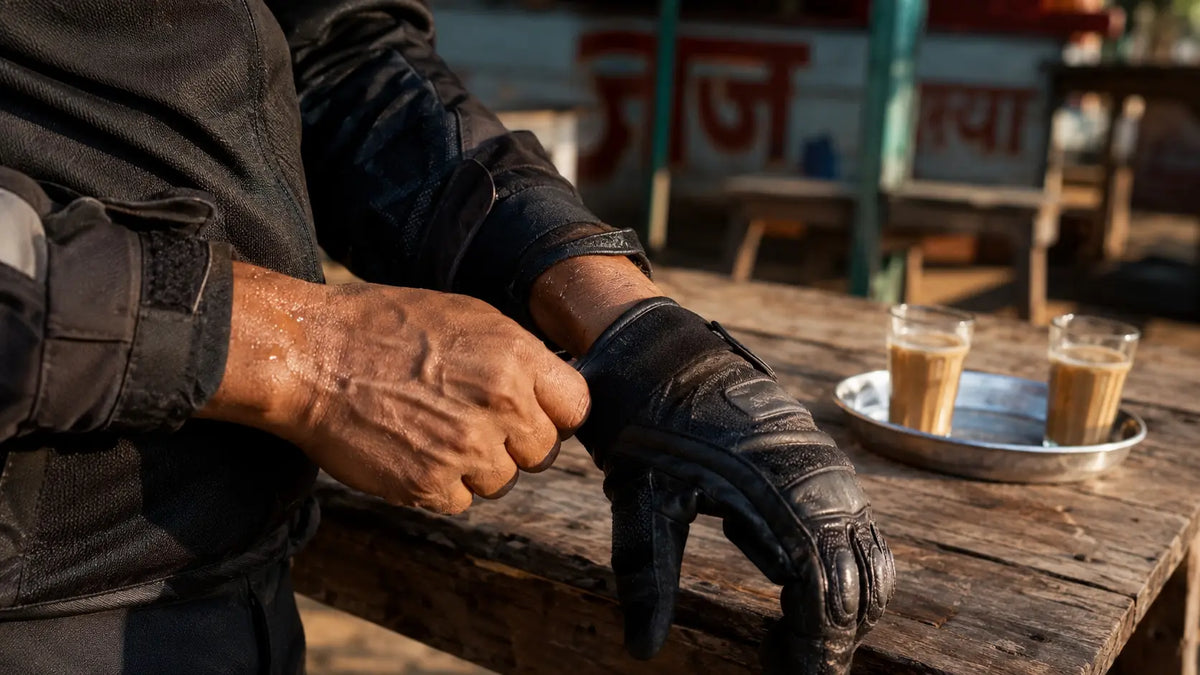
Pull your gloves off after a two-hour ride and smell your own hands. Not great, right?
Every rider knows this moment. Jacket damp at the collar, gloves stiff with dried sweat, helmet liner smelling like something died in there. You've tried airing it out. You've tried perfume. Nothing sticks.
Here's the part most riders miss: sweat itself doesn't smell. Bacteria feeding on it does. That's true for your jacket, your gloves, your boots, and your helmet. It changes how you actually need to fix this.
Rider Takeaways
- Fresh sweat is odorless. The smell comes from bacteria breaking it down, confirmed by a 2023 sportswear microbiology review.
- A 2020 study on 130 motorcycle helmets found 392 bacterial isolates, including drug-resistant staph strains.
- Your palms carry up to 500 sweat glands per square centimeter, the densest concentration on your body. That's why gloves turn foul fastest.
- Airing gear out slows evaporation but doesn't kill the bacteria already living in the fabric.
Why Does Riding Gear Start to Smell So Fast?
In 2023, a review published on sweat and odor in sportswear confirmed something counterintuitive. Freshly secreted sweat has almost no smell of its own. The review found that odor develops only after skin bacteria break sweat down into smaller compounds. That's the real source of the stink in your gear.
Riding gear makes this worse because it traps everything. A jacket zipped to the chin, gloves sealed at the wrist, a helmet strapped tight. None of it breathes the way loose clothing does. Sweat sits against fabric for hours instead of evaporating.
Add heat from the engine and friction from riding, and you've built a small, warm, damp chamber. Bacteria don't need much more than that to multiply fast.
So why does the smell linger even after you wash your jacket once? Because bacteria embed themselves in fabric fibers and foam padding, not just on the surface.
Quick Fact:
Sweat is roughly 99% water with trace salts and proteins. It has no scent on its own. Odor only appears once bacteria such as Staphylococcus and Corynebacterium species metabolize those proteins into smaller, smellier compounds. Source: Sweat and Odor in Sportswear Review, 2023
Sweat is roughly 99% water with trace salts and proteins. It has no scent on its own. Odor only appears once bacteria such as Staphylococcus and Corynebacterium species metabolize those proteins into smaller, smellier compounds. Source: Sweat and Odor in Sportswear Review, 2023
What's Actually Growing Inside Your Jacket, Gloves, and Helmet?
In 2020, researchers tested 130 motorcycle helmets and recovered 392 separate bacterial isolates and 346 fungal ones. Sapkota et al., International Journal of Microbiology found Staphylococcus aureus in 22.7% of samples, the single most common species.
That's not the alarming part. Thirty-nine percent of all bacterial isolates in the study were multidrug-resistant. Among the S. aureus strains, 33.7% were methicillin-resistant, the same MRSA family you'd want nowhere near broken skin or a scalp scratch.
Gloves and boots aren't tested as often, but they follow the same logic. Anywhere fabric traps warmth and moisture against skin becomes a bacterial habitat. Leather gloves are worse. Sweat and bacteria buildup inside leather often develops a sharp, vinegar-like smell that doesn't wash out easily.
Kaunsi cheez zyada dangerous hai, bacteria ya smell? Bhai, they're the same problem. The smell is just your nose warning you the bacteria have already moved in.

Unique Insight
Our finding: Most riders treat helmet, jacket, and glove odor as three separate problems. They're not. It's one bacterial ecosystem spread across your whole kit, and cleaning only the helmet while ignoring the gloves just lets bacteria migrate back the next time you gear up.
Why Do Indian Summers Make It So Much Worse?
Under heavy exertion, eccrine sweat glands can produce between 0.5 and 2 liters of sweat per hour. That climbs to 4 liters an hour in extreme heat. International Hyperhidrosis Society data shows just how much fluid your gear absorbs on a single ride.
Now picture a Delhi or Nagpur commute in peak summer. Humidity slows evaporation, so sweat sits on your skin and inside your gear instead of drying off. That's a longer window for bacteria to feed and multiply.
Mesh jackets and ventilated helmets help air move, but they don't stop sweat production. They just buy you a little time before the smell sets in. For daily commuters riding one to three hours a day, that time runs out fast.
The Gear Most Riders Ignore: Gloves, Boots & Base Layers
Your palms and soles pack up to 500 eccrine sweat glands per square centimeter. That's the densest concentration anywhere on your body. IHT Bio confirms this is far higher than the density on your torso or scalp.
That's exactly why gloves and boots go bad faster than most riders expect. Hands sweat more per square inch than almost anywhere else, and gloves seal that moisture in with zero airflow.
Cotton base layers make it worse. Cotton absorbs sweat and holds onto it instead of letting it evaporate. You end up riding in a damp layer for hours. Polyester or nylon technical fabric wicks moisture away and dries faster.
Most riders wash their jacket occasionally and never touch their gloves. One pair, worn ride after ride, never fully dried between uses. That's a habit worth breaking.
Quick Fact:
Non-antiperspirant users carry roughly 50 times more skin bacteria on average than people using antibacterial products, according to a 2015 microbiome study. The gap in bacterial load, not just sweat volume, is what separates gear that smells from gear that doesn't. Source: Troccaz et al., Microbiome, 2015
Non-antiperspirant users carry roughly 50 times more skin bacteria on average than people using antibacterial products, according to a 2015 microbiome study. The gap in bacterial load, not just sweat volume, is what separates gear that smells from gear that doesn't. Source: Troccaz et al., Microbiome, 2015
How to Actually Stop the Smell, Not Just Mask It
Perfume sprays and fabric fresheners cover the smell for an hour, maybe two. They don't touch the bacteria causing it, so the odor comes right back once the fragrance fades.
Start with the basics: rotate between two pairs of gloves so each one gets a full day to dry out. Never stuff a damp jacket straight into your bike's topbox. That's a sealed, warm space that speeds bacterial growth.
Wash removable liners and padding every one to two weeks if you ride daily. Swap cotton base layers for moisture-wicking fabric. Let gloves and boots dry fully in open air, never sealed in a bag.
This is where a bacteriostatic approach matters more than a fragrance one. Hygena's spray doesn't mask odor. It targets the bacteria feeding on sweat residue inside your helmet. That keeps it fresh for your next ride, not just your next hour.
A few seconds after every ride, sprayed directly onto the liner, beats a full wash cycle. Do it before the smell shows up, not after.
Unique Insight
Our finding: Riders who treat their helmet after every single ride report far less buildup than riders who wait for the smell to show up. By the time you can smell it, bacteria have already had days to multiply. Treating proactively beats treating reactively every time.
Frequently Asked Questions
Why does my riding gear smell even after I wash it?
Bacteria embed themselves deep in fabric fibers and foam padding, not just the surface. A single wash cycle often misses residue trapped inside liners, according to the 2023 sportswear odor review. Spot-cleaning liners between full washes helps close that gap.
Do gloves really smell worse than jackets?
Yes. Palms carry up to 500 sweat glands per square centimeter, the highest density on the body, per IHT Bio research. Sealed glove fabric traps that moisture with almost no airflow.
Does airing out gear actually kill the bacteria?
No. Airing gear speeds up evaporation but doesn't eliminate bacteria already colonizing the fabric. A 2020 helmet study found multidrug-resistant strains persisting in samples that riders described as "regularly aired out."
Can I just use a fragrance spray instead?
Fragrance sprays cover smell for an hour or two at best. They don't reduce the bacterial load causing the odor, so it returns once the scent fades. A bacteriostatic approach targets the actual source.
How often should I clean my helmet liner and gloves?
Every one to two weeks for daily riders, with a quick bacteriostatic treatment after each individual ride. Delivery riders logging 6 to 10 hours a day need more frequent attention than weekend tourers.
Conclusion
Sweat was never the actual enemy. Bacteria feeding on it turns your jacket, gloves, and helmet into something you don't want to put back on.
Fragrance sprays and airing out gear only delay the smell. They don't stop what's causing it. A bacteriostatic habit, applied consistently after rides, does. Spray your helmet liner after every ride, rotate your gloves, and wash removable padding every one to two weeks.
Small habit, real difference. Your gear, and everyone who sits behind you, will thank you.
Sources
1. "Sweat and odor in sportswear – A review," National Center for Biotechnology Information, 2023. Retrieved 2026-07-03. Link
2. Sapkota, S. et al., "Microbial Diversity and Antibiotic Susceptibility Pattern of Bacteria Associated with Motorcycle Helmets," International Journal of Microbiology, 2020. Retrieved 2026-07-03. Link
3. "Physiology of Normal Sweating," International Hyperhidrosis Society. Retrieved 2026-07-03. Link
4. "What To Know About Eccrine Sweat Glands," IHT Bio. Retrieved 2026-07-03. Link
5. Troccaz, M. et al., "Mapping axillary microbiota responsible for body odours using a culture-independent approach," Microbiome, 2015. Retrieved 2026-07-03. Link
Share:
Best Lightweight Camping Gear for Motorcycle Touring
Silk vs. Regular Balaclava: Hair Protection Under a Helmet