
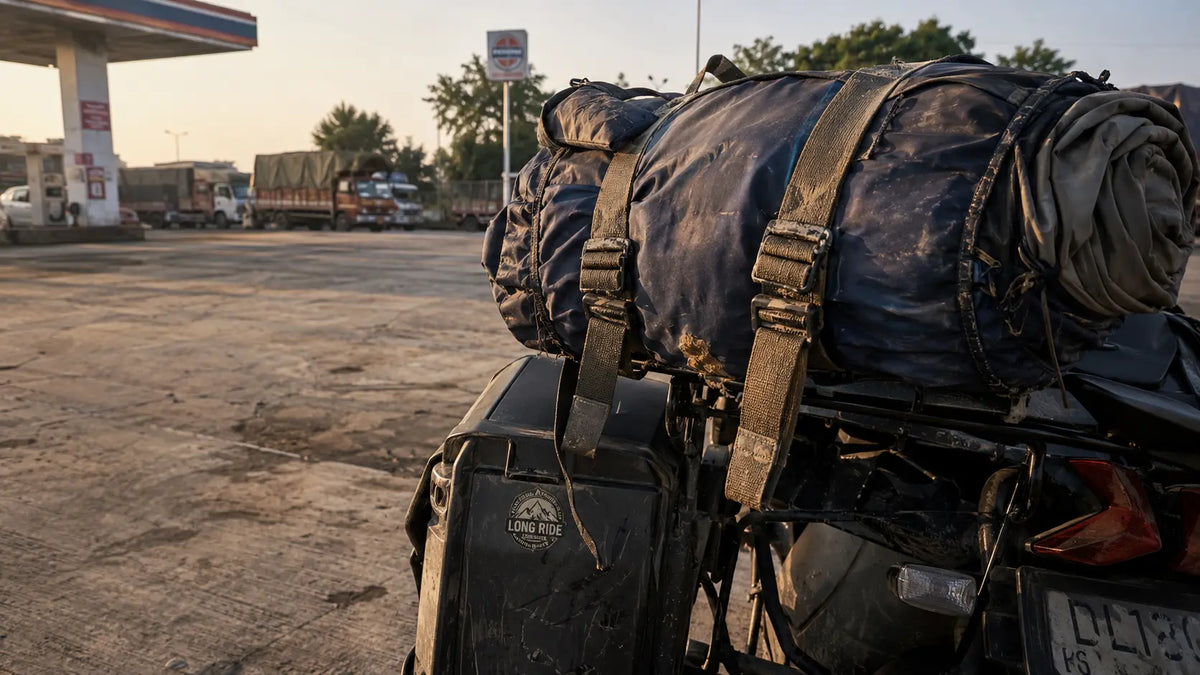
Your bike is loaded, the sun's dropping, and you're still 40 km from camp. Every kilogram you strapped on this morning is now a kilogram your suspension has to answer for.
Most riders over-pack gear and under-pack sense. They'll agonize over a 200-gram stove but throw in a full-size shampoo bottle without a second thought. The result is a bike that handles like a loaded mule and a camping kit that still leaves you feeling grimy by day two.
This guide breaks down the lightest gear categories for motorcycle touring: shelter, cooking, and storage. It also covers the one category almost every packing list forgets, hygiene. Phir bhi, that's usually the first thing riders wish they'd packed better.
Rider Takeaways
- Soft panniers run 1–3 kg each versus 7–9 kg for hard cases, per FarWayOut's touring luggage guide, an easy 4–6 kg saving.
- A 2020 study in the International Journal of Microbiology found 392 bacteria isolates across 130 motorcycle helmets.
- Compressed camping wipes can weigh as little as 3 grams a pack, lighter than almost anything else in your kit.
- Most packing lists rank tents and stoves by weight but never rank hygiene gear the same way.
How Much Weight Should Camping Gear Really Add to Your Bike?
Most adventure motorcycles safely carry between 170 and 250 kg total, according to TFX Suspension's touring guide. That's rider, gear, and fuel combined. There isn't much room left for guesswork, so every kilogram of camping gear you add needs to earn its spot on the bike.
That's why weight, not volume, should drive every gear decision. A tent that packs small but weighs 3 kg isn't actually lightweight. It's just compact, and riders mix the two up constantly.
Luggage itself is often the biggest hidden weight tax. A single hard pannier can weigh as much as your sleeping bag, tent, and stove combined, before you've packed a single item inside it.
Quick Fact:
Soft panniers weigh 1–3 kg each, while hard cases run 7–9 kg per side, according to FarWayOut's touring luggage guide. Swapping a hard pannier setup for a rackless soft-luggage system can save 4–6 kg of dead weight before you've packed anything inside. Source: FarWayOut Touring Luggage Guide.
Soft panniers weigh 1–3 kg each, while hard cases run 7–9 kg per side, according to FarWayOut's touring luggage guide. Swapping a hard pannier setup for a rackless soft-luggage system can save 4–6 kg of dead weight before you've packed anything inside. Source: FarWayOut Touring Luggage Guide.
Shelter and Sleep: The Heaviest Part of Any Camping Kit
A freestanding, low-volume tent is the single biggest weight decision a touring rider makes, according to Mad or Nomad's camping gear checklist. Waterproofing and packed size matter, but weight is what your bike actually feels on a mountain pass.
Inflatable sleeping pads beat foam pads on weight and pack size, without giving up comfort on hard ground. Pair one with a down or synthetic-fill sleeping bag. Both compress smaller and weigh less than cotton-filled alternatives.
Layering matters here too. A 3-season bag paired with a liner often beats a single heavy 4-season bag for total kit weight, especially if you're touring through changing altitudes like Ladakh or Spiti.
Unique Insight
Our finding: Almost every gear guide ranks tents, stoves, and sleeping bags by weight in grams. Almost none rank hygiene items the same way, even though a helmet interior collects more bacteria per square inch, ride after ride, than any tent floor ever will.

Cooking and Water: A Minimalist Kitchen for the Road
Compact stove systems have gotten dramatically lighter in the last few years. The Jetboil Stash, for example, combines a titanium burner and cook pot in a single unit weighing just 7.1 oz (about 201 grams), per Mad or Nomad's gear checklist. That's less than a smartphone.
Water is heavier than any gear choice you'll make, so plan refill points instead of carrying it all. A compact filter or purification tablets weigh next to nothing compared to bottled water for three days.
Choose gear that pulls double duty: a mug that's also your cook pot, a spork instead of a full cutlery set. Every multi-use item is one less thing strapped to your pillion seat.
Quick Fact:
Ultralight titanium stove-and-pot combos now weigh as little as 201 grams (7.1 oz), roughly the weight of a large smartphone. Choosing gear like this over a traditional multi-piece cook set can save close to half a kilogram in your cooking bag alone. Source: Mad or Nomad Camping Gear Checklist.
Ultralight titanium stove-and-pot combos now weigh as little as 201 grams (7.1 oz), roughly the weight of a large smartphone. Choosing gear like this over a traditional multi-piece cook set can save close to half a kilogram in your cooking bag alone. Source: Mad or Nomad Camping Gear Checklist.
Packing Smart: Dry Bags, Compression, and What Actually Fits
The simplest packing system for most tourers is one waterproof duffel plus compression sacks, strapped down with cam straps or Rok Straps. It's cheaper than panniers and easier to load and unload at camp.
Distribute weight low and centered, especially on ADV and dual-sport bikes headed off-road. A top-heavy load turns every gravel patch into a wrestling match with your own bike.
Ever notice how the same gear feels heavier on day three than day one? That's not the gear. That's fatigue, and packing lighter on the front end pays off hardest when you're tired.
Compression sacks aren't just about space. Squeezing air out of your sleeping bag and clothing roll also keeps your center of gravity lower and your bike more predictable at speed.
Why Do Riders Forget Hygiene Until Day Three of a Tour?
In 2020, a study published in the International Journal of Microbiology examined 130 motorcycle helmets and recovered 392 bacterial isolates and 346 fungal isolates across seven genera, led by Staphylococcus aureus. Camping trips only add to that baseline — more sweat, more dust, no laundry in sight.
Most packing lists stop at toothpaste and a bar of soap. They skip the one item riders wear for six, eight, sometimes ten hours a day: the helmet. That's the gap nobody plans for until the smell shows up.
By day three of a tour, sweat has soaked into the liner every single riding day, with no proper wash in between. That's exactly the "enclosed, warm environment" bacteria need to multiply.
Quick Fact:
Of the bacterial isolates recovered from motorcycle helmets in the 2020 study, 39% were multidrug-resistant. That's not a reason to panic. It's a reason to treat helmet hygiene as seriously as you treat brushing your teeth on tour. Source: Sapkota et al., International Journal of Microbiology, 2020.
Of the bacterial isolates recovered from motorcycle helmets in the 2020 study, 39% were multidrug-resistant. That's not a reason to panic. It's a reason to treat helmet hygiene as seriously as you treat brushing your teeth on tour. Source: Sapkota et al., International Journal of Microbiology, 2020.
The fix is simpler than you think. You don't need a shower or a washing machine mid-tour. You need thirty seconds and something that actually kills bacteria instead of masking the smell.
Building a Lightweight Hygiene Kit for Motorcycle Touring
Compressed camping wipes can weigh as little as 3 grams a pack, according to Nature Buff's 2026 biodegradable wipes guide. That's lighter than a rupee coin, and it covers what a full-size wipes pack does.
A biodegradable soap bar or sheet set adds roughly 50–100 grams, and a quick-dry pack towel adds another 50 grams or so. None of this is the item most riders forget, though.
Hygena's helmet spray weighs less than most wipe packs and takes the one job nothing else in your kit does: it keeps bacteria from building up in your liner between rides, not just masking the smell with fragrance.
Pack it next to your toothbrush. A few sprays after you park for the night, and your helmet's ready for tomorrow's ride. No water, no wash, no waiting.
Unique Insight
Our finding: When riders build a "weight budget" for touring gear, hygiene items usually get 10% or less of total pack weight — yet they're used daily, unlike a stove or tent stake. Pound for pound, hygiene gear delivers more daily utility than almost anything else in the bag.

Frequently Asked Questions
How much weight should motorcycle camping gear add to my bike?
Aim to stay well under your bike's rated payload. Most ADV motorcycles safely carry 170–250 kg total, rider and fuel included. Source: TFX Suspension touring guide, 2026.
What's the lightest tent option for motorcycle touring?
Freestanding, single-wall backpacking tents under 2 kg pack down small and set up fast, according to Mad or Nomad's camping gear checklist. Pair one with an inflatable pad to save more weight.
Can I stay clean on a multi-day motorcycle camping trip without a shower?
Yes. Compressed biodegradable wipes (as light as 3 grams a pack), a quick-dry towel, and a helmet spray cover most of what a shower would, according to Nature Buff's biodegradable wipes guide.
Does Hygena's helmet spray work on multi-day camping tours?
Yes. It's built for exactly this: no water or wash needed, just a few sprays after each riding day to keep bacteria from building up in the liner overnight.
How often should I clean my helmet during a long tour?
Spray or wipe the liner daily on a multi-day tour, since sweat and heat build up fast in an enclosed helmet. A 2020 study found 392 bacterial isolates across 130 helmets. Daily attention matters more on tour than at home.
Conclusion
Lightweight touring gear isn't about owning the fanciest tent or the smallest stove. It's about making every kilogram on your bike count. Shelter, cooking, and storage get all the attention in most packing guides.
Hygiene rarely gets the same treatment, even though your helmet works harder than your tent ever will. Hygena fits into that gap: light enough to ignore, effective enough that you won't want to.
Pack smart, pack light, and don't let day three be the day your helmet reminds you what you forgot.
Sources
1. Sapkota, A. et al., "Microbial Diversity and Antibiotic Susceptibility Pattern of Bacteria Associated with Motorcycle Helmets," International Journal of Microbiology, 2020. Retrieved 2026-07-03.
2. "How to Choose Motorcycle Luggage for ADV & RTW Travel," FarWayOut, 2026. Retrieved 2026-07-03.
3. "Motorcycle Luggage Capacity," ReiseMoto, 2026. Retrieved 2026-07-03.
4. "Ultimate Motorcycle Camping Gear Checklist," Mad or Nomad, 2026. Retrieved 2026-07-03.
5. "Best Biodegradable Wipes for Camping and Backpacking," Nature Buff, 2026. Retrieved 2026-07-03.
6. "How Much Weight Can an Adventure Motorcycle Carry?," TFX Suspension, 2026. Retrieved 2026-07-03.
Share:
Helmet Cleaner Durgapur: It's Not the Dust, It's the Roads
Sweat, Smell & Riding Gear: The Problem Every Biker Has