
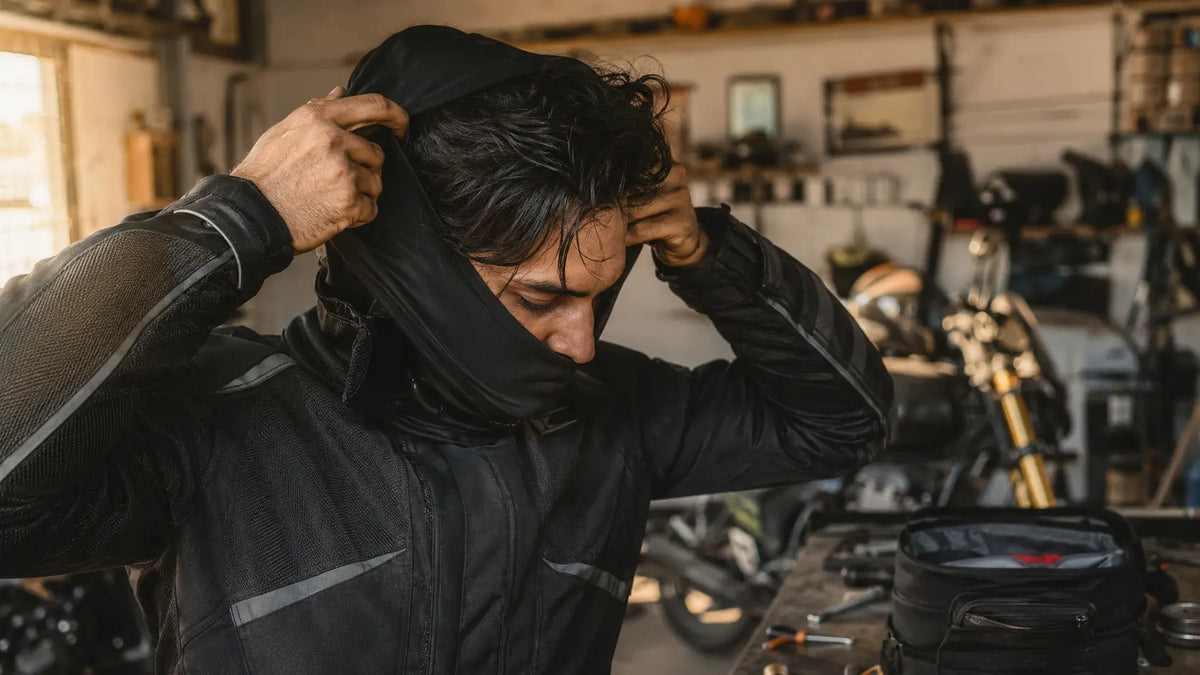
You pull off your helmet and your hair comes out in a tangled, sweaty knot.
That's not random. Every ride pushes your hair against helmet padding for an hour or more. Most riders never think about what's causing the damage. A balaclava is supposed to fix this, but the fabric it's made from changes how much protection you actually get.
We compared silk against a regular balaclava made from cotton, polyester, or a blend. Here's what actually delivers hair protection under a helmet, and what's just marketing.
Rider Takeaways
- Independent lab testing in 2025 found silk creates 34% less hair-damaging friction than cotton. Source: Mulberry Park Silks friction study, 2025.
- Wet, sweaty hair is far more prone to friction damage because moisture lifts the hair's outer cuticle scales.
- Regular cotton balaclavas hold sweat against your scalp longer than silk, based on standard textile moisture-regain data.
- A balaclava reduces friction on your hair. It doesn't clean bacteria off your helmet liner — that's a separate habit.
What's the Real Difference Between a Silk and a Regular Balaclava?
In October 2025, independent lab testing found that silk creates 34% less hair-damaging friction than cotton fabric. Source: Mulberry Park Silks friction study, 2025. Most regular balaclavas sold in India use cotton, polyester, or a cotton-poly blend. That rougher weave is exactly what generates extra friction against your hair with every head movement inside a helmet.
The lab used a texture analyzer to measure the actual force between fabric and hair, not just a feel test. Silk registered 3,529 g·mm of friction force against hair. Cotton registered 5,344 g·mm — 51% higher. Researchers ran 80 separate measurements to confirm the gap was consistent, not a fluke.
Why does the fiber itself matter this much? Silk is a smooth protein fiber with a low-friction surface. Cotton is a woven plant fiber with a rougher, more textured surface. Every time your head turns, hair drags across whichever fabric is between it and the padding.
Quick Fact:
Lab testing in October 2025 measured friction force directly: pure silk registered 3,529 g·mm against hair, cotton registered 5,344 g·mm. That's 51% more friction from cotton fabric, confirmed across 80 separate measurements. Source: Mulberry Park Silks friction study, 2025.
Lab testing in October 2025 measured friction force directly: pure silk registered 3,529 g·mm against hair, cotton registered 5,344 g·mm. That's 51% more friction from cotton fabric, confirmed across 80 separate measurements. Source: Mulberry Park Silks friction study, 2025.
Does a Silk Balaclava Actually Reduce Hair Breakage?
Hair is most vulnerable to friction damage when it's wet, according to 2025 research on hair fiber friction. Source: ScienceDirect, 2025. Water swells the hair shaft and lifts the outer cuticle scales. That's exactly the state your hair is in halfway through a hot, sweaty commute.
Once the cuticle lifts, those tiny overlapping scales catch on rough fabric instead of sliding past it. Each catch pulls at the hair shaft. Do that thousands of times over a two-hour ride, and split ends and breakage aren't surprising anymore.
A smooth fabric like silk lets damp hair glide instead of catching. It won't stop sweating. It changes what happens to your hair once you're sweating.
Unique Insight
Our finding: Most silk-vs-cotton friction data comes from pillowcase studies, tested on dry hair over a single night. Riding conditions are harsher. Sweat adds moisture, and helmet pressure adds constant contact for hours at a stretch, not eight hours of gentle movement. The friction gap between fabrics likely matters more under a helmet than it does on a pillow.

Which Balaclava Handles Indian Riding Heat and Sweat Better?
Standard textile testing puts silk's moisture regain at about 11%, against roughly 8.5% for cotton. Source: ASTM D1909 moisture regain standard. Silk actually holds slightly more moisture by weight. But it releases that moisture faster than cotton does, instead of trapping it against your scalp.
That release speed matters more than the raw percentage. Cotton stays damp longer after it absorbs sweat. That means longer stretches of your ride with wet fabric pressed against wet hair. That's the exact combination that raises friction damage the most.
Daily commuters in India wear a helmet for one to three hours at a stretch. Delivery riders often go six to ten hours. Ever notice your scalp feels hottest on the same ride every single day? That's not your imagination. It's the same damp fabric, reheated, hour after hour.
Quick Fact:
Textile researchers have confirmed a consistent pattern across fabric-skin studies: rougher, coarser fabric produces measurably higher friction against skin and hair than smooth fabric does. Source: PMC, review of skin-textile tribological interaction.
Textile researchers have confirmed a consistent pattern across fabric-skin studies: rougher, coarser fabric produces measurably higher friction against skin and hair than smooth fabric does. Source: PMC, review of skin-textile tribological interaction.
A balaclava, silk or regular, sits between your scalp and the helmet's padding for that entire ride. It manages friction and sweat contact with your hair. It doesn't touch the bacteria building up in the padding underneath it. That's a separate habit, whichever fabric you're wearing.
The fix is simpler than you think. A few sprays of Hygena on your helmet liner after a ride keeps what's touching your scalp bacteria-free. That holds no matter which balaclava you're wearing.
Silk vs. Regular Balaclava: Durability, Cost and Care
Silk balaclavas typically cost ₹800 to ₹2,000-plus in India. Regular polyester or cotton balaclavas run ₹150 to ₹500. That price gap is the first thing most riders notice, and it's a fair trade-off to weigh.
Silk needs hand-washing or a gentle machine cycle with mild detergent, and it tears more easily under rough daily handling. A regular balaclava shrugs off machine washes, monsoon soakings, and the general abuse of daily commuting.
Bhai, most riders end up keeping both. Silk for long tours where hair matters, regular for the daily grind where durability wins.
Can a Balaclava Really Stop Helmet Hair Loss?
Close to 200,000 riders were booked in Bangalore alone in a single year for skipping helmets. Many cited fear of hair loss as the reason. Source: Belgravia Centre, citing New Indian Express reporting. That fear runs deep across Indian riding culture.
Here's the part that gets lost. There's no established medical link between wearing a helmet and permanent hair loss. Traction alopecia, the condition riders actually worry about, comes from constant pulling tension on hair follicles. That's the kind of tension seen with tightly wound turbans, not helmet padding.
So what's actually happening to helmet-hair sufferers? Friction-driven breakage and split ends, not follicle loss. It looks the same in the mirror, but it's a different, fixable problem.
Unique Insight
Our finding: The fear driving India's helmet-hair anxiety isn't backed by dermatology data on hair loss. It's backed by a real, smaller problem: visible breakage and frizz from hours of fabric friction. A better balaclava fixes the problem riders actually have, not the one most of them think they have.

Frequently Asked Questions
Does a silk balaclava really protect hair better than a regular one?
Yes, based on lab measurements. Silk creates 34% less hair-damaging friction than cotton, per 2025 independent testing. Source: Mulberry Park Silks, 2025. The difference comes from silk's smoother fiber surface, not marketing claims.
Can I wear a silk balaclava for daily commuting?
You can, but expect more upkeep. Silk needs hand-washing and handles rough daily use less well than polyester or cotton. Many daily commuters keep a regular balaclava for weekdays and silk for longer, less frequent rides.
Does wearing a balaclava stop helmet-related hair loss?
There's no established medical link between helmets and permanent hair loss. A balaclava reduces friction-driven breakage, which is the real, reversible problem most riders actually have, not follicle loss.
Do I still need to clean my helmet if I wear a balaclava?
Yes. A balaclava sits between your scalp and the padding. But sweat and skin oils still reach the liner underneath over time. Bacteria builds up there regardless of what fabric you're wearing on top.
What's the cheapest way to reduce helmet hair damage?
A regular balaclava that fits snugly already cuts direct hair-to-padding contact. Pairing it with a clean, bacteria-free liner adds real protection. Letting hair air out after rides helps too, all at low cost.
Conclusion
Silk measurably reduces friction against your hair compared to a regular balaclava. That much is backed by lab data, not just brand claims. Whether the cost and upkeep are worth it depends on your riding habits. It also depends on how much your hair matters to you.
Either way, the balaclava only handles half the equation. It protects your hair from the fabric touching it. It doesn't protect you from what's building up in the helmet liner underneath. Hygena covers that half in a few seconds after every ride, whichever balaclava you choose.
Next up: find out whether your helmet is actually behind your hair loss, or if something else is. See how a full hair care routine fits around daily riding.
Sources
1. Doyle, Z., "The Definitive Silk vs. Cotton Study: Why Silk Wins for Hair Protection," Mulberry Park Silks, November 2025 (independent lab testing, October 2025). Retrieved 2026-07-03.
2. "ASTM D1909: Standard Tables of Commercial Moisture Regains for Textile Fibers," ASTM International. Retrieved 2026-07-03.
3. "Understanding and controlling the friction of human hair," ScienceDirect, 2025. Retrieved 2026-07-03.
4. "A Brief Review on Factors Affecting the Tribological Interaction between Human Skin and Different Textile Materials," PMC, 2022. Retrieved 2026-07-03.
5. Peake, M., "Indian Bikers Shun Helmets For Fear Of Hair Loss," Belgravia Centre, 2015. Retrieved 2026-07-03.
Share:
Sweat, Smell & Riding Gear: The Problem Every Biker Has
Textile vs Leather Motorcycle Gear: Which Cleans Easier?