
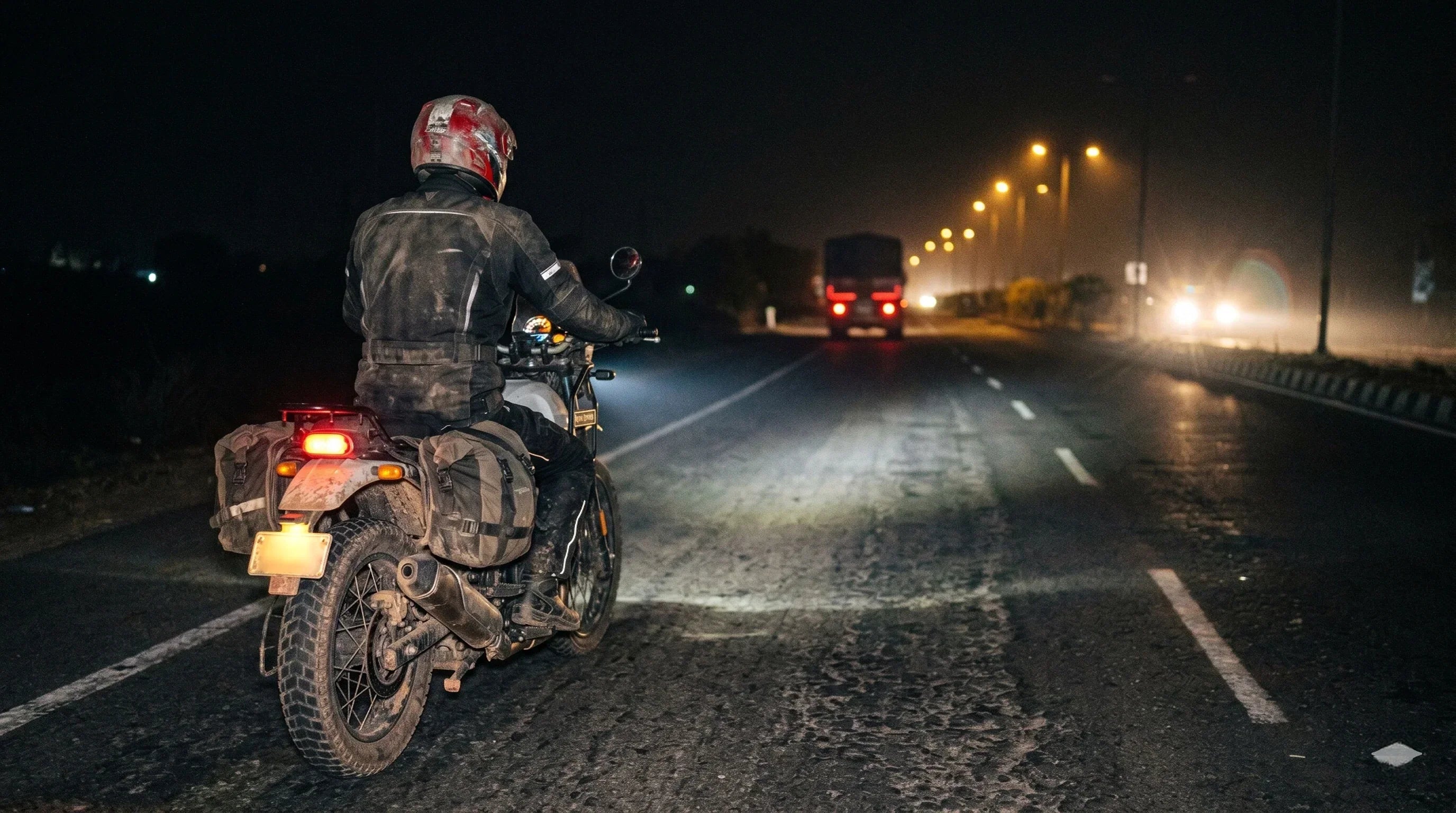
It's 11 PM, the highway is empty, and you think you'll make Jaipur by 2. That stretch is where most riders get it wrong.
Night riding feels faster and freer. Less traffic, cooler air. But the dark hides the two things that actually hurt riders: creeping fatigue and a body that's quietly running out. These night riding Indian highways tips cover what the safety blogs skip, including the smelly helmet that's wrecking your focus. Read this before your next overnight run.
Rider Takeaways
- Two-wheelers caused 84,599 deaths in 2024, or 48.3% of all road deaths in India. Source: NCRB 2024.
- Stay awake 17 hours and your reaction time matches a 0.05% blood-alcohol rider. Plan sleep, not just fuel stops.
- Most highway crashes cluster in the evening and late-night window, when visibility drops and bumps disappear.
- A fresh helmet keeps you alert. A stale, sweaty one fogs your visor and pulls your focus off the road.

What Makes Night Riding on Indian Highways So Risky?
In 2024, the NCRB recorded that 20.7% of all road accidents happened between 6 PM and 9 PM, the single worst window of the day. That's 1,01,232 cases. Indian highways get more dangerous right as the light fades and traffic thins out.
Highways themselves are a trap. National highways are just 2.1% of India's road network. Yet they saw 29.8% of all accidents in 2024. High speeds and long, dark gaps between towns leave little room to react.
And it's riders like you who pay most. Two-wheelers caused 84,599 deaths in 2024, the largest share of any vehicle type. Poor night visibility means you spot potholes, stray cattle, and unlit trucks far too late.
Quick Fact:
In 2024, two-wheelers accounted for 84,599 road deaths in India, or 48.3% of all fatalities, the highest of any vehicle category, per the NCRB. National highways carry only 2.1% of road length but 29.8% of accidents, making fast night stretches especially deadly for riders. Source: [NCRB 2024 via Deccan Chronicle]
In 2024, two-wheelers accounted for 84,599 road deaths in India, or 48.3% of all fatalities, the highest of any vehicle category, per the NCRB. National highways carry only 2.1% of road length but 29.8% of accidents, making fast night stretches especially deadly for riders. Source: [NCRB 2024 via Deccan Chronicle]
Why Does Fatigue Hit Harder After Dark?
Sleep loss impairs you like alcohol does. Research summarised by the CDC found that being awake for 17 hours drops your performance to a 0.05% blood-alcohol level. Push to 24 hours and you're at 0.10%, well past the drunk-driving line.
Your body clock works against you too. Alertness bottoms out between 2 AM and 5 AM, exactly when long-haul riders push for one last stretch. Reaction time can slow by half when you're sleep-deprived.
Fatigue is also a quiet killer in the data. Studies link drowsiness to 20 to 30% of road fatalities. The scary part? You rarely feel it coming. One micro-sleep at 90 kmph covers 25 metres with your eyes shut.
Quick Fact:
Staying awake for 17 hours impairs reaction time and judgement to the level of a 0.05% blood-alcohol concentration, and 24 hours matches 0.10%, according to research compiled by the CDC and Harvard Sleep Medicine. Drowsiness is linked to 20 to 30% of road deaths. Source: [CDC NIOSH]
Staying awake for 17 hours impairs reaction time and judgement to the level of a 0.05% blood-alcohol concentration, and 24 hours matches 0.10%, according to research compiled by the CDC and Harvard Sleep Medicine. Drowsiness is linked to 20 to 30% of road deaths. Source: [CDC NIOSH]
How Do You Stay Alert on a Long Night Ride?
The fix isn't coffee. It's planning your ride around your body, not against it. Treat sleep like fuel: you wouldn't start a 400 km run on a half tank. Don't start one on four hours of sleep either.
Build your night ride around these habits:
- Stop every 90 to 120 minutes. Walk for five minutes. Stretch your neck and wrists.
- Eat light. Heavy dhaba thalis make you drowsy. Keep it small and frequent.
- Hydrate often. Cool, dry air dehydrates you without sweat as a warning.
- Respect the 2-to-5 AM dip. If you're nodding, sleep an hour. Ek nap zindagi bacha sakta hai.
- Refresh at every stop. Splash your face, cool your head, reset your helmet.
That last one matters more than riders think. A cool, fresh head stays alert. A hot, sweaty, smelly one starts drifting. Which brings us to the part nobody talks about.

Can a Smelly Helmet Really Make Night Riding More Dangerous?
Yes, and the science backs it. A helmet's interior is dark, warm, and damp from sweat, which is a near-perfect home for bacteria like Staphylococcus. Microbiology researchers note these microbes feed on the proteins in your sweat and multiply fast.
On a night ride, that turns into a real problem. The bad smell is a constant distraction. The trapped humidity fogs your visor at the worst moments. And a clammy, itchy scalp keeps pulling your attention off the road ahead.
Most riders mask it with perfume or just ride through it. That doesn't kill the bacteria causing the smell. It only hides it for an hour, then the stink and the fog come right back on the highway.
Unique Insight
Our finding: Riders obsess over headlights and reflective vests for night safety, but ignore the helmet interior. A fogged visor and a distracting smell steal focus during the exact 2-to-5 AM window when your reactions are already at their slowest. Freshness is a safety feature, not a luxury.
This is where a quick habit pays off. Hygena is India's first helmet deodorant, built to stop odour-causing bacteria at the source instead of masking it. A few sprays after each ride keeps your helmet bacteria-free and dry for tomorrow's run.
On an overnight trip, carry it. Spray at your chai stops, let it air for a minute, and ride on with a clear head and a clearer visor. The fix is simpler than you think, and it takes five seconds.
What Visibility and Gear Tips Matter Most at Night?
Being seen is half of night-riding safety. Most riders fixate on their own headlight, but Indian highways are full of unlit trucks and trolleys. Your job is to be visible from 200 metres away, not just to see.
Get these basics right before you ride after dark:
- Use a clear visor, never tinted. A dark visor at night cuts your vision badly.
- Keep that visor clean and fog-free. Smears scatter every oncoming headlight into glare.
- Wear reflective gear. A reflective vest or jacket strips make you pop in headlights.
- Aim your headlight correctly. A loaded bike points its beam at the sky. Adjust it.
- Hold your lane and slow down. Leave more gap. Brake earlier than you would by day.
One more thing riders skip: helmet non-compliance is a killer. Of the roughly 75,000 two-wheeler riders who died in 2023, about 73% weren't wearing a helmet at all. At night, a good helmet is non-negotiable.
Quick Fact:
Of the roughly 75,000 Indian two-wheeler and pillion riders who died in 2023, about 73% were not wearing a helmet, official data shows. A clear, clean visor and reflective gear further cut night-riding risk by improving both how you see and how you're seen. Source: [NCRB / Scroll.in]
Of the roughly 75,000 Indian two-wheeler and pillion riders who died in 2023, about 73% were not wearing a helmet, official data shows. A clear, clean visor and reflective gear further cut night-riding risk by improving both how you see and how you're seen. Source: [NCRB / Scroll.in]
Frequently Asked Questions
Is night riding on Indian highways safe for beginners?
It's riskier than daytime, so beginners should wait. In 2024, 20.7% of accidents struck in the 6-9 PM window, the day's worst, per the NCRB. Build daytime highway experience first, then try short night stretches with an experienced rider.
How do I stop feeling sleepy while riding at night?
Sleep before you ride, not coffee during. Being awake 17 hours impairs you like a 0.05% blood-alcohol level, per CDC data. Stop every 90 minutes, hydrate, eat light, and nap if you're nodding off between 2 and 5 AM.
Does a smelly helmet affect my riding?
Yes. A sweaty helmet interior breeds bacteria, fogs your visor, and distracts you with odour and scalp itch. Microbiology research shows Staphylococcus thrives in that warm, damp space. A helmet deodorant like Hygena stops the bacteria instead of masking the smell.
Should I use a tinted visor for night riding?
Never. A tinted visor cuts the light your eyes need after dark and makes hazards harder to spot. Use a clear, clean, fog-free visor at night. Keep a separate tinted one only for bright daytime rides.
Conclusion
Night riding on Indian highways rewards riders who plan for fatigue, visibility, and a clear head, not just the ones who ride hard. The dark amplifies every weakness, from slow reactions to a fogged visor.
Most of it is in your control. Sleep before you ride, stop often, gear up to be seen, and keep your helmet fresh so your focus stays where it belongs. Hygena makes that last step a five-second habit at every chai stop. Ride smart, reach home, do it again tomorrow.
Sources
1. "Two-wheelers Contribute To Maximum Road Mishap Fatalities In 2024: NCRB," Deccan Chronicle, 2025. Retrieved 2026-06-16.
2. "Road accidents in India in 2024 (NCRB analysis)," Factly, 2025. Retrieved 2026-06-16.
3. "India's 2024 Road Accident Report," Legacy IAS, 2025. Retrieved 2026-06-16.
4. "Impairments due to sleep deprivation are similar to alcohol intoxication," CDC NIOSH. Retrieved 2026-06-16.
5. "Judgment and Safety," Harvard Division of Sleep Medicine. Retrieved 2026-06-16.
6. "Indian roads are deadliest for pedestrians, two-wheeler riders," Scroll.in, 2025. Retrieved 2026-06-16.
Share:
Motorcycle Camping in India: The Beginner's Hygiene Guide
Royal Enfield Long Tour Preparation: Gear & Hygiene Guide