
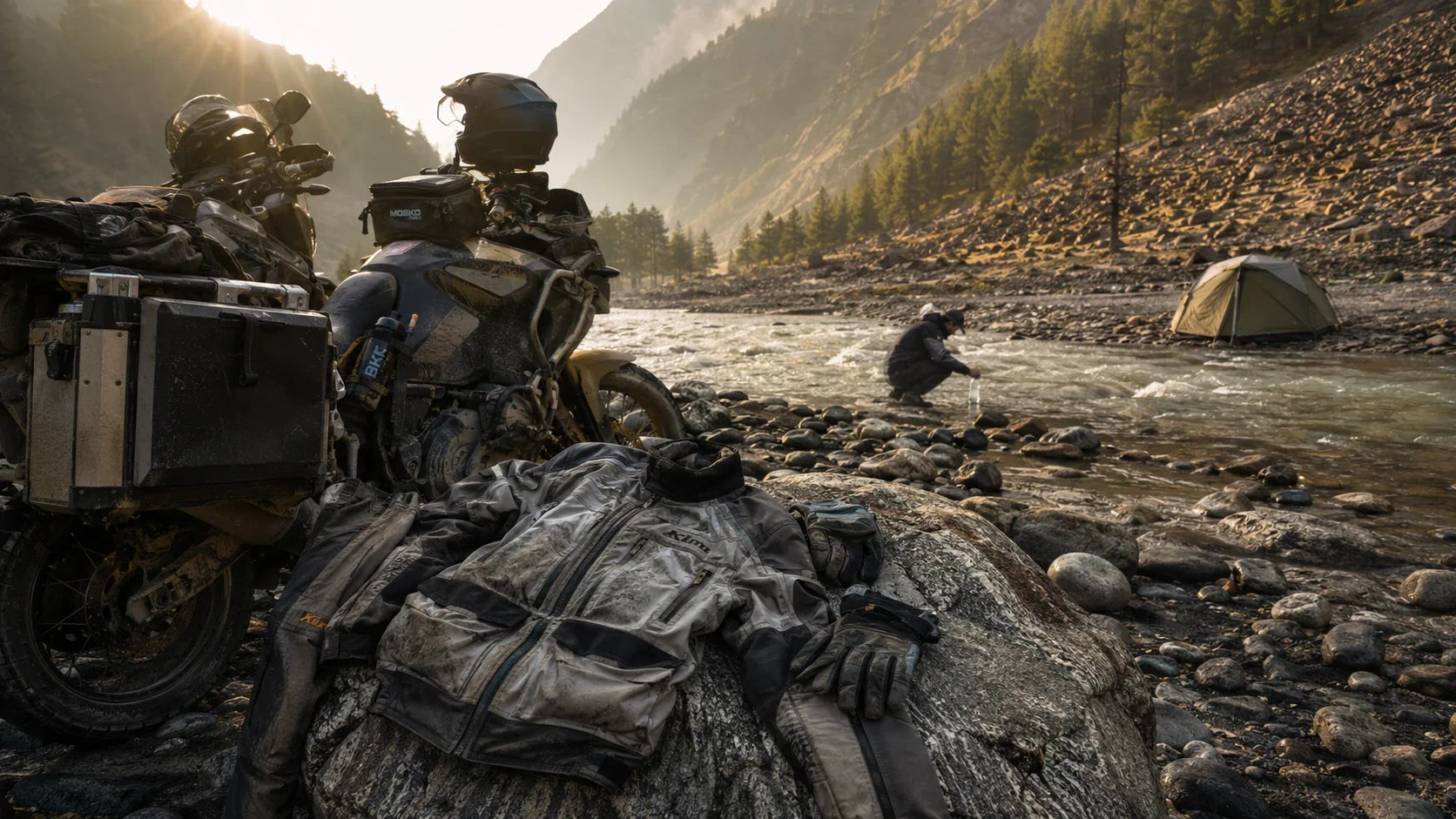
You wake up by the river. The water's perfect. Your riding jacket isn't.
Day one of a bike trip feels amazing. Then day two arrives, and your helmet smells like a gym bag. Your gloves are damp. Your scalp itches before you've even kicked the engine. Most riders blame the heat and ride on. The real cause is what grows in your gear overnight.
This guide covers India's best riverside camping spots for bike trips, plus the campsite hygiene routine that keeps you fresh enough to enjoy day two.
Rider Takeaways
- Riders can lose up to 10 litres of sweat a day in heat, per NCBI research. Most of it soaks into gear.
- Rishikesh, Tirthan Valley and Chandratal are India's top riverside camps for bikers, each with a different season window.
- A 2020 study found S. aureus in 22.7% of motorcycle helmets, so day-2 odor is bacteria, not just sweat.
- Pack a dry routine for gear and helmet, and never bathe in flood-swollen rivers.
Where Are India's Best Riverside Camping Spots for Bike Trips?
India gives riders a riverside camp for almost every month of the year. The trick is matching the spot to the season. Rishikesh runs best September to April, while Himalayan high-altitude camps only open June to October. Pick wrong and you're stuck on a closed pass.
Rishikesh and nearby Shivpuri sit on the Ganga and stay rideable most of the year. Tents start near ₹1,200 a night, and the road in is smooth tar. It's the easy first trip for new tourers.
Tirthan Valley in Himachal is quieter. The Tirthan river runs cold and clean past small homestay-camps near Gushaini. Fewer crowds, more trout, better sleep. The ride from Aut tunnel is short and scenic.
For the big one, Chandratal in Spiti is a crescent lake camp at 4,300 metres. It's open June to mid-October only, when Kunzum La clears. The cold here is real, so this is a tougher, higher-prep trip.
Quick Fact:
The best season for a Spiti Valley bike trip runs June to mid-October, when high passes like Kunzum La and Rohtang are open and the weather is clear. Rishikesh riverside camping, by contrast, peaks September to April. Source: The Wander Yak.
The best season for a Spiti Valley bike trip runs June to mid-October, when high passes like Kunzum La and Rohtang are open and the weather is clear. Rishikesh riverside camping, by contrast, peaks September to April. Source: The Wander Yak.
Why Do You Smell Worse on Day 2 of a Bike Trip?
Because day one's sweat is still in your gear, and bacteria spent the night feeding on it. Riding in heat can push fluid loss as high as 10 litres a day. That's per NCBI research on exercise in hot environments. Your jacket, gloves and helmet liner absorb a big share of that.
Sweat itself barely smells. The odor comes from bacteria breaking it down. Warmth and damp foam are perfect for them. A helmet liner left in a hot tent overnight is basically an incubator.
So by morning, your gear hasn't reset. It's worse than when you took it off. That's why a quick airing isn't enough on a multi-day trip. The bacteria are already established.

Quick Fact:
In 2020, a study of 130 motorcycle helmets recovered 392 bacterial isolates, with Staphylococcus aureus the most common at 22.7%, followed by S. epidermidis at 19.6%. Nearly 39% of isolates were multidrug-resistant. Source: Microbial Diversity of Motorcycle Helmets, PMC.
In 2020, a study of 130 motorcycle helmets recovered 392 bacterial isolates, with Staphylococcus aureus the most common at 22.7%, followed by S. epidermidis at 19.6%. Nearly 39% of isolates were multidrug-resistant. Source: Microbial Diversity of Motorcycle Helmets, PMC.
How Do You Set Up a Hygienic Riverside Campsite?
Start with three zones: a clean tent zone, a wet gear zone, and a wash zone downstream. Health bodies advise keeping wash water and waste away from the river you drink or bathe in. A few metres of separation keeps your camp clean and the river cleaner.
Pitch your tent on high, dry ground, not the sandy bank. River banks flood fast and trap dew. Air your jacket, gloves and boots on a rope or rock before sleeping. Damp gear in a sealed tent breeds the smell you're trying to avoid.
Carry your own water for brushing and drinking. Boil or filter river water before any use. Pack out every wrapper and bottle. Leave the bank cleaner than you found it, na? That's basic rider etiquette.
Unique Insight
Our finding: Most riders dry their jacket overnight but forget the helmet. The liner holds more trapped sweat per gram than any other gear. It sits closest to your skin. And it gets zero airflow once you bag it. Air it inside-out and open, away from the tent floor.
How Do You Pack Fresh for Day 2?
You can't carry a washing machine, so you manage bacteria instead of chasing a full wash. The skin's own microbiome resets within roughly 24 hours, per studies on swimmers. But your gear doesn't reset on its own. It needs help.
Pack light and smart. Two quick-dry tees beat five cotton ones. Body wipes handle a no-shower morning. A small microfibre towel dries fast on the bike. Merino socks resist odor for days.
The one item most riders skip is helmet care. A clean helmet won't help if it's a bacteria farm by sunrise. This is where a helmet deodorant earns its place in the kit.
Hygena is a bacteriostatic helmet spray that stops odor-causing bacteria from multiplying in the liner. A few sprays before you bag your lid at night, and it's fresh for tomorrow's ride. It weighs almost nothing and takes five seconds. On a four-day trip, that's the difference between dreading your helmet and forgetting about it.
Quick Fact:
Sweat is nearly odorless on its own. Bacteria such as Staphylococcus and Corynebacterium break it down into the compounds you smell, and they thrive in the warm, humid foam of a helmet liner. Inhibiting that bacterial growth stops the odor at its source rather than masking it. Source: Mapping Axillary Microbiota and Body Odour, PMC.
Sweat is nearly odorless on its own. Bacteria such as Staphylococcus and Corynebacterium break it down into the compounds you smell, and they thrive in the warm, humid foam of a helmet liner. Inhibiting that bacterial growth stops the odor at its source rather than masking it. Source: Mapping Axillary Microbiota and Body Odour, PMC.
Is It Safe to Bathe in the River at Your Campsite?
Usually yes in clear, flowing water, but not after rain or flooding. Health authorities recommend avoiding contact with rivers and streams after flooding, and showering soon after exposure. The risk is leptospirosis, a bacterial infection spread through contaminated water.
Leptospira bacteria enter through cuts, grazes or soft skin. Riders pick up plenty of small nicks loading bikes and pitching tents. So cover any open cut with a waterproof dressing before you wade in. It's a 10-second habit that matters.
If the water's brown, fast or post-monsoon swollen, skip the swim. Use stored water and body wipes instead. A missed bath is annoying. A fever 200 km from the nearest hospital is far worse.
Unique Insight
Our finding: The riskiest river dip on a bike trip isn't the deep, cold Himalayan stream. It's the warm, slow-moving water near villages and cattle, especially after rain. Cooler, faster mountain water carries lower bacterial load. When in doubt, choose moving water over a still pool.
Frequently Asked Questions
What is the best riverside camping spot for a first bike trip in India?
Rishikesh and nearby Shivpuri on the Ganga are the easiest start. Tents run from around ₹1,200 a night, the roads are smooth tar, and the season runs September to April, per Thrillophilia and TripTradition listings. It's beginner-friendly with rafting and easy access from Delhi.
How do I keep my helmet from smelling on a multi-day ride?
Air the liner inside-out and open every night, away from the tent floor. Then use a bacteriostatic helmet spray to stop bacteria multiplying overnight. A 2020 PMC study found S. aureus in 22.7% of helmets, so targeting bacteria, not just sweat, is what works.
Is it safe to drink river water while camping?
Not without treatment. Boil it for at least one minute or use a proper filter. River water can carry bacteria like Leptospira and E. coli, and health bodies advise caution especially after flooding. Carry your own water for drinking and brushing where possible.
How much should I pack for a 4-day riverside bike trip?
Pack two quick-dry tees, merino socks, body wipes, a microfibre towel, and helmet spray. You manage hygiene rather than carrying a full wardrobe. Riders can lose up to 10 litres of sweat a day in heat, per NCBI data. So quick-dry fabrics matter more than quantity.
Conclusion
A good riverside bike trip lives or dies on day two, and day two is decided by how you treat your gear on night one.
Pick your spot for the season, set up a clean three-zone camp, and air your gear properly. Then handle the one thing riders forget: a few sprays of Hygena in the helmet before you sleep. Your lid stays fresh, not foul, at sunrise. It's the lightest insurance in your kit.
Wake up to a fresh helmet instead of a foul one. That alone makes day two better. Try Hygena before your next tour, and pack like day two matters.
Sources
1. "Microbial Diversity and Antibiotic Susceptibility Pattern of Bacteria Associated with Motorcycle Helmets," PMC / NCBI, 2020. Retrieved 2026-06-24.
2. "Water Requirements During Exercise in the Heat," NCBI Bookshelf, Nutritional Needs in Hot Environments. Retrieved 2026-06-24.
3. "Mapping Axillary Microbiota Responsible for Body Odours Using a Culture-Independent Approach," PMC / NCBI, 2015. Retrieved 2026-06-24.
4. "Bacterial Community Profiles Within the Water Samples of Leptospirosis Outbreak Areas," PMC / NCBI, 2024. Retrieved 2026-06-24.
5. "Leptospirosis Associated With a Triathlon Event," UK Health Security Agency. Retrieved 2026-06-24.
6. "Spiti Bike Trip Route and Season Guide," The Wander Yak. Retrieved 2026-06-24.
7. "Riverside Camping in Rishikesh," Thrillophilia. Retrieved 2026-06-24.
Share:
How Often Should You Really Clean Your Motorcycle Helmet?
Wild Camping Bike Trips India: Is It Safe?