
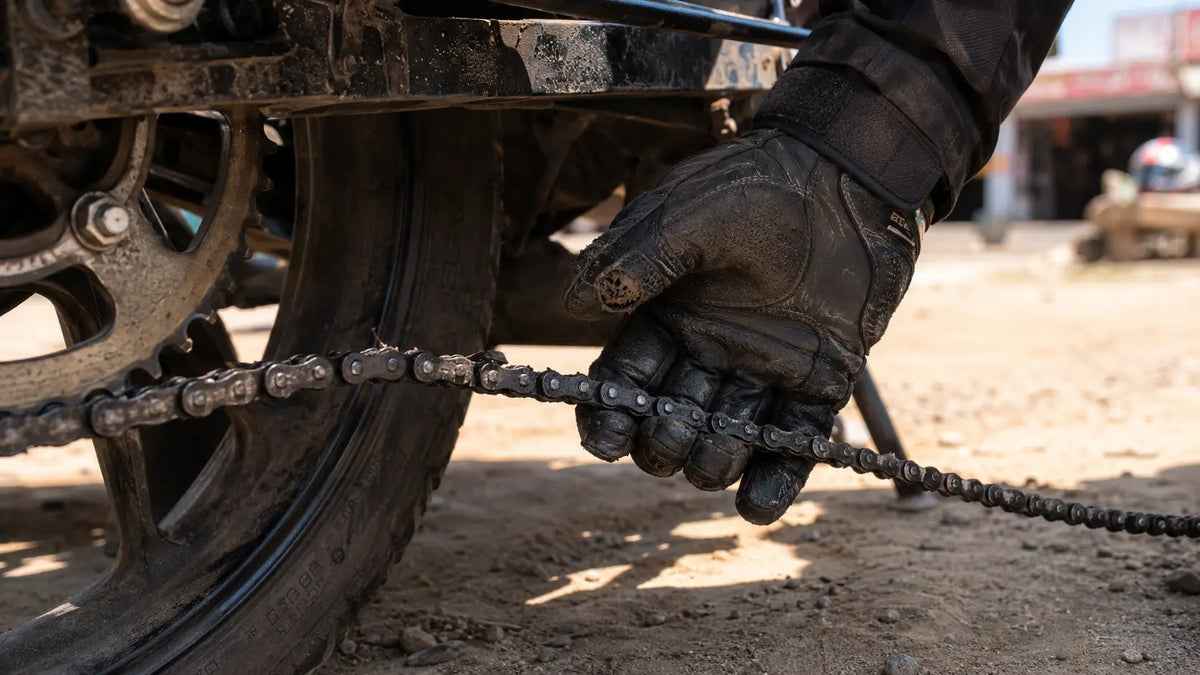
Somewhere past Rohtang, your chain decides if you finish the tour.
Most riders get the oil changed and the tyres checked before a long tour. The chain gets a quick glance, maybe a squirt of WD-40, and that's it. Right up until it starts screeching on day three or, worse, jumps a sprocket somewhere with no phone signal. A dry, worn chain doesn't just wear out quietly. It runs hotter, drags harder on your fuel, and fails exactly when you're farthest from a mechanic.
This guide covers exactly how often to lubricate your chain on tour, what a proper pre-ride check looks like, what to carry for roadside fixes, and the personal prep routine that keeps you riding too. A tour breaks down your body just as fast as it breaks down your bike.
Rider Takeaways
- A lubricated chain runs up to 42% cooler and transmits power roughly 5% more efficiently than a dry one, per bench testing published in Industrial Lubrication and Tribology (Palazzetti & Yan, 2015).
- Lubricate and check slack every 500 km on tour: more often in monsoon or off-road stretches, less often on a clean daily commute.
- Carry a compact chain kit: lube, a rag, a slack gauge (or your fingers), and a spare master link on multi-day rides.
- Your body needs the same discipline as your bike. Hydration, skin, and helmet hygiene routines prevent the fatigue that causes riding mistakes.
Why a Neglected Chain Ends Tours Early
In 2015, researchers at the University of Strathclyde ran motorcycle chains under controlled lab conditions and found that an unlubricated chain reached up to 40.85°C at test speed, compared to 24.65°C for a continuously oiled one. Heat like that accelerates wear, stretches the chain, and eats into fuel efficiency before you even notice a problem.
A chain doesn't fail on day one. It fails on day four, after 1,200 km of dust, heat, and zero attention, usually somewhere between fuel stops, not in your garage.
Heat, vibration, and elongation all compound on each other. The same study recorded vibration levels roughly 50% higher in unlubricated chains, which means more stress on the sprockets and swingarm with every kilometre. That's not a comfort problem. That's a component-failure problem, and it shows up fastest on the exact terrain Indian tourers actually ride: dusty highways, high-altitude passes, monsoon slush.
A snapped chain rarely happens on a straight, empty highway. It happens mid-corner, or climbing a switchback, when the sudden loss of drive catches the rear wheel off guard. Best case, you're pushing the bike to the nearest village. Worst case, a stretched chain jumps the sprocket and locks the rear wheel while you're leaned over. Neither scenario is one you want to test on a mountain pass.
Quick Fact:
A 2015 University of Strathclyde bench study found that lubricated motorcycle chains ran up to 42% cooler and showed roughly 50% lower vibration than unlubricated ones, directly reducing wear and elongation. Source: Palazzetti & Yan, Industrial Lubrication and Tribology, 2015.
A 2015 University of Strathclyde bench study found that lubricated motorcycle chains ran up to 42% cooler and showed roughly 50% lower vibration than unlubricated ones, directly reducing wear and elongation. Source: Palazzetti & Yan, Industrial Lubrication and Tribology, 2015.

How Often Should You Lubricate a Motorcycle Chain on Tour?
In 2026, touring gear brand GrandPitstop recommended cleaning and lubricating your chain every 500–700 km on long tours, tighter than the 1,000+ km interval most brands quote for daily city riding. Dust, heat, and river crossings on tour routes strip lubricant far faster than a paved commute does.
The honest interval depends on what you're riding through. A dry highway stretch in Rajasthan is forgiving. A monsoon crossing in the Northeast, or the dust storms past Sarchu, will strip a chain in under 300 km.
Grease-based lubricants cling longer than spray lube on long tours, and wax-based options hold up better in wet weather. Whatever you carry, the rule is simple: lubricate after every wash, after every rain crossing, and at least every 500 km in between.
Quick Fact:
For long-distance touring, cleaning and lubricating the chain every 500–700 km is the widely recommended interval, tighter than the 1,000+ km general-use guideline. Source: GrandPitstop, 2026.
For long-distance touring, cleaning and lubricating the chain every 500–700 km is the widely recommended interval, tighter than the 1,000+ km general-use guideline. Source: GrandPitstop, 2026.
The Pre-Tour Chain Check: Slack, Wear, and Sprocket Alignment
Before anything else, get the bike on its side stand and roll the wheel by hand. In 2026, touring gear guides consistently recommend around half an inch of vertical play in the middle of the lower chain run: not slack, not bar-tight. Too tight, and every bump hammers the gearbox bearings. Too loose, and the chain can jump teeth under load.
Check three things in sequence: slack, straight-line wear, and sprocket teeth shape. Pull the chain away from the rear sprocket at its most worn point. If you can see daylight behind more than half a tooth, the chain has stretched past a safe margin and needs replacing before you leave, not after you break down.
Sprocket teeth tell their own story. Healthy teeth look roughly triangular. Worn ones curve into a hooked, shark-fin shape, a sign the chain and sprocket have been running loose or dry for a while. Replace them as a set; a new chain on worn sprockets wears out in a fraction of its expected life.
Unique Insight
Our finding: Most riders check chain slack once, before leaving home, and never again until something feels wrong. On a multi-day tour, that's one check covering 2,000 km of dust, heat, and river crossings. The fix isn't a better initial check. It's tying the chain check to something you already do at every fuel stop, so it happens without needing to remember it.
What to Carry for Roadside Chain Maintenance
In 2026, ViaTerra Gear's Leh-Ladakh preparation guide told riders to check chain condition at every single stop, not just at fuel stations, alongside tyre pressure and hydration. That only works if the kit is already in your tank bag: chain lube in a travel-size can, a rag, a small brush, and a spare master link with clip.
On multi-week tours through the Northeast or Ladakh, add a small tube of grease. It survives heat and dust better than spray lube once you're three days from the nearest bike shop.
Apply lube to the inside of the chain, where it meets the sprockets, not the outer face. That's where the rollers and pins actually need it. Spray, wait a few minutes for it to penetrate, then wipe off the excess. Excess lube just collects road grit and turns into a grinding paste.
Long-ride guides agree on one rule for every stop: check tyre pressure, check the chain, and drink water, in that order, every single time you get off the bike. It takes ninety seconds and it's the difference between catching a problem at a dhaba and catching it on a mountain pass with no signal.
Quick Fact:
Touring guides for Himalayan routes recommend capping daily distance at 200–300 km and checking tyre pressure, chain condition, and hydration at every stop, not just at fuel stations. Source: ViaTerra Gear, Leh-Ladakh Trip Preparation Guide, 2026.
Touring guides for Himalayan routes recommend capping daily distance at 200–300 km and checking tyre pressure, chain condition, and hydration at every stop, not just at fuel stations. Source: ViaTerra Gear, Leh-Ladakh Trip Preparation Guide, 2026.
Your Body Needs the Same Routine as Your Bike
In 2025, road safety data compiled across India recorded over 1.6 lakh road deaths, with two-wheelers involved in roughly 45% of them, up from about 30% a decade earlier. Speeding gets most of the blame, but fatigue plays its own quiet role. A tired rider makes the same overconfident calls a worn chain makes on a bad road.
On touring days past 300 km, heat and poor ventilation under riding gear push sweat and dehydration to levels that blur judgment before you'd call it exhaustion. Your chain gets checked at every stop. Your hydration usually doesn't, until a headache forces the issue somewhere past lunch.
Helmet hygiene sits in the same blind spot. A helmet worn eight hours a day on tour traps sweat, heat, and road dust against your scalp. The same combination that turns a chain gritty turns a helmet liner into a breeding ground for the bacteria that actually cause that end-of-day smell. Airing it out at a dhaba doesn't touch the bacteria; it just dries the surface. Bhai, you wouldn't skip lubing a chain for a week on tour. The helmet interior deserves the same five seconds of attention.
That's the gap Hygena's bacteriostatic spray closes. A few sprays into the liner after a long riding day keeps bacteria from multiplying overnight, so the helmet you put back on at 6 a.m. doesn't smell like the one you took off at sunset. It's a five-second habit sitting right next to your chain lube in the tank bag.
Skin needs the same attention as scalp and chain. Long riding days mean hours of direct sun on the wrists, neck, and any gap between gloves and jacket cuffs. A high-SPF sunscreen reapplied at fuel stops does more for a multi-day tour than any amount of moisturizer applied once in the morning.
Quick Fact:
Two-wheelers were involved in roughly 45% of India's road fatalities in 2025, up from about 30% in 2014, with fatigue and reduced alertness cited alongside speeding as contributing factors. Source: Data For India, Road Accident Deaths, 2025.
Two-wheelers were involved in roughly 45% of India's road fatalities in 2025, up from about 30% in 2014, with fatigue and reduced alertness cited alongside speeding as contributing factors. Source: Data For India, Road Accident Deaths, 2025.

Make this easier: Hygena takes five seconds, right after you wipe down the chain.
Building a Bike-and-Body Touring Checklist
In 2026, Himalayan touring guides recommended capping daily distance at 200–300 km, largely so riders have time to stop, check the bike, and look after themselves before fatigue sets in. The riders who finish long tours without drama tend to run one habit: they pair a bike check with a body check at every single stop, so neither gets forgotten. Chain slack and hydration. Tyre pressure and helmet interior. Sprocket wear and sunscreen. Nothing here takes more than a few minutes combined.
A simple version for every fuel stop: check chain slack and wipe it down if dusty, check tyre pressure, drink water, and, if it's been a full riding day, spray the helmet liner before you close the visor for the last time. None of these individually feels urgent. Skipped together for four days straight, they're exactly how tours end early.
Unique Insight
Our finding: Riders who treat maintenance as one combined routine, bike and body together, report skipping it far less often than riders who treat them as separate tasks. Bundling the habit removes the decision fatigue of remembering two unrelated checklists on a long day.
Frequently Asked Questions
How often should I lubricate my motorcycle chain on a long tour?
Every 500–700 km on tour, and after any rain or river crossing. Dust and heat strip lubricant faster on tour routes than on a daily commute, per touring guidance from GrandPitstop, 2026.
How much chain slack is normal?
Around half an inch (roughly 20–30 mm) of vertical play at the tightest point of the lower run is the commonly cited range for most motorcycles. Check your owner's manual for the exact figure for your bike.
Can a dry chain actually cause a breakdown?
Yes. Bench testing found unlubricated chains ran up to 42% hotter and vibrated roughly 50% more than lubricated ones, accelerating wear, elongation, and eventual failure. Source: Palazzetti & Yan, 2015.
Does helmet hygiene actually matter on a long tour?
Yes. A helmet worn for hours daily traps sweat and heat that feed odor-causing bacteria in the liner. Airing it out dries the surface but doesn't address the bacteria underneath, which is why the smell returns by the next riding day.
Can I use regular engine oil to lubricate a motorcycle chain?
It works in an emergency but isn't ideal. Engine oil is thinner than dedicated chain lube, so it flings off under speed and attracts more dust and grit. Carry proper chain lube; use engine oil only if you're stuck with nothing else.
Conclusion
A tour doesn't end because of one big failure. It ends because small things pile up over several days: a dry chain, a skipped water break, a helmet nobody thought about, until one of them wins.
Check the chain every 500 km. Carry lube and a spare master link. Drink water before you're thirsty. And spray the helmet liner the same way you lube the chain: automatically, at every stop, before it becomes a problem you can smell from across the room. Hygena handles the last one in five seconds.
Sources
1. Palazzetti, R. & Yan, X., "Study on lubrication effect on motorbike chain transmissions," Industrial Lubrication and Tribology / University of Strathclyde, 2015. Retrieved 2026-07-10.
2. GrandPitstop, "Motorcycle Chain Maintenance for Long Tours: Quick Guide," 2026. Retrieved 2026-07-10.
3. Scottoiler, "Understanding Motorcycle Chain Wear, Maintenance and Lubrication," 2025. Retrieved 2026-07-10.
4. ViaTerra Gear, "Leh-Ladakh Motorcycle Trip Preparation Guide," 2026. Retrieved 2026-07-10.
5. Data For India, "Road Accident Deaths," 2025. Retrieved 2026-07-10.
6. Tru-Tension USA, "How Often Should You Lubricate a Motorcycle Chain?" Retrieved 2026-07-10.
Share:
Helmet Cleaner Siliguri: Your Helmet Never Dries Here
Puncture Repair on the Road: What Every Rider Must Know