
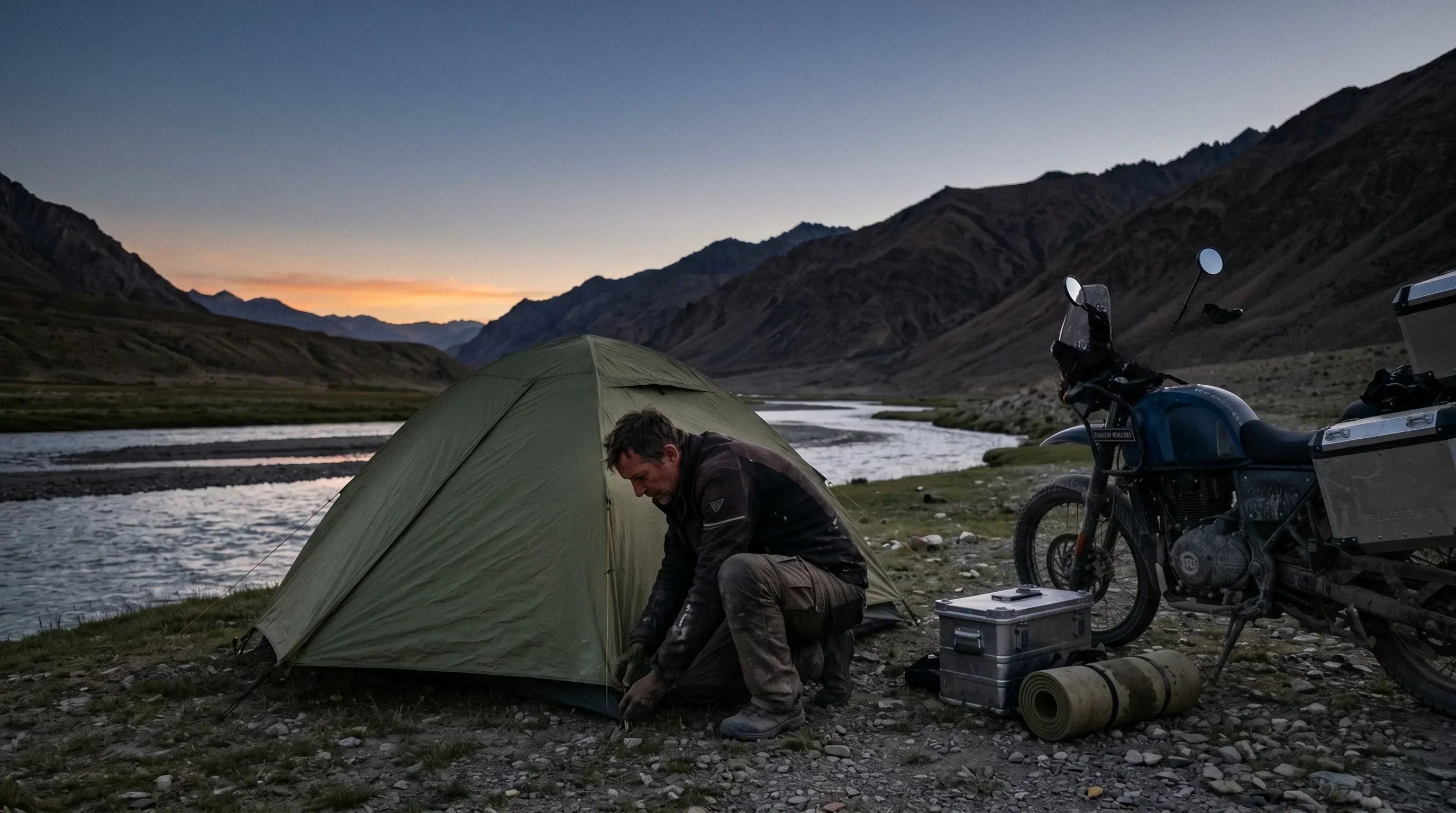
You've ridden 300 km, pitched your first tent beside a stream, and the sun's gone behind the ridge. Then it hits you: there's no tap, no toilet, no shower. Just you, your bike, and a long night.
Welcome to motorcycle camping. It's the best way to see India on two wheels. But the part nobody preps you for isn't the riding or the tent. It's staying clean when there's nothing around.
This motorcycle camping India guide is built around that gap. We'll cover the campsite hygiene essentials that keep a beginner healthy, comfortable, and out of trouble on the road.

Rider Takeaways
- The biggest camping risk isn't the cold. It's water and hands. On most days, an untreated wild water source has an 80–90% chance of carrying parasites.
- Washing hands with soap cuts diarrhoea risk by about 30%, per a CDC review. It's the cheapest gear you'll pack.
- Your bike limits luggage, so pack a compact hygiene kit and keep your helmet and gear bacteria-free between rides.
What Makes Campsite Hygiene Different on a Motorcycle Trip?
A motorcycle gives you freedom and a luggage problem. You can't carry a car boot of supplies. So every hygiene item has to earn its space, and you'll often camp far from any tap.
That combination is why riders get sick on tour. Backpackers can over-pack. You can't. The India camping equipment market hit USD 892 million in 2024, yet most beginner kits skip hygiene basics entirely.
Then there's the climate. You sweat hard in summer, freeze at altitude, and ride through dust all day. Sweat and grime build up on your skin, your gear, and the inside of your helmet.
Quick Fact:
India's camping equipment market reached USD 892 million in 2024 and is projected to hit USD 2,027 million by 2030, growing at roughly 14.66% a year. More first-time riders are camping than ever, but hygiene gear rarely makes it onto beginner packing lists. Source: MarkNtel Advisors.
India's camping equipment market reached USD 892 million in 2024 and is projected to hit USD 2,027 million by 2030, growing at roughly 14.66% a year. More first-time riders are camping than ever, but hygiene gear rarely makes it onto beginner packing lists. Source: MarkNtel Advisors.
So campsite hygiene on a bike is about doing more with less. A few small, smart items replace a bathroom. Get them right and your trip stays fun, not feverish.
Is the Water Safe to Drink at an Indian Campsite?
Usually not, and this is the one that ends trips. Backcountry researchers estimate the chance of a protozoan being present in untreated wild water sits at 80–90% on most days, in most places. That clear mountain stream isn't clean.
The numbers back it up. A study of backpackers on California's John Muir Trail found 16% got diarrhoea on the trip. On the Appalachian Trail, an older study saw a brutal 56% report it. Bad water is the usual culprit.
In India, add cattle, farms, and villages upstream. Even high-altitude streams in Spiti or Ladakh can carry Giardia. Treat every drop you didn't boil or filter yourself.
So how do you make water safe? Boiling is the surest method. The CDC says a rolling boil for one minute kills bacteria, viruses, and parasites. At altitude above 2,000 metres, give it three minutes.
No stove handy? Carry a pocket filter rated for protozoa and bacteria, or purification tablets as backup. A 25-gram filter weighs nothing and saves your whole trip.
Unique Insight
Our finding: Most beginners obsess over the tent and forget the water plan. But a ruined stomach ends more first tours than rain or cold ever will. Your filter is the most important thing in your panniers.
How Do You Stay Clean Without a Bathroom?
You build a routine that doesn't need running water. Start with your hands, because that's where most illness begins. Washing with soap cuts diarrhoea risk by about 30%, according to a CDC review of the research.
Carry a small soap bar and a collapsible bottle. Wash before you cook, before you eat, and after any toilet trip. When water's scarce, a 60% alcohol sanitiser bridges the gap.
For your body, biodegradable wet wipes are a rider's best friend. A quick wipe-down at night clears sweat, salt, and dust. Focus on the face, underarms, feet, and anywhere your gear rubs.
Quick Fact:
A 2018 CDC review found that teaching people to wash hands with soap and water reduced diarrhoea by about 30%, protecting roughly one in three young children who fall ill. On a campsite with no toilet, hand hygiene is your single highest-impact habit. Source: CDC, Handwashing Facts.
A 2018 CDC review found that teaching people to wash hands with soap and water reduced diarrhoea by about 30%, protecting roughly one in three young children who fall ill. On a campsite with no toilet, hand hygiene is your single highest-impact habit. Source: CDC, Handwashing Facts.
Dig a cat-hole for waste at least 15 to 20 metres from any water and 15 cm deep. Pack out your wipes and toilet paper in a zip bag. India's trails are getting crowded, so leave nothing behind.
Subah, before you ride, brush your teeth with treated water and air out your sleeping bag. Small habits keep you feeling human on day five.

What Hygiene Gear Should a Beginner Pack?
Keep it small and specific. Your hygiene kit should fit in one corner of a pannier and cover water, hands, body, and gear. Here's the beginner list that earns its space.
Start with a pocket water filter and purification tablets. Add a soap bar, a 60% alcohol sanitiser, and a pack of biodegradable wipes. Throw in a quick-dry microfibre towel and a small toothbrush kit.
Then the part most riders forget: gear hygiene. A bacteriostatic helmet spray, a spare moisture-wicking base layer, and foot powder keep the things touching your skin from turning rancid.
Skip the heavy stuff. No big shampoo bottles, no aerosols that explode at altitude, no glass. Decant into 50 ml travel bottles and you'll free up half a pannier.
Why Do Your Helmet and Gear Need Hygiene Attention at Camp?
Because your helmet is the dirtiest thing you own, and camping makes it worse. In 2020, a study of 130 helmets found 392 bacterial isolates, with Staphylococcus aureus the most common at 22.7%. That liner sits against your sweaty scalp all day.
On a camping trip, you can't wash and dry a liner properly. You ride, you sweat, you stuff the helmet in a tent, and the damp padding becomes a bacteria farm overnight. By morning it's wet and it stinks.
Same story with gloves, boots, and base layers. Trapped sweat plus no laundry equals odour and skin trouble. Your gear needs a hygiene habit, not just your body.
That's where Hygena fits a camping kit. A few sprays inside the liner inhibits the bacteria that build up between washes, so tomorrow's helmet feels fresh instead of foul. It takes five seconds at the tent and weighs almost nothing in a pannier.

Air the helmet out each night with the padding facing up. Treat the interior daily, not just at home. Think of it like brushing teeth: small, daily, non-negotiable on a long ride.
Frequently Asked Questions
How do I drink water safely while camping in India?
Boil it or filter it, every time. The CDC says a one-minute rolling boil kills bacteria, viruses, and parasites; make it three minutes above 2,000 metres. Untreated wild water carries parasites on 80–90% of days. Source: CDC and backcountry water studies, 2019–2023.
What hygiene items are must-haves for moto camping?
A pocket water filter, soap, a 60% alcohol sanitiser, biodegradable wipes, a microfibre towel, and a helmet spray. Hand-washing with soap alone cuts diarrhoea risk by about 30%, so it's the highest-value item you'll pack. Source: CDC Handwashing Facts, 2018.
How do I keep my helmet fresh on a multi-day trip?
Air the padding out nightly and treat the interior with a bacteriostatic spray daily. A 2020 study found Staphylococcus aureus on 22.7% of helmet samples, and damp camping conditions speed that growth. Don't wait until you're home. Source: Sapkota et al., 2020.
Is motorcycle camping safe for a complete beginner?
Yes, if you plan water and hygiene first. Most ruined first trips come from a bad stomach, not bad riding. Start with one or two nights near a known campsite, carry the basics, and build up. Source: rider field guidance, 2026.
Conclusion
Motorcycle camping in India isn't hard. It just rewards riders who plan the boring stuff: clean water, clean hands, and gear that doesn't turn against you.
Get the hygiene essentials right and everything else is just a good ride. Treat your water, wash your hands, and keep the inside of your helmet bacteria-free. A few sprays of Hygena means tomorrow's helmet feels fresh, even five days into the pahaadon. Pack smart, ride far, stay healthy.
Sources
1. "India Camping Equipment Market Size, Share & Growth 2030," MarkNtel Advisors, 2024. Retrieved 2026-06-16.
2. "Do Hikers Actually Need to Filter Their Water?," Backpacker, 2023. Retrieved 2026-06-16.
3. "Handwashing Facts," Centers for Disease Control and Prevention, 2018. Retrieved 2026-06-16.
4. "Preventing Illness while Camping, Hiking, and Traveling," Minnesota Department of Health, 2023. Retrieved 2026-06-16.
5. "Microbial Diversity and Antibiotic Susceptibility Pattern of Bacteria Associated with Motorcycle Helmets," Sapkota et al., International Journal of Microbiology, 2020. Retrieved 2026-06-16.
Share:
Best Earplugs for Motorcycle Riders (That Stay Hygienic)
Night Riding on Indian Highways: Tips Every Rider Needs