
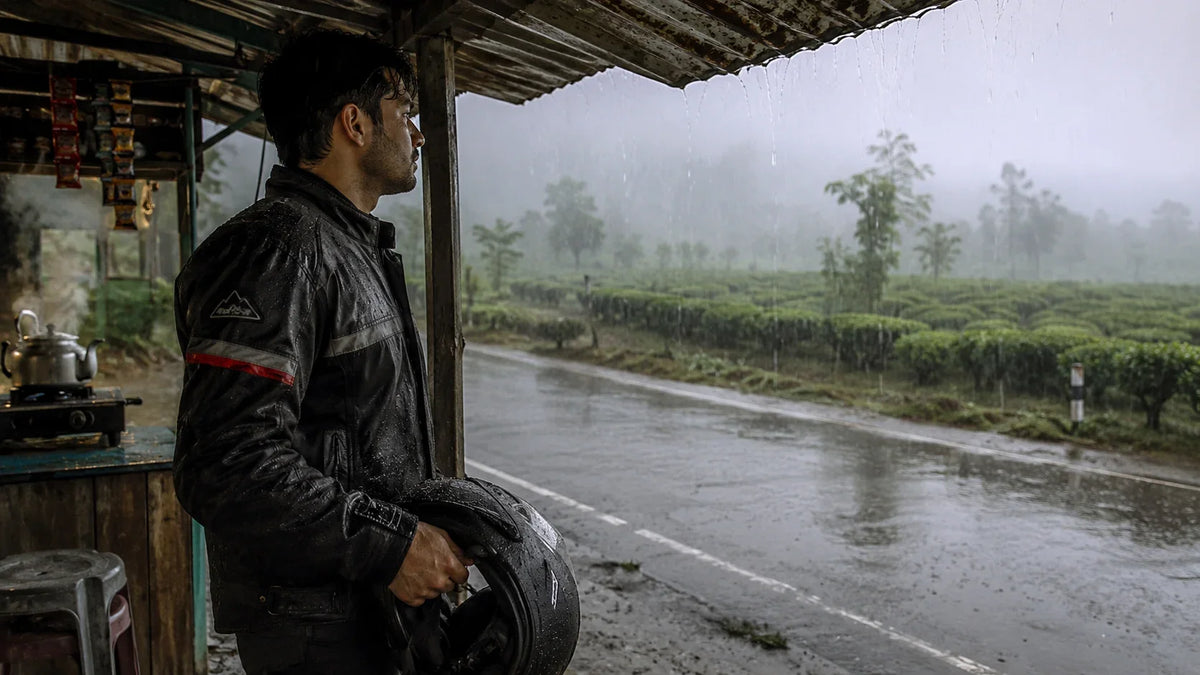
You park under a tea-stall tin roof on Sevoke Road, rain hammering down, and pull your helmet off. The padding is already damp. Not from the ride. From the air.
That's normal here. Siliguri sits at the base of the Himalayan foothills. Its air holds more moisture than almost anywhere else you'll ride in India. A "helmet cleaner" wipes off the mud spray from the road. It does nothing about what that moisture is doing to the padding underneath.
Here's what actually shapes a Siliguri rider's helmet problem, and what closes the gap a cleaner leaves open.
Rider Takeaways
- Siliguri's relative humidity runs 74% to 94% year-round, averaging 84%, per Weather and Climate's monthly data.
- Even December, the driest month, still clears 62% humidity, the level researchers found ideal for bacterial biofilm on fabric.
- Over 3,000mm of rain falls here a year, 80% of it packed into June through September, per Wikipedia.
- A cleaner lifts road mud off the shell. It doesn't stop bacteria multiplying in padding that never fully dries.
Why Do Siliguri Riders Deal With Two Climates in One Weekend?
Siliguri isn't just a city you commute through. It's the launch point for the hills. NH110, the old Hill Cart Road, runs 77km up to Darjeeling. Bagdogra Airport nearby handled 3.2 million passengers in 2019-20, per Wikipedia's most recent figure. It flies riders and tourists in from across India, plus Paro and Bangkok. Most of them rent a bike locally and head uphill.
Local operators like Darjeeling Riders and group-ride outfits running weekend loops through the tea estates see this pattern constantly. A rider spends Saturday sweating through Siliguri's valley humidity. By evening they've climbed into Darjeeling's cool hill air, then dropped back into the heat by Sunday. That's a genuine mixed load on gear that flat-terrain cities simply don't put a helmet through.
The city itself carries that gateway identity in its people too. The 2011 census put Bengali speakers at 60.88%, Hindi at 25.24%, and Nepali at 4.66%. Bhojpuri, Marwari, and Urdu speakers round out the mix. The city's population also reaches into Bihari, Punjabi, and tribal communities. Siliguri sits within reach of three international borders: Nepal, Bangladesh, and Bhutan.
Unique Insight
Our finding: a Siliguri rider's helmet doesn't just fight one city's humidity. It swings between valley monsoon and hill-station cold within the same weekend. Most single-climate cities in this series never put a helmet through that.
What Does Siliguri's Traffic Add to Your Helmet-On Hours?
Sevoke Road, Hill Cart Road, and the City Centre stretch all see the same thing at peak hours: unexpected bottlenecks. Parking spills into the road itself near Bidhan Market and Hong Kong Market.
Part of the squeeze comes from Siliguri's toto fleet. In March 2025, the state transport minister confirmed 4,000 registered e-rickshaws running on police-issued QR codes and fixed routes. Roughly 7,000 unauthorised totos are now barred from major roads like Sevoke Road and Hill Cart Road. Darjeeling More has become a separate choking point of its own. It's bad enough that traffic police started running drone footage there every two hours to track it.
Every extra minute stuck behind a toto queue near Sevoke Road adds trapped heat and moisture against your scalp. And you're not even moving yet.
Does Siliguri's Humidity Push Bacteria Past the Growth Threshold?
A 2024 study in International Microbiology tested how bacteria form biofilm on fabric under different conditions. Pseudomonas aeruginosa and Staphylococcus aureus, both common odor-causing strains, turned out to be strong biofilm producers. Growth peaked around 30°C and 62% relative humidity.
Siliguri's driest month still averages 74% humidity. Every single month here clears that 62% mark, some by a wide margin. The study also found rougher fabric surfaces held more bacterial load than smooth ones. That matters for a foam liner, which carries far more surface texture than bare skin.
Unique Insight
Our finding: most cities in this series only clear that 62% biofilm threshold during their wettest months. Siliguri clears it in its driest month too. There's no seasonal break where the padding gets a real chance to reset.
Why Doesn't Your Helmet Ever Fully Dry in Siliguri?
Most Indian cities get a dry season your helmet padding can actually use. Siliguri barely gets one. Relative humidity here runs from 74% in December, the driest month, up to 94% in July. The annual average sits at 84%.
Sitting at the foot of the Himalayas does that. Moist air rolling off the hills meets the Terai plain and stays put. Even a helmet left open on a shelf overnight rarely drops back to bone dry before the next ride.
Quick Fact:
Siliguri's humidity swings from 74% in December to 94% in July, an annual average of 84%. Source: Weather and Climate.
Siliguri's humidity swings from 74% in December to 94% in July, an annual average of 84%. Source: Weather and Climate.
How Much of the Year Is Actually Monsoon Here?
Siliguri gets over 3,000mm of rain a year. Roughly 80% of it falls in a single four-month stretch: June through September. July alone brings around 804mm. January, the driest month, gets about 12mm.
That's not a few wet weeks. It's four straight months. Leave a helmet on the bike seat even briefly and it comes back wetter than it went out. Some datasets put the annual figure closer to 3,091mm. Every source agrees on the same shape: a short, brutal monsoon carrying most of the year's water.
Is a Helmet Cleaner Spray the Same as a Hygiene Spray?
No, and in a city this wet, that mix-up costs you. A cleaner is built to lift dirt and the faint mildew smell monsoon dampness leaves behind. It doesn't claim to touch what's growing in the foam once that smell shows up again a day later.
Hygena isn't a cleaner. It's a bacteriostatic hygiene spray. It stops odor-causing bacteria from multiplying instead of just masking the damp smell for an afternoon.
| What you need | A cleaning spray | Hygena hygiene spray |
|---|---|---|
| Removes visible mud and road spray | Yes | Partial, not its main job |
| Stops bacteria from multiplying | No | Yes, bacteriostatic action |
| Safe on damp foam padding daily | Varies by formula | Yes, dermatologically tested |
| Addresses the odor source | Masks it temporarily | Yes, targets bacteria directly |

What Actually Fixes This for a Siliguri Rider
You can't dry out the Terai's air or shorten the monsoon. What you can control is what happens to your helmet the moment you're off the bike.
Two steps, about two minutes, right after you park:
- Wipe the shell and visor to clear mud spray and surface moisture from the ride.
- Spray Hygena's bacteriostatic formula into the padding so bacteria can't build on the moisture your helmet never fully sheds. It's built to hold up through a Siliguri monsoon, and through a weekend swing up to Darjeeling and back.

Frequently Asked Questions
Does Siliguri's humidity actually make helmet smell worse than other cities?
Yes. Siliguri's humidity runs 74% to 94% all year. That stays above the 62% mark researchers link to peak bacterial biofilm on fabric, every single month, not just monsoon.
How often should I spray my helmet if I ride into Darjeeling on weekends?
Spray after the ride up and again after the ride back down. The valley-to-hill-station swing exposes padding to two different moisture loads in one weekend. Treat each leg as its own ride.
Is a helmet cleaner spray the same as a hygiene spray?
No. A cleaner removes visible dirt and the surface mildew smell. A hygiene spray like Hygena is bacteriostatic, stopping odor-causing bacteria from multiplying in the padding itself.
Can I use Hygena on a rental helmet from a Siliguri bike-rental shop?
Yes, and rental helmets need it more than your own. A rental sees dozens of riders' sweat before you ever put it on. That's exactly the setup bacteria multiply fastest in.
Where can I buy helmet deodorant spray in Siliguri?
Hygena ships pan-India, including Siliguri and the wider Darjeeling district, through hygena.in.
Conclusion
Siliguri's helmet problem isn't dust or heat the way it is in other cities. It's moisture that never really leaves. Humidity stays above 74% every month of the year. The monsoon dumps 80% of the annual rain in sixteen weeks. Weekend rides swing your helmet between a soaked valley and a cold hillside.
A cleaner handles the mud. It won't touch the bacteria that all that moisture keeps feeding. Spray Hygena into your padding after every ride, especially before and after a hill run. You're treating the actual problem instead of just wiping the surface. Grab a bottle and make it as routine as checking your tyre pressure before a Darjeeling weekend.
Sources
1. "Siliguri," Wikipedia. Retrieved 2026-08-25.
2. "Siliguri Humidity by Month," Weather and Climate. Retrieved 2026-08-25.
3. "Siliguri Rainfall by Month," Weather and Climate. Retrieved 2026-08-25.
4. Dixit, N. et al., "Factors affecting biofilm formation by bacteria on fabrics," International Microbiology, 27(4):1111-1123, August 2024. Retrieved 2026-08-25.
5. "State Initiated Slew of Measures to Ease Traffic in Siliguri, Informs Min," Millennium Post, March 14, 2025. Retrieved 2026-08-25.
6. "Siliguri Traffic Police Deploys Drones to Track Traffic Bottlenecks and Violations," Millennium Post, January 22, 2026. Retrieved 2026-08-25.
7. "Why 2-Wheeler Is Best for City Riding in Siliguri," Bike Wale Bhaiya. Retrieved 2026-08-25.
8. "Bagdogra Airport," Wikipedia. Retrieved 2026-08-25.
9. "Unseen Darjeeling on 2 Wheels," Bike Wale Bhaiya. Retrieved 2026-08-25.
Share:
Motorcycle Breakdown in a Remote Area: What to Pack
Motorcycle Chain Maintenance for Touring: What Riders Skip