
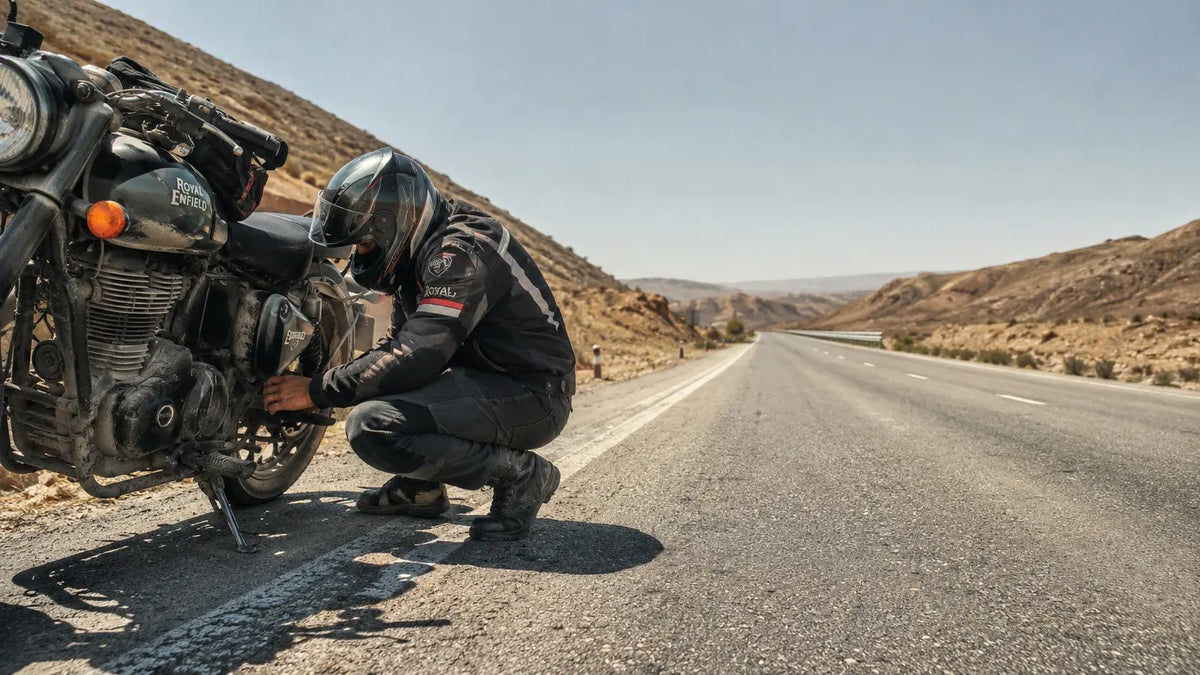
Your engine cuts out 40 km from the nearest town. No signal bars, no shade, nobody in sight.
A motorcycle breakdown in a remote area is never just a mechanical problem. It's a wait you didn't plan for, in heat you can't control. Your helmet's been baking on the seat since the engine died.
This piece covers what to do in the first ten minutes. It also covers what belongs in your roadside kit, and why hygiene deserves a spot next to your tool roll. Here's what actually works when the map runs out.
Rider Takeaways
- Two-wheelers made up 45% of India's road deaths in 2024, up from 30% in 2014 (IIT Delhi, 2024).
- Get off the road and stay visible before you touch a single tool.
- Heat and dehydration set in faster than most riders expect during a long wait.
- A real roadside kit carries hygiene items too, not just tools.
Why a Motorcycle Breakdown in a Remote Area Gets Dangerous Fast
In 2024, two-wheelers accounted for 45% of all road deaths in India. That's according to the India Status Report on Road Safety 2024, from IIT Delhi's TRIPP centre. That number was 30% in 2014. A breakdown on a quiet stretch turns a mechanical problem into an exposure problem.
National highways make up just 2.1% of India's total road network. They still accounted for nearly 30% of all road accidents in 2024. Highways are exactly where riders tend to break down, far from a town, a mechanic, or a phone signal.
Think Ladakh, Spiti, or the long haul through Rajasthan's back roads. These are the rides riders dream about, and exactly where a breakdown means real isolation.
Bhai, this isn't about panic. It's about knowing the odds before you're stuck on the shoulder wondering how long the wait will be.
Quick Fact:
India's national highways carry just 2.1% of the country's road network. They still accounted for nearly 30% of all road accidents in 2024. These same highways are where most long-distance riders break down, often outside network coverage. Source: India Status Report on Road Safety 2024
India's national highways carry just 2.1% of the country's road network. They still accounted for nearly 30% of all road accidents in 2024. These same highways are where most long-distance riders break down, often outside network coverage. Source: India Status Report on Road Safety 2024
What to Do in the First Ten Minutes After a Breakdown
Pull off the road first, before you touch a single tool. Get the bike onto the shoulder, away from the traffic line, and put your hazard lights on if they work.
Next, make yourself visible. A reflective vest or jacket strip takes seconds and matters more than you'd think on a blind curve. Then check your phone.
In January 2026, the National Highways Authority of India flagged mobile network gaps at 424 highway locations. It asked telecom regulators to fix them, citing emergency response concerns. Don't assume you'll have signal. Note your last known location, mentally or on paper, before you lose the network.
Download offline maps before you ride into low-coverage stretches. A saved pin of your last confirmed location helps rescuers or fellow riders find you faster, even without live signal.
Quick Fact:
In January 2026, NHAI identified mobile network gaps at 424 locations across India's national highways. It urged telecom regulators to close them for public safety. Don't count on a signal the moment you need one most. Source: Medianama, NHAI Highway Coverage Report
In January 2026, NHAI identified mobile network gaps at 424 locations across India's national highways. It urged telecom regulators to close them for public safety. Don't count on a signal the moment you need one most. Source: Medianama, NHAI Highway Coverage Report

Why Waiting for Help Is Harder on Your Body Than You Think
Sweat rates can reach up to a litre an hour in heat. That's according to the CDC's 2026 Yellow Book on travel health. Standing beside a dead bike on an unshaded highway is exactly that kind of heat.
Dehydration is the biggest driver of heat exhaustion. It raises your heart rate and body temperature before you even notice you're thirsty. And your helmet isn't helping.
In 2018, a study in Scientific Reports found something worth knowing. Bacteria multiply fastest in the warmest, most humid zones of an enclosed space worn against skin. A helmet sitting on a hot seat, still holding your sweat from the ride, is that environment exactly.
Quick Fact:
A 2018 study in Scientific Reports looked at bacteria in enclosed spaces worn against skin. Colonies grew fastest in the warmest, most humid pockets. Think an N95 respirator, or a helmet liner after a long ride. Source: Scientific Reports, 2018
A 2018 study in Scientific Reports looked at bacteria in enclosed spaces worn against skin. Colonies grew fastest in the warmest, most humid pockets. Think an N95 respirator, or a helmet liner after a long ride. Source: Scientific Reports, 2018
Unique Insight
Our finding: The wait after a breakdown does something odd to your helmet. It's the same wear a full day of riding causes, just standing still. Heat, sweat, and zero airflow, all happening while the helmet sits on your seat or in your lap.
What Belongs in a Motorcycle Breakdown Kit for Remote Rides
Most roadside kit guides focus entirely on tools. Wrenches, tyre levers, a puncture kit, spare fuses. All necessary. None of them help you survive the wait once the repair is out of your hands.
A kit built for remote breakdowns needs four categories. Repair tools, safety and visibility gear, hydration and hygiene items, and basic first aid. Skip the last two, and you're prepared for the bike but not for yourself.
Hydration and hygiene means water, electrolyte sachets, a small towel, wet wipes, and something for your helmet. Sweat and bacteria don't pause because you're stuck on the shoulder waiting for a mechanic.
This is where a helmet spray earns its place next to your tool roll. Hygena's bacteriostatic formula keeps bacteria from multiplying inside your liner while you wait. That way, you're not putting a hot, sweaty helmet back on once help arrives.
Quick Fact:
Hygena is dermatologically tested and used by over 10,000 riders across India, rated 4.8 out of 5. It's built to fit in a jacket pocket or tank bag. That matters when every gram of your kit has to earn its place. Source: Hygena internal testing and customer data, 2026.
Hygena is dermatologically tested and used by over 10,000 riders across India, rated 4.8 out of 5. It's built to fit in a jacket pocket or tank bag. That matters when every gram of your kit has to earn its place. Source: Hygena internal testing and customer data, 2026.
How to Stay Safe and Comfortable Until Help Arrives
Move to shade if there's any within sight, even if that means walking the bike a short distance. Direct sun raises your core temperature faster than most riders realize.
Sip water regularly instead of gulping it once you're already thirsty. Thirst shows up after dehydration has already started, not before.
Flag down passing vehicles for help or a signal, especially trucks and buses that stop more often on rural routes. Keep your reflective gear visible, day or night.
Keep your phone charged before you need it, not after. A small power bank in your kit means you can still call for help even hours into the wait.
Once help arrives, don't just put the same hot, sweaty helmet back on. A quick spray takes five seconds and means tomorrow's ride doesn't start with yesterday's sweat.
Quick Fact:
Most heat exhaustion resolves with rest in shade and fluids containing salt and glucose. Recovery typically happens within a few hours. Waiting it out in direct sun on a highway shoulder makes recovery slower, not faster. Source: CDC Yellow Book, 2026
Most heat exhaustion resolves with rest in shade and fluids containing salt and glucose. Recovery typically happens within a few hours. Waiting it out in direct sun on a highway shoulder makes recovery slower, not faster. Source: CDC Yellow Book, 2026

Unique Insight
Our finding: Nearly every roadside kit guide we reviewed listed tools first and hygiene last, if at all. On a highway with a 424-location network gap, the wait can run longer than the fix. Pack for the wait, not just the repair.
Frequently Asked Questions
What should I do first if my motorcycle breaks down in a remote area?
Pull off the road, put on reflective gear, and turn on hazards if they work. Two-wheelers made up 45% of India's road deaths in 2024. Visibility matters most in the first few minutes (India Status Report on Road Safety, 2024).
How long can I safely wait for help on a remote highway?
There's no fixed number, but hydration and shade buy you time. Sweat loss can reach a litre an hour in heat. Refill fluids before you feel thirsty (CDC Yellow Book, 2026).
What hygiene items should go in a motorcycle roadside kit?
Water, electrolyte sachets, wet wipes, a small towel, and a helmet spray cover most of it. Bacteria multiply fastest in warm, enclosed spaces worn against skin, which describes a helmet exactly (Scientific Reports, 2018).
Should I attempt repairs myself or wait for a mechanic?
Basic fixes like a flat tyre or a loose chain are worth attempting if you're carrying the tools. Anything electrical or engine-related is safer left to a mechanic, especially with no signal to call for guidance.
Does Hygena help if I can't shower during a breakdown?
Yes. Hygena's bacteriostatic spray targets the bacteria inside your helmet liner, not sweat itself. That means it works even when a shower isn't an option. It's dermatologically tested and used by over 10,000 riders.
Conclusion
A motorcycle breakdown in a remote area tests more than your mechanical skills. It tests how prepared you are to wait it out, stay cool, and stay clean until help shows up.
Pack the tools. Pack the water and electrolytes. And pack something for your helmet, because a hot, sweaty liner doesn't wait for the mechanic either. Hygena takes five seconds and fits in any jacket pocket, so there's no excuse to skip it.
Next time you load up for a long tour, treat hygiene like part of the kit, not an afterthought.
Sources
1. "India Status Report on Road Safety 2024," IIT Delhi Transportation Research and Injury Prevention Programme, 2024. Retrieved 2026-07-10.
2. "NHAI Asks TRAI to Improve Highway Mobile Coverage," Medianama, 2026. Retrieved 2026-07-10.
3. "Heat and Cold Illness in Travelers," CDC Yellow Book, 2026 edition. Retrieved 2026-07-10.
4. "Study of the Micro-Climate and Bacterial Distribution in the Deadspace of N95 Filtering Face Respirators," Scientific Reports, 2018. Retrieved 2026-07-10.
5. Hygena internal testing and customer data, 2026.
Share:
Wet Boots After a Water Crossing? Dry Fast, Stay Fungus-Free
Helmet Cleaner Siliguri: Your Helmet Never Dries Here