
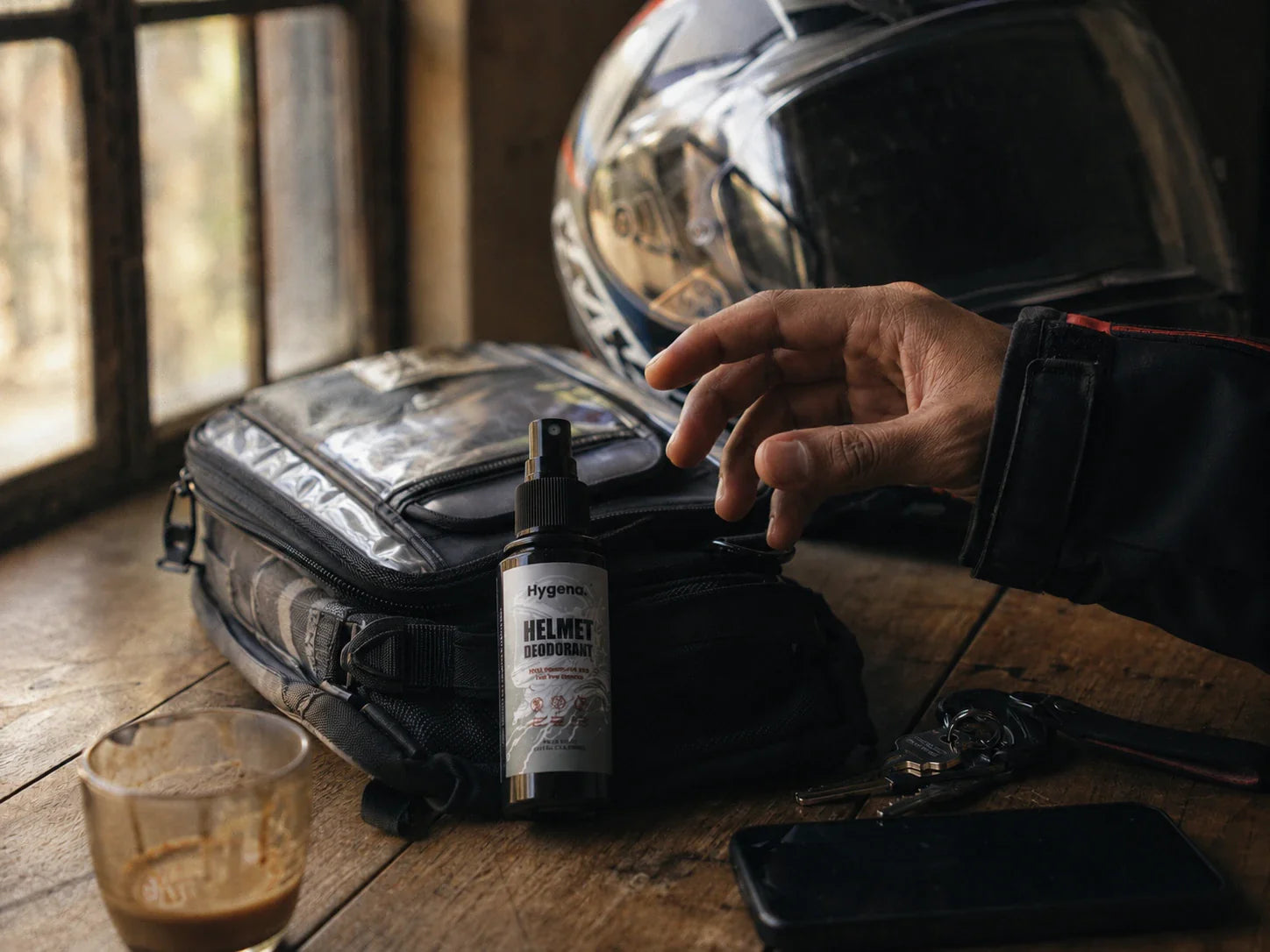
You pull your helmet on. The smell hits before you've even started the bike.
It's a familiar moment for most riders. You've cleaned it, aired it out, maybe sprayed some deodorant inside. The smell still comes back within days. That's because you've been treating sweat, when the real problem is bacteria. A Hygena helmet deodorant works on the bacteria, not the smell.
This is the full story. We'll break down what's actually growing in your helmet, how Hygena kills it, and why thousands of riders won't ride without it.
Rider Takeaways
- Sweat is nearly odorless. Bacteria feeding on that sweat is what makes your helmet stink.
- A 2020 study found Staphylococcus aureus in 22.7% of motorcycle helmets tested.
- Hygena uses a bacteriostatic formula with tea tree and neem to stop bacteria, not mask odor.
- One five-second spray after a ride keeps your helmet fresh for the next one.
What actually causes that helmet smell?
Bacteria cause the smell, not sweat. In 2021, microbiologists at ASM confirmed that fresh sweat is almost odorless. Skin bacteria break it down into smelly acids. Inside a warm, damp helmet, that process runs all day.
Here's the chain. You sweat into the liner. The padding stays warm and wet. Bacteria like Corynebacterium feed on that sweat. They release isovaleric acid, the compound behind that sharp, cheesy odor.
In India, this gets worse fast. A summer commute means 40°C heat, high humidity, and a helmet you can't wash daily. That's a perfect home for bacteria. Phir bhi, most riders blame the sweat and reach for perfume.

Quick Fact:
A 2020 study of 130 motorcycle helmets recovered 392 bacteria across seven genera. Staphylococcus aureus (22.7%) was the most common, and 33.7% of those isolates were antibiotic-resistant MRSA. Your helmet isn't just smelly. It's a living surface. Source: Sapkota et al., 2020.
A 2020 study of 130 motorcycle helmets recovered 392 bacteria across seven genera. Staphylococcus aureus (22.7%) was the most common, and 33.7% of those isolates were antibiotic-resistant MRSA. Your helmet isn't just smelly. It's a living surface. Source: Sapkota et al., 2020.
So how does Hygena helmet deodorant work?
Hygena stops bacteria from multiplying. That's what "bacteriostatic" means. In 1995, a study in Letters in Applied Microbiology showed tea tree oil inhibits Staphylococcus aureus directly. Hygena builds on that science with a rider-specific spray.
The formula does two jobs at once. Tea tree extract, a proven natural antimicrobial, slows bacterial growth on the liner. Neem, used in Indian homes for centuries, adds a second antibacterial layer that works even on resistant strains.
So when you spray after a ride, you're not covering the smell. You're cutting off the bacteria's food chain before it restarts overnight. No bacteria means no acid. No acid means no smell.
Unique Insight
Our finding: Most "helmet sprays" sold in India are surface cleaners or perfumes. None target the liner's bacteria. Hygena is built around the one variable that actually controls odor, which is bacterial load, not fragrance.
Quick Fact:
Tea tree oil's active compound, terpinen-4-ol, disrupts bacterial cell membranes. A 2023 study in Pharmaceutics reported tea tree oil cut bacterial biofilm by 30% to 70%. That's the science behind Hygena's odor control. Source: Pharmaceutics, 2023.
Tea tree oil's active compound, terpinen-4-ol, disrupts bacterial cell membranes. A 2023 study in Pharmaceutics reported tea tree oil cut bacterial biofilm by 30% to 70%. That's the science behind Hygena's odor control. Source: Pharmaceutics, 2023.
Why don't perfume and Febreze fix it?
They mask odor instead of removing its cause. Fabric fresheners and body sprays add a scent on top of the bacteria. The bacteria keep working. Within a day or two, the smell pushes right back through the fragrance.
Think of it like spraying perfume on an unwashed shirt. It smells fine for an hour. Then it's worse, because now it's perfume plus sweat. Your helmet liner does exactly the same thing.
Airing it out helps a little, but it doesn't kill anything. The bacteria just wait for your next sweaty ride. This is the gap Hygena was built to close.

How do you use Hygena helmet deodorant?
You spray it inside the liner after a ride, and you're done in five seconds. There's no wiping it down and no waiting for it to dry. That's the whole point. A hygiene habit only sticks if it's effortless.
Hold the bottle a few inches from the interior. Give the padding two or three sprays, focusing on the forehead and cheek pads. Those spots soak up the most sweat. Then set the helmet down and let it sit.
Do it daily if you commute, or after every ride on a tour. The bottle is compact enough for a tank bag. Ek baar habit ban gayi, you won't even think about it.
Quick Fact:
Riders wear helmets 1 to 3 hours a day on average, and delivery riders far longer. Each session loads the liner with fresh sweat for bacteria to feed on. A five-second daily spray interrupts that cycle before odor sets in. Source: Hygena.
Riders wear helmets 1 to 3 hours a day on average, and delivery riders far longer. Each session loads the liner with fresh sweat for bacteria to feed on. A five-second daily spray interrupts that cycle before odor sets in. Source: Hygena.
The simple fix riders keep coming back to
Here's where Hygena fits your day. Park the bike, spray the helmet, walk away. Tomorrow's helmet smells like nothing, not like yesterday's ride. That five seconds is the entire pitch. Try Hygena helmet deodorant and skip the morning smell for good.
Why do riders actually love it?
Because it solves a daily problem they'd given up on. India is the world's largest two-wheeler market, with over 60% of households owning one in 2024. That's millions of riders living with helmet odor and no real fix. Hygena gave them one.
Riders tell us the same things. The smell is gone, not hidden. Their scalp feels less itchy. Lending a helmet to a friend isn't embarrassing anymore. And it fits a rider's life, not a bathroom shelf.
That last part matters. Hygena isn't a grooming product that happens to mention bikes. It was built by riders, for the helmet, around real riding conditions. Bhai, that difference shows.
Unique Insight
Our finding: Riders don't quit on hygiene because they don't care. They quit because no product fit their routine. Hygena's loyalty comes from being a five-second step, not a chore. Convenience, not lectures, is what builds the habit.
Frequently Asked Questions
Is Hygena helmet deodorant safe for all helmets?
Yes. Hygena is made for helmet interiors, so it's safe on foam liners, cloth padding, and removable cheek pads. It treats the liner without soaking or damaging it. Spray from a few inches away and let it air-set for best results.
Does it kill bacteria or just cover the smell?
It works on the bacteria. Hygena's bacteriostatic formula uses tea tree and neem to slow bacterial growth. A 1995 study in Letters in Applied Microbiology showed tea tree oil inhibits Staphylococcus aureus. That's the most common helmet bacteria found in a 2020 survey.
How often should I use it?
Daily if you commute, or after each ride on a tour. Riders wear helmets 1 to 3 hours a day on average, loading the liner with sweat each time. A quick spray after every session stops odor before it builds up over the week.
Can't I just wash the helmet padding instead?
You can, but washing is slow and you can't do it daily on the road. Most riders wash a liner once in weeks, if at all. A 2020 helmet study linked infrequent cleaning to heavy bacterial growth. Hygena fills the gap between washes.
Conclusion
Your helmet smells because of bacteria, not sweat, and masking it has never worked. Hygena helmet deodorant goes after the bacteria with tea tree and neem, so the odor doesn't come back the next morning.
The fix takes five seconds after a ride. No washing it, no waiting around for it to dry. That's why riders keep it in their tank bag and won't ride without it. Grab a bottle of Hygena and give your nose a break tomorrow.
Sources
1. "Microbial Diversity and Antibiotic Susceptibility Pattern of Bacteria Associated with Motorcycle Helmets," Sapkota et al., International Journal of Microbiology, 2020. Retrieved 2026-06-18.
2. "Microbial Origins of Body Odor," American Society for Microbiology, 2021. Retrieved 2026-06-18.
3. "Antimicrobial effects of tea-tree oil and its major components on Staphylococcus aureus, Staph. epidermidis and Propionibacterium acnes," Raman et al., Letters in Applied Microbiology, 1995. Retrieved 2026-06-18.
4. "Enhancing the Functional Properties of Tea Tree Oil: In Vitro Antimicrobial Activity," Pharmaceutics, 2023. Retrieved 2026-06-18.
5. "Vehicle Ownership in India," Data For India, 2024. Retrieved 2026-06-18.
Share:
Best Riding Jacket for Indian Conditions - How to Choose
How to Set Up Camp on a Motorcycle Trip - Gear, Spots & Tips