
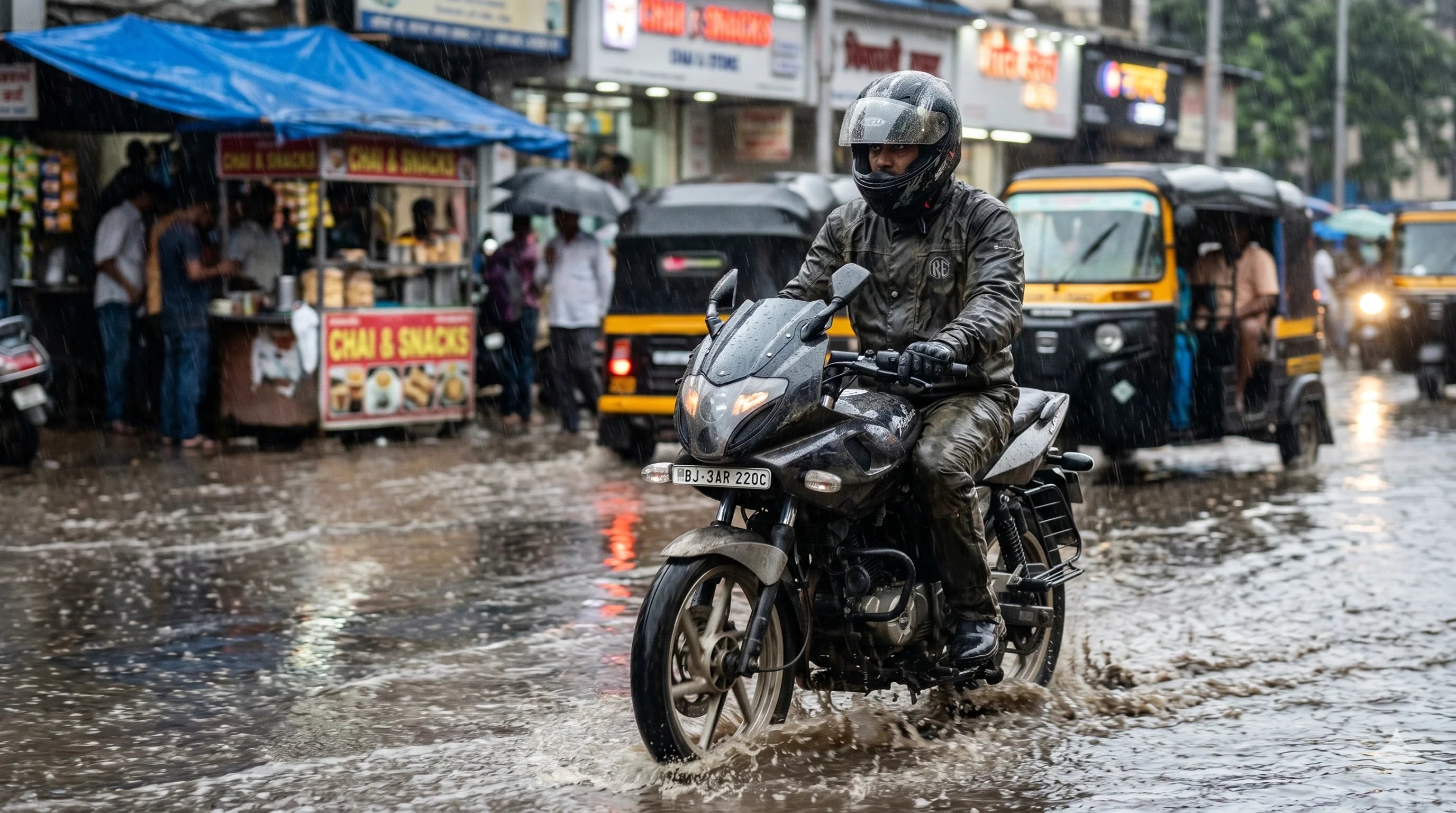
The first big rain hits, and suddenly your bike feels like a stranger.
The road shines. Your visor fogs. Your gloves soak through by the second signal. And two days later, your helmet smells like a wet dog slept in it. Every Indian rider knows this season. The monsoon is the best time to ride and the easiest time to crash or to ruin your gear.
These monsoon motorcycle riding tips cover three things that actually keep you safe and sane: road sense in the wet, gear that works, and how to stop your damp kit from turning into a bacteria farm.
Rider Takeaways
- Wet roads can stretch braking distance by 30–50%, so following gaps and gentle inputs matter more than skill (general braking research, 2024).
- India's two-wheeler riders are the most vulnerable road users, per the India Status Report on Road Safety 2024 (IIT Delhi TRIP Centre).
- Damp liners breed bacteria and fungi fast. One 2020 study found Staphylococcus aureus as the top microbe across 130 helmets.
- Drying gear properly, then deodorizing it, stops the monsoon smell at the source instead of masking it.
Why Is Monsoon Riding Riskier for Two-Wheelers?
In 2024, the India Status Report on Road Safety named motorised two-wheeler riders the most vulnerable road users on Indian roads. That risk climbs in the rain. Braking research shows wet surfaces can raise stopping distance by 30-50% versus dry tarmac. Your tyres simply have less to grip.
Monsoon roads stack problems on top of each other. Water hides potholes. Oil and rubber rise to the surface in the first hour of rain. Painted lane markings and steel manhole covers turn slick as ice.
Then there's visibility. Spray from trucks, a fogged visor, and grey light all shrink how far ahead you can see. You react later, and you react with less grip. That's the real monsoon trap.
Quick Fact:
Wet roads can increase a two-wheeler's braking distance by 30 to 50 percent compared with dry tarmac, depending on speed, tyre condition and surface. The India Status Report on Road Safety 2024 also lists two-wheeler riders as the country's most vulnerable road users. Source: India Status Report on Road Safety 2024.
Wet roads can increase a two-wheeler's braking distance by 30 to 50 percent compared with dry tarmac, depending on speed, tyre condition and surface. The India Status Report on Road Safety 2024 also lists two-wheeler riders as the country's most vulnerable road users. Source: India Status Report on Road Safety 2024.
How Should You Change Your Road Sense in the Rain?
Most monsoon crashes aren't about speed alone. They come from sudden inputs on low-grip roads. A 2025 weather-risk study on two-wheeler crashes in Uttar Pradesh linked very wet, high-humidity days to slippery surfaces and skidding. The fix is smoothness, not bravery.
Give yourself room. Bump your following gap from two seconds to four or more. That extra space is your margin when the brakes bite late.
Then ride gentle. Brake earlier and softer, mostly with the rear and a light front. Roll the throttle, don't snap it. And avoid the shiny stuff. Painted lines, tar patches, and metal covers are the slipperiest spots on any wet road.
One more thing riders forget: standing water. If you can't judge its depth, treat it as a trap. Bro, that innocent puddle can hide a pothole deep enough to swallow a wheel.
Unique Insight
Our take: Riders obsess over tyre grip but ignore vision. In the rain, a clear, anti-fog visor and a quick wipe at every signal do more for safety than any aggressive tyre. You can't brake for what you can't see in time.
What Monsoon Riding Gear Actually Keeps You Safe?
Good wet-weather gear isn't about looking pro. It's about staying dry enough to stay alert. Per the India Status Report on Road Safety 2024, more than half of two-wheeler riders wear helmets in only seven states. Basic protection is still the gap, before we even talk rain kit.
Start at the top. A helmet with a Pinlock or anti-fog visor saves you from the constant fog-and-wipe cycle. Riding gloves with a visor wiper blade are a small upgrade that pays off every single ride.
For your body, a proper rain suit or a waterproof riding jacket beats a flimsy poncho that flaps into your chain. Waterproof gloves and over-boots keep your hands and feet working, because cold, wet fingers brake badly.
Here's the catch nobody mentions. All this gear traps sweat and rainwater against fabric. That's comfortable on the ride and a problem the moment you park.

Why Does Your Wet Gear Smell After Monsoon Rides?
That sour, musty smell isn't just rainwater. It's bacteria and fungi feeding on the warm, damp lining of your gear. A 2020 study in the International Journal of Microbiology tested 130 motorcycle helmets and found 392 bacteria and 346 fungi. Staphylococcus aureus was the top microbe at 22.7%.
Monsoon makes it worse. Your helmet liner, gloves and jacket stay damp for hours. That moisture plus body heat is exactly what microbes love. The smell you notice is their waste, not the sweat itself.
Laundry science backs this up. Research in Applied and Environmental Microbiology shows slow drying in humid air lets odour-causing bacteria regrow and rebuild the smell. Indian monsoon air, sitting at high humidity for weeks, is a perfect regrowth chamber for your gear.
Quick Fact:
A 2020 study of 130 motorcycle helmets recovered 392 bacteria and 346 fungi, with Staphylococcus aureus the most common microbe at 22.7%. Nearly 39% of bacterial isolates were multidrug-resistant. Damp monsoon gear gives these microbes ideal warmth and moisture to multiply. Source: International Journal of Microbiology, 2020.
A 2020 study of 130 motorcycle helmets recovered 392 bacteria and 346 fungi, with Staphylococcus aureus the most common microbe at 22.7%. Nearly 39% of bacterial isolates were multidrug-resistant. Damp monsoon gear gives these microbes ideal warmth and moisture to multiply. Source: International Journal of Microbiology, 2020.
This is the part of monsoon riding nobody plans for. You can buy the best rain suit in the country and still end up with gear that smells, and a scalp that itches. Masking it with perfume or fabric spray doesn't touch the bacteria. It just adds a second smell on top.
That's the gap Hygena was built for. It's a bacteriostatic helmet deodorant that stops odour-causing bacteria from multiplying inside your liner, instead of covering the smell. A few sprays after a wet ride keeps your helmet fresh for tomorrow. The fix is simpler than you think.
How Do You Dry and Deodorize Wet Gear Between Rides?
Drying speed decides everything. Research in Applied and Environmental Microbiology found that slow drying in warm, humid air lets bacteria regrow and worsen odour. Think 32°C and 80% humidity. So after every wet ride, your goal is simple: dry fast, then deodorize.
Start the moment you park. Open all helmet vents and lift the visor. Pull out the liner and cheek pads if your helmet allows it. Lay them on a dry towel in a ventilated room, never in direct sun or a sealed top box.
Speed it up with airflow. A table fan does more than sunlight in monsoon. Slip a couple of silica gel sachets inside the shell between rides to pull moisture out. Do the same for gloves: stuff them with newspaper and let them breathe.
Once gear is dry, deodorize it. Spray Hygena into the helmet liner and let it sit. Because it's bacteriostatic, it works on the cause of the smell, not the symptom. Takes five seconds, saves you a week of funk.
Original Data
Our finding: Riders who deodorize a dry liner stay fresh far longer than those who spray a wet one. Spraying damp padding traps moisture under the surface. Dry first, then deodorize. That order is the whole secret to monsoon helmet hygiene.
Frequently Asked Questions
Is it safe to ride a motorcycle during heavy monsoon rain?
It can be, with caution. Wet roads raise braking distance by 30–50%, so slow down and widen your gap. The India Status Report on Road Safety 2024 calls two-wheeler riders the most vulnerable, so gear up and avoid waterlogged roads when you can.
Why does my helmet smell so bad in the monsoon?
Trapped moisture feeds bacteria and fungi. A 2020 study of 130 helmets found Staphylococcus aureus as the top microbe at 22.7%. Damp liners in humid air let these microbes multiply, and their waste is the smell you notice after wet rides.
How do I dry my riding gear fast in humid weather?
Use airflow, not sunlight. A 2021 microbiology review showed slow, humid drying lets odour bacteria regrow. Remove liners, point a fan at them, and add silica gel sachets. Make sure everything is fully dry before you store or reassemble it.
Does spraying perfume on my helmet help?
No. Perfume and fabric sprays only mask odour for a few hours. They don't stop bacteria multiplying in the liner. A bacteriostatic spray like Hygena targets the bacteria itself, which is why the freshness lasts much longer between rides.
Conclusion
Monsoon riding rewards the rider who slows down, sees clearly, and looks after their gear. Wet roads and damp kit are both manageable once you respect them.
The safety part is road sense. The smell part is bacteria, and the easy fix is to dry your gear fast, then spray Hygena to keep odour-causing bacteria from coming back. Five seconds after a wet ride, and your helmet's ready for tomorrow. Ride safe this season, and keep your gear as fresh as your bike.

Sources
1. "India Status Report on Road Safety 2024," TRIP Centre, IIT Delhi, 2024. Retrieved 2026-06-16.
2. "Weather-driven risk assessment model for two-wheeler road crashes in Uttar Pradesh, India," Scientific Reports, 2025. Retrieved 2026-06-16.
3. "Microbial Diversity and Antibiotic Susceptibility Pattern of Bacteria Associated with Motorcycle Helmets," International Journal of Microbiology, 2020. Retrieved 2026-06-16.
4. "Laundry Hygiene and Odor Control: State of the Science," Applied and Environmental Microbiology, 2021. Retrieved 2026-06-16.
5. "How to Clean Your Helmet During Monsoon Rides in India," ReiseMoto, 2024. Retrieved 2026-06-16.
Share:
How to Set Up Camp on a Motorcycle Trip - Gear, Spots & Tips
Solo Bike Trip Packing List: What to Actually Carry