
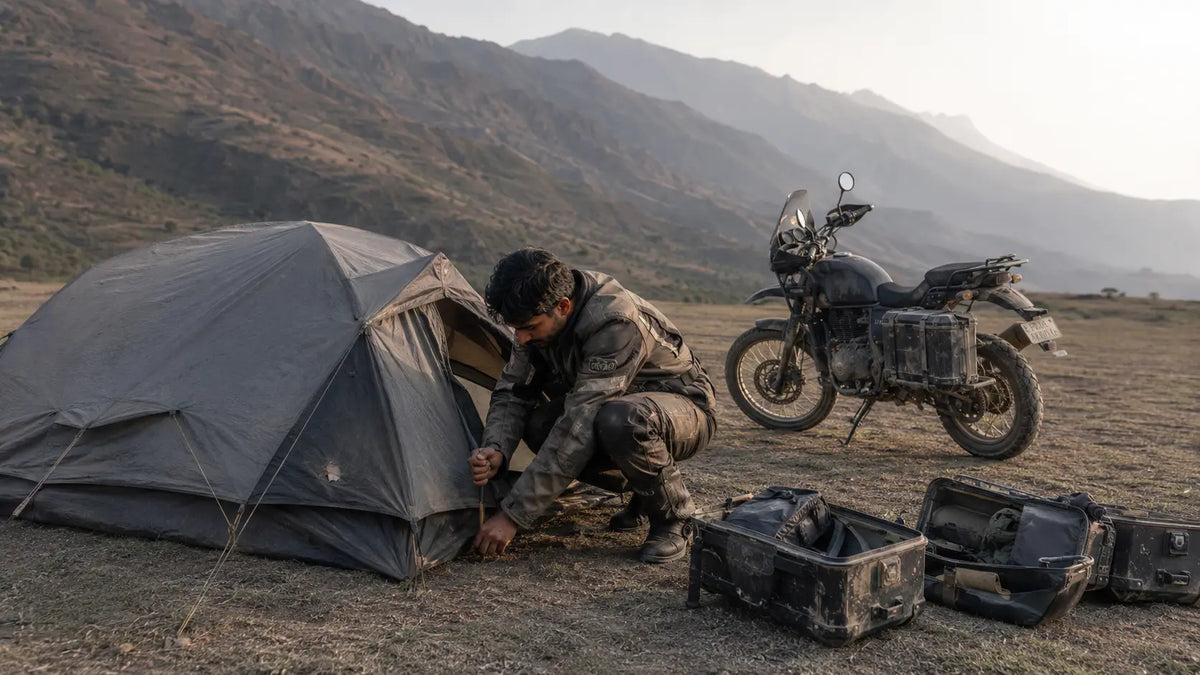
It's 5 PM, your legs are stiff, and you still haven't picked a spot to sleep.
Motorcycle camping isn't car camping. You've got less storage, you arrive later than you planned, and your body is more tired than it looks. Pitching a tent on ground you haven't checked is risky. So is camping near water you haven't tested. Either one turns a good day into a bad night.
This guide walks through picking a safe spot and packing gear that actually fits on a bike. It also covers setting up camp in the right order. And it shows you how to build a hygiene kit that keeps you comfortable through the whole trip.
Rider Takeaways
- Camp at least 200 feet from water and from where you park the bike. That's the minimum wilderness-hygiene distance the U.S. National Park Service (2017) uses.
- Pick flat, bare ground on higher terrain, away from dead trees and loose rock.
- Pack your hygiene kit before you pack anything else. Sweat and road dust build up faster than most riders expect.
- India's adventure tourism market is growing 20.9% a year through 2033, per Grand View Research (2026). Campsites are only getting busier.
How Do You Pick a Safe Spot to Camp on a Motorcycle Trip?
Motorcycle-camping guide Moto Camp Nerd warns against picking a spot by looks instead of ground condition. A pretty view near a river can flood, funnel wind, or sit under dead branches.
Start with water. Camp at least 200 feet from any river, lake, or stream, a distance the U.S. National Park Service (2017) sets as the minimum for washing, bathing, and bathroom breaks near a water source. In India, trekking outfitters like Bikat Adventures apply the same 200-foot rule near rivers and lakes considered sacred. It's both a safety habit and a courtesy one.
Next, look up before you look down. Skip any spot under dead branches or below loose scree and talus slopes. That's a rockfall path, not a campsite. Higher, flatter ground is safer than a low spot near water, which also draws mosquitoes after dark. Avoid the exact top of a pass too; wind funnels hardest right there.
Bare rock or packed dirt beats soft earth or grass. It won't get muddy if it rains, and it leaves no scar behind.
Quick Fact:
Camp at least 200 feet, roughly 70 adult steps, from water sources and your bike. That's the minimum distance the U.S. National Park Service (2017) sets for washing, bathing, and bathroom use near wilderness water. Source: National Park Service
Camp at least 200 feet, roughly 70 adult steps, from water sources and your bike. That's the minimum distance the U.S. National Park Service (2017) sets for washing, bathing, and bathroom use near wilderness water. Source: National Park Service
What Gear Do You Actually Need to Set Up Camp on a Bike?
A car camper packs for comfort. A motorcycle camper packs by liter and by kilogram. Every extra item competes for pannier space with fuel and water. Pack light, but don't skip the basics.
Start with shelter. Pack a two-person tent rated for the season and a sleeping bag suited to night temperatures at altitude. Add a lightweight sleeping mat, a compact stove, one pot, and a lighter. Pack a headlamp too, not a torch that eats both hands.
Rope or paracord earns its weight fast, for a clothesline, a tarp, or a temporary tent guy-line fix. Pack two riding outfits so one can dry while you wear the other. The U.S. National Park Service (2017) recommends this rotation specifically because damp fabric holds bacteria and odor longer than dry fabric does.
Skip anything you can improvise with what's already strapped to the bike. Your riding jacket doubles as a pillow. Your tank bag doubles as a dry-storage box for anything you can't get wet.
Unique Insight
Our finding: Most camping checklists are built around the tent. On a motorcycle trip, build yours around the panniers instead. Every liter of water or fuel you carry for camp is a liter you didn't carry for the ride. So weigh your hygiene kit and cooking gear before you weigh your tent.

How Do You Set Up Camp Step by Step After You Park the Bike?
Order matters more than speed at a motorcycle campsite. Follow these four steps in sequence, from parking the bike to changing out of riding gear.
- Park the bike. Set it on its stand, on ground firm enough that it won't sink overnight. Angle it for a quick exit if weather turns.
- Pitch the tent. Do this before you unpack anything else, while there's still light to check for roots and stones. Stake it down even on a calm evening.
- Set up cooking downwind. Keep it a few meters from the tent door so smoke and food smell stay out of your sleeping space.
- Unpack, then change. Bring your sleeping bag, mat, and hygiene kit inside the tent. Changing out of riding gear right after is the biggest comfort upgrade of the evening.
Quick Fact:
Pitch the tent before you unpack anything else. There's still daylight then to check for roots, stones, and drainage slope. Stakes should go in even on a still evening, since wind can pick up well after dark at altitude. Source: Moto Camp Nerd
Pitch the tent before you unpack anything else. There's still daylight then to check for roots, stones, and drainage slope. Stakes should go in even on a still evening, since wind can pick up well after dark at altitude. Source: Moto Camp Nerd
What Should Be in Your Hygiene Kit for Campsite Setup?
Mayo Clinic (2022) lists heat-trapping clothing and excessive sweating among the main triggers for folliculitis. Riders often just call it a heat rash. After a full day in gear and a helmet, that's the risk a night at camp needs to interrupt.
Pack biodegradable soap, a microfiber towel, and unscented wipes for a no-water clean-up. Add a small comb, toothbrush and paste, and hand sanitizer for before cooking and after bathroom breaks. Keep scented products out of the bag; they attract insects at camp the way they attract attention on a date.
Your helmet needs the same attention as your skin. It's been trapping sweat and bacteria all day, and it's going back on your head tomorrow morning. A quick spray of Hygena's bacteriostatic helmet deodorant after you set up camp keeps the liner from breeding odor overnight. You won't start day two with a helmet that smells like day one.
Kits should stay under half a kilogram. Bulk isn't the goal; coverage is.
Quick Fact:
Mayo Clinic (2022) names heat-trapping clothing and excessive sweating as leading triggers for folliculitis. Riders often mistake the itchy bump breakouts for a heat rash. A full day in riding gear and a helmet checks both boxes. Source: Mayo Clinic
Mayo Clinic (2022) names heat-trapping clothing and excessive sweating as leading triggers for folliculitis. Riders often mistake the itchy bump breakouts for a heat rash. A full day in riding gear and a helmet checks both boxes. Source: Mayo Clinic

How Do You Keep the Campsite Clean and Leave No Trace?
Research cited by Bikat Adventures (2021) found that Himalayan trail cleanups collect 60% multi-layered food packaging. Most of it can't be recycled. Instant noodles and chips packets are the easiest thing to pack in and the hardest thing to pack out responsibly.
Choose local food over packaged snacks where you can. Rajma-chawal from a roadside dhaba beats instant noodles in a foil pouch, for your trash bag and your stomach. Pack out everything you pack in, including used wipes and food scraps, in a dedicated trash bag.
Wash dishes and yourself at least 200 feet from any water source, using biodegradable soap only. Break camp the way you found it. Flatten grass, scatter any fire ash once it's fully cold, and do a last walk-around for anything left behind.
Quick Fact:
Bikat Adventures (2021) cites research showing 60% of plastic waste from Himalayan trail cleanups is multi-layered food packaging. Most of it can't be recycled. Choosing local food over packaged snacks cuts that waste at the source. Source: Bikat Adventures
Bikat Adventures (2021) cites research showing 60% of plastic waste from Himalayan trail cleanups is multi-layered food packaging. Most of it can't be recycled. Choosing local food over packaged snacks cuts that waste at the source. Source: Bikat Adventures
Frequently Asked Questions
How far should you camp from a water source on a motorcycle trip?
At least 200 feet, roughly 70 adult steps, for washing, bathing, and bathroom use. The U.S. National Park Service (2017) sets this as the minimum. Indian trekking guides apply the same distance near sacred rivers and lakes.
What's the minimum gear list for motorcycle camping?
Tent, sleeping bag, sleeping mat, compact stove, headlamp, paracord, and a hygiene kit under half a kilogram. Add layers based on altitude and season rather than packing for every possibility.
Should you set up your tent before or after unpacking the bike?
Before. Pitch the tent while there's daylight to check the ground, then unpack everything else once shelter is standing. Moto Camp Nerd flags this order as the difference between a fast setup and a dark scramble.
What goes in a motorcycle camping hygiene kit?
Biodegradable soap, a microfiber towel, unscented wipes, hand sanitizer, a toothbrush, and a helmet deodorant spray. Mayo Clinic (2022) links trapped sweat and heat to skin breakouts, which is exactly what post-ride hygiene interrupts.
How do you leave a good campsite for the next rider?
Pack out every piece of trash, including food packaging. Himalayan trail waste is 60% non-recyclable packaging (Bikat Adventures, 2021). Flatten grass, cool any fire fully, and check the ground before you ride out.
Conclusion
Setting up camp on a motorcycle trip comes down to three habits. Pick your spot by ground condition, not by view. Pack by weight instead of comfort. Treat your hygiene kit as gear, not an afterthought.
Do those three things. The ride tomorrow starts from a good night's sleep instead of a damp tent and a smelly helmet. A quick spray of Hygena after you set up camp is the fastest habit on this list to build. It's also the one you'll notice missing the most.
Sources
1. "How to Maintain Personal Hygiene While Camping, for Everyone's Sake," National Park Service, 2017. Retrieved 2026-08-29. nps.gov
2. "India Adventure Tourism Market Size & Outlook," Grand View Research, 2026. Retrieved 2026-08-29. grandviewresearch.com
3. "How to Choose a Safe Campsite for Moto Camping," Moto Camp Nerd, n.d. Retrieved 2026-08-29. motocampnerd.com
4. "Leave No Trace Principles Applied to the Context of Trekking in India," Bikat Adventures, 2021. Retrieved 2026-08-29. bikatadventures.com
5. "Folliculitis: Symptoms & Causes," Mayo Clinic, 2022. Retrieved 2026-08-29. mayoclinic.org
Share:
Hygena Helmet Deodorant: How It Works & Why Riders Love It
Monsoon Motorcycle Riding Tips: Safe, Dry & Odour-Free