
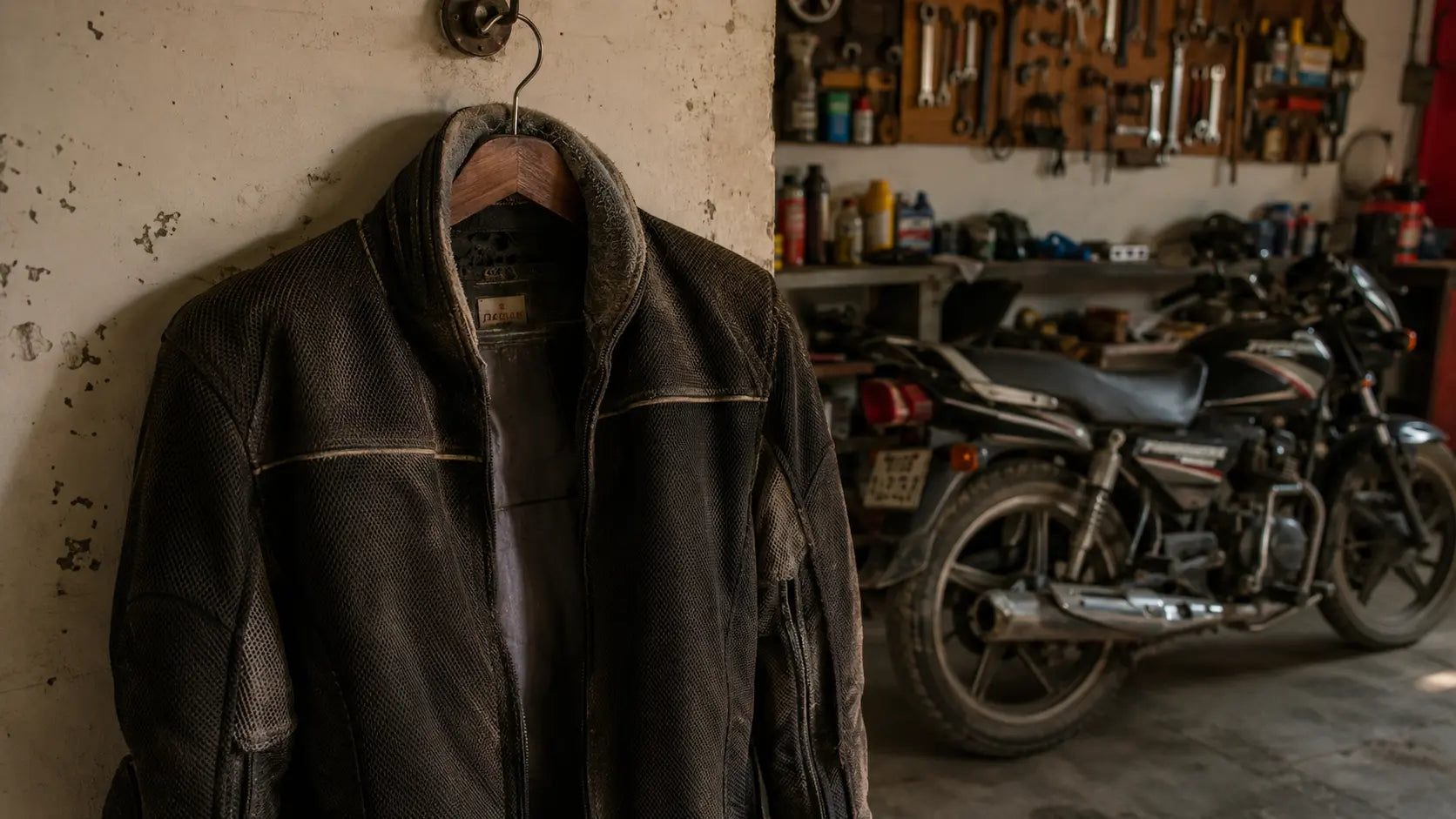
You unzip your jacket after a ride and the smell hits before you do.
It's that sour, locked-in stink that no amount of airing seems to shift. You've sprayed deo on it. Maybe even Febreze. Two days later, it's back. The problem isn't your sweat. It's what your sweat feeds. Bacteria living deep in the gear keep producing odor long after the ride ends. This guide breaks down how to deodorize motorcycle riding gear properly, covering your jacket, gloves, and boots, plus how to stop the smell from coming back.
Rider Takeaways
- Your gear stinks because of bacteria converting sweat into acids, not sweat itself.
- In 2014, a study in Applied and Environmental Microbiology found polyester traps far more odor than cotton.
- Masking sprays don't work. You need to kill or remove the bacteria.
- A quick bacteriostatic spray after each ride stops smell before it builds.
Why Does Your Riding Gear Stink in the First Place?
Your gear smells because bacteria break down sweat into acids. In 2014, a study in Applied and Environmental Microbiology found polyester clothing smelled far more intense than cotton after exercise. Callewaert et al. traced it to Micrococcus bacteria thriving on synthetic fibres. Most riding gear is synthetic. That's the catch.
Here's the chain. You sweat. The sweat itself is nearly odourless. Then skin bacteria like Staphylococcus feed on it. They convert an amino acid called leucine into isovaleric acid. That's the sour, cheesy note you know too well.
Your jacket lining, glove palms, and boot insoles are the worst hit. They stay damp, warm, and dark for hours. In Indian heat, that's a perfect bacterial nursery. So the smell isn't a one-time thing. It's a colony that grows between rides.
Quick Fact:
Body odor isn't caused by sweat directly. Skin bacteria such as Staphylococcus and Corynebacterium metabolise sweat compounds into volatile acids like isovaleric acid, the source of the sour smell in worn gear. Source: MicrobiologyOpen, 2021.
Body odor isn't caused by sweat directly. Skin bacteria such as Staphylococcus and Corynebacterium metabolise sweat compounds into volatile acids like isovaleric acid, the source of the sour smell in worn gear. Source: MicrobiologyOpen, 2021.
How to Deodorize Motorcycle Riding Gear, Step by Step
Match the method to the material. A 2025 review in the Journal of the Textile Institute confirmed that washing removes odour-causing residue more reliably than masking ever can. So your goal is removal, not perfume. Here's how to deodorize motorcycle riding gear by type.
Textile jackets and pants
Check the label first. Most mesh and textile gear is machine-safe on a cold, gentle cycle. Remove the armour. Use a mild detergent, never fabric softener, which clogs the breathable layer. Air-dry in shade, never direct sun for long, which weakens waterproof membranes.
Gloves
Gloves trap the most sweat per gram of fabric. Hand-wash textile gloves in cool water with a little detergent. Press out the water. Don't wring them. Stuff them with paper to hold their shape while drying.
Boots and liners
Pull out the insoles. Wash them separately. Wipe the inside with a damp cloth, then let everything dry fully before the next ride. Damp boots are where the worst smell starts.

Can You Deodorize Leather Gear Safely?
Yes, but leather needs gentler handling. Water and harsh cleaners strip the oils that keep leather supple. A 2025 textile-care review notes that pH-balanced cleaning protects natural fibres better than aggressive washing. For leather, that means surface care, not soaking.
Wipe the lining with a cloth dampened in a 50/50 water-and-white-vinegar mix. Vinegar neutralises the acidic odour molecules instead of covering them. Let it air out fully. Then use a leather conditioner to restore moisture.
For deep, stubborn smell, seal the jacket in a bag with activated charcoal for 24 to 72 hours. Charcoal pulls odour out of the fibres. It's slow, but it works on old gear that nothing else touches.
Unique Insight
Our finding: Most riders treat leather smell like a stain to scrub out. It isn't. The odour lives in the soft lining against your skin, not the leather shell. Clean the lining, then condition the shell, and the smell rarely comes back.
Which Home Remedies Actually Work?
Some popular tricks neutralise odour. Others just hide it for a day. In 2014, sensory research confirmed that synthetic fibres release odour molecules readily, which is why masking fails so fast on riding gear. Here's what's worth your time.
Baking soda absorbs moisture and acids. Sprinkle it inside, leave it overnight, then shake it out. White vinegar neutralises the smell at the chemical level. Sunlight and full airing help, but won't kill an established colony alone. Perfume and Febreze only mask, so the stink returns within a day or two.
How Do You Keep Gear From Smelling Again?
Prevention beats deep-cleaning every time. A 2021 study in PMC found that bacteria survive longer on hydrophobic synthetic fibres, which is exactly what your gear is made of. So if you only wash, the colony rebuilds within days. The fix is to stop bacteria between washes.
After each ride, air your gear before storing it. Never zip damp gear into a dark cupboard. That's bacterial paradise. Rotate gloves if you ride daily. And treat the high-sweat zones like the collar, palms, and insoles before the smell sets in.
This is where a bacteriostatic spray earns its place. Instead of masking, it stops odour-causing bacteria from multiplying on the fabric. Hygena was built for riders for exactly this. A few sprays on the lining keeps your gear fresh for tomorrow's ride. No washing, no waiting around for it to air out.
Make this easier. Hygena takes five seconds after you park. Spray it and ride fresh tomorrow.

Frequently Asked Questions
Why does my riding gear smell even after washing?
Because bacteria rebuild fast on synthetic fabric. A 2021 PMC study found bacteria survive longer on water-repelling synthetic fibres than on cotton. Washing removes some, but the colony returns within days unless you stop regrowth between washes with airing or a bacteriostatic treatment.
Can I machine wash my motorcycle jacket?
Most textile jackets can handle a cold gentle cycle, but check the label first. Remove the armour, skip fabric softener, and air-dry in shade. A 2025 Journal of the Textile Institute review confirms gentle washing removes odour residue better than masking sprays.
Does perfume or Febreze actually deodorize gear?
No. They mask odour without removing the bacteria producing it. Since 2014 research shows synthetic fibres release odour molecules quickly, the smell returns within a day. To truly deodorize motorcycle riding gear, you must remove or inhibit the bacteria, not cover the scent.
How often should I deodorize my gear?
A quick treatment after every ride, with a deeper wash every few weeks for daily riders. In Indian summer heat, sweat and humidity speed up bacterial growth, so high-use riders may need more frequent care than weekend tourers.
Conclusion
Your gear stinks because of bacteria turning sweat into acid, not the sweat itself.
Wash by material, neutralise with vinegar or baking soda, and skip the perfume tricks that only buy you a day. Then keep the smell from coming back. A few seconds of Hygena on your lining after each ride stops bacteria before they build a colony. That's the difference between fixing the smell once and never smelling it again.
Fresh gear, every ride. Bas spray karo aur chalo.
Sources
1. "Microbial Odor Profile of Polyester and Cotton Clothes after a Fitness Session," Applied and Environmental Microbiology (Callewaert et al.), 2014. Retrieved 2026-06-21.
2. "Inhibition of microbial production of the malodorous substance isovaleric acid," MicrobiologyOpen, 2021. Retrieved 2026-06-21.
3. "The Bacterial Life Cycle in Textiles is Governed by Fiber Hydrophobicity," PMC, 2021. Retrieved 2026-06-21.
4. "Textile laundering and body odor: a comprehensive review," Journal of the Textile Institute, 2025. Retrieved 2026-06-21.
5. "How To Deodorize Motorcycle Riding Gear," Motorcyclist, 2023. Retrieved 2026-06-21.
Share:
Spiti Valley Bike Trip: Keep Your Helmet Fresh at 4,500m
Helmet Cleaner Agra: Why Cleaning Won't Kill the Smell