
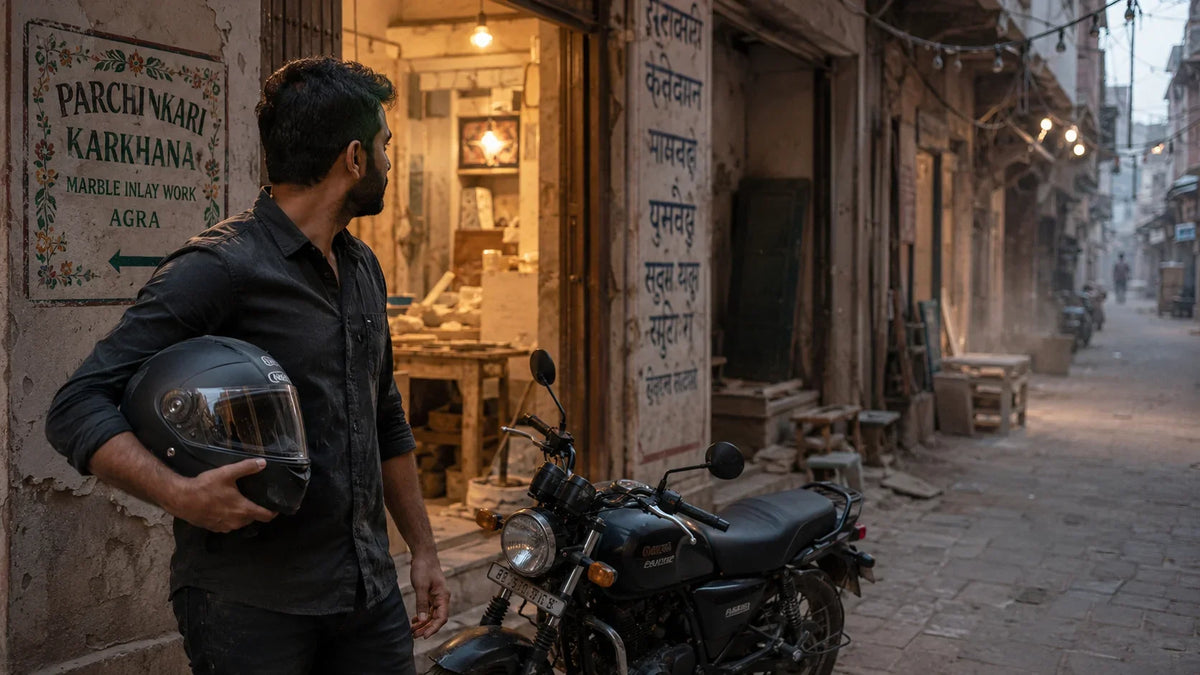
You've just parked outside a petha shop near Sadar Bazaar, pulled your helmet off, and caught that smell again.
It's not just sweat. Agra's dust and its 33.5°C summers feed the same problem. So does every hour stuck in Taj-season traffic: bacteria breeding inside your padding. A 2025 study found a direct, measurable link between that bacteria and the odor itself. Searching for a "helmet cleaner" is the instinct, but cleaning and hygiene aren't the same job. Here's what's actually happening inside your helmet, and what fixes it.
Rider Takeaways
- Helmet odor tracks bacteria, not just sweat. A 2025 study found a 0.706 correlation between one sweat bacterium and odor intensity.
- Agra's Taj Trapezium Zone bans coal-fired industry, but 89.0 μg/m3 of modeled PM2.5 still coats every ride.
- Humidity here swings from 29% in April to 78% in August. Both extremes push bacteria to multiply faster.
- A helmet cleaner wipes away grime; a hygiene spray kills what's actually causing the smell.
Why Are Agra's Old-City Lanes Rougher on Your Helmet?
Agra sits inside the Taj Trapezium Zone, a 10,400 sq km area around the city. The Supreme Court banned coal and coke-fired industry here in 1996 to protect the Taj Mahal's marble. Source: Wikipedia, Taj Trapezium Zone.
That ban never touched the city's real economy: petha production and hand-finished leather footwear. Both run out of dense, narrow lanes, not factory floors. Source: Down To Earth.
Riding through Sadar Bazaar or the marble-inlay quarters means low-speed, stop-start traffic through galis barely wide enough for two bikes. Syrup-steam from petha karkhanas and stone dust from inlay workshops settle straight onto your helmet's foam. No open highway air ever gets in to dry that padding out.
Quick Fact:
The Taj Trapezium Zone, established by the Supreme Court in 1996 (M.C. Mehta v. Union of India), covers 10,400 sq km across five Uttar Pradesh districts and Rajasthan's Bharatpur, and banned coal/coke as an industrial fuel inside the zone. Source: Vajiram & Ravi, Taj Trapezium Zone.
The Taj Trapezium Zone, established by the Supreme Court in 1996 (M.C. Mehta v. Union of India), covers 10,400 sq km across five Uttar Pradesh districts and Rajasthan's Bharatpur, and banned coal/coke as an industrial fuel inside the zone. Source: Vajiram & Ravi, Taj Trapezium Zone.
Does Taj-Season Traffic Make Helmet Smell Worse?
Yes. The Taj Mahal alone pulled 6.9 million visitors in FY 2024-25. Of those, 6.26 million were domestic tourists, arriving mostly by road. Source: Xinhua, citing ASI monument data.
That volume funnels into a compact old-city core, built for foot and cycle traffic. It was never meant for seven million tourists a year, plus every local commuter and delivery rider on two wheels. Longer idle time at barricades near Fatehabad Road and the Taj East Gate means longer helmet-on time. And longer helmet-on time means more trapped sweat with nowhere to evaporate.
Unique Insight
Our finding: Agra is the rare Indian city where tourism, not industry or IT-corridor commuting, is the traffic driver behind rider sweat. Every other UP city in this series ties its congestion to factories or office corridors; Agra's comes from 6.9 million annual visitors funneling through a helmet-length old-city bottleneck.
What's Actually Causing the Smell Inside Your Helmet?
A 2025 study in the Indian Journal of Microbiology tracked bacteria on sweat-soaked polyester over eight weeks of continuous wear. It found the abundance of one bacterium, Staphylococcus hominis, correlated with odor intensity at r = 0.706. Researchers confirmed the link with qPCR testing. Source: Indian Journal of Microbiology, Springer, 2025.
Your helmet's foam liner works the same way as that fabric. Sweat alone doesn't smell. Bacteria feeding on it does, and the stronger the bacterial growth, the stronger the smell gets. Wiping the shell or airing the helmet out does nothing to that bacteria living inside the foam.

Agra's Dust and Dry Heat Push Bacteria Further
Relative humidity here swings hard across the year. It runs from 29% in April, the driest month, to 78% in August at monsoon peak. Source: Climate-Data.org, Agra.
Both ends punish your helmet. Dry April air cakes stone and street dust into the foam, where it holds skin oils bacteria feed on. Monsoon-humid August does the opposite. It keeps that same foam damp for hours after every ride, exactly the moisture bacteria need to multiply.
Quick Fact:
Agra's modeled urban PM2.5 averages 89.0 ± 12.2 µg/m3, more than 8 times the WHO guideline, with road dust alone contributing an estimated 1,350 tons a year, on top of transport and residential burning. Source: UrbanEmissions.Info, Agra APnA.
Agra's modeled urban PM2.5 averages 89.0 ± 12.2 µg/m3, more than 8 times the WHO guideline, with road dust alone contributing an estimated 1,350 tons a year, on top of transport and residential burning. Source: UrbanEmissions.Info, Agra APnA.
Is a Helmet Cleaner the Same Thing as a Helmet Hygiene Spray?
No, and this is where most riders searching "helmet cleaner Agra" go wrong. A cleaner removes visible dirt, dust, and grime from the shell or padding. It doesn't touch the bacteria causing the smell, it just clears the surface they're living on.
Hygena isn't a cleaner. It's a bacteriostatic hygiene spray, meaning it stops odor-causing bacteria from multiplying in the first place. It uses tea tree extract and hydrogen peroxide instead of masking the smell with fragrance.
| What It Does | Cleaning Spray | Hygena Hygiene Spray |
|---|---|---|
| Removes visible dust/grime | Yes | No, not its job |
| Kills odor-causing bacteria | No | Yes, bacteriostatic action |
| Prevents smell from returning | No, temporary at best | Yes, with regular use |
| Meant for daily use | Occasional | After every sweaty ride |
Fixing It: A Habit Built for Agra's Riding Conditions
Between petha-lane traffic, marble dust, and gridlock near the Taj gates, your helmet has a lot working against it. An occasional wipe-down isn't enough, especially with humidity that never sits still.
Spray Hygena directly onto the foam liner and padding after any ride longer than 20 minutes. That's especially true after Fatehabad Road traffic or a dusty inlay-quarter detour. Let it sit for a minute before you put the helmet away. It survives a multi-hour tourist-season crawl. It keeps working through Agra's humid August stretch too, not just on a dry winter morning.

Frequently Asked Questions
Does Agra's dust make helmet smell worse than other UP cities?
It adds a layer other cities don't deal with as much. Road dust alone contributes an estimated 1,350 tons of PM2.5 a year here. That's on top of the sweat-bacteria problem every rider already faces. Source: UrbanEmissions.Info.
Where can I buy a helmet hygiene spray in Agra?
Hygena ships across Agra and the rest of Uttar Pradesh through hygena.in. No physical Agra storefront yet, but delivery covers the city and nearby districts.
Is Taj-season traffic really bad enough to affect helmet hygiene?
Yes. With 6.9 million annual Taj Mahal visitors funneling through a compact old-city core, idle time at barricades adds up fast. That means longer helmet-on time and more trapped sweat per ride. Source: Xinhua, citing ASI data.
How often should I use a hygiene spray during Agra's monsoon?
After every ride where you sweat noticeably, which in August's 78% humidity is most rides. Damp padding that doesn't fully dry between uses is exactly where bacteria multiply fastest.
Conclusion
Agra's helmet-odor problem isn't really about industry or factory smoke. The Taj Trapezium Zone banned most of that back in 1996. It's about narrow old-city lanes, marble and street dust, and a humidity swing from 29% to 78%. Add 6.9 million tourists a year, and short rides turn into long, sweaty ones.
A cleaner handles the dust on the outside. It won't touch the bacteria multiplying inside your padding. That's the bacteria the 2025 sweat-odor study says actually drives the smell. Spray Hygena after every ride that leaves you sweating. Give your helmet the same non-negotiable routine you'd give your teeth.
Sources
1. "Taj Trapezium Zone," Wikipedia. Retrieved 2026-08-29.
2. "Taj Trapezium Zone," Vajiram & Ravi Current Affairs. Retrieved 2026-08-29.
3. "Agra Beyond Taj: Waste Management of Leather Footwear & Petha Production," Down To Earth. Retrieved 2026-08-29.
4. "Taj Mahal Remains India's Most Visited Monument, Attracts 6.9 Million Visitors in 2024-25," Xinhua, 2025. Retrieved 2026-08-29.
5. "Association of Staphylococcus_hominis and Odor Production on Sweaty Polyester Sportswear," Indian Journal of Microbiology, Springer Nature, 2025. Retrieved 2026-08-29.
6. "Agra Climate," Climate-Data.org. Retrieved 2026-08-29.
7. "Air Quality Analysis for Agra, India," UrbanEmissions.Info APnA. Retrieved 2026-08-29.
Share:
How to Deodorize Motorcycle Riding Gear That Stinks
Does a Motorcycle Helmet Cause Hair Loss?