
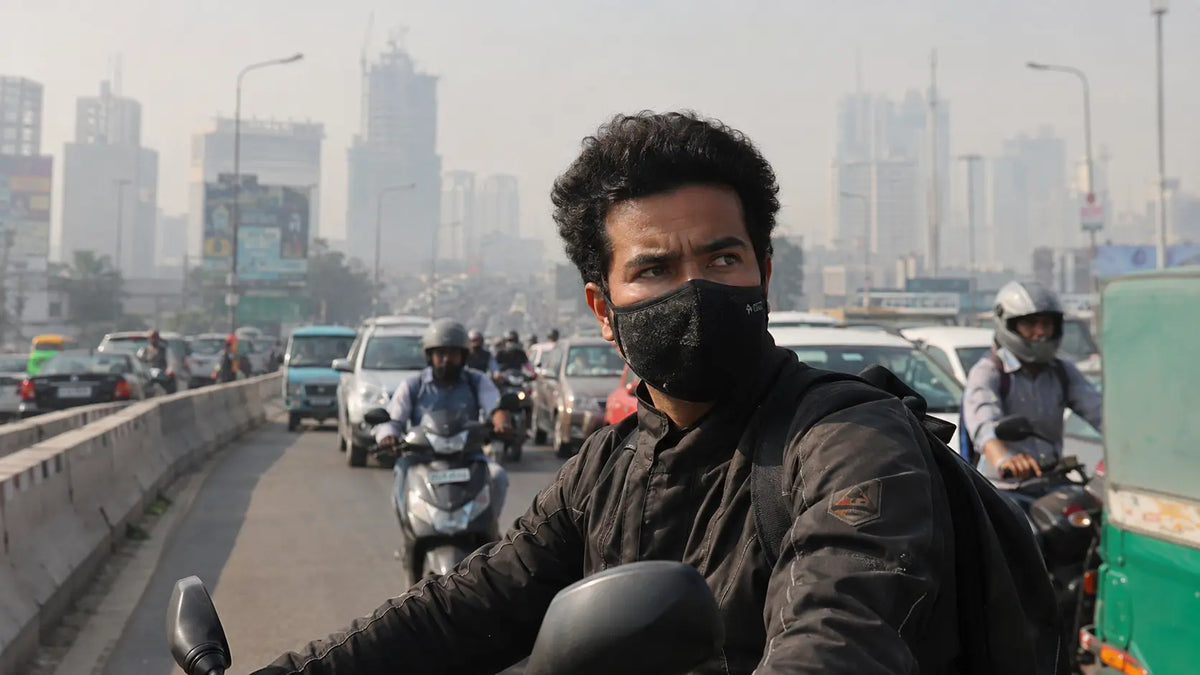
How to Clean Your Anti-Pollution Riding Mask, Safely
You've worn the same riding mask for three weeks straight.
It's greyed out at the edges. It smells faintly of sweat and exhaust, and you've been meaning to wash it since week two.
Most riders either scrub it like a handkerchief or never wash it at all. Both habits quietly ruin the one thing that's supposed to protect you.
Here's how to clean an anti-pollution riding mask without wrecking its filtration. This piece also covers how often to do it, and when to just replace the thing.
Rider Takeaways
- Loni's 2025 PM2.5 average hit 112.5 µg/m³, 22 times the WHO guideline (IQAir 2025).
- Detergent washing kills the electrostatic charge N95-style masks need. One wash can drop it from -500V to -20V (Journal of Aerosol Science, 2021).
- Cotton and cloth masks hold up far better. Filtration stayed stable through 52 wash cycles in a 2021 study (Aerosol and Air Quality Research).
- CDC/NIOSH caps N95-style reuse at five donnings. Integrity isn't guaranteed past that.
Why India's Air Makes a Riding Mask Non-Negotiable
In 2025, Loni recorded the highest annual PM2.5 average of any city in the world: 112.5 µg/m³. That's according to IQAir's 2025 World Air Quality Report. Delhi wasn't far behind at 99.6 µg/m³.
If you commute through NCR, or honestly most north Indian cities between October and February, your mask isn't optional gear. It's doing real work every single ride, which is exactly why what you do to it afterward matters.
Most riders treat the mask like a bandana: wear it, stuff it in the tank bag, wear it again. Bhai, that's the fastest way to make an expensive filter useless.
Quick Fact:
Loni, India recorded an annual average PM2.5 of 112.5 µg/m³ in 2025. That's a 23% jump from 2024, and 22 times the WHO's guideline of 5 µg/m³. India was home to three of the world's four most polluted cities that year. Source: IQAir 2025 World Air Quality Report
Loni, India recorded an annual average PM2.5 of 112.5 µg/m³ in 2025. That's a 23% jump from 2024, and 22 times the WHO's guideline of 5 µg/m³. India was home to three of the world's four most polluted cities that year. Source: IQAir 2025 World Air Quality Report
Can You Wash a Pollution Mask Without Ruining It?
In 2021, a Journal of Aerosol Science study tested washing an FFP2-style mask with detergent. Fiber surface charge dropped from about -500V to -20V after a single cycle.
That charge is what traps the smallest particles. Once it's gone, the mask no longer meets filtration standards, even if it looks fine.
So no, you can't just throw an N95-style riding mask in soapy water. It won't work the same way after.
Cloth and cotton masks are a different story. The same research area tested cotton masks through 52 hot wash and dry cycles. Filtration performance held steady overall. There was only a ~10% dip at the finest particle size, and it happened early in week one. The fabric wears visibly, but it keeps filtering.
The fix isn't "never wash it." It's knowing which mask you're wearing before you decide how to clean it.
Quick Fact:
Washing an FFP2 or N95-style mask with detergent strips its electrostatic charge fast. Fiber surface charge drops from roughly -500V to -20V after just one cycle. That's enough to fail FFP2 filtration standards. Washing without detergent preserves it. Source: Journal of Aerosol Science, 2021
Washing an FFP2 or N95-style mask with detergent strips its electrostatic charge fast. Fiber surface charge drops from roughly -500V to -20V after just one cycle. That's enough to fail FFP2 filtration standards. Washing without detergent preserves it. Source: Journal of Aerosol Science, 2021

How Many Times Should You Actually Reuse One?
CDC/NIOSH guidance caps N95-style respirator reuse at five total donnings per device, and says structural integrity isn't guaranteed past that. That guidance is written for healthcare settings. The underlying logic still holds for a riding mask. Straps stretch, seals loosen, and filtration drops with every use.
For a valve-style or N95-style riding mask, treat five to seven rides as the practical ceiling. After that, swap the filter, not the whole mask.
For a cotton or cloth mask, you've got more room. Fifty-plus hot wash cycles is realistic before performance drops, based on the same research. What kills a cloth mask first is usually the elastic, not the fabric.
Keep two masks in rotation instead of one. One dries fully while the other's on your face. That matters more during monsoon commutes, when everything stays damp for hours.
How do you know it's time to bin it? Check three things. The strap should still hold tension. The nose clip should still shape properly, with no visible tear or gap at the seams.
Quick Fact:
CDC/NIOSH guidance limits N95-style respirator reuse to five total donnings per device. Beyond that, structural and functional integrity "may be compromised," the agency notes. Riders should apply the same five-use ceiling to any filter-style mask they wear daily. Source: CDC/NIOSH, 2024
CDC/NIOSH guidance limits N95-style respirator reuse to five total donnings per device. Beyond that, structural and functional integrity "may be compromised," the agency notes. Riders should apply the same five-use ceiling to any filter-style mask they wear daily. Source: CDC/NIOSH, 2024
Unique Insight
Our take: Most riders replace a pollution mask when it looks worn out, not when it stops filtering. Those are two different timelines. The fabric almost always outlasts the filter's actual performance.
The Right Way to Clean and Dry Your Riding Mask
If your mask is cotton or cloth, here's the routine that actually protects the filter instead of wrecking it.
- Hand wash in lukewarm water with a mild soap, never laundry detergent.
- Swish gently for thirty seconds. Don't scrub, and don't wring the fabric.
- Press out excess water between two clean towels instead of twisting it.
- Dry it flat, away from direct sun and away from humid corners.
Detergent leaves a residue that clogs the weave over time, which is why plain mild soap works better here.
Twisting the fabric stretches the elastic and distorts the nose clip. Both are harder to fix than the fabric itself.
A 2025 study in Scientific Reports found bacteria survive longer on mask fabric in humid conditions. A damp mask left in a gym bag overnight does the opposite of what you want.
If it's a valve-style or N95-style mask, skip the wash entirely. Air it out in sunlight for a few hours instead. The same research found direct sun exposure cleared bacteria far more effectively than a wipe-down ever could.
Quick Fact:
A 2025 Scientific Reports study tracked bacteria on mask fabric under different conditions. Bacteria survived two to three log orders longer at higher humidity. Direct sunlight exposure cleared contamination far more effectively than surface wiping did. Source: Scientific Reports, 2025
A 2025 Scientific Reports study tracked bacteria on mask fabric under different conditions. Bacteria survived two to three log orders longer at higher humidity. Direct sunlight exposure cleared contamination far more effectively than surface wiping did. Source: Scientific Reports, 2025
What's Actually Growing in a Mask You Never Wash?
Bacteria don't care whether it's a helmet liner or a mask. Warm, damp fabric touching your face for an hour a day is exactly the environment bacteria need to multiply. A mask you wear and stuff away wet is no different from a helmet you never air out.
Here's the part most riders miss: you can rinse a mask in five minutes. You can't rinse a helmet liner the same way, and most people don't even try.
Your helmet interior goes through the same heat, sweat, and pollution exposure as your mask, every single ride. But it stays sealed against your scalp for longer. Airing it out on the balcony doesn't touch the bacteria living in the foam.
That's the gap Hygena's bacteriostatic helmet spray was built for. It's not a cleaning spray. It inhibits the bacteria that cause odor and scalp irritation between washes. That's how the one piece of gear you can't easily rinse still gets looked after.
Unique Insight
Our take: Riders careful about mask hygiene are often the exact same riders who've never once cleaned inside their helmet. The two habits don't seem connected. But the bacteria doesn't know the difference.

Frequently Asked Questions
How often should I wash my riding mask?
Wash a cloth mask after every two or three rides, or sooner if it looks dirty. Cotton masks held filtration through 52 wash cycles, per a 2021 Aerosol and Air Quality Research study. Frequent washing isn't the real risk. Detergent build-up and rough handling are.
Can I put my pollution mask in the washing machine?
Hand wash it instead. Machine agitation stretches the straps and distorts the nose clip faster than hand washing does. Detergent residue from a machine cycle is also harder to rinse out fully.
Does sun-drying a mask actually kill bacteria?
Yes. A 2025 Scientific Reports study found direct sunlight cleared bacterial contamination on mask fabric far more effectively than wiping did. Higher humidity let the bacteria survive longer.
How do I know when to replace my mask instead of cleaning it?
Replace it once the strap loses tension, the nose clip won't hold shape, or you see gaps at the seams. CDC/NIOSH caps N95-style reuse at five donnings for the same structural reasons.
Can I use an alcohol spray to disinfect my mask between rides?
A light 70% ethanol spray works well between washes. The 2025 Scientific Reports study recorded a six-log reduction in bacteria on sprayed, sealed masks. Let it air dry fully before you wear it again.
Conclusion
Your riding mask can absolutely be cleaned and reused, but not the way most people do it. Know what it's made of. Skip the detergent on filter-style masks. Dry it flat, away from direct humidity. Retire it based on the straps and seal, not just how it looks.
The mask is the gear riders remember to think about. The helmet, the one thing that's against your scalp for the whole ride, usually isn't. That's exactly where Hygena comes in. It keeps the bacteria in check between the washes you actually remember to do.
Sources
1. "IQAir 2025 World Air Quality Report finds only 14% of cities meet WHO air pollution guideline," IQAir, 2026. Retrieved 2026-09-01.
2. "5 Most polluted major cities in the world in 2025," IQAir India, 2026. Retrieved 2026-09-01.
3. "Impact of washing cycles on the performances of face masks," Journal of Aerosol Science, 2021. Retrieved 2026-09-01.
4. "Filtration Performance of Layering Masks and Face Coverings and the Reusability of Cotton Masks after Repeated Washing and Drying," Aerosol and Air Quality Research, 2021. Retrieved 2026-09-01.
5. "Strategies for Conserving the Supply of N95 Filtering Facepiece Respirators," CDC/NIOSH, 2024. Retrieved 2026-09-01.
6. "Factors influencing bacterial viability on face masks and bactericidal effect of disinfection methods," Scientific Reports, 2025. Retrieved 2026-09-01.
Share:
Beyond Helmet Deodorant: A Real Rider Personal Care Routine
Helmet Cleaning Spray Jaipur: Made Here, Proven Locally