
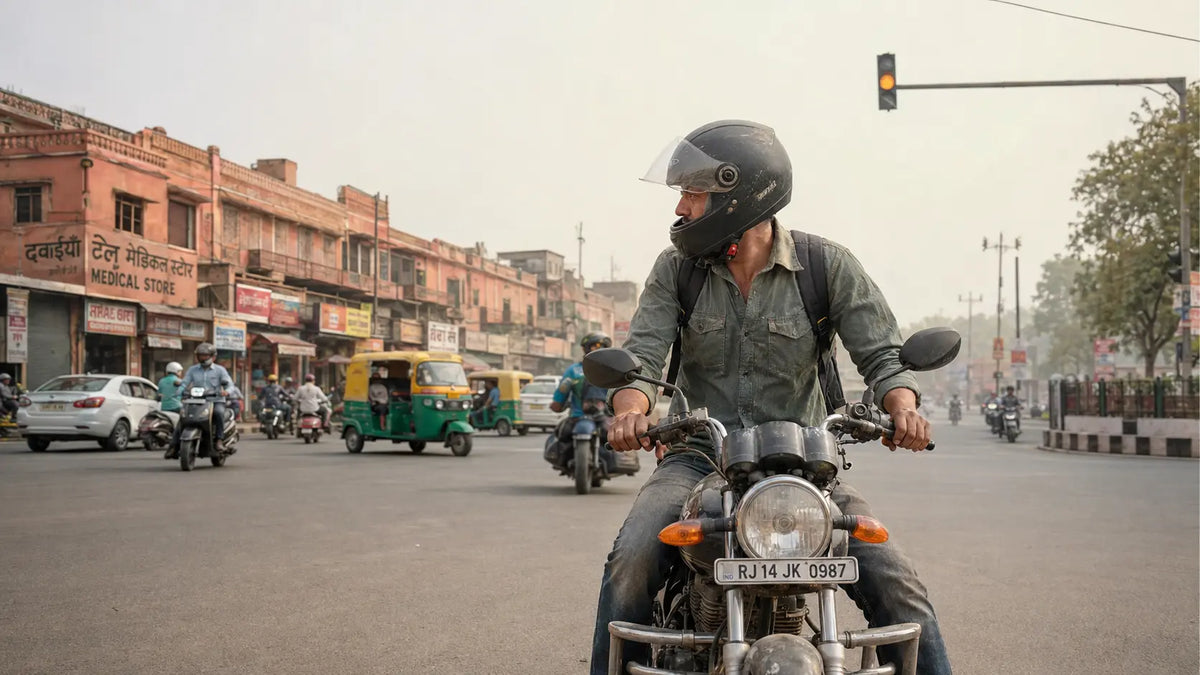
You're stopped at Ajmeri Gate at 6 PM, engine idling, sun still hot at 38°C.
Your helmet's been sealed for forty minutes and it's not getting any better in there. Jaipur's evening commute regularly crosses 94% congestion. That's exactly the kind of trapped, sweaty time that turns a liner into a bacteria farm, ride after ride.
A helmet cleaning spray promises to fix the smell, here in Jaipur or anywhere else. Most riders don't know what it's actually doing, or whether it's doing anything at all. This one's made right here, tested against Jaipur's own heat and traffic before it ever leaves the city.
Rider Takeaways
- Jaipur's evening rush hits 94.9% congestion, per TomTom's 2025 Traffic Index, sealing your helmet longer than most cities manage.
- A 2016 Lagos study found every bacterial isolate tested resistant to penicillin-family antibiotics, across 40 motorcycle helmets.
- Hygena is manufactured in Jaipur by Falcon Hygiene Industries, in the same heat and dust your helmet actually rides through.
- It's already stocked at Helmet Point and Xriders, two of the city's own biking accessory stores.
Why Doesn't Rajasthan's Heat Let Your Helmet Cool Down?
Jaipur's May highs average 40.3°C. Humidity swings from 21% in April to 76% in August, per Climate-Data.org's 30-year averages. Dry heat evaporates sweat fast, but it doesn't kill what's breeding in the padding underneath.
Quick Fact:
Climate-Data.org's 1991-2020 averages put Jaipur's mean annual temperature at 25.1°C. May highs hit 40.3°C, and humidity jumps from 21% in April to 76% by August. Bacteria doesn't need constant humidity, just repeated cycles of sweat and heat. Source: Climate-Data.org
Climate-Data.org's 1991-2020 averages put Jaipur's mean annual temperature at 25.1°C. May highs hit 40.3°C, and humidity jumps from 21% in April to 76% by August. Bacteria doesn't need constant humidity, just repeated cycles of sweat and heat. Source: Climate-Data.org
Air quality plays a part too. Jaipur's PM2.5 reading sits around 32.6 µg/m³ on an average day, per IQAir. That's still 6.5 times the WHO's annual guideline, even after real improvement from 88.3 µg/m³ back in 2017. Dust and particulate matter settle into a damp liner and give bacteria something extra to feed on.
Why Does Jaipur Traffic Turn a Quick Ride Into a Slow Bake?
Jaipur's evening rush hour now averages 94.9% congestion. A 10km ride takes over 36 minutes, according to TomTom's 2025 Traffic Index. That's more sealed, sweaty helmet-time than most riders account for. The longer it stays shut, the more time bacteria gets to multiply undisturbed.
Quick Fact:
TomTom's 2025 Traffic Index puts Jaipur's average congestion at 58.7% across the day. That climbs to 94.9% in evening rush. A 10km commute that should take 15 minutes stretches past 36. Riders here lose roughly 121 hours a year sitting in traffic, helmet sealed the entire time. Source: TomTom Traffic Index
TomTom's 2025 Traffic Index puts Jaipur's average congestion at 58.7% across the day. That climbs to 94.9% in evening rush. A 10km commute that should take 15 minutes stretches past 36. Riders here lose roughly 121 hours a year sitting in traffic, helmet sealed the entire time. Source: TomTom Traffic Index
Slower traffic doesn't mean safer traffic, either. Jaipur logged 3,664 accidents and 1,273 deaths in 2025. That's a fatality rate of 34.7 per 100 crashes, a five-year high. The raw accident count actually fell from 2024, but severity didn't. Jaipur Rural alone accounted for 426 deaths, a third of the region's total. It's also the only district where crashes rose year over year.
What's Actually Growing Inside That Liner?
A 2016 study swabbed 40 motorcycle helmets in Lagos, Nigeria. Researchers recovered 83 bacterial isolates across nine species, led by Staphylococcus aureus. Every single isolate tested came back resistant to penicillin-family antibiotics.
Quick Fact:
A 2016 Lagos study (American Journal of Microbiological Research) tested 40 motorcycle helmets. It recovered 83 bacterial isolates across nine species, and Staphylococcus aureus made up 31 of them. Every isolate tested came back resistant to penicillin, augmentin, amoxicillin, and cloxacillin, and 56% resisted gentamicin too. Source: American Journal of Microbiological Research, 2016
A 2016 Lagos study (American Journal of Microbiological Research) tested 40 motorcycle helmets. It recovered 83 bacterial isolates across nine species, and Staphylococcus aureus made up 31 of them. Every isolate tested came back resistant to penicillin, augmentin, amoxicillin, and cloxacillin, and 56% resisted gentamicin too. Source: American Journal of Microbiological Research, 2016
This isn't dirt you can see. Sweat and skin oils feed bacteria that perfume can't touch. A bacteriostatic formula works differently: it stops bacteria from multiplying instead of masking what they've already produced. In a city where heat and traffic already stack the odds, that distinction matters more than it does somewhere milder.

Why Does It Matter That Hygena Is Made Right Here in Jaipur?
Hygena's formula isn't developed somewhere far off and shipped in. We manufacture it right here, through Falcon Hygiene Industries, in the same heat this article just walked through. If a spray can't hold up through a 40°C summer, we'd know before you would.
Unique Insight
Our finding: Jaipur's Old City earned UNESCO World Heritage status in 2019. The recognition cited its 1727 grid plan, laid out under Sawai Jai Singh II. Riders still thread that same grid daily, helmet on. Heat radiates off pink sandstone walls that trap it rather than let it breathe.
Jaipur's own riders navigate the walled city's chaupar intersections and the newer sprawl beyond it every day. Often it's the same bike, and the same helmet, doing both. A helmet that works has to hold up across that whole range, not just one kind of street.
Is a Helmet Cleaning Spray the Same as a Helmet Cleaner?
No. A helmet cleaner removes visible dirt and grime from the shell and visor. A hygiene spray like Hygena targets the bacteria living inside the liner, the actual source of the smell. Riders often use one and assume it covers the other. It doesn't, and that gap is exactly where the smell keeps coming back from.
| What It Does | Helmet Cleaner | Hygena Hygiene Spray |
|---|---|---|
| Removes visible dirt/grime | Yes | Not the goal |
| Kills odor-causing bacteria | Not usually | Yes, bacteriostatic |
| Where it works | Shell, visor exterior | Liner, padding, interior |
| Stops recurring smell | No | Yes, with regular use |
The Fix: Built for the Conditions It's Tested In
Hygena is a bacteriostatic helmet spray, ₹599. It's made to survive exactly what you just read about. A 90-minute Jaipur traffic crawl, a 40°C afternoon, and the bacteria both leave behind, all in a day's ride.
Tea tree and neem extracts do the antimicrobial work here, not fragrance covering anything up. A few sprays on the liner after a ride, and the smell doesn't get the chance to build back up. You're not masking it. You're stopping it before it starts.

Frequently Asked Questions
Does Jaipur's dry heat make helmet smell worse or better than a humid city?
Dry heat evaporates sweat fast, but it doesn't stop bacteria from multiplying between rides. Jaipur's humidity still climbs to 76% in August, per Climate-Data.org. That's the moisture window bacteria needs, even in a "dry" city.
Where can I buy a helmet cleaning spray in Jaipur?
Hygena is stocked at Helmet Point and Xriders, both established biking accessory stores in Jaipur. You'll also find it on hygena.in, Amazon, and Flipkart.
Is it safe to use a helmet hygiene spray in direct summer heat?
Yes. Spray a cooled helmet, out of direct sun, and let it sit a few minutes before wearing. Skip a helmet that's been baking on a parked bike all afternoon in Jaipur's May sun. Heat won't hurt the formula, but a scorching-hot shell makes it evaporate before it can work.
How often should Jaipur commuters treat their helmet, given the traffic?
With evening congestion regularly above 90%, per TomTom, riders here rack up more sealed helmet-time than most cities. Treat the liner every 3 to 4 rides, more often through peak summer.
What's the real difference between cleaning and hygiene for a helmet?
Cleaning removes dirt you can see. Hygiene targets bacteria you can't, the ones actually producing the smell. A cleaning spray alone won't stop odor from coming back.
Conclusion
Jaipur asks more of a helmet than most cities. Evening traffic seals it shut for longer, and summer heat pushes past 40°C. Bacteria found in helmets elsewhere has come back resistant to entire families of antibiotics. A cleaning spray that only wipes the outside never touches any of that, no matter how good it smells afterward.
Hygena was built and tested in these exact conditions, not somewhere else and shipped in. Pick it up at Helmet Point, Xriders, or hygena.in, and give your liner something that actually works on Jaipur's terms.
Sources
1. "Jaipur Traffic Report," TomTom Traffic Index, 2025. Retrieved 2026-08-31.
2. "Crash Severity, Not Frequency, Rajasthan's Road Safety Challenge," NewKerala, 2026. Retrieved 2026-08-31.
3. "Jaipur Climate," Climate-Data.org, 1991-2020 averages. Retrieved 2026-08-31.
4. "Jaipur Air Quality Index," IQAir. Retrieved 2026-08-31.
5. "Antibiotics Susceptibility Pattern and Plasmid Profile of Bacteria Isolated from Public Motorcycle Helmets," American Journal of Microbiological Research, 2016. Retrieved 2026-08-31.
6. "Jaipur: A World Heritage Site," Drishti IAS, 2019 inscription. Retrieved 2026-08-31.
Share:
How to Clean Your Anti-Pollution Riding Mask, Safely
How Poor Hygiene Habits Affect Rider Health Long-Term