
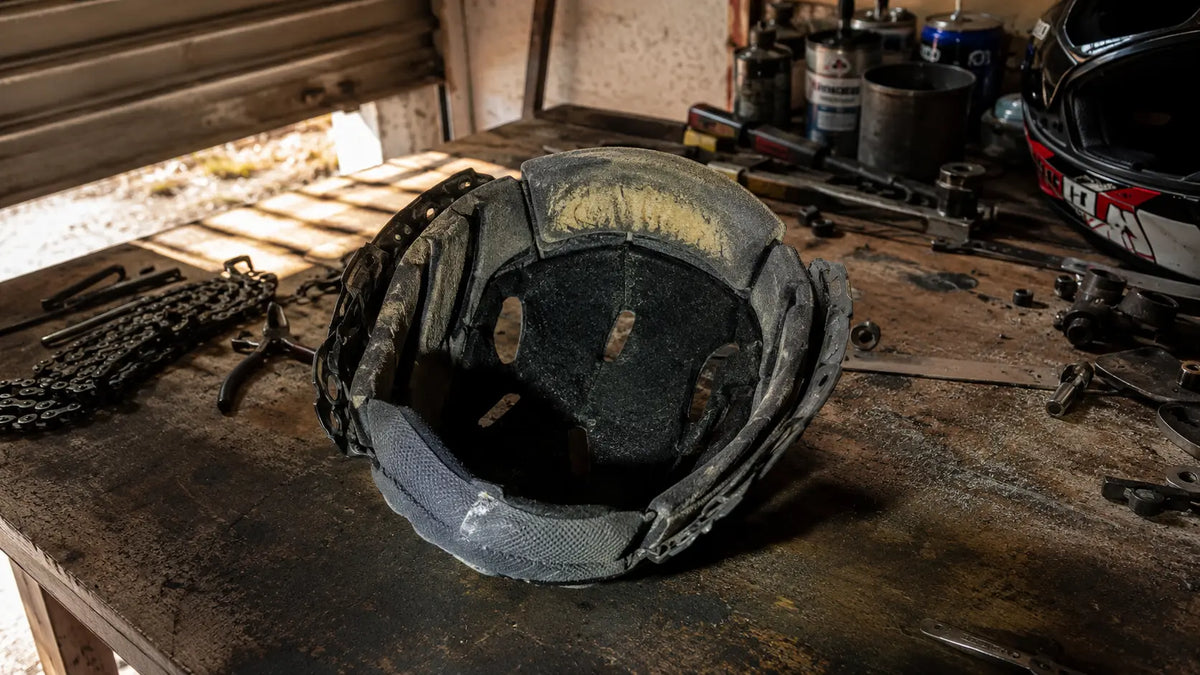
You've worn the same helmet for three years without a real deep clean. No rash yet, no infection, so it feels like nothing's wrong.
That's the part that catches riders off guard. Poor hygiene doesn't announce itself. It builds quietly, ride after ride, until a helmet is carrying bacteria that's already resistant to common antibiotics.
Here's what the actual studies say happens to your skin, scalp, and long-term health. This is about years of skipped hygiene, not just a few weeks.
Rider Takeaways
- A 2020 study found 39% of bacteria in unwashed motorcycle helmets were multidrug-resistant, including MRSA strains.
- Years of sweat and friction under a helmet are linked to chronic scalp seborrheic dermatitis. A 2025 global study found it disrupts work and personal life.
- Riders who log the longest hours, like delivery riders, face the highest exposure to skin and biological hazards.
- None of this needs a dramatic fix. It needs a habit you actually keep up.
Your body isn't unprepared for this. Skin and immune defenses fight off low-level bacterial exposure without you noticing. That's exactly why nothing feels wrong for months or years.
But that defense has limits. Keep feeding it multidrug-resistant bacteria, ride after ride, and eventually something gets through. That could be a stubborn infection, a flare-up that won't clear, or a scalp condition that sticks around.
The smell was never the real problem. It was what built up underneath it the whole time.
What's Actually Growing Inside a Helmet You Never Clean?
In 2020, a study in the International Journal of Microbiology swabbed 130 motorcycle helmets. It recovered 392 bacterial isolates and 346 fungal ones, with Staphylococcus aureus making up 22.7% of the bacteria found.
That's not just an odor problem. Helmet foam traps sweat, body oil, and dead skin in a warm, damp pocket pressed against your scalp for hours. Bacteria don't just survive there. They multiply.
India makes this worse. Between monsoon humidity and everyday garmi on a city commute, helmet foam rarely gets a full dry-out between rides. The warm, damp environment those researchers described doesn't let up for months at a stretch in most Indian cities.
Wipe your helmet with a wet cloth once a month, and you're barely touching what's actually living inside the liner.
Quick Fact:
A 2020 study in the International Journal of Microbiology found 392 bacterial isolates and 346 fungal isolates across 130 sampled motorcycle helmets, with Staphylococcus aureus making up 22.7% of bacteria recovered. Source: Sapkota et al., International Journal of Microbiology, 2020
A 2020 study in the International Journal of Microbiology found 392 bacterial isolates and 346 fungal isolates across 130 sampled motorcycle helmets, with Staphylococcus aureus making up 22.7% of bacteria recovered. Source: Sapkota et al., International Journal of Microbiology, 2020

Can Ignoring Helmet Hygiene Lead to Antibiotic-Resistant Infections?
Yes, and this is the part most riders never hear. The same 2020 study found 39.0% of bacterial isolates from those 130 helmets were multidrug-resistant. Among the Staphylococcus aureus isolates specifically, 33.7% were methicillin-resistant, or MRSA.
MRSA is harder to treat than ordinary staph. It doesn't respond to the antibiotics doctors would normally reach for first. Riders who develop a skin infection from a contaminated helmet aren't just dealing with a rash. They're dealing with bacteria that takes longer to treat, with more targeted antibiotics.
The researchers also found extended-spectrum beta-lactamase producers at 10.4% and metallo-beta-lactamase producers at 4.3% among the isolates. Those numbers describe bacteria built to survive the drugs meant to kill them.
Quick Fact:
In the same 2020 study, 39.0% of all bacterial isolates from 130 motorcycle helmets were multidrug-resistant, and 33.7% of the Staphylococcus aureus isolates were MRSA. Extended-spectrum beta-lactamase producers made up another 10.4%. Source: Sapkota et al., International Journal of Microbiology, 2020
In the same 2020 study, 39.0% of all bacterial isolates from 130 motorcycle helmets were multidrug-resistant, and 33.7% of the Staphylococcus aureus isolates were MRSA. Extended-spectrum beta-lactamase producers made up another 10.4%. Source: Sapkota et al., International Journal of Microbiology, 2020
Why Do Riders Develop Chronic Scalp and Skin Problems After Years of Riding?
In 2025, a study spanning 20 countries and over 50,000 participants found scalp seborrheic dermatitis in 3.3% of people overall. Urban riders saw 3.8% prevalence versus 1.8% in rural areas. It peaked at 3.4% in the 16-to-39 age bracket most riders fall into.
This isn't a one-ride problem. It's cumulative. Years of trapped sweat and friction under a chin strap keep the scalp's skin barrier under constant, low-grade stress.
The same mechanism shows up on the face. Cleveland Clinic dermatologist Dr. Shilpi Khetarpal explains that pressure, heat, and rubbing from tight gear irritate skin. That friction forms acne-like bumps, a condition called acne mechanica. Riders know it as the breakout pattern that follows the exact shape of a chin strap.
Left untreated, chronic folliculitis can leave real marks. Recurring inflammation at the same follicles can scar skin and thin hair permanently, not just for a season.
Quick Fact:
A 2025 study spanning 20 countries and over 50,000 participants found scalp seborrheic dermatitis in 3.3% of people overall, rising to 3.8% in urban populations and peaking at 3.4% in the 16-to-39 age bracket most riders fall into. Source: Gupta et al., Journal of Cosmetic Dermatology, 2025
A 2025 study spanning 20 countries and over 50,000 participants found scalp seborrheic dermatitis in 3.3% of people overall, rising to 3.8% in urban populations and peaking at 3.4% in the 16-to-39 age bracket most riders fall into. Source: Gupta et al., Journal of Cosmetic Dermatology, 2025
Unique Insight
Our finding: Most riders treat helmet acne and scalp irritation as separate, one-off annoyances. But both come from the same three ingredients: heat, moisture, and friction, repeated thousands of times over years of riding. Fix the environment inside the helmet, and both problems shrink together.
Does Skipping Hygiene Affect More Than Just Skin and Scalp?
For riders who spend the most hours in the saddle, yes. A 2025 occupational health study of 709 motorcycle food delivery riders found 22.0% had skin burns. Another 22.7% had been exposed to biological hazards on the job.
The same riders reported musculoskeletal problems at 62.1% and eye issues at 45.1%. Long hours in gear compound every hygiene risk instead of just adding to it.
For a delivery rider, a skin infection isn't just uncomfortable. Time off to treat it means lost shifts. Lost shifts mean lost income for riders paid per delivery, not by the hour.
Feet aren't spared either. Riding boots trap the same heat and moisture that a helmet does. That combination is a well-documented trigger for fungal foot infections, and monsoon commutes recreate it every day.
Quick Fact:
A 2025 survey of 709 motorcycle food delivery riders found 62.1% reported musculoskeletal problems, 45.1% eye issues, 22.7% biological hazard exposure, and 22.0% skin burns tied to the job. Source: Journal of Occupational Medicine and Toxicology, 2025
A 2025 survey of 709 motorcycle food delivery riders found 62.1% reported musculoskeletal problems, 45.1% eye issues, 22.7% biological hazard exposure, and 22.0% skin burns tied to the job. Source: Journal of Occupational Medicine and Toxicology, 2025
What's the Long-Term Cost of Ignoring Body Odor?
It's not only physical. A 2021 study found people could smell the difference between confident and anxious sweat with 61.2% accuracy, well above chance. Body odor genuinely communicates something about you, whether you mean it to or not.
Ignore it for years and it doesn't stay a private problem. Colleagues notice. Riding buddies notice. The rider usually finds out last.
Quick Fact:
A 2021 study found people could distinguish confident sweat from anxious sweat with 61.2% accuracy, well above chance, showing that body odor genuinely communicates information about a person. Source: PLOS ONE, 2021
A 2021 study found people could distinguish confident sweat from anxious sweat with 61.2% accuracy, well above chance, showing that body odor genuinely communicates information about a person. Source: PLOS ONE, 2021
This is where the fix stops being complicated. A bacteriostatic helmet spray like Hygena doesn't mask the smell. It goes after the bacteria causing it instead, so your helmet stays fresher between washes.

Frequently Asked Questions
Can a dirty helmet actually cause a skin infection?
Yes. A 2020 study found Staphylococcus aureus in 22.7% of bacteria isolated from 130 unwashed helmets. Over a third of those isolates were MRSA. Prolonged contact with contaminated foam can trigger folliculitis or worse.
Is helmet acne the same as regular acne?
No. It's called acne mechanica, caused by heat, pressure, and friction rather than oil alone, per Cleveland Clinic dermatology guidance. It follows the exact contact points of your helmet and strap.
Are delivery riders more at risk than casual riders?
Yes. A 2025 study of 709 delivery riders found 22.7% had faced biological hazard exposure. Another 22.0% had skin burns, both tied directly to hours spent in gear.
How often should I actually clean my helmet to avoid this?
Deep clean the liner every 2 to 4 weeks, and treat the interior with an antibacterial spray after most rides. Bacteria multiply fast in a warm, damp liner, so gaps of months let resistant strains build up.
Conclusion
Poor rider hygiene doesn't cause a single dramatic event. It compounds, ride after ride, into scalp conditions, resistant bacteria, and skin problems that outlast the ride that caused them.
None of these outcomes need to happen. Every stat in this article traces back to the same root cause: gear that never gets properly cleaned.
The fix isn't a deep clean once a year. It's a habit you keep between them, and that's exactly what Hygena is built for.
Sources
1. "Microbial Diversity and Antibiotic Susceptibility Pattern of Bacteria Associated with Motorcycle Helmets," Sapkota et al., International Journal of Microbiology, 2020. Retrieved 2026-09-01.
2. "Large-scale international study on scalp seborrheic dermatitis: Prevalence, demographics, healthcare trends and quality of life," Gupta et al., Journal of Cosmetic Dermatology, 2025. Retrieved 2026-09-01.
3. "Daily Mask Wearing Is Hard on Skin: What To Do for 'Maskne' and Facial Bruises," Cleveland Clinic, 2020. Retrieved 2026-09-01.
4. "Assessment of occupational hazards, health effects, and personal protective equipment usage among motorcycle food delivery riders in Thailand," Journal of Occupational Medicine and Toxicology, 2025. Retrieved 2026-09-01.
5. "The role of fragrance and self-esteem in perception of body odors and impressions of others," PLOS ONE, 2021. Retrieved 2026-09-01.
Share:
Helmet Cleaning Spray Jaipur: Made Here, Proven Locally
Helmet Cleaner Bikaner: What Desert Dust Does to It