
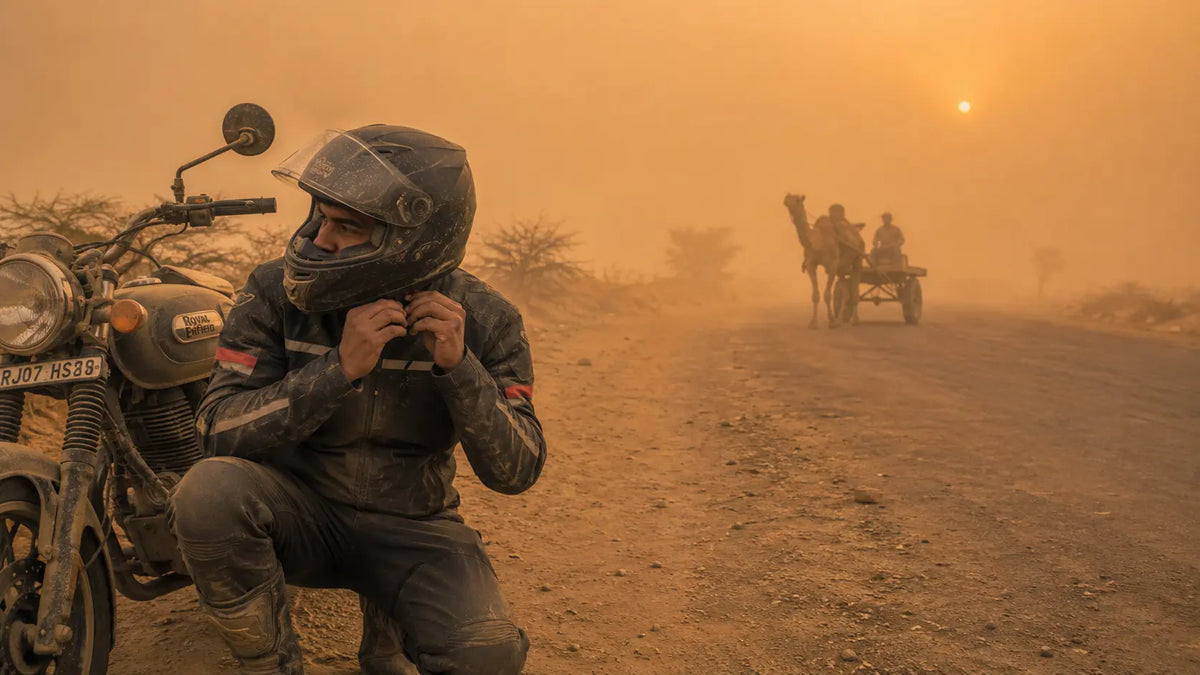
You're two minutes from Kote Gate market when the sky turns turmeric-yellow. The wind picks up past 60 kmph. That's a Bikaner dust storm. Your helmet is the only thing between your face and a wall of Thar desert grit.
Riders here deal with more than heat, though Bikaner's May afternoons average 42.7°C. They deal with dust that works its way into everything, including the padding you never think to clean. Search "helmet cleaner Bikaner" and most results just cover wiping down the shell. That does nothing for what's building up inside. Here's what Bikaner's climate, traffic, and desert dust actually do to a helmet, and what actually stops it.
Rider Takeaways
- Summer highs average 42.7°C. Humidity climbs from 28% in May to 60% by August (Climatestotravel, 1991-2020). Sweat keeps feeding bacteria well past the hottest month.
- Bikaner's dust storms bring winds up to 60-70 kmph (recorded May 30, 2026). That pushes grit and airborne bacteria straight into helmet vents, not just the visor.
- Desert dust isn't sterile. A 2025 Scientific Reports study found seven bacterial species, including Staph, living inside dust from an arid, dust-prone city.
- Wiping the shell down after a storm is cleaning. It's not hygiene, and the liner needs something built to kill bacteria, not just move grit around.
How Hot Does It Actually Get Inside a Bikaner Rider's Helmet?
Bikaner's May average high is 42.7°C, with lows still near 27.7°C overnight. A helmet rarely gets a real chance to cool down between rides. The city has hit far worse: an official record of 49.5°C was set on May 19, 2016.
Quick Fact:
Bikaner's May average high is 42.7°C (min 27.7°C), per Climatestotravel's 1991-2020 dataset, with an official record of 49.5°C set May 19, 2016. Relative humidity climbs from 28% in May to 60% by August as the monsoon arrives, keeping sweat production high well past the hottest month. Source: Climatestotravel.com and Wikipedia, Bikaner.
Bikaner's May average high is 42.7°C (min 27.7°C), per Climatestotravel's 1991-2020 dataset, with an official record of 49.5°C set May 19, 2016. Relative humidity climbs from 28% in May to 60% by August as the monsoon arrives, keeping sweat production high well past the hottest month. Source: Climatestotravel.com and Wikipedia, Bikaner.
What Happens to Bikaner's Roads When a Dust Storm Hits?
On May 30, 2026, a dust storm hit Bikaner with winds up to 60-70 kmph. It turned the afternoon sky the color of turmeric. Visibility on major roads dropped sharply within minutes.
Riders caught outside had two choices. Pull over and wait it out, or keep moving with a helmet as the only real shield against the grit.
Quick Fact:
A May 30, 2026 dust storm brought 60-70 kmph winds to Bikaner, dropping visibility sharply on major roads, forcing shopkeepers to shutter early, and triggering localized power outages; the local meteorological center warned similar conditions could persist four to five days across Rajasthan. Source: OpIndia, May 2026.
A May 30, 2026 dust storm brought 60-70 kmph winds to Bikaner, dropping visibility sharply on major roads, forcing shopkeepers to shutter early, and triggering localized power outages; the local meteorological center warned similar conditions could persist four to five days across Rajasthan. Source: OpIndia, May 2026.
That's not a once-a-year event. Bikaner sits at the edge of the Thar Desert. Dust storms are a recurring feature of its pre-monsoon summer, not a rare disruption. Every storm means more grit forced through helmet vents, not just settled on the visor.

Is the Dust Itself Making Your Helmet Dirtier?
Yes. Desert dust isn't just grit, it carries its own bacteria. A 2025 study in Scientific Reports sampled airborne dust from a dust-prone arid city. It found seven bacterial species inside the particulate matter itself, identified through genetic sequencing.
Combine that with sweat, and a Bikaner helmet liner isn't just holding onto what your scalp produces. It's holding onto what blew in through the vents, too.
Quick Fact:
Mahroos et al. (Scientific Reports, 2025) analyzed dust collected from a dust-prone arid region and identified seven bacterial species via 16S rRNA sequencing, including Staphylococcus, Enterococcus faecium, and Acinetobacter radioresistens, organisms the study classified as risk-group 1-2 opportunistic pathogens capable of causing skin and wound infections. Source: Nature, Scientific Reports, 2025.
Mahroos et al. (Scientific Reports, 2025) analyzed dust collected from a dust-prone arid region and identified seven bacterial species via 16S rRNA sequencing, including Staphylococcus, Enterococcus faecium, and Acinetobacter radioresistens, organisms the study classified as risk-group 1-2 opportunistic pathogens capable of causing skin and wound infections. Source: Nature, Scientific Reports, 2025.
A wipe-down or spray-and-forget cleaner doesn't reach bacteria embedded in foam padding. It needs something built to kill bacteria, not just move it around inside the liner.
Unique Insight
Our finding: every prior Rajasthan city post in this series has focused on heat-driven bacterial growth from sweat alone. Bikaner is the first where the dust itself, not just the sweat it mixes with, is a documented carrier of live bacteria, a genuinely separate contamination path into the same helmet.
Why Do Bikaner Riders Spend So Much Time in the Saddle?
Bikaner's economy runs on more than temple visits. Bikaneri Bhujia is the GI-tagged namkeen that built Haldiram's, Bikaji, and Bikanervala. It still ships out of Bikaner by the truckload. That supply chain keeps two-wheelers moving between factories, wholesale markets, and Kote Gate's old-city lanes all day.
Add Karni Mata Temple's pilgrim traffic, 30 km south down NH89 in Deshnoke. Add the steady flow to the National Research Centre on Camels too. Riders end up with helmet-on time that runs far longer than a quick errand suggests.
Quick Fact:
Bikaneri Bhujia carries a Geographical Indication tag, and its industry traces back to a Bikaner native who founded Haldiram's, alongside Bikaji and Bikanervala, both still headquartered in the city. Karni Mata Temple, 30 km south in Deshnoke, houses roughly 20,000 sacred rats and draws pilgrim traffic through two annual Navratri fairs. Source: Wikipedia, Bikaner and Wikipedia, Karni Mata Temple.
Bikaneri Bhujia carries a Geographical Indication tag, and its industry traces back to a Bikaner native who founded Haldiram's, alongside Bikaji and Bikanervala, both still headquartered in the city. Karni Mata Temple, 30 km south in Deshnoke, houses roughly 20,000 sacred rats and draws pilgrim traffic through two annual Navratri fairs. Source: Wikipedia, Bikaner and Wikipedia, Karni Mata Temple.
Unique Insight
Our finding: most Rajasthan riding cities in this series are driven by office traffic or coaching-center commutes. Bikaner's core helmet-on time is driven by food-export logistics and pilgrimage traffic instead, which means longer, slower, dustier stretches per ride, not just more of them.
Helmet Cleaner Bikaner: Why a Wipe-Down Isn't Enough
Not on its own. A helmet cleaner lifts dirt and grime off the shell and visor. That's exactly what a dust storm leaves behind on the outside. It isn't built to kill bacteria multiplying in the sweat-soaked liner underneath. In Bikaner, that liner deals with heat, sweat, and dust-borne bacteria at once.
Hygena isn't a cleaner. It's a bacteriostatic hygiene spray: tea tree, neem, and hydrogen peroxide. It's built to stop bacteria from multiplying at the source, not mask what's already there.
| What you need | Helmet cleaner / wipe-down | Hygena bacteriostatic spray |
|---|---|---|
| Removes visible dust and grit | Yes | Not its job |
| Kills odor-causing bacteria | No | Yes |
| Works after a dust storm | Surface only | Reaches liner and padding |
| Prevents bacterial regrowth between rides | No | Yes |
The Helmet Cleaner Bikaner Riders Actually Need
A Bikaner rider needs something that survives a 42°C afternoon and a dust storm's worth of grit. It has to handle the sweat both leave behind, without a full wash between every ride.
That's what Hygena is built for. A few sprays inside the liner after a dusty ride target the bacteria feeding on sweat and settled dust. That stops them before they multiply into a smell you'd have to fight later. It's not a rinse, and it's not a fragrance. It kills what's actually causing the problem.

Frequently Asked Questions
Does Bikaner's dust make helmet smell worse than the heat does?
Both compound each other. Bikaner's May humidity sits near 28% but climbs to 60% by August. A 2025 Scientific Reports study also found live bacteria inside desert dust itself. Heat drives sweat, dust adds its own bacterial load, and together they multiply faster than either alone.
How often should I clean my helmet during Bikaner's dust storm season?
After any storm with visible dust exposure, at minimum. Bikaner sees dust events with winds up to 60-70 kmph through the pre-monsoon months. Each one deposits grit and bacteria directly into the liner, not just the outer shell.
Can I just wipe my helmet down after a dust storm?
A wipe-down removes visible grit from the shell and visor. It doesn't reach bacteria embedded in the foam padding or liner stitching, which is where the actual odor problem starts. Cleaning and hygiene solve two different problems.
Where can I buy helmet deodorant spray in Bikaner?
Hygena's bacteriostatic helmet spray ships directly to Bikaner through hygena.in. There's no need for a local storefront visit. A bottle reaches you the same way it reaches riders anywhere else in Rajasthan.
Does a helmet cleaner kill bacteria too?
Most helmet cleaners are built to lift dirt and grime, not to kill bacteria. Hygena's bacteriostatic formula, tea tree, neem, and hydrogen peroxide, targets the bacteria itself. That's the actual source of the smell cleaning alone won't fix.
Conclusion
Bikaner's helmet problem isn't just heat, and it isn't just dust. It's both at once. 42.7°C afternoons keep sweat production high, and dust storms carry their own bacteria straight into the liner through the vents. A helmet cleaner handles the visible grit. It leaves the actual source of the smell untouched.
Hygena's bacteriostatic spray goes after the bacteria directly, whether it came from sweat, dust, or both. A few sprays after a dusty ride keep the liner from turning into a problem you'd notice a week later. Shop Hygena's helmet deodorant spray at hygena.in. Check out our guide on how often you should really clean your motorcycle helmet for a full routine.
Sources
1. "Bikaner Climate," Climatestotravel.com, 1991-2020 averages. Retrieved 2026-09-01.
2. "Bikaner," Wikipedia. Retrieved 2026-09-01.
3. "Bikaner district," Wikipedia. Retrieved 2026-09-01.
4. "Massive dust storm engulfs Bikaner, triggers power outages and traffic chaos," OpIndia, May 30, 2026. Retrieved 2026-09-01.
5. Mahroos, F., Habiba, S., Lazreg, I.K., Kanan, S., Samara, F., "Characterization and health risk assessment of chemical and microbial pollutants in particulate matter from dust prone regions," Scientific Reports, 2025. Retrieved 2026-09-01.
6. "Karni Mata Temple," Wikipedia. Retrieved 2026-09-01.
Share:
How Poor Hygiene Habits Affect Rider Health Long-Term
Helmet Cleaning Spray Indore: Does It Really Work?