
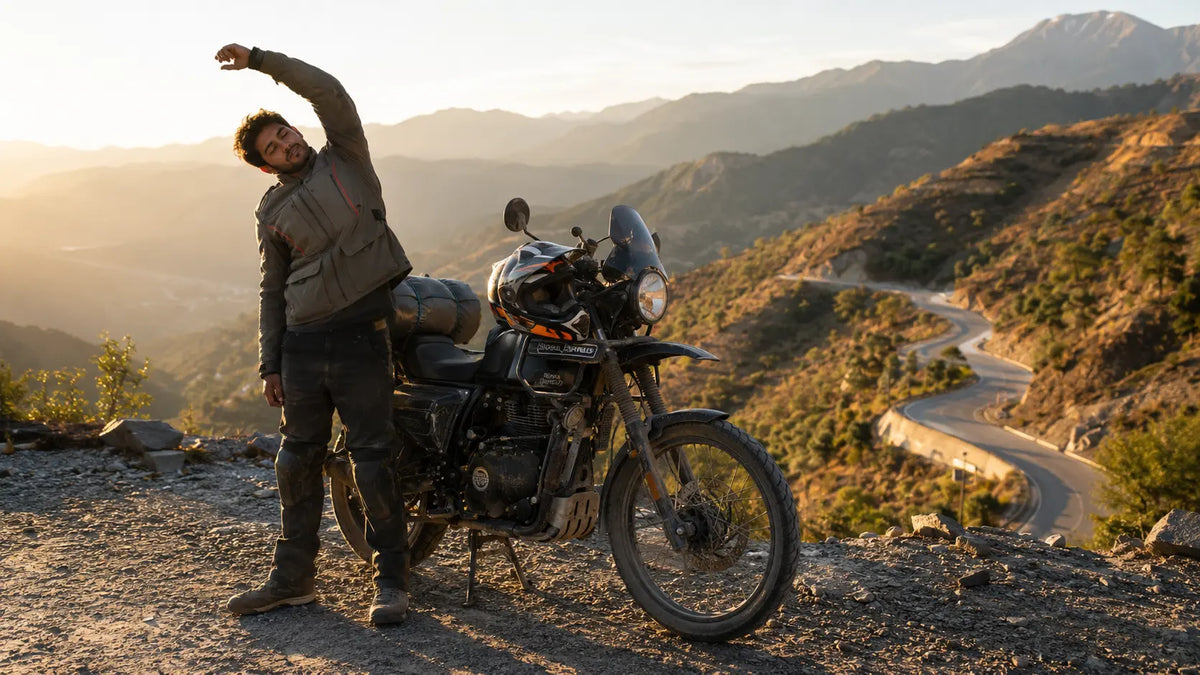
Six hours into a tour, your shoulders ache and your grip feels weaker. You can smell yourself over the exhaust fumes. None of that is in your head.
A 2021 case study on motorcycle touring found something clear. Long stretches in the saddle cause muscle fatigue and slower reaction times. Heat, sweat, and hours of static posture all work against your body at the same time. Most riders treat this as normal wear and tear. It isn't, and there's a way to ride through it without falling apart by day three.
Rider Takeaways
- A 2021 case study found forearm fatigue in 84% of the extensor digitorum communis muscle after extended riding - your grip goes before you notice it.
- Losing just 2% of your body's water measurably slows reaction time, according to motorcycle-medicine research covered by RevZilla's touring medicine coverage.
- A 2018 study on Indian sweat chemistry identified 36 previously undocumented compounds. That's one reason gear odor on Indian tours is so stubborn.
- Sunscreen loses up to 80% of its coverage to sweat, so reapplying every two hours matters more than the SPF number on the bottle.
Why Do Long Motorcycle Tours Drain Your Body So Fast?
In 2021, a published case study on motorcycle touring found that forearm muscles fatigue unevenly and fast. The extensor digitorum communis keeps your fingers extended on the grips. It showed fatigue markers in 84% of measurements, compared to 44% and 39% in neighboring forearm muscles. That's why your hands cramp before your legs do.
The same research tracked a rider across a 1,487 km tour. By the end, auditory reaction times were slower and left hand-grip strength had dropped. You're not imagining the dullness that creeps in on day two of a long ride. Your nervous system and muscles are both running a deficit.
Riding isn't passive. You're bracing against wind, absorbing every pothole through your wrists and spine, and holding a fixed posture for hours. None of that shows up on a speedometer, but your body keeps score.
Engine and road vibration adds a second layer riders rarely account for. Constant low-level vibration through the handlebars and footpegs forces small stabilizing muscles in your hands and calves to fire nonstop. Even steady highway speed doesn't give them a break. It's a quiet drain, and it adds up faster on cheaper suspension or rougher roads.
Quick Fact:
A 2021 case study measured forearm muscle fatigue in a touring motorcyclist and found the extensor digitorum communis fatigued in 84% of trials, far more than other forearm muscles. Reaction time and grip strength also dropped over a 1,487 km ride. Source: Muscle Fatigue When Riding a Motorcycle: A Case Study
A 2021 case study measured forearm muscle fatigue in a touring motorcyclist and found the extensor digitorum communis fatigued in 84% of trials, far more than other forearm muscles. Reaction time and grip strength also dropped over a 1,487 km ride. Source: Muscle Fatigue When Riding a Motorcycle: A Case Study
How Much Water Do You Actually Need on a Long Ride?
In 2015, researchers at the University of Wollongong tested riders in full protective gear at 25°C, 30°C, and 35°C. At 35°C, core body temperature climbed fast. Researchers predicted moderate heat strain within 105 minutes and profound heat strain within three hours. At 25°C, neither threshold was reached at all.
Temperature is the difference between a manageable ride and a genuinely dangerous one. Your gear traps heat that a car's air conditioning would otherwise remove. Sweat evaporates faster in dry heat than you can even feel it happening.
Losing 2% of your body's water is enough to measurably slow reaction time, according to touring-medicine coverage from RevZilla. That's a small percentage with a real effect on how fast you brake or swerve. Riders heading into the Himalayas often follow a 4 to 5 litre daily hydration target. It's adjusted for altitude and effort, not chugged at once.
Kitni paani piya, yaad hai? If you can't remember your last sip, that's already a sign you're behind on hydration, not ahead of it.
Plain water alone isn't enough on a full riding day. You lose sodium and potassium through sweat along with water. Replacing only the water can leave you feeling foggy even after drinking plenty. A pinch of electrolyte powder or an ORS sachet in one bottle every few hours keeps that balance in check. It matters most on hot plains stretches or high-altitude climbs, where sweat and altitude both push fluid loss higher.
What's Actually Causing That Body Odor After Hours in the Saddle?
In 2018, a study on Indian sweat chemistry analyzed local samples. It found 36 chemical compounds never documented before. Sweat isn't a simple mix of water and salt. It's a complex chemical signature, and bacteria feed on parts of it that don't evaporate.
Here's the part most riders miss: the smell you notice at a fuel stop isn't fresh sweat. It's bacteria, multiplying inside your helmet padding, gloves, and riding jacket for hours in a warm, damp, enclosed space. Airing your gear out overnight slows this down. It doesn't stop it.
This is exactly the gap Hygena was built for. Its bacteriostatic spray targets the bacteria inside your helmet liner directly. A body spray or fabric freshener only masks the smell with fragrance. A few sprays before you close your helmet keeps bacterial growth in check for the ride ahead. Day four of a tour won't smell like day one gone wrong.
Unique Insight
Our finding: Riders on multi-day tours often blame gear odor on sweat volume alone. The chemistry says otherwise — it's what's living in that sweat, not how much of it there is, that determines how bad the smell gets by day three.
Quick Fact:
A 2018 study on Indian sweat chemistry found 36 previously undocumented compounds in Indian sweat samples, underlining how variable and complex sweat composition really is. Source: Characterization of Chemical Constituents of Human Sweat: A Study Based on Indian Population
A 2018 study on Indian sweat chemistry found 36 previously undocumented compounds in Indian sweat samples, underlining how variable and complex sweat composition really is. Source: Characterization of Chemical Constituents of Human Sweat: A Study Based on Indian Population

A Simple Skincare Routine to Protect Your Skin on Tour
In 2000, a study tracked cyclists across an eight-stage tour. UV exposure levels came in more than 30 times over international recommended limits, even with partial face coverage. Full-face helmets cut this down, but every hour outdoors still counts against your skin.
Sunscreen is doing less work than you think it is. Research on sunscreen habits among cyclists found that nearly half of users applied it only once a day. Dermatologists estimate up to 80% of sunscreen wears off through sweat within a couple of hours. On a six-hour riding day, that's one application for a job that needs three.
Windburn adds to the damage. What looks like wind-chapped skin is often sunburn made worse by wind stripping away your skin's natural oil barrier. A basic routine covers most of it. Apply SPF 30+ on exposed skin before you gear up. Carry a lip balm with SPF in your tank bag. Add a light moisturizer at your next stop to rebuild what the wind took.
Have you actually reapplied sunscreen since you left this morning, or has it been riding on yesterday's layer?
Quick Fact:
Dermatology research on cyclists found that up to 80% of sunscreen can wear off through sweat within hours, and nearly half of users reapply only once per day. Source: Dermatology Times, Sunscreen Use Among Cyclists Falls Short
Dermatology research on cyclists found that up to 80% of sunscreen can wear off through sweat within hours, and nearly half of users reapply only once per day. Source: Dermatology Times, Sunscreen Use Among Cyclists Falls Short
What Fitness Habits Actually Help on Multi-Day Tours?
Riding burns roughly 100 to 300 calories an hour on-road, rising past 600 for aggressive off-road stretches. Most of that comes from core and postural muscles working to keep you upright through turns and traffic. That's real effort, but it isn't a substitute for a fitness routine.
The riders who feel strongest on day five of a tour usually aren't the fittest at the gym. They're the ones who stop, stretch, and reset every couple of hours instead of pushing through stiffness. A five-minute routine at your fuel stop does more for you than skipping breaks to save time.
Three things help most. Shoulder rolls and wrist stretches counter the grip fatigue from earlier. A short walk resets circulation in your legs. A few deep breaths lower your heart rate before you get back on. None of it takes more than the time it takes to refuel.
For the wrists specifically, extend one arm out and gently pull your fingers back with the other hand. Hold for 15 seconds, then switch. Follow it with a loose fist-and-release motion ten times per hand. It's a small routine. But it directly targets the extensor digitorum communis, the exact muscle the 2021 study flagged as fatiguing first.
Building general strength before a tour helps too. Riders who do even light strength training in the weeks before a multi-day trip report less soreness by day three. Stronger core and shoulder muscles simply don't have to work as hard to hold riding posture over long stretches.
Unique Insight
Our finding: Most touring fatigue advice focuses on the legs and lower back. The research points somewhere less obvious: your forearms fatigue first and fastest, which means grip-focused stretches deserve more attention than they usually get.

Eating, Sleeping, and Recovering Right Mid-Tour
Altitude touring adds a layer most riders underestimate. On routes like Ladakh, riders are advised to stay at high passes for only 15 to 20 minutes before descending. Thin air combined with physical exertion accelerates altitude sickness risk. Recovery isn't optional at altitude. It's the whole plan.
Digestion also slows at altitude and after long riding days, even though you're burning more energy. Light, frequent meals work better than one heavy dhaba plate. A big plate leaves you sluggish for the next two hours on the bike.
Sleep is the recovery step riders skip most. A short, consistent wind-down before bed matters more for tomorrow's alertness than 30 extra minutes of riding tonight. Even a basic guesthouse works. Your reaction time the next morning depends on it.
A basic end-of-day routine covers most of it. Rinse off road dust before you sleep. Keep your gear laid out to dry rather than balled up in a bag. Eat your last meal at least an hour before lying down, so digestion doesn't compete with rest. Riders who skip this most often wake up more tired than when they stopped riding.
Frequently Asked Questions
How much water should a biker drink on a long tour?
Most touring guides recommend 4 to 5 litres a day, sipped steadily rather than consumed all at once. Add electrolytes on hot or high-altitude days. Losing just 2% of body water measurably slows reaction time.
Why do my hands and forearms get tired before anything else?
A 2021 case study found the extensor digitorum communis, a key grip muscle, fatigued in 84% of trials. That's more than any other forearm muscle measured.
How often should I reapply sunscreen while riding?
Every two hours at minimum. Dermatology research shows up to 80% of sunscreen can wear off through sweat within hours. Applying it once in the morning leaves most of the day unprotected.
Does riding a motorcycle count as exercise?
It engages your core and postural muscles and burns roughly 100 to 300 calories an hour. It doesn't replace dedicated strength or cardio training for touring fitness.
What causes body odor on multi-day tours if I'm showering regularly?
Bacteria trapped in helmet padding and gear multiply for hours between washes. A 2018 study found Indian sweat contains dozens of compounds that feed this process. Showering handles your skin, not your gear.
Conclusion
Long tours put real, measurable strain on your body. Fatigued grip muscles, rising heat stress, sun damage, bacteria multiplying inside gear you can't wash mid-ride. None of it is dramatic on its own, which is exactly why riders ignore it until day three.
Hydration, sunscreen, short stretch breaks, and a helmet that isn't breeding bacteria between stops handle most of it. Hygena covers the one part riders forget fastest. It keeps your helmet hygienic for the next leg, instead of leaving it for the destination.
Sources
1. de Rome L, Taylor EA, Croft RJ, Brown J, Taylor NAS. "Can motorcycle riding in Australia really be that thermally stressful?" Extreme Physiology & Medicine, 2015. Retrieved 2026-07-05.
2. "Muscle Fatigue When Riding a Motorcycle: A Case Study." PubMed, 2021. Retrieved 2026-07-05.
3. "Characterization of Chemical Constituents of Human Sweat: A Study Based on Indian Population." PubMed, 2018. Retrieved 2026-07-05.
4. Skin Cancer Foundation. "Against the Wind," 2021. Retrieved 2026-07-05.
5. Dermatology Times. "Sunscreen Use Among Cyclists Falls Short," 2023. Retrieved 2026-07-05.
6. RevZilla Common Tread. "A Motorcycle Racing Doctor's Tips for Avoiding Dehydration When Riding." Retrieved 2026-07-05.
7. Royal Bike Riders. "Prepare for a Motorcycle Trip to Ladakh." Retrieved 2026-07-05.
8. VikingBags. "Does Riding a Motorcycle Burn Calories?" Retrieved 2026-07-05.
Share:
Budget Bike Trip India: How to Do It Under ₹20,000
How to Avoid Rider Fatigue on Long Motorcycle Trips