
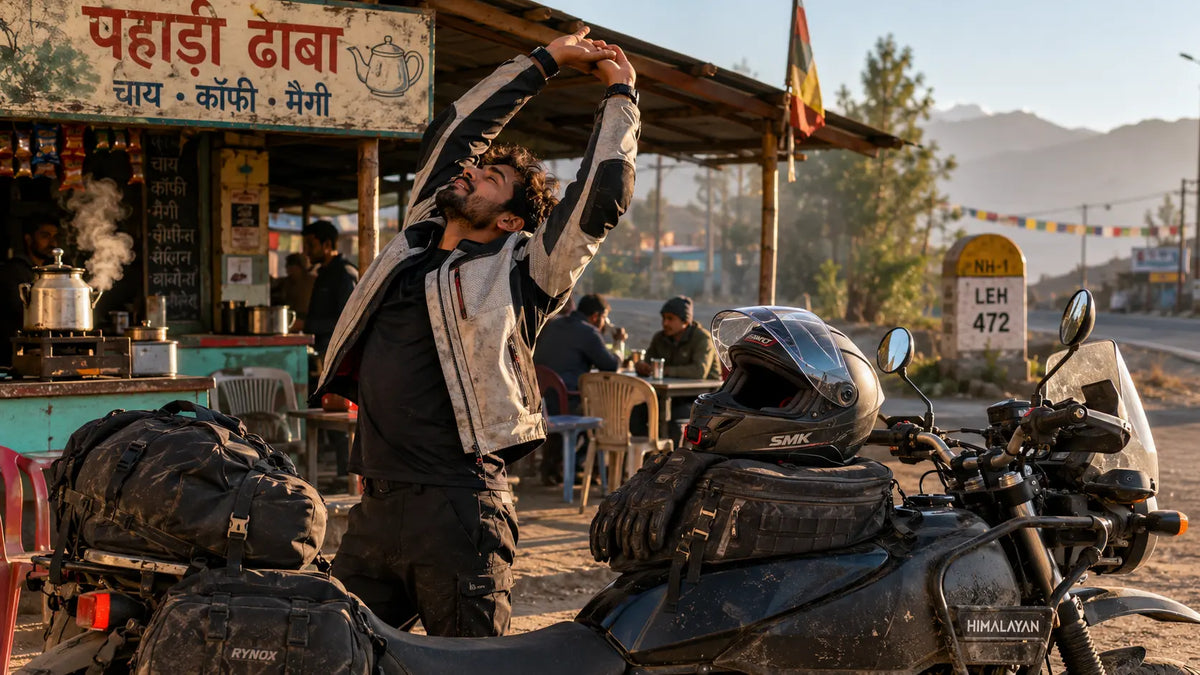
Somewhere around kilometre 250, your shoulders stop feeling like shoulders. Your eyes blink a half-second too long. You tell yourself it's just the heat.
It isn't just the heat. It's fatigue, and it builds faster on a motorcycle than in a car. Wind, vibration, a hot helmet, and hours of muscle tension add up before you feel "tired" in the normal sense.
This guide breaks down what actually causes rider fatigue on long trips. It also covers the specific habits, including the one most riders skip, that keep you alert until the last kilometre.
Rider Takeaways
- In a 2023 hospital study of two-wheeler crash victims in Benin, 12.2% reported fatigue in the moments before their collision.
- Staying awake for 17 hours straight impairs reaction time about as much as a 0.05% blood alcohol level, per a 1997 Nature study.
- A hot, sweaty helmet doesn't just feel unpleasant. It compounds physical strain that's already working against you on a long ride.
- Stopping every 90 minutes, hydrating properly, and keeping your gear fresh are the three habits that make the biggest difference.
What Causes Rider Fatigue on Long Motorcycle Trips?
In 1997, researchers Dawson and Reid published a study in Nature. It showed that 17 hours of sustained wakefulness impairs cognitive performance about as much as a 0.05% blood alcohol level. After 24 hours, it's closer to 0.10%. Fatigue isn't a feeling you can push through. It's measurable impairment.
Riding adds its own layer on top of that. You're managing wind buffeting, engine vibration, road noise, and constant micro-corrections to stay balanced. None of that happens in a car seat. A 2018 systematic review of motorcyclist physical fatigue found that postural strain builds steadily over a ride. Vibration and awkward seating positions are the main causes, even in riders who slept well the night before.
So fatigue on a bike usually comes from two directions at once: how rested you were before you left, and how much physical load the ride itself puts on your body.
Quick Fact:
In a 2023 study published in the Journal of Public Health in Africa, researchers analysed hospital data from two-wheeler crash victims. 12.2% reported fatigue in the moments before their collision. Risk climbed sharply at night and on long-distance trips. Source: Glèlè Ahanhanzo et al., 2023
In a 2023 study published in the Journal of Public Health in Africa, researchers analysed hospital data from two-wheeler crash victims. 12.2% reported fatigue in the moments before their collision. Risk climbed sharply at night and on long-distance trips. Source: Glèlè Ahanhanzo et al., 2023
Why a Hot, Sweaty Helmet Makes Fatigue Worse
In 2015, researchers at the University of Wollongong tested riders in full protective gear at rising temperatures. At 25°C, wearing a helmet and jacket raised skin temperature by 2°C. Heart rate rose by 12 beats per minute compared to riding unprotected. At 35°C, riders were projected to reach moderate hyperthermia within about 105 minutes.
Your body doesn't treat that heat load as background noise. It's working overtime to cool your head while you're also trying to focus on traffic. That's two demanding jobs running at once, and something has to give.
Here's the part most riders miss. A helmet already carrying days of sweat and bacteria traps heat and moisture far worse than a fresh one. Damp foam doesn't wick sweat the way it did on day one. The same ride feels hotter, itchier, and more distracting by day three than it did on day one.
Quick Fact:
In a 2015 laboratory study, full motorcycle protective gear at 25°C raised riders' skin temperature by 2°C. Heart rate rose by 12 beats per minute compared to unprotected riding. At 35°C, moderate hyperthermia was projected within 105 minutes. Source: de Rome et al., Extreme Physiology & Medicine, 2015
In a 2015 laboratory study, full motorcycle protective gear at 25°C raised riders' skin temperature by 2°C. Heart rate rose by 12 beats per minute compared to unprotected riding. At 35°C, moderate hyperthermia was projected within 105 minutes. Source: de Rome et al., Extreme Physiology & Medicine, 2015

Unique Insight
Our finding: Riders rarely name their helmet as a fatigue factor because it doesn't feel dramatic. It shows up as small distractions: an itch you keep adjusting, a smell you keep noticing. Together, they chip away at focus over a 300 km day.
The 90-Minute Rule: How Often You Should Actually Stop
Touring riders and safety researchers generally agree: plan a stop at least every 90 minutes. Do this regardless of how fresh you feel. Fatigue doesn't announce itself early. By the time you notice it, your reaction time has already slipped.
In the same Benin study, distance itself showed up as a risk factor. Inter-state and long-distance riders showed two to four times higher odds of a fatigue-related crash than local riders.
Use every stop for more than fuel. Stretch your neck and shoulders. Splash water on your face. Take 30 seconds to freshen the inside of your helmet too. A cooler, drier liner makes the next 90 minutes easier on your focus.
Quick Fact:
The same 2023 hospital-data study found fatigue-related crash odds were nearly seven times higher for night riders (aOR 6.90). Odds were over four times higher at dusk (aOR 4.22) than in full daylight. That's why timed breaks matter most on longer, later trips. Source: Glèlè Ahanhanzo et al., 2023
The same 2023 hospital-data study found fatigue-related crash odds were nearly seven times higher for night riders (aOR 6.90). Odds were over four times higher at dusk (aOR 4.22) than in full daylight. That's why timed breaks matter most on longer, later trips. Source: Glèlè Ahanhanzo et al., 2023
How Do You Prep Your Gear for a Long Tour?
Most riders prep the bike the night before a tour. Chain, tyres, oil, all checked. Gear prep usually stops at "is my jacket packed?" That's the gap.
A helmet sitting in a cupboard since your last ride already carries old sweat and bacteria in the liner. Add a few hundred kilometres of fresh sweat on top. By day two of a tour, you're dealing with heat, odour, and itchiness at once. None of that helps you stay alert.
Yeh chhoti si habit bahut fark karti hai. Before you throw a leg over the bike each morning, give your helmet interior 5 seconds of attention. Hygena's bacteriostatic spray targets the bacteria causing that buildup at the source. Your helmet stays cooler and less distracting mile after mile, not masked with perfume that fades by lunch.
Quick Fact:
Hygena's helmet spray is dermatologically tested. It's formulated to inhibit bacterial growth inside helmet padding between washes, rather than masking odour with fragrance. It's currently used by more than 10,000 riders across India. Source: Hygena internal testing data, 2026.
Hygena's helmet spray is dermatologically tested. It's formulated to inhibit bacterial growth inside helmet padding between washes, rather than masking odour with fragrance. It's currently used by more than 10,000 riders across India. Source: Hygena internal testing data, 2026.

What Should You Eat, Drink, and Skip to Stay Sharp on the Road?
In a 2015 driving-simulator study, mild dehydration increased driving errors on a long, monotonous drive. The effect was similar in size to sleep deprivation or a 0.08% blood alcohol level. On a motorcycle, where sweat loss is higher due to heat trapped under gear, that risk arrives faster.
Drink water before you feel thirsty, not after. Thirst is already a lagging signal. Pair it with small, steady meals instead of one heavy lunch. A big meal pulls blood toward digestion and away from alertness.
Skip the extra-sweet chai or energy drink as your only fuel strategy. The sugar spike helps for twenty minutes, then drops you lower than before. That chai stop at the dhaba still has its place. Just don't let it replace water.
Unique Insight
Our finding: Riders who report the most "random" afternoon fatigue on tours are often skipping water at fuel stops. It's not sleep they're missing the night before. Hydration timing matters as much as hydration volume.
Frequently Asked Questions
How do I know if I'm too fatigued to keep riding?
Warning signs include drifting within your lane, missing a turn you know well, or yawning repeatedly. A 1997 Nature study found 17 hours awake impairs reaction time like a 0.05% blood alcohol level. Don't wait to "feel" tired before stopping.
How often should I take breaks on a long motorcycle ride?
Plan a stop at least every 90 minutes. A 2023 hospital study found fatigue-related crash risk climbs sharply on long-distance and night trips. Frequent, planned breaks matter more the longer your route gets.
Can a dirty or smelly helmet actually make fatigue worse?
Indirectly, yes. A 2015 study found full riding gear raises skin temperature and heart rate versus unprotected riding. A helmet already holding sweat and bacteria traps heat even worse, adding distraction on top of that strain.
Does dehydration affect motorcycle riding fatigue?
Yes. A 2015 driving study found mild dehydration increased errors on long drives. The margin was similar to sleep deprivation or a 0.08% blood alcohol level. Riders lose fluid faster than drivers due to heat trapped under gear.
What should I pack to fight fatigue on a multi-day tour?
Water, light snacks, a neck-and-shoulder stretch routine, and a daily helmet hygiene spray are basics most riders forget. Small daily maintenance beats trying to recover from accumulated fatigue on day three.
Conclusion
Rider fatigue rarely comes from one big failure. It builds from stacked small ones: a late start, a skipped stop, a helmet quietly working against you since morning.
You can't control every variable on a long tour. But sleep, timed breaks, hydration, and a fresh helmet are four you can control. Hygena handles the last one in 5 seconds, so it's one less thing pulling at your focus by kilometre 250.
Plan your next ride around these habits, not around how tired you think you'll feel.
Sources
1. "Fatigue, alcohol and performance impairment," Dawson, D. and Reid, K., Nature, 1997. Retrieved 2026-07-05.
2. "Prevalence of fatigue while driving among two-wheeled vehicle drivers and associated factors," Glèlè Ahanhanzo, Y. et al., Journal of Public Health in Africa, 2023. Retrieved 2026-07-05.
3. "Can motorcycle riding in Australia really be that thermally stressful?" de Rome, L. et al., Extreme Physiology & Medicine, 2015. Retrieved 2026-07-05.
4. "Mild hypohydration increases the frequency of driver errors during a prolonged, monotonous driving task," Watson, P. et al., Physiology & Behavior, 2015. Retrieved 2026-07-05.
5. "Understanding the impact of physical fatigue and postural comfort experienced during motorcycling: A systematic review," ScienceDirect, 2018. Retrieved 2026-07-05.
Share:
How Bikers Stay Fit and Healthy on Long Tours
The First Aid Kit Every Motorcycle Rider Should Carry