
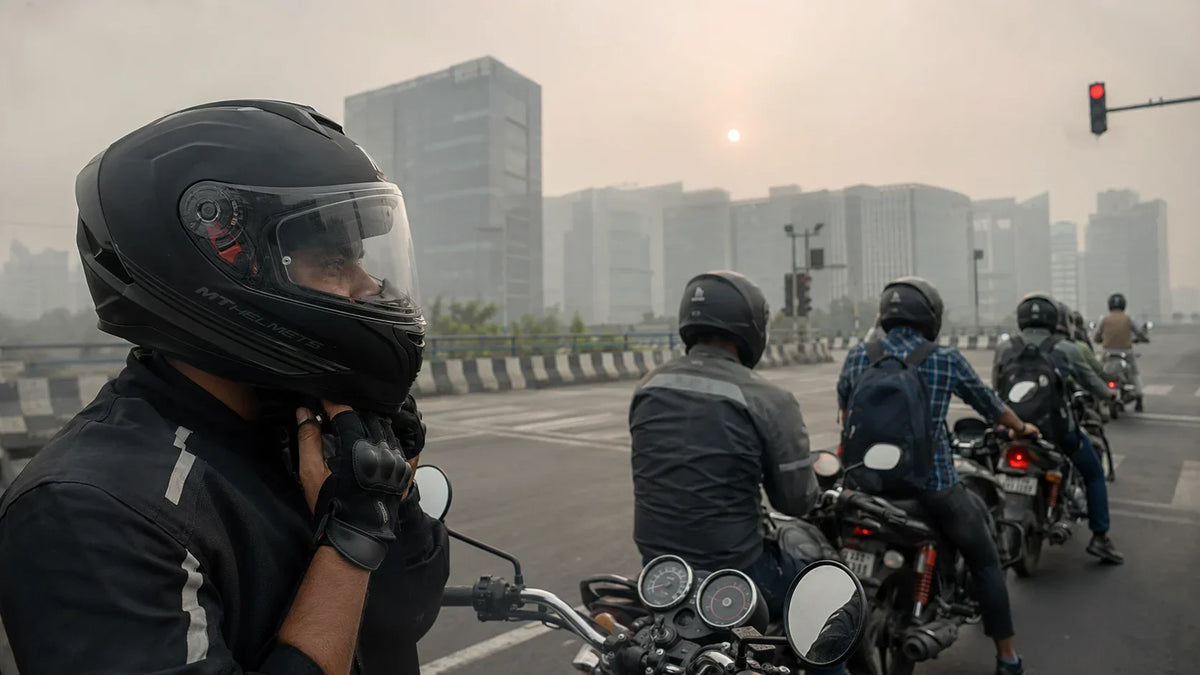
Idle on the DND Flyway long enough and you stop checking the signal. You just wait for the row of brake lights ahead to move.
Search helmet sanitizer Noida and you'll find plenty of sprays promising a quick kill. Most riders spray once, feel better for a day, and never ask what happens after.
Noida's problem isn't a one-time fix. It's a helmet that goes back into gridlock and hazardous air every single day. Here's what's actually happening inside that liner, and what holds up against it.
Rider Takeaways
- The DND Flyway was built for 70,000 vehicles a day. It now carries roughly 2.7 lakh. Source: DCP Traffic, via Lokmat Times.
- Noida's PM2.5 sat at 34.3 µg/m³ in late July 2026, 6.9 times the WHO's annual safety guideline. Source: IQAir.
- A 2020 study found Staphylococcus aureus in 22.7% of bacteria isolated from motorcycle helmets, a third of it drug-resistant.
- A sanitizer kills bacteria once. Only a bacteriostatic spray like Hygena keeps stopping regrowth between Noida's daily gridlock commutes.
How Much Sealed Helmet Time Does Noida's Traffic Really Add?
A lot more than the map suggests. DCP (Traffic) Yamuna Prasad has said the DND Flyway was designed to carry 70,000 vehicles a day. It now carries roughly 2.7 lakh, nearly four times over capacity.
That bottleneck isn't an accident of geography. Two-wheelers have been barred from the Delhi-Meerut Expressway since a January 2021 gazette notification. Several other NCR expressways carry similar restrictions. Riders funnel onto the same few arterial roads instead, DND and the Noida-Greater Noida Expressway among them.
A signal at Sector 14A or Sector 18 costs a rider a couple of minutes, visor sealed shut. Stack that across a full DND crawl and Noida helmets rack up sealed hours most riders never think to count.
Quick Fact:
The DND Flyway was designed to accommodate 70,000 vehicles a day but now carries approximately 2.7 lakh, nearly four times its planned capacity. Source: DCP (Traffic) Yamuna Prasad, quoted in Lokmat Times, February 25, 2025
The DND Flyway was designed to accommodate 70,000 vehicles a day but now carries approximately 2.7 lakh, nearly four times its planned capacity. Source: DCP (Traffic) Yamuna Prasad, quoted in Lokmat Times, February 25, 2025
Is Noida's Air Making It Worse?
Yes, and breathing it in is the smaller half of the problem. As of late July 2026, Noida's PM2.5 concentration measured 34.3 micrograms per cubic meter. That's nearly seven times the World Health Organization's annual guideline of 5 µg/m³.
Every one of those particles that doesn't reach your lungs settles somewhere else. Think visor, jacket, and the foam padding pressed against your scalp for hours a day, the same hours the DND crawl just added.
In November 2019, Noida briefly overtook Ghaziabad as India's most polluted city. The causes read like a checklist for helmet trouble too: heavy traffic, ongoing construction, seasonal stubble burning, and diesel generators. A wind shift trapped it all, pushing Delhi's smog straight over the city.
Quick Fact:
Noida's PM2.5 concentration measured 34.3 µg/m³ in late July 2026, 6.9 times the WHO's annual guideline of 5 µg/m³, placing air quality in the "unhealthy for sensitive groups" band. Source: IQAir, Noida real-time air quality data
Noida's PM2.5 concentration measured 34.3 µg/m³ in late July 2026, 6.9 times the WHO's annual guideline of 5 µg/m³, placing air quality in the "unhealthy for sensitive groups" band. Source: IQAir, Noida real-time air quality data
Unique Insight
Our finding: most helmet-hygiene advice online is written for cities where sweat and humidity drive bacteria growth. Noida stacks two inputs on top of that: a gridlocked flyover and particulate-heavy air, both feeding the same padding at once.

Does a Sanitizer Actually Solve Helmet Odor?
Partly, and only for a moment. In 2020, a study in the International Journal of Microbiology tested 130 motorcycle helmets and isolated 392 bacteria. Staphylococcus aureus topped the list at 22.7%, and 33.7% of those isolates came back as MRSA, a drug-resistant strain.
Separate research on an automated helmet-sanitizing kiosk recorded a 94.5% average bacterial reduction right after treatment. That's a real, measurable kill. But it doesn't stop what grows back on your very next ride.
That's the gap between sanitizing and hygiene. A sanitizer wipes the slate clean once. A bacteriostatic spray like Hygena keeps stopping bacteria from multiplying, ride after ride, not just the moment you spray it.
Quick Fact:
A 2020 study of 130 motorcycle helmets isolated 392 bacteria, led by Staphylococcus aureus at 22.7%, with 33.7% of those isolates confirmed as MRSA. Source: Sapkota et al., International Journal of Microbiology, 2020
A 2020 study of 130 motorcycle helmets isolated 392 bacteria, led by Staphylococcus aureus at 22.7%, with 33.7% of those isolates confirmed as MRSA. Source: Sapkota et al., International Journal of Microbiology, 2020
How Are Noida Riders Actually Coping Right Now?
Mostly by improvising, the same way riders do across polluted Indian cities. On a long-running Team-BHP thread about anti-pollution masks, one Delhi-based rider's advice stands out. Masks only offer partial defense, he said. Pair one with an air filter at home and breathing exercises, not as a full fix.
A mask, scarf, or filter helps the lungs. None of it helps the helmet. Whatever gets filtered out still ends up trapped in the liner, sitting against warm, sweaty scalp skin for the whole ride.
Most Noida riders wash their liner occasionally and call it done. Between washes, nothing is actually working on the bacteria building up underneath. Not on the days stuck at the Sector 14A signal, not while crawling across the DND loop.
Unique Insight
Our finding: Noida riders already treat pollution as a daily fact of life, masks, scarves, air purifiers at home. Almost none of that routine extends to the one item sealed against their scalp for hours: the helmet itself.
The Fix for Noida's Daily Grind
Washing your liner weekly is still the baseline. It clears out what the DND crawl and Sector 62 haze leave behind. But a weekly wash leaves six or seven days of commuting in between, unprotected.
That's the gap Hygena fills. A few sprays after a signal-to-signal commute or a smog-heavy evening ride keep bacterial buildup down. That's between washes, not instead of them.
The routine that actually holds up against Noida's traffic and air:
- Wash the liner weekly, more often during peak winter smog season.
- Spray a bacteriostatic deodorant like Hygena after every commute, DND crawl included.

Frequently Asked Questions
Does sitting longer in Noida traffic make helmet smell worse?
Yes. The DND Flyway carries nearly four times its designed capacity, which means more signal-to-signal time with the visor sealed shut. Every extra sealed hour gives bacteria already in the liner more time to multiply.
Does Noida's pollution make helmet smell worse than a less polluted city?
Yes. Particulate matter works into the liner alongside sweat, giving bacteria more material to feed on. Noida's PM2.5 ran 6.9 times the WHO guideline in late July 2026, high even for an NCR riding city.
Is a one-time helmet sanitizer enough for daily Noida commutes?
No. A sanitizer can knock down bacteria by roughly 94% the moment you use it. But nothing stops regrowth on your next ride. A bacteriostatic spray works between rides, not just once.
Where can I buy a helmet sanitizer or hygiene spray in Noida?
Hygena ships to Noida and Greater Noida directly from hygena.in, with cash-on-delivery available. There's no dedicated helmet-hygiene counter in Noida's markets yet.
How often should Noida riders wash their helmet given the traffic and AQI?
Weekly at minimum, more often through winter's peak stubble-burning smog. Long DND or expressway commutes pack in more sealed helmet hours than a short local hop. The liner reaches the same bacterial load faster.
Conclusion
Noida's helmet problem isn't seasonal weather. It's daily. A DND Flyway carries nearly four times its designed load, every single day. Air ran 6.9 times the WHO's PM2.5 guideline in late July 2026. Both stack onto a helmet that never gets a real break.
A helmet sanitizer Noida search gets you a one-time kill. Wash your liner weekly. Use a bacteriostatic spray like Hygena between washes. Bacteria never gets the chance to rebuild before your next signal-to-signal commute.
Sources
1. "Noida Traffic Update: Massive Vehicle Congestion on DND Flyway, Commuters Stuck for Hours," Lokmat Times, February 25, 2025. Retrieved 2026-07-30.
2. "Use of Two-Wheelers on Expressways," Press Information Bureau, Ministry of Road Transport & Highways, December 2, 2021. Retrieved 2026-07-30.
3. "Noida Air Quality Index (AQI) and India Air Pollution," IQAir, real-time data. Retrieved 2026-07-30.
4. "WHO Global Air Quality Guidelines," World Health Organization, 2021.
5. "Microbial Diversity and Antibiotic Susceptibility Pattern of Bacteria Associated with Motorcycle Helmets," Sapkota et al., International Journal of Microbiology, 2020. Retrieved 2026-07-30.
6. "HygieHelm: An IoT-Enabled Automated Helmet Sanitization Kiosk," IJERT. Retrieved 2026-07-30.
7. "Anti-Pollution Masks for Bikers," Team-BHP forum, community discussion. Retrieved 2026-07-30.
Share:
Helmet Sanitizer Gurgaon: What It Should Actually Do
Best Helmet Deodorant Bengaluru: Beat the 45-Minute Crawl