
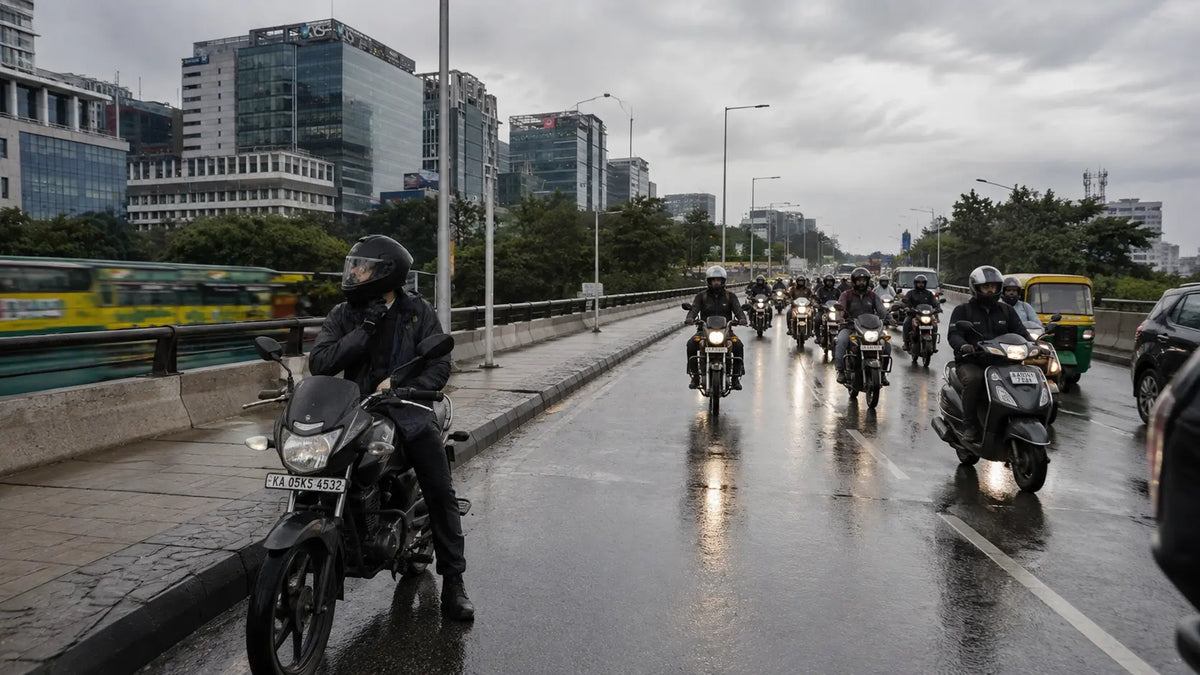
Ten kilometres, forty-five minutes. That's Bengaluru's evening rush hour, and your helmet stays sealed the entire time.
If you're searching for the best helmet deodorant in Bengaluru, that traffic number is exactly why the search matters more here than in most cities. Cars sit in that same crawl, but only riders wear it. Every extra minute is sweat and heat with nowhere to go inside a closed-face helmet, and 2025 made it worse. Add a rider culture that treats weekends as an excuse to ride further, not less, and you get some of the hardest-working helmets in India.
This piece breaks down why Bengaluru's traffic, weather, and rider culture combine to make helmet odor worse than most cities, and what a search for the "best" helmet deodorant here should actually lead you to.
Rider Takeaways
- Bengaluru riders lost 168 hours to traffic in 2025, per TomTom's Traffic Index, 13 more hours than 2024.
- The city added 4.68 lakh new two-wheelers in 2024-25 alone, more helmets doing daily duty on the same roads.
- A 2020 study found Staph aureus in 22.7% of 392 bacteria isolated from motorcycle helmets, a third of it drug-resistant.
- Wash your liner on a schedule. Spray a bacteriostatic deodorant like Hygena after every ride to stop bacteria rebuilding.
Why Does Bengaluru's Rider Culture Mean More Helmet-On Hours?
Bengaluru is home to some of India's most active motorcycle clubs, and that adds real helmet-on time beyond the daily commute. Tales on 2 Wheels, formerly the Bangalore Motorcycle Club, has run since 2011 and now counts more than 500 active riders on a group ride every third weekend. Source: taleson2wheels.com, 2026.
Those rides aren't short. Members head out on day trips to Nandi Hills and Coorg, then further out to Hampi, Ladakh, Nepal, and Thailand on longer expeditions. Every one of those hours is helmet-on time that a commute-only calculation never counts.
Most riders think about their commute helmet and their touring helmet as two separate problems. They're the same liner. A Monday-to-Friday IT-corridor crawl and a monthly sunrise ride to Nandi Hills both feed the same bacteria, and neither gets washed twice as often to compensate.
Quick Fact:
Tales on 2 Wheels (formerly the Bangalore Motorcycle Club), founded in 2011, has been one of Bangalore's most active biker groups for 15 years, with a ride every third weekend and 500+ active riders touring to Nandi Hills, Coorg, Ladakh, Nepal, and Thailand. Source: Tales on 2 Wheels, 2026.
Tales on 2 Wheels (formerly the Bangalore Motorcycle Club), founded in 2011, has been one of Bangalore's most active biker groups for 15 years, with a ride every third weekend and 500+ active riders touring to Nandi Hills, Coorg, Ladakh, Nepal, and Thailand. Source: Tales on 2 Wheels, 2026.
Unique Insight
Our finding: A Bengaluru rider doing a five-day IT-corridor commute and a monthly Nandi Hills dawn ride puts a helmet through more total sealed hours than almost any single-layer city routine. Two different riding patterns, one liner, and nobody washes it twice as often to keep up.
How Much Sealed Helmet Time Does Bengaluru's Traffic Really Add?
A lot, and it got worse in 2025. TomTom's Traffic Index put Bengaluru's average congestion level at 74.4%, up 1.7 points from 2024, with the average 10km drive now taking 36 minutes 9 seconds. Evening rush hour alone stretches that same 10km to 45 minutes 27 seconds at just 13.2 km/h.
Morning rush hour isn't much better: 41 minutes 6 seconds for 10km, at 94.2% congestion. Across the year, Bengaluru riders lost 168 hours to traffic in 2025, nearly 13 hours more than the year before. That's 168 hours of zero airflow reaching the padding.
The city isn't giving riders a break either. Bengaluru added 7.22 lakh new vehicles in 2024-25, including 4.68 lakh two-wheelers, per Transport Department data. More helmets, same roads, same crawl.
Quick Fact:
In 2025, Bengaluru riders lost 168 hours to traffic congestion, and evening rush hour stretched a 10km ride to 45 minutes 27 seconds at an average speed of 13.2 km/h. Source: TomTom Traffic Index, Bengaluru, 2025
In 2025, Bengaluru riders lost 168 hours to traffic congestion, and evening rush hour stretched a 10km ride to 45 minutes 27 seconds at an average speed of 13.2 km/h. Source: TomTom Traffic Index, Bengaluru, 2025
What's Actually Growing Inside an Unwashed Helmet?
In 2020, a study published in the International Journal of Microbiology tested 130 motorcycle helmets and isolated 392 bacteria. Staphylococcus aureus was the most common strain at 22.7%, and 33.7% of those isolates were confirmed as MRSA, a drug-resistant strain. That bacteria is what actually causes the smell, not sweat by itself.
Sweat is just the food source. Bacteria already living on your scalp and in the foam feed on it, and warm, damp conditions let them multiply fast. A 45-minute evening crawl produces exactly that environment, twice a day, five days a week.
Quick Fact:
A 2020 study of 130 motorcycle helmets isolated 392 bacteria, led by Staphylococcus aureus at 22.7%, with 33.7% of those isolates confirmed as MRSA. Source: Sapkota et al., International Journal of Microbiology, 2020
A 2020 study of 130 motorcycle helmets isolated 392 bacteria, led by Staphylococcus aureus at 22.7%, with 33.7% of those isolates confirmed as MRSA. Source: Sapkota et al., International Journal of Microbiology, 2020

Does Bengaluru's Weather Make Helmet Odor Worse?
Less dramatically than Mumbai's monsoon, but the swing still matters. Bengaluru's humidity ranges from 30% in March to 68% in August, a 38-point jump, while April sees the year's highest average temperatures, around 35°C. Source: Weather and Climate, climate averages 1991-2020.
Bengaluru's reputation for pleasant weather is mostly earned. Average year-round humidity sits at just 52%, mild compared to India's coastal cities. That's exactly what makes August's spike catch riders off guard. A liner that dries fine in February doesn't get the same chance once the rains set in.
Quick Fact:
Bengaluru's average humidity is 52% year-round, swinging from 30% in March to 68% in August, with April recording the year's highest average temperatures near 35°C. Source: Weather and Climate, climate averages 1991-2020
Bengaluru's average humidity is 52% year-round, swinging from 30% in March to 68% in August, with April recording the year's highest average temperatures near 35°C. Source: Weather and Climate, climate averages 1991-2020
Unique Insight
Our finding: Bengaluru's mild 52% average humidity looks harmless next to a monsoon city's numbers. That's the problem. Riders here never build the wash habit those cities are forced into, so when August's 68% hits, bacteria get a head start nobody planned for.
What Actually Makes a Helmet Deodorant the Best Choice in Bengaluru?
Not the one that smells strongest off the shelf. A spray that just masks odor with fragrance covers the smell for an hour or two, then the bacteria producing it are still multiplying underneath. The "best" one is the one built to stop that bacteria at the source, not perfume around it.
That's a bacteriostatic formula: something that actively slows bacterial growth rather than covering the result. It needs to survive a 45-minute sealed commute without breaking down, work on both a daily helmet and a once-a-month touring one, and carry real dermatological testing behind it, not just a marketing claim.
Hygena is built around tea tree extract and other natural antimicrobials, dermatologically tested, and formulated specifically for the sealed, sweaty environment inside a motorcycle helmet, not a general-purpose body spray repurposed for gear. Wash your liner on a schedule. Spray Hygena after every ride, commute or Nandi Hills sunrise run, and the bacterial count stays down between washes.

Frequently Asked Questions
Does Bengaluru's traffic make helmet smell worse?
Yes. Riders lost 168 hours to traffic in 2025, per TomTom's Traffic Index, and every one of those hours keeps a helmet sealed with zero airflow reaching the padding, giving bacteria more time to multiply.
What's the best helmet deodorant for Bengaluru's daily commute?
Look for a bacteriostatic spray, not a fragrance-only one. It needs to survive a 45-minute sealed crawl and work between washes. Hygena is formulated with tea tree extract specifically for that kind of sustained, sweaty helmet time.
Where can I buy helmet deodorant spray in Bengaluru?
Hygena ships across Bengaluru directly from hygena.in, with cash-on-delivery available. There's no dedicated helmet-hygiene retail counter in most Bengaluru markets yet, so online is the fastest route.
How often should I clean my helmet interior in Bengaluru?
Every two to three weeks if you ride daily, and weekly through the August monsoon peak when humidity hits 68%. A 2020 study found bacteria in the majority of tested helmets, so waiting longer usually means waiting too long.
Does a helmet deodorant spray replace washing the liner?
No. A deodorant like Hygena works between washes to slow bacterial buildup, but it isn't a substitute for actually washing the liner on a regular schedule.
Conclusion
Bengaluru's helmet problem isn't really about the weather. It's traffic keeping your helmet sealed for 45-plus minutes at a stretch, a rider culture that adds weekend touring hours on top, and a monsoon spike in August that catches everyone off guard.
Wash your liner on a schedule, not just when you notice the smell. Between washes, a bacteriostatic spray like Hygena keeps the bacterial count from climbing back to where it started, whether that's a Monday commute or a Nandi Hills sunrise ride.
Sources
1. "Bengaluru Traffic Report," TomTom Traffic Index, 2025. Retrieved 2026-07-30.
2. "Bengaluru Humidity by Month," Weather and Climate, climate averages 1991-2020. Retrieved 2026-07-30.
3. Sapkota, A. et al., "Microbial Diversity and Antibiotic Susceptibility Pattern of Bacteria Associated with Motorcycle Helmets," International Journal of Microbiology, 2020. Retrieved 2026-07-30.
4. "Bengaluru Adds 7.22L New Vehicles, Total Hits 1.23 Cr," Deccan Herald, April 8, 2025. Retrieved 2026-07-30.
5. "Tales on 2 Wheels (T2W)," official site, 2026. Retrieved 2026-07-30.
Share:
Helmet Sanitizer Noida: Why One Spray Isn't Enough
Helmet Cleaner Belgaum: What Altitude Won't Fix