
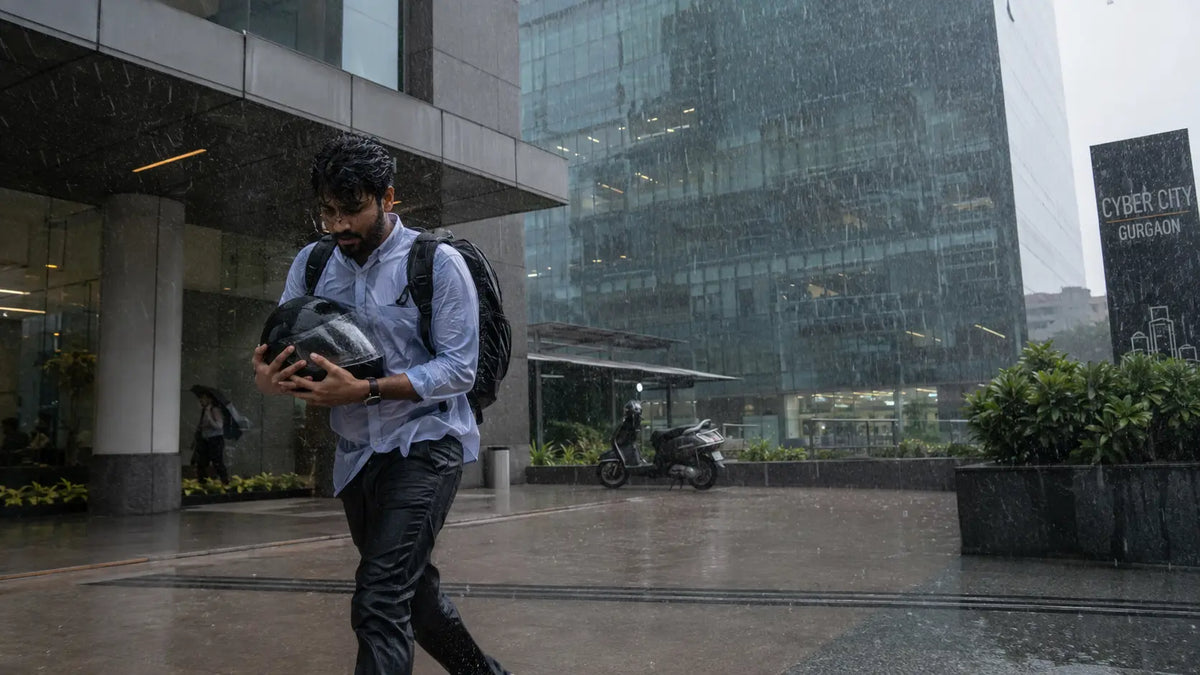
You're idling at Iffco Chowk, helmet already damp with sweat before your 9 AM stand-up call.
Type "helmet sanitizer Gurgaon" into Google and you'll find sprays promising a fresh helmet in seconds. Most of them just cover the smell for an hour. None of them explain what's actually multiplying inside your liner while you sit in that Cyber City queue.
Gurgaon ki hawa is one of India's worst, and its traffic is right up there too. This piece breaks down what the city's smog, its humidity, and its packed commute actually do to a helmet. And what a real sanitizer needs to do that a quick wipe can't.
Rider Takeaways
- Gurgaon's winter PM2.5 tops 250 µg/m³, over 20x the WHO safe limit. Source: The Tribune, April 2026.
- 1,00,675 new two-wheelers joined Gurgaon's roads in just 13 months. Source: The Tribune, April 2026.
- 73% of Indian riders clean their helmet liner less than once a month. Source: IJERT, 2026.
- A spray-only clean removes 62% of bacteria. Real sanitizing needs to clear 90%-plus.
What Makes Riding Through Gurgaon's Cyber City So Hard on a Helmet?
Gurgaon packs more corporate density into one district than almost anywhere else in India. DLF Cyber City alone spans 125 acres and 15 million square feet of office space. The city is home to over 3 million residents and roughly half of all Fortune 500 companies operating in India. Source: The Tribune, April 2026; 91Springboard, 2025.
Every one of those professionals needs to reach office by nine, and a two-wheeler is often the only way through the gridlock. You zip between DLF Phase towers on a scooter, park in seconds, and skip the 45-minute cab queue. But you rarely have five minutes to let your helmet air out before the next meeting.
Quick Fact:
DLF Cyber City spans 125 acres and 15 million square feet of office space, sitting directly off NH-8 with a 16-lane signal-free road and Rapid Metro access. Source: 91Springboard, "DLF Cyber City: The Emerging Hotspot for GCCs," 2025
DLF Cyber City spans 125 acres and 15 million square feet of office space, sitting directly off NH-8 with a 16-lane signal-free road and Rapid Metro access. Source: 91Springboard, "DLF Cyber City: The Emerging Hotspot for GCCs," 2025
That rushed handoff from parking spot to office lobby is exactly why the helmet never gets a real clean. It goes straight from your head to your desk drawer, still warm, still damp.
How Do Gurgaon's Humidity Swings and Winter Smog Affect Your Helmet?
Gurgaon's humidity swings from 27% in April to 75% in August, a 48-point jump across the year. Winter adds a second problem: smog that sits low and thick over the city. Source: Climate-Data.org, 1991-2021 average; The Tribune, April 2026.
July alone brings about 197mm of rain, and the monsoon runs June through September. That's four straight months of a helmet that never fully dries between rides.
Quick Fact:
Gurgaon's average humidity climbs from 27% in April to 75% in August, and winter PM2.5 regularly exceeds 250 µg/m³, more than 20 times the WHO safe limit. Source: Climate-Data.org, "Gurgaon Climate," 1991-2021 data
Gurgaon's average humidity climbs from 27% in April to 75% in August, and winter PM2.5 regularly exceeds 250 µg/m³, more than 20 times the WHO safe limit. Source: Climate-Data.org, "Gurgaon Climate," 1991-2021 data
Unique Insight
Our finding: Gurgaon's helmet problem is really two problems stacked on top of each other. Sweat and humidity feed bacteria, while winter smog adds a layer of fine particulate matter that settles into the same damp foam. Sanitizing needs to answer both, not just the smell.
What's Actually Growing Inside a Helmet That's Never Sanitized?
Helmet foam that's never sanitized becomes a warm, damp breeding ground. A 2026 pilot study at a Bengaluru university found a disinfectant spray alone removes just 62% of bacteria, while a full multi-stage sanitizing cycle reaches 94.5%. Source: IJERT, "HygieHelm," June 2026.
That gap matters. A one-time spray or wipe is not the same as sustained sanitizing. Untreated helmets in the same study showed almost no natural bacterial die-off at all, just 3.2% over six minutes.
Quick Fact:
A pan-India survey found that 73% of riders clean their helmet liner less than once a month, leaving foam padding to soak up sweat, sebum, and road dust ride after ride. Source: IJERT, "HygieHelm: An IoT-Enabled Automated Helmet Sanitization Kiosk," June 2026
A pan-India survey found that 73% of riders clean their helmet liner less than once a month, leaving foam padding to soak up sweat, sebum, and road dust ride after ride. Source: IJERT, "HygieHelm: An IoT-Enabled Automated Helmet Sanitization Kiosk," June 2026

In Gurgaon specifically, that foam isn't just absorbing sweat. Every commute through Cyber City traffic adds a fresh coat of exhaust dust and PM2.5 to the mix, sitting right against your scalp for the ride home.
How Much Time Is Gurgaon's Traffic Really Adding to Your Ride?
More than most riders realize. Gurgaon's roads absorbed 2,29,964 new vehicles between March 2025 and April 2026, the highest tally in seven years. Of those, 1,00,675 were two-wheelers. Source: The Tribune, April 2026.
The Delhi-Gurgaon Expressway now sees peak-hour speeds barely crossing 30 kmph. At Shankar Chowk, Hero Honda Chowk, and Iffco Chowk, five-kilometre stretches can take over 90 minutes on a bad day. That's 90 minutes of trapped heat and sweat with nowhere to go, right against your scalp.
Quick Fact:
The Gurugram Metropolitan Development Authority has identified 17 major chokepoints, including Bakhtawar Chowk and stretches near Cyber Park, and is running a ₹7.58 crore intervention plan to ease them. Source: The Tribune, "Gurugram Records Highest Vehicle Count in 7 Years," April 2026
The Gurugram Metropolitan Development Authority has identified 17 major chokepoints, including Bakhtawar Chowk and stretches near Cyber Park, and is running a ₹7.58 crore intervention plan to ease them. Source: The Tribune, "Gurugram Records Highest Vehicle Count in 7 Years," April 2026
Unique Insight
Our finding: Gurgaon's worst window for a helmet lands right at 9 AM. That's when the Cyber City rush peaks, humidity is still climbing from the morning, and winter smog hasn't lifted yet. Three stressors overlapping in the same 45 minutes, every single weekday.
What Should a Helmet Sanitizer in Gurgaon Actually Do?
It needs to do more than mask smell for a day. Given Gurgaon's mix of smog, humidity, and hours-long commutes, a sanitizer has to keep working between rides, not just at the moment you spray it.
That's the gap between a disinfectant wipe and Hygena's bacteriostatic spray. A wipe kills what's there once. Hygena's formula, built around tea tree and neem extracts, keeps suppressing bacterial growth as sweat and dust build back up on your next Cyber City crawl.
A few sprays after you park, and your helmet is ready before the next 90-minute jam at Iffco Chowk even starts.
A routine that actually holds up against Gurgaon's traffic and smog:
- Wash the liner weekly, more often through winter's peak smog season.
- Spray a bacteriostatic sanitizer like Hygena after every Cyber City commute, not just on wash day.

Frequently Asked Questions
Is Gurgaon's air quality actually bad enough to affect helmet hygiene?
Yes. Winter PM2.5 in Gurgaon regularly exceeds 250 µg/m³, more than 20 times the WHO safe limit, and that particulate matter settles into sweat-damp foam alongside the bacteria already growing there. Source: The Tribune, April 2026.
Can I just use an alcohol-based hand sanitizer inside my helmet?
It's not built for foam padding. Alcohol dries out the material and evaporates fast, so it stops working within minutes. Bacteriostatic sprays are formulated to keep working on foam over hours.
How often should I sanitize my helmet if I commute through Cyber City daily?
Given Gurgaon's traffic and humidity, spray after every ride, or at minimum once daily. A pan-India survey found 73% of riders wait a month or longer. Source: IJERT, 2026.
Does Gurgaon's monsoon humidity add to the bacteria problem?
Yes. Humidity climbs to 75% in August with about 197mm of July rain, and that moisture keeps helmet foam from ever fully drying between rides. Source: Climate-Data.org, 1991-2021 data.
Where can I buy a helmet sanitizer spray in Gurgaon?
Hygena ships across Gurgaon and the rest of NCR directly from hygena.in. There's no dedicated helmet-hygiene counter in Gurgaon's markets yet.
Conclusion
Gurgaon asks more of a helmet than most Indian cities. Between Cyber City's gridlock, humidity that swings 48 points across the year, and winter smog that's 20 times over the WHO limit, a quick spray-and-wipe just isn't enough.
A real sanitizer needs to keep suppressing bacteria between rides, not just at the moment you use it. That's what Hygena's bacteriostatic spray is built for. Grab a bottle at hygena.in and give your helmet the same daily reset your Cyber City commute demands.
Sources
1. "Gurugram Records Highest Vehicle Count in 7 Years, City Braces for Worsening Traffic and Toxic Air," The Tribune, April 13, 2026. Retrieved 2026-07-30.
2. "Gurgaon Climate (India)," Climate-Data.org, 1991-2021 data. Retrieved 2026-07-30.
3. "DLF Cyber City: The Emerging Hotspot for GCCs," 91Springboard, 2025. Retrieved 2026-07-30.
4. Tejas H. R., Dhruv Kumar, Lohith R. D., "HygieHelm: An IoT-Enabled Automated Helmet Sanitization Kiosk Using ESP32 Microcontroller," International Journal of Engineering Research & Technology, Vol. 15, Issue 06, June 2026. Retrieved 2026-07-30.
Share:
Helmet Cleaner Solapur: Dust, Heat, and What Actually Works
Helmet Sanitizer Noida: Why One Spray Isn't Enough