
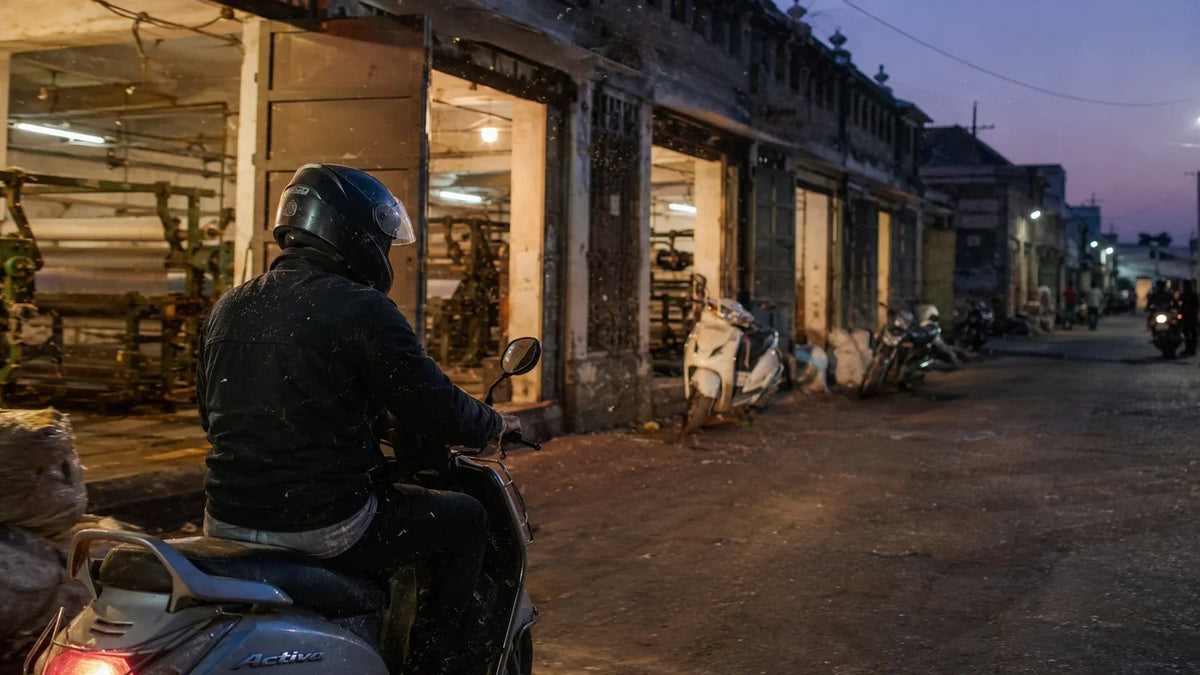
Solapur touched 43°C during Maharashtra's April 2026 heatwave, the kind of heat that turns a sealed helmet into a small oven by mid-morning.
Type "helmet cleaner Solapur" into Google and most results promise a fresh helmet by evening. They handle the dust on the shell. They don't touch what's actually breeding underneath it.
Solapur runs on two things most helmet-hygiene advice never accounts for: summer heat that regularly clears 43°C, and a workforce of more than a lakh riders commuting through dust-heavy trades. Here's what that combination does to a helmet, and why a cleaner alone won't fix it.
Rider Takeaways
- Solapur hit a high of 43°C during Maharashtra's April 2026 heatwave, per IMD data.
- Solapur's humidity swings from 21% in March to nearly 71% in August, close to a 50-point jump across five months.
- Solapur's powerloom and beedi trades employ more than 1 lakh workers, most riding to shifts through cotton lint or tobacco dust. Source: Solapur District industries page.
- A cleaner wipes off lint and dust. Only a bacteriostatic spray like Hygena stops the odor-causing bacteria underneath.
Just How Hot Does a Sealed Helmet Get in Solapur?
Solapur's yearly average temperature runs 30.38°C, about 4.4% above India's national average. May is the hottest month, averaging a 40.44°C high, and the city has recorded readings as high as 46°C on its worst days. Source: Weather and Climate, Solapur.
Humidity swings just as hard. It bottoms out at 21.05% in March, the driest month, then climbs to 70.77% by August, the monsoon peak, a near 50-point jump across five months. Source: Weather and Climate, Solapur.
Dry heat bakes lint and dust straight into the padding. Monsoon humidity then stops that same padding from ever fully drying. A helmet caught between the two rarely gets a clean reset.
Quick Fact:
Solapur registered a high of 43°C during Maharashtra's April 2026 heatwave, even as Vidarbha cities like Akola touched 46.9°C the same week. Source: Pune Pulse, citing IMD, April 27, 2026
Solapur registered a high of 43°C during Maharashtra's April 2026 heatwave, even as Vidarbha cities like Akola touched 46.9°C the same week. Source: Pune Pulse, citing IMD, April 27, 2026
Why Do So Many Solapur Riders Start Their Day Already Covered in Dust?
Solapur's economy runs on two informal trades most outsiders never hear about: powerloom weaving and beedi rolling. Around 6,000 powerloom units operate across the district, running roughly 25,000 looms and employing about 30,000 workers. Source: Solapur District industries page.
The beedi trade is bigger still. It employs close to 70,000 women beedi rollers plus 1,725 factory workers, spread across 115 units and 29 factories. Source: Solapur District industries page.
Together, these two trades put more than a lakh riders on Solapur's roads every shift change, most on two-wheelers, most riding home with cotton lint or tobacco dust already worked into their helmet padding. Many powerloom units run a single day shift from 8am to 6pm; others split into two shifts ending at 4pm and midnight, adding a second dusty commute to the day.
Ask a powerloom worker about helmet hygiene and you'll probably get a shrug. Dust is just part of the job, the same way it ends up part of every ride home.
Quick Fact:
Solapur's powerloom and beedi trades together employ more than 1 lakh workers, most commuting by two-wheeler through cotton lint and tobacco dust. Source: Solapur District Industries page
Solapur's powerloom and beedi trades together employ more than 1 lakh workers, most commuting by two-wheeler through cotton lint and tobacco dust. Source: Solapur District Industries page
Unique Insight
Our finding: most helmet-hygiene advice assumes a clean office commute. Solapur's largest rider population works in trades that put dust into the air before the ride even starts, a starting point most city guides never account for.
What's Actually Growing Inside That Helmet?
In 2020, researchers examined 130 motorcycle helmets and isolated 392 bacteria across seven genera. Staphylococcus aureus made up 22.7% of what they found, and a share of those isolates came back drug-resistant. Source: Sapkota et al., International Journal of Microbiology, 2020.
Dust and lint don't feed that bacteria. Sweat and skin oil do, trapped in warm foam with nowhere to go. Wiping cotton lint off a Solapur helmet's shell looks like progress. The bacteria underneath never notices.
Quick Fact:
A 2020 study of 130 motorcycle helmets isolated 392 bacteria, led by Staphylococcus aureus at 22.7%. Source: Sapkota et al., International Journal of Microbiology, 2020
A 2020 study of 130 motorcycle helmets isolated 392 bacteria, led by Staphylococcus aureus at 22.7%. Source: Sapkota et al., International Journal of Microbiology, 2020

How Many Two-Wheelers Are Actually on Solapur's Roads?
As of March 31, 2025, Solapur's RTO recorded a total vehicle population of 1,297,857. Two-wheelers accounted for 1,029,796 of that, close to 79% of everything registered in the district. Source: Maharashtra Transport Department, RTO-wise vehicle statistics, 2024-25.
The 2024-25 fiscal year alone added 70,328 new vehicles in Solapur, and 54,503 of those were two-wheelers, roughly 77% of all new registrations. That's a steady stream of fresh helmets entering circulation every year.
Quick Fact:
Two-wheelers made up 1,029,796 of Solapur's 1,297,857 registered vehicles as of March 2025, nearly 79% of the district's entire vehicle population. Source: Maharashtra Transport Department, RTO-wise Vehicle Statistics 2024-25
Two-wheelers made up 1,029,796 of Solapur's 1,297,857 registered vehicles as of March 2025, nearly 79% of the district's entire vehicle population. Source: Maharashtra Transport Department, RTO-wise Vehicle Statistics 2024-25
Unique Insight
Our finding: nearly 8 in 10 vehicles on Solapur's roads are two-wheelers, yet the city has no dedicated helmet-hygiene retail counter, unlike larger Maharashtra metros. Most riders default to whatever's on a local shelf, usually a cleaner, not a hygiene product.
Is a Helmet Cleaner the Same as a Helmet Hygiene Spray?
No, and this is where most "helmet cleaner Solapur" searches go wrong. A cleaner is built to lift dirt, lint, and grime off a surface. A hygiene product like Hygena is built to stop odor-causing bacteria from multiplying in the first place.
Both jobs matter in a city where cotton lint and road dust settle into padding daily. But they solve different problems. Wiping a visor down with a cleaning spray does nothing about the Staph aureus and other bacteria already living in the foam, the ones actually responsible for that smell.
| Job | Helmet Cleaner | Helmet Hygiene Spray (Hygena) |
|---|---|---|
| Removes visible lint and dust | Yes | No, not its job |
| Stops odor-causing bacteria multiplying | No | Yes, bacteriostatic formula |
| Used between washes | Occasionally | Every ride |
Hygena is a bacteriostatic spray, not a cleaner. It's formulated with tea tree extract and other natural antimicrobials that stop bacterial growth at the source, survives a 43°C shift-change commute, and takes seconds to apply after a ride. In a city where dust and heat hit a helmet from two directions at once, that's the routine that actually holds up.
The routine that actually works through Solapur's dust and heat:
- Wash the removable liner every two to three weeks, or weekly if you work a dusty trade like powerloom or beedi rolling.
- Spray a bacteriostatic hygiene product like Hygena after every ride, shift-change commute included.

The fix is simpler than hunting for another spray at the local market. Spray it on after every ride, dry season or monsoon, and you're covering the one job a cleaner never could.
Frequently Asked Questions
Does a helmet cleaner spray remove the cotton dust from Solapur's powerloom sheds?
It removes what's visible on the surface, but not what's underneath. Cotton lint sits on top of the padding, while sweat and bacteria build up inside it. A cleaner handles the first problem, not the second.
Why does my helmet smell worse in Solapur's summer than other months?
Solapur's average high hits 40.44°C in May, with record readings up to 46°C. Source: Weather and Climate, Solapur. That heat speeds up sweating inside a sealed helmet, feeding the bacteria that causes odor.
How often should Solapur riders clean or sanitize their helmet interior?
Wash the removable padding every two to three weeks, more often during peak summer or if you work a dusty trade. Spray a bacteriostatic hygiene product like Hygena after every ride, since bacteria start multiplying within hours.
Where can I buy a helmet hygiene spray in Solapur?
Hygena ships to Solapur through hygena.in, with cash-on-delivery available. There's no dedicated helmet-hygiene counter in Solapur's markets yet, so ordering online is currently the fastest way to get one.
Can I just use a helmet cleaner instead of washing the padding?
No. A cleaner handles surface lint and grime on the shell and visor. The padding needs its own wash cycle plus a bacteriostatic spray between washes, since that's where sweat, heat, and bacteria actually collect.
Conclusion
Solapur's helmets deal with a specific combination: summer heat that hit 43°C in 2026, humidity swinging nearly 50 points across the year, and more than a lakh riders commuting through powerloom and beedi dust. A cleaner spray addresses none of that on its own.
Hygena does. It's not a cleaner, it's a hygiene habit, a few seconds after every ride that stops bacteria before it starts smelling. Try it and see what a genuinely fresh helmet feels like after a Solapur shift.
Sources
1. "Solapur, Maharashtra Climate Zone, Monthly Averages," Weather and Climate, climate averages 1991-2020. Retrieved 2026-07-30.
2. "Industries," District Solapur, Government of Maharashtra. Retrieved 2026-07-30.
3. "RTO-wise Vehicle Population, New Registration During 2024-25," Maharashtra Transport Department. Retrieved 2026-07-30.
4. "This Maharashtra City Records Highest Temperature In India At 46.9°C," Pune Pulse, citing IMD, April 27, 2026. Retrieved 2026-07-30.
5. Sapkota, A. et al., "Microbial Diversity and Antibiotic Susceptibility Pattern of Bacteria Associated with Motorcycle Helmets," International Journal of Microbiology, 2020. Retrieved 2026-07-30.
Share:
Helmet Cleaner Kolhapur: What the Monsoon Leaves Behind
Helmet Sanitizer Gurgaon: What It Should Actually Do