
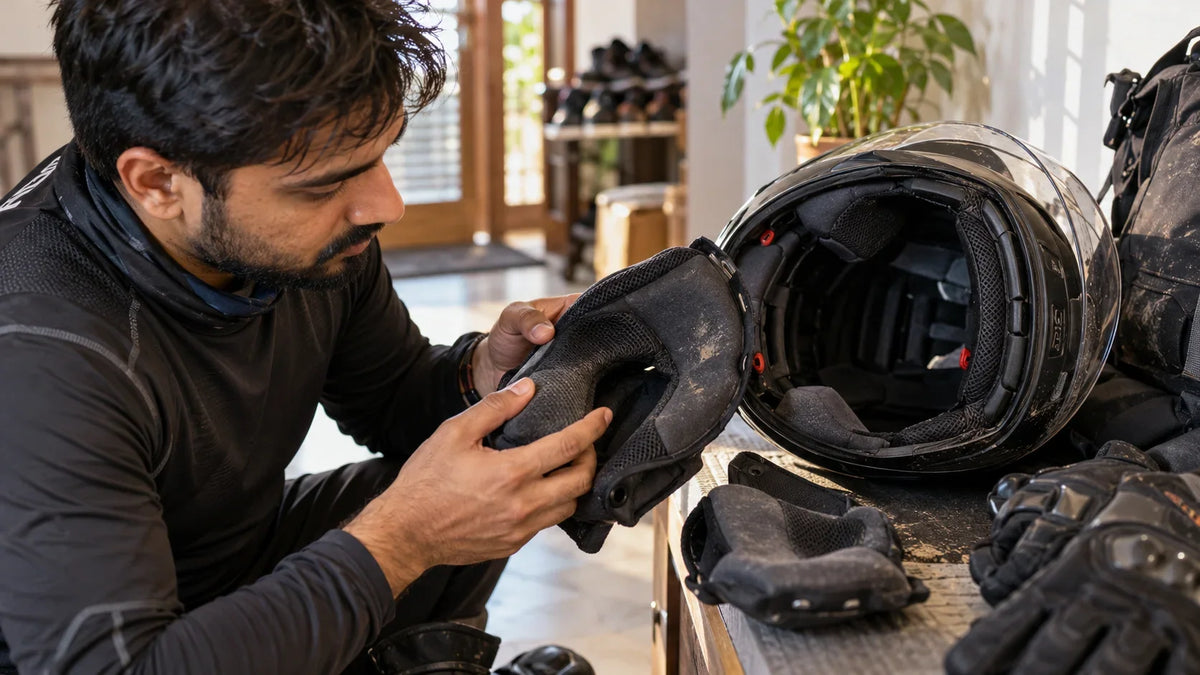
Your helmet feels fine when you leave home. After a hot commute, the padding feels damp, your cheeks feel sticky, and an old smell returns. That's your helmet padding doing its job: contacting your head and absorbing some of the sweat and oils that build up during a ride.
But padding isn't one single material, and every part shouldn't be treated the same way. The removable comfort liner and cheek pads are different from the firm impact-absorbing EPS liner underneath. Confusing them can damage materials or affect how your helmet fits.
This guide explains what helmet padding does, how to care for it safely, and when cleaning isn't enough.
Rider Takeaways
- A 2020 study sampled 130 motorcycle helmets and recovered bacteria and fungi from the helmets tested. That doesn't mean every helmet carries the same microbes or presents the same risk.
- Remove and wash only the padding your helmet maker says is removable.
- Keep water, solvents, and heat away from the EPS impact liner unless the manufacturer's instructions specifically permit a method.
- Replace damaged or loose padding with the correct model-specific parts.
What does helmet padding actually do?
Helmet padding helps your helmet sit comfortably and securely, while the inner impact liner helps manage crash energy. These are related parts, but they aren't interchangeable. The soft fabric-covered comfort liner and cheek pads contact your skin. The EPS liner is the firmer expanded-polystyrene layer beneath them.
The comfort padding can absorb sweat, skin oils, dust, and moisture during everyday rides. That buildup can leave the fabric stained, damp, or unpleasant-smelling. It can also change how the padding feels over time.
A 2020 study in the International Journal of Microbiology examined 130 motorcycle helmets and recovered 392 bacterial isolates and 346 fungal isolates. Those are isolate counts from the study, not percentages of helmets that were infected. The findings support regular, suitable helmet care, but they don't prove that a dirty helmet will make every rider ill.
In a 2020 study of 130 motorcycle helmets, researchers recovered 392 bacterial isolates and 346 fungal isolates. The study shows that microbes can be present on helmet interiors. It doesn't establish that all helmets carry the same organisms or that every exposure causes illness. Source: Sapkota et al., 2020, International Journal of Microbiology.
Our finding: Riders often use the word "padding" for every soft or firm layer inside a helmet. Before cleaning anything, identify which part you're touching. That simple check helps prevent a routine hygiene task from becoming a material-damage or fit problem.
How should you clean removable helmet padding?
Start with your helmet's manual. If the comfort liner and cheek pads are designed to come out, remove them carefully and follow the maker's washing instructions. Don't pull at fixed padding or force clips that don't release easily.
SHOEI's official maintenance guidance says removable comfort-liner parts can be hand-washed or machine-washed at 30°C with a washing bag and neutral detergent. It advises wiping fixed padding with a damp cloth and neutral cleaner. That's model-specific guidance, not permission to machine-wash every helmet liner.
Use this safe sequence when your manual allows washing:
- Take photos before removing parts, so you can reinstall them correctly.
- Release the comfort liner and cheek pads gently. Don't pull hard on stitching, tabs, or wiring.
- Wash only as instructed, using the recommended mild or neutral detergent and water temperature.
- Rinse as directed and press out excess water gently. Don't twist or wring the padding.
- Air-dry completely in a ventilated, shaded place before reinstalling it.
- Refit each part exactly as the manual shows. Check that clips and edges sit flat.
Airoh also advises delicate detergent and a maximum of 30°C for machine-washable removable interiors, and says to avoid direct heat sources during drying. Your helmet's own manual takes priority if its instructions differ.
SHOEI permits washing its removable comfort-liner parts by hand or in a washing machine at 30°C, using a washing bag and neutral detergent. Its instructions differ for fixed padding and the EPS impact liner. Check the exact manual for your helmet before copying another brand's cleaning method. Source: SHOEI Helmet Care & Maintenance.
What should you never do to helmet padding?
Don't assume a household cleaner is safe just because it works on clothing. Strong solvents, aggressive cleaners, and high heat may damage materials used inside a helmet. Avoid soaking the EPS impact liner or scrubbing it hard.
SHOEI specifically warns that its EPS liner isn't solvent- or heat-proof. Its maintenance guidance recommends a damp cloth and careful handling to avoid scratches or indentations. The same guidance says to use only a damp cloth for fixed comfort padding with a neutral cleaner.
Avoid these common mistakes:
- Don't machine-wash fixed padding. It isn't designed to be removed and laundered.
- Don't use a hair dryer, radiator, or heater to speed up drying. Let the parts dry naturally.
- Don't use bleach, petrol, strong solvents, or unapproved disinfectants. Check your manual and product labels first.
- Don't scrape, dent, or pull at the EPS liner. It is part of the helmet's impact-management system.
- Don't reinstall damp padding. Trapped moisture can contribute to stale smells and may encourage mould growth.
If a product label doesn't clearly confirm compatibility with your helmet materials, don't experiment on the inside of your helmet. When in doubt, ask the helmet maker or an authorised service centre.
SHOEI warns that its EPS impact liner is sensitive to solvents and heat, and recommends careful cleaning with a damp cloth. The manufacturer also says to avoid scratches and indentations. These instructions are a reminder to treat the impact liner differently from removable fabric comfort pads. Source: SHOEI Helmet Care & Maintenance.
When should you replace helmet padding?
Replace padding when it no longer holds its shape, fastens securely, or fits as intended. Look for torn fabric, broken clips, flattened cheek pads, loose sections, damaged stitching, or foam that crumbles. Persistent smell alone doesn't automatically mean the padding must be replaced, but it does mean you should inspect and care for it.
Use only replacement parts compatible with your helmet's exact model and size. Padding can affect how snugly the helmet fits. Adding random foam or using thicker pads from another model can change that fit.

SHOEI's guidance says a helmet should be replaced if its comfort padding or retention system has become loose or deteriorated. It also lists impact damage and a separated or damaged EPS liner as replacement triggers. Follow the manufacturer guidance for your own helmet, especially after a crash or hard impact.
Our finding: Treat padding condition as part of your regular pre-ride check. If the helmet suddenly feels looser, shifts when you move your head, or has damaged padding, don't try to solve the fit with improvised inserts. Ask the manufacturer or an authorised dealer about correct replacement parts.
| Part | Main job | Care approach |
|---|---|---|
| Removable comfort liner | Comfort and skin contact | Wash only if the manual permits it |
| Cheek pads | Comfort and fit around the cheeks | Remove and wash only as instructed |
| Fixed comfort padding | Comfort and skin contact | Wipe gently as the manual directs |
| EPS impact liner | Helps manage impact energy | Handle carefully; avoid solvents, heat, and dents |
How do you keep helmet padding fresher between washes?
Let your helmet dry after each ride. Open the visor when it's safe to do so, remove the helmet from a closed bag, and leave it in a clean, ventilated area away from direct heat. Don't store a wet helmet in a sealed backpack or under a bike seat for hours.
If you ride daily in hot weather, a short drying routine matters. Sweat and skin oils can build up faster when your helmet stays damp between trips. A removable, manufacturer-approved liner can be washed when needed, but washing isn't the only part of hygiene.

You can also use a helmet hygiene product that clearly states it's suitable for your helmet's interior materials. Follow the product directions and your helmet manufacturer's guidance. Hygena is designed for helmet hygiene and helps control odour-causing bacteria; it isn't a substitute for washing visibly dirty padding or repairing worn parts. Don't saturate the liner, and allow the interior to dry as directed.
Keep the routine simple: air the helmet out after rides, inspect the padding regularly, wash removable parts according to the manual, and address odour instead of covering it with perfume.
Frequently asked questions
Can I wash all motorcycle helmet padding?
No. Some comfort liners and cheek pads are removable and washable, while others are fixed. Check the manual for your exact model. The EPS impact liner needs different care and shouldn't be treated like laundry.
Can I put removable helmet pads in a washing machine?
Only if your helmet manufacturer allows it. SHOEI permits machine washing its removable comfort-liner parts at 30°C with a washing bag and neutral detergent. Other manufacturers may give different instructions, so don't assume that setting applies to your helmet.
Why does helmet padding smell after washing?
Padding may still smell if sweat and residue remain, or if it hasn't dried fully. Check that you followed the washing directions and let the parts dry completely. If the smell persists, inspect the liner and helmet interior and consult the manufacturer before trying stronger cleaners.
How do I know if helmet padding is worn out?
Check for flattened cheek pads, torn fabric, loose attachments, broken clips, or padding that no longer holds the helmet securely in place. Use compatible replacement parts. If your helmet shifts or feels loose, stop using it until you can check the fit properly.
Can I spray deodorant directly onto helmet padding?
Don't use ordinary body perfume or a generic fabric spray unless the helmet maker confirms it's suitable. Choose a product intended for helmet hygiene, follow its label, and avoid saturating the padding. Hygiene sprays don't replace washing or damaged-part replacement.
Keep your padding clean without compromising fit
Helmet padding touches your skin on every ride, so it deserves regular attention. But the right care depends on which part you're cleaning. Wash only removable parts that your manufacturer approves, protect the EPS impact liner, and let everything dry completely before reassembly.
If the padding is loose, torn, or flattened, replace it with the correct model-specific part. If odour keeps returning between washes, build a consistent helmet hygiene habit rather than relying on perfume.
For related advice, read Hygena's helmet padding cleaning guide and learn more about why helmet hygiene matters. Keep your helmet comfortable, properly fitted, and ready for the next ride.
Sources
- Sapkota S. et al. (2020). “Microbial Diversity and Antibiotic Susceptibility Pattern of Bacteria Associated with Motorcycle Helmets.” International Journal of Microbiology. https://pubmed.ncbi.nlm.nih.gov/33488730/ (accessed 16 October 2026).
- SHOEI. “Helmet Care & Maintenance.” https://shoei-helmets.com/support/helmet-maintenance.html (accessed 16 October 2026).
- Airoh. “Motorcycle Helmet FAQs: Cleaning, Approval, and Warranty.” https://www.airoh.com/en/domande-frequenti/ (accessed 16 October 2026).
- Hygena. “Helmet Padding Cleaning Guide: Step-by-Step.” https://hygena.in/blogs/journal/helmet-padding-cleaning-guide-step-by-step (accessed 16 October 2026).
Share:
10 Hygiene Essentials for Long-Distance Motorcycle Tourers
How to Prevent Sweat and Body Odor While Riding