
You bought a helmet interior cleaner. So why does the smell come back in a week?
Most riders reach for one product and expect it to do two different jobs. A cleaner and a deodorant are not the same thing. They solve different problems, on different timelines, with completely different chemistry. Confuse them, and you'll keep scrubbing a helmet that smells fresh for two days and sour by Friday.
This article breaks down what each one actually does, when to use which, and why your helmet keeps stinking even after a deep clean.
Rider Takeaways
- A helmet interior cleaner physically removes sweat, oil, and grime. A deodorant manages the smell between those cleans.
- A 2020 study found Staphylococcus species made up over 42% of bacteria on helmets. Source: International Journal of Microbiology.
- Masking sprays cover odor. A bacteriostatic deodorant stops the bacteria from multiplying in the first place.
- You likely need both. Clean monthly, deodorize between rides.
What's the difference between a helmet cleaner and a helmet deodorant?
A helmet interior cleaner removes the stuff causing the smell. A deodorant deals with the smell itself. In 2022, research in the Asian Journal of Biological and Life Sciences confirmed helmets act as fomites that carry bacteria, and that disinfectant sprays cut that load. Cleaning and deodorizing are two steps, not one.
Think of it like your own routine. A bath washes off sweat and dirt. Deodorant keeps you fresh through the day. You don't pick one and skip the other.
Your helmet works the same way. The cleaner is the bath. The deodorant is what gets you through the week between baths. Both belong in a rider's kit.
What does a helmet interior cleaner actually do?
A helmet interior cleaner uses surfactants to lift sweat, oil, and dead skin out of the padding. In 2020, a study of 130 helmets in the International Journal of Microbiology recovered 392 bacteria from the liners alone. That's the buildup a cleaner is designed to physically strip away from the foam.
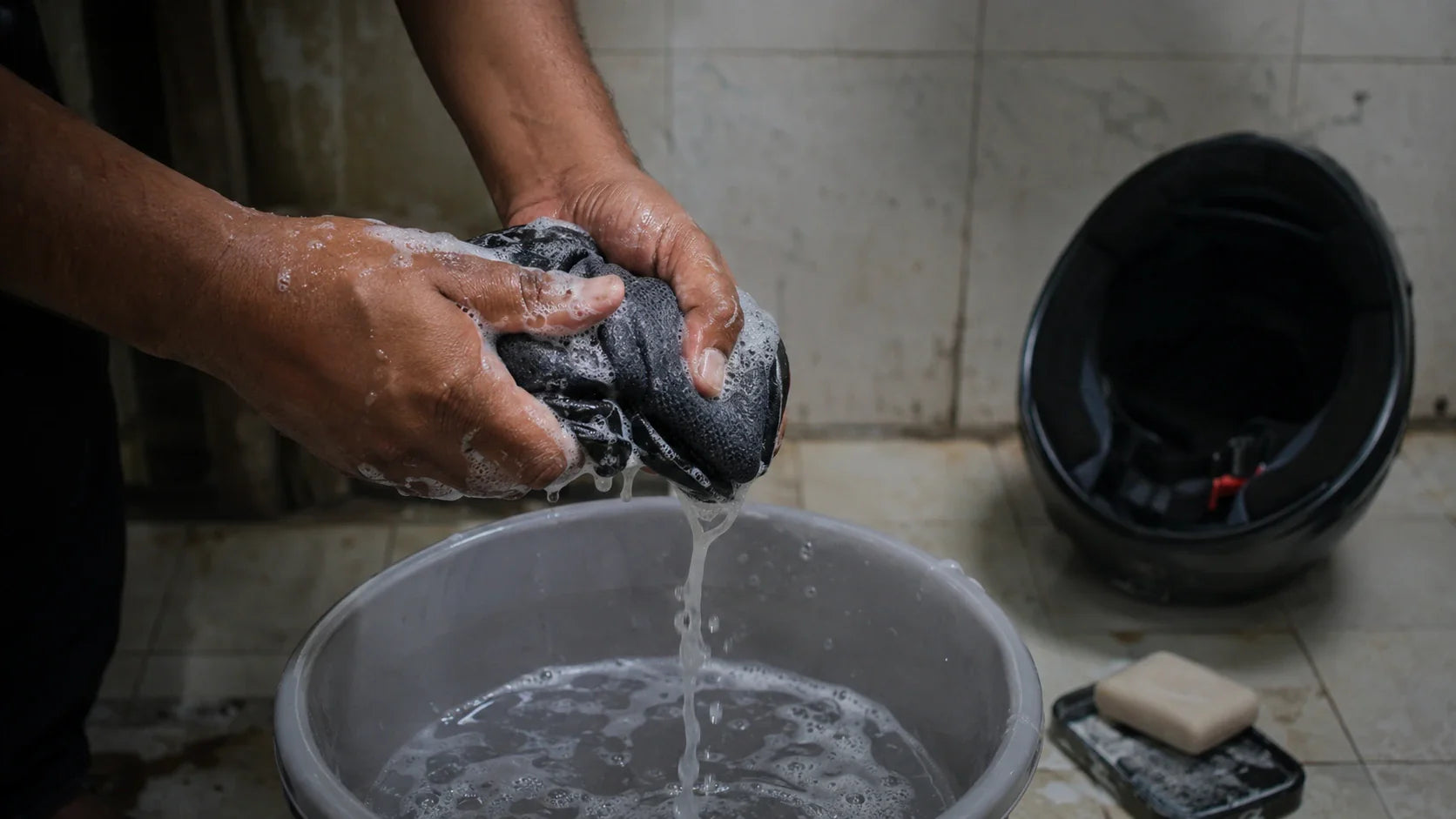
Done right, cleaning means removing the liner, washing it with a mild solution, rinsing, and air-drying. It's thorough. It resets the helmet.
But here's the catch. A proper clean takes time and a full day to dry. Most riders won't do it after every commute. Be honest. When did you last pull out your liner and wash it?
Quick Fact:
A 2020 study published in the International Journal of Microbiology recovered 392 bacteria and 346 fungi from 130 motorcycle helmet liners. Staphylococcus aureus was the single most common organism at 22.7% of isolates. A helmet interior cleaner targets exactly this buildup, but only when you actually do the deep clean. Source: Sapkota et al., 2020
A 2020 study published in the International Journal of Microbiology recovered 392 bacteria and 346 fungi from 130 motorcycle helmet liners. Staphylococcus aureus was the single most common organism at 22.7% of isolates. A helmet interior cleaner targets exactly this buildup, but only when you actually do the deep clean. Source: Sapkota et al., 2020
What does a helmet deodorant do that a cleaner can't?
A helmet deodorant works between cleans, when bacteria come back fast. Bacteria that feed on sweat can double their population in roughly 20 minutes under warm, enclosed conditions. Your helmet after a Mumbai summer commute is exactly that. A deep clean resets the count to zero, but the regrowth starts on your very next ride.
That's the gap a cleaner can't fill. You can't wash and dry your liner every single day. A deodorant takes seconds and keeps the helmet usable in between.
But not all deodorants are equal. And this is where most riders waste their money.
Unique Insight
Our finding: A cleaner and a deodorant aren't competitors fighting for the same slot in your kit. They're a relay. The cleaner resets bacteria to zero once a month. The deodorant holds that line on the 29 days you don't have time to wash and dry a liner.
Masking vs killing: why most helmet sprays fail
Most helmet sprays just cover the smell with fragrance. They don't touch the bacteria making it. In 2025, research in the Indian Journal of Microbiology linked specific bacteria like Staphylococcus hominis directly to odor on sweaty fabric. Spray perfume over that, and the bacteria keep multiplying under a nicer smell.
That's the difference between masking and managing. A masking spray buys you an hour. Then the funk wins again.
A bacteriostatic deodorant takes a different route. Instead of hiding odor, it stops the bacteria from multiplying. No bacteria boom, no smell. This is where Hygena sits. It's India's first helmet deodorant built to inhibit bacterial growth inside the liner, not just mask it with scent.
So the fix is simpler than scrubbing every week. Clean your helmet when it needs a reset. Spray Hygena between rides to keep the bacteria from coming back. Two sprays, five seconds, and tomorrow's ride doesn't smell like yesterday's sweat.

Quick Fact:
A bacteriostatic spray differs from a masking deodorizer by mechanism, not fragrance. Masking sprays add scent on top of active bacteria. A bacteriostatic formula inhibits the bacteria from multiplying, removing the source of the odor. A 2025 Indian Journal of Microbiology study tied Staphylococcus hominis directly to fabric odor. Source: Indian Journal of Microbiology, 2025
A bacteriostatic spray differs from a masking deodorizer by mechanism, not fragrance. Masking sprays add scent on top of active bacteria. A bacteriostatic formula inhibits the bacteria from multiplying, removing the source of the odor. A 2025 Indian Journal of Microbiology study tied Staphylococcus hominis directly to fabric odor. Source: Indian Journal of Microbiology, 2025
Do you need both? When to clean vs when to deodorize
Yes, you need both, and they run on different schedules. A 2020 study found 39% of helmet bacteria were multidrug-resistant, which means buildup isn't just smelly. It's worth removing properly. Deep clean monthly. Deodorize daily. That combination keeps the bacteria count low all month, not just for a day after washing.
Here's the simple rule. If your liner is visibly dirty, sweat-stained, or you've ridden through rain, it's cleaning time. If it just needs to stay fresh between rides, that's the deodorant's job.
Riders who do both stop the cycle of scrubbing, smelling fine for two days, then scrubbing again. Tumhara helmet fresh rehta hai, without the weekly wash marathon.

Frequently Asked Questions
Is a helmet interior cleaner the same as a deodorant?
No. A cleaner physically removes sweat and oil from the padding using surfactants. A deodorant manages odor between cleans. A 2020 International Journal of Microbiology study found 392 bacteria across 130 helmet liners, the buildup a cleaner strips and a deodorant keeps in check.
Can I just use a deodorant and skip cleaning?
Not long-term. Deodorants don't remove the oil and dead skin bacteria feed on. A 2020 study found 39% of helmet bacteria were multidrug-resistant. You still need a monthly deep clean to physically remove that buildup from the foam.
Why does my helmet smell again right after cleaning?
Because bacteria regrow fast. Under warm, enclosed conditions, sweat-feeding bacteria can roughly double every 20 minutes. A clean resets the count, but your next ride restarts it. A bacteriostatic deodorant slows that regrowth between washes.
What makes a bacteriostatic deodorant different?
It stops bacteria from multiplying instead of masking smell with fragrance. A 2025 Indian Journal of Microbiology study linked specific Staphylococcus bacteria to fabric odor. Removing the bacteria's ability to grow removes the source of the smell, not just the symptom.
Conclusion
A helmet interior cleaner and a helmet deodorant aren't rivals. One removes the buildup, the other keeps it from coming back between washes.
Clean your liner monthly. Then spray Hygena between rides to stop the bacteria from multiplying, so your helmet stays fresh without a weekly scrub. Five seconds before you ride beats an hour of washing after the smell wins. Try Hygena and break the cycle for good.
Sources
1. "Microbial Diversity and Antibiotic Susceptibility Pattern of Bacteria Associated with Motorcycle Helmets," International Journal of Microbiology (Sapkota et al.), 2020. Retrieved 2026-06-27.
2. "Motorcycle Helmets as Potential Fomites in Transmission of Pathogenic Micro-organisms and Antibacterial Activity of Helmet Disinfectant Spray," Asian Journal of Biological and Life Sciences, 2022. Retrieved 2026-06-27.
3. "Association of Staphylococcus hominis and Odor Production on Sweaty Polyester Sportswear," Indian Journal of Microbiology, 2025. Retrieved 2026-06-27.
Share:
Dhaba Food Stops for Bikers in India: Eat, Rest, Freshen Up
How Often Should You Really Clean Your Motorcycle Helmet?