
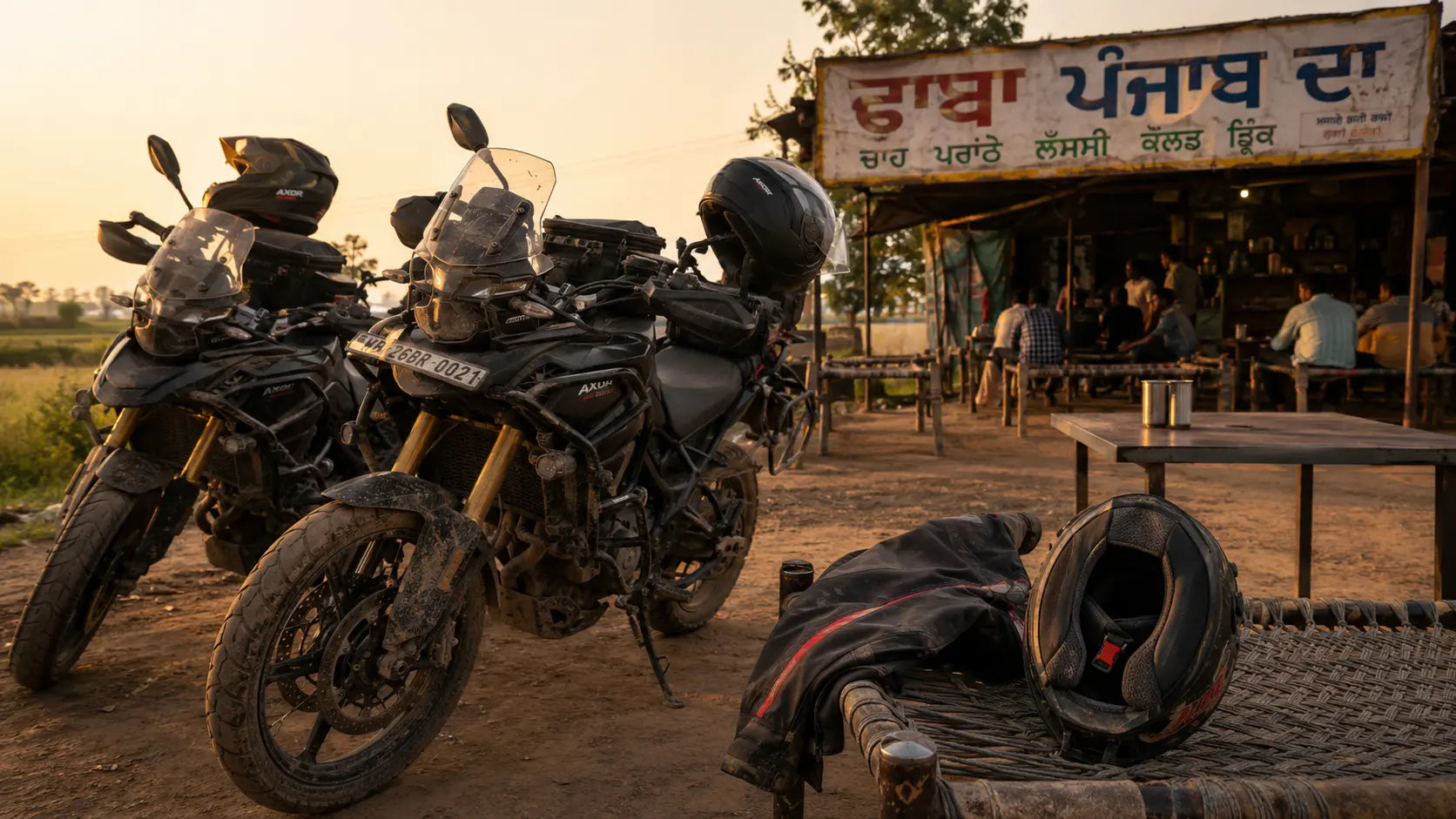
Four hours in the saddle. Your back aches, your throat is dry, and a hand-painted sign reads "Dhaba - 500m."
That sign is the best thing you'll see all day. A dhaba isn't just food on an Indian highway. It's where you rest, refuel, and finally peel off a sweat-soaked helmet. The food gets all the love. The freshen-up part is where most riders mess up.
This guide covers the best dhaba food stops for bikers, what to eat, and the 5-minute routine that gets you back on the road clean.
Rider Takeaways
- Dhabas began as truck stops on the Grand Trunk Road in the mid-20th century and now run 24 hours across every major highway.
- In Indian summer heat, riders can lose 1 to 1.5 litres of sweat per hour, most of it soaking into helmet padding.
- A 2020 study found S. aureus in 22.7% of motorcycle helmets, so a pit stop is the right time to treat your lid.
- Use the dhaba stop to hydrate, eat smart, and run a quick freshen-up before the next leg.
What Makes a Dhaba the Perfect Pit Stop for Bikers?
A dhaba gives you everything a tired rider needs in one place: hot food, a charpai to stretch out, a tap to wash up, and shade. These roadside kitchens started in the mid-20th century as rest points for truckers on the Grand Trunk Road. That trucker DNA is exactly why they suit bikers.
Truckers built the dhaba blueprint over decades on the road. Cheap, filling, fast, and open all night. The word comes from a Hindi term for a roadside eatery, and most sit right next to petrol pumps. Fuel for the bike, fuel for you, both in one stop.
For a rider, that layout is gold. You park where you can see your bike. You eat in ten minutes. And there's almost always water to splash your face. When did a fancy highway food court last let you nap on a cot? Bhai, the dhaba wins on every count that matters mid-ride.
Quick Fact:
Dhabas are roadside restaurants on the Indian subcontinent that emerged in the mid-20th century as pit stops for truck drivers, most famously along the Grand Trunk Road through Punjab and Haryana. They typically sit beside petrol stations and stay open 24 hours, serving local cuisine to highway travellers. Source: Dhaba, Wikipedia
Dhabas are roadside restaurants on the Indian subcontinent that emerged in the mid-20th century as pit stops for truck drivers, most famously along the Grand Trunk Road through Punjab and Haryana. They typically sit beside petrol stations and stay open 24 hours, serving local cuisine to highway travellers. Source: Dhaba, Wikipedia
Which Dhaba Food Stops Are Best on Indian Highways?
The best dhabas cluster on the routes bikers actually ride: the GT Road belt, the Delhi-Manali run, and the desert highways of Rajasthan. The Murthal stretch on NH-44 is the most famous, packed with paratha dhabas an hour north of Delhi. Each region has its own signature plate.
On the Delhi to Manali leg, riders stop at the Karnal and Murthal dhabas for ghee-loaded parathas before the hills. Heading into Ladakh, the small Himalayan dhabas near Jispa and Sarchu serve hot dal and rice at altitude, where nothing else is open. In Rajasthan, highway dhabas push dal baati and bajra rotis.
Down south, the Tamil Nadu and Karnataka highway "military hotels" play the same role with rice meals on banana leaves. The names change. The job stays the same: feed a traveller fast and cheap. Pick a busy one. A crowded dhaba means fresh food and fast turnover.
Unique Insight
Our take: Most dhaba lists rank food. Riders should rank logistics. The best biker dhaba has clear sightlines to your parked bike, a working tap or washroom, and shade for the helmet. Great parathas with nowhere to wash your hands is a worse stop than average dal with a clean tap.
What Should You Actually Eat at a Dhaba on a Long Ride?
Eat light, hydrate hard, and be picky about water. In Indian summer heat, riders can lose 1 to 1.5 litres of sweat an hour, so dehydration hits before hunger does. A heavy, greasy plate makes the next two hours sluggish. The classic dhaba spread can work for you or against you.
Go for dal, fresh rotis, curd, and a simple sabzi. Curd and lemon water help replace what you sweat out. Skip the deep-fried, heavy-cream dishes until the day's last leg. Drink sealed bottled water or the dhaba's filtered water, not a random jug, especially on rural stretches.
Food safety matters more than riders admit. Studies of Indian roadside food have found pathogens like E. coli and S. aureus in some samples. A busy dhaba with high turnover and food cooked hot in front of you is your safest bet. Watch it hit the tawa.
Why Is a Pit Stop Your Best Chance to Freshen Up?
Because your helmet has been a sealed sweat box for hours, and the dhaba is the first place you can fix it. In a 2020 study, researchers found Staphylococcus aureus in 22.7% of motorcycle helmets, the most common bacteria of the lot. That growth feeds on the sweat soaking your liner right now.
Here's what happens on a long ride. You sweat litres an hour in summer. Most of it goes into the padding against your scalp and forehead. The helmet sits in the sun on your tank bag. Warm, damp, dark. That's a perfect home for the bacteria that cause odor, itch, and breakouts.
The same 2020 study found a third of the S. aureus strains were drug-resistant. This isn't only a smell problem. A damp, bacteria-heavy liner against broken, sweaty skin is how riders pick up scalp irritation and helmet acne. The pit stop is your window to break that cycle before the next leg.
Quick Fact:
A 2020 study of 130 motorcycle helmets recovered 392 bacteria, with Staphylococcus aureus the most common at 22.7% of isolates, followed by S. epidermidis at 19.6%. Roughly a third of the S. aureus strains were methicillin-resistant. The authors advised riders to clean helmets regularly with a suitable agent. Source: Sapkota et al., PMC (2020)
A 2020 study of 130 motorcycle helmets recovered 392 bacteria, with Staphylococcus aureus the most common at 22.7% of isolates, followed by S. epidermidis at 19.6%. Roughly a third of the S. aureus strains were methicillin-resistant. The authors advised riders to clean helmets regularly with a suitable agent. Source: Sapkota et al., PMC (2020)
How Do You Freshen Up at a Dhaba in 5 Minutes?
Park, eat, then run a quick reset before you gear up again. You don't need a shower. You need five focused minutes at the dhaba tap and your tank bag. Riders who skip this start the next leg in a damp, smelly helmet and pay for it by evening with an itchy scalp.
Start with your face and neck. Splash cold water, wipe down with a clean cloth or wipe, and dry off. Rinse your hands well before and after eating, dhaba taps are right there. Drink more water than you think you need. Loosen your collar and let your jacket air on the charpai while you eat.
Now the part most riders forget: the helmet. Turn it upside down in the shade so the liner airs out while you eat. Before you wear it again, treat the inside so bacteria don't keep multiplying for the next four hours. This is where Hygena earns its spot in the tank bag.
Make this easier, Hygena takes five seconds. A few sprays of its bacteriostatic formula kill odor-causing bacteria at the source, so your helmet is fresh for the next leg instead of getting worse with every hour.

Unique Insight
Our finding: The dhaba stop is the only point on a long ride where all three problems can be fixed at once: dehydration, hunger, and helmet bacteria. Riders treat it as a food break. Treated as a full reset, it cuts the day's fatigue and stops the slow hygiene problem from building leg after leg.

Frequently Asked Questions
Are dhabas safe to eat at on a long bike ride?
Mostly yes, if you pick a busy one. High turnover means fresher food. Roadside food can carry pathogens like E. coli and S. aureus. Choose dishes cooked hot in front of you, and drink sealed or filtered water, not an open jug.
What should I eat at a dhaba to stay sharp while riding?
Eat light: dal, fresh rotis, curd, and a simple sabzi. In summer heat you can lose 1 to 1.5 litres of sweat an hour, so curd, lemon water, and plain water matter more than a heavy meal. Save the rich, fried dishes for your last leg of the day.
How do I freshen up at a highway pit stop without a shower?
Splash your face and neck, wipe down, rinse your hands, and air your jacket on the charpai. Then air and treat your helmet interior. A 2020 study found S. aureus in 22.7% of helmets, so a bacteriostatic spray like Hygena stops bacteria multiplying through the next leg.
Which dhabas are best on the Delhi to Manali route?
The Murthal stretch on NH-44, about an hour north of Delhi, is famous for paratha dhabas, with more clustered around Karnal. Higher up near Jispa and Sarchu, small Himalayan dhabas serve hot dal and rice where little else is open. Pick the crowded ones for fresher food.
Conclusion
A dhaba is more than a food stop. It's the one place on a long Indian ride where you can eat, rest, and reset your gear before the next leg.
Eat light, hydrate hard, and don't waste those five minutes. Air your helmet, treat the inside, and ride on fresh. Hygena keeps your lid bacteria-free between washes, so a four-day tour doesn't end with a stinking, itchy helmet. Park it in your tank bag, spray at every dhaba, ride clean.
Sources
1. "Dhaba," Wikipedia, 2024. Retrieved 2026-06-27.
2. "Microbial Diversity and Antibiotic Susceptibility Pattern of Bacteria Associated with Motorcycle Helmets," Sapkota et al., International Journal of Microbiology (PMC), 2020. Retrieved 2026-06-27.
3. "Prevalence and characterization of selected foodborne pathogens in frequently consumed street foods of India," Indian Journal of Microbiology Research, 2024. Retrieved 2026-06-27.
4. "Hydration and Nutrition Considerations for Endurance Exercise in the Heat," Gatorade Sports Science Institute, 2024. Retrieved 2026-06-27.
Share:
Can a Dirty Helmet Cause Skin Infections?
Helmet Interior Cleaner vs Deodorant: The Real Difference