
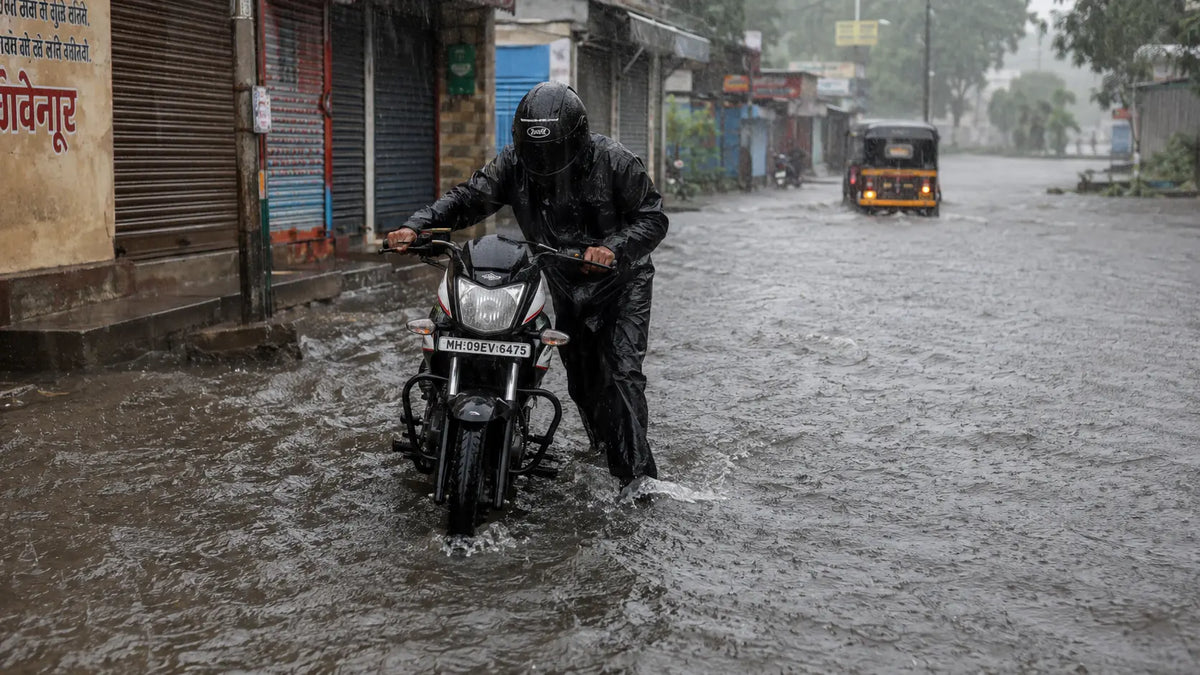
You're two hours into the Kolhapur-Goa run when the monsoon finally catches you.
Type "helmet cleaner Kolhapur" into Google and you'll get a wall of sprays and foams promising a fresh helmet in one wipe. Most of them lift mud off the shell. None of them touch the bacteria multiplying inside your liner while you're stuck under a dhaba awning waiting for the rain to ease.
Kolhapur ki barish kuch alag hi level ki hai, and this city sits right where Maharashtra's sugar belt meets the climb into the Sahyadris toward Goa. This piece breaks down what Kolhapur's roads, its rain, and its own riding culture actually do to a helmet, and why cleaning one isn't the same as making it hygienic.
Rider Takeaways
- As of March 2025, Kolhapur's RTO region had 18,42,263 registered vehicles, and two-wheelers make up roughly 78% of them. Source: Maharashtra State Transport Department, 2024-25.
- Kolhapur's humidity swings from 40% in March to 89% in July and August, and July alone brings 253mm of rain across 20 rainy days. Source: Climate-Data.org, Kolhapur climate averages.
- Kolhapur is also the last real stop before Amboli Ghat, the rain-soaked Sahyadri pass riders cross on the way down to Goa.
- A cleaner wipes off mud and dust. Only a bacteriostatic spray like Hygena stops the odor-causing bacteria growing underneath.
How Many of Kolhapur's Vehicles Are Two-Wheelers?
Most of them. As of March 31, 2025, Kolhapur's RTO region had 18,42,263 registered vehicles on its books, with 60,246 fresh registrations added during 2024-25 alone. Two-wheelers, motorcycles, scooters, and mopeds combined, account for roughly 78% of that total. Source: Maharashtra State Transport Department, Statistics 2024-25.
That's about 14.34 lakh two-wheelers against roughly 2 lakh cars. Kolhapur doesn't show up in national congestion rankings, but at nearly eight two-wheelers for every ten vehicles on its roads, more people here strap on a helmet every day than in cities several times its size.
Quick Fact:
Kolhapur's RTO region had 18,42,263 registered vehicles as of March 31, 2025, with two-wheelers, motorcycles, scooters, and mopeds combined, accounting for roughly 78% of that total. Source: Maharashtra State Transport Department, Statistics 2024-25
Kolhapur's RTO region had 18,42,263 registered vehicles as of March 31, 2025, with two-wheelers, motorcycles, scooters, and mopeds combined, accounting for roughly 78% of that total. Source: Maharashtra State Transport Department, Statistics 2024-25

Unique Insight
Our finding: Kolhapur's helmet count is growing quietly, without the traffic-ranking headlines Mumbai or Pune get. That makes it an easy city for helmet hygiene to stay invisible, right up until monsoon season makes the smell impossible to ignore.
Why Doesn't a Kolhapur Monsoon Ever Let a Helmet Fully Dry?
Because the rain here doesn't really stop for four months straight. Kolhapur's average relative humidity bottoms out at 40% in March, the driest month, then climbs to 89% by July and stays there through August. Source: Climate-Data.org, Kolhapur climate averages, 1991-2021.
July alone brings 253mm of rain spread across 20 rainy days, the heaviest single month of any Hygena city guide so far. Sitting at the foot of the Sahyadris means Kolhapur catches the full force of the southwest monsoon before it even reaches the ghats.
Quick Fact:
Kolhapur's relative humidity ranges from 40% in March, the driest month, to 89% in July and August, the monsoon peak, with July bringing 253mm of rain over 20 rainy days. Source: Climate-Data.org, Kolhapur climate averages, 1991-2021
Kolhapur's relative humidity ranges from 40% in March, the driest month, to 89% in July and August, the monsoon peak, with July bringing 253mm of rain over 20 rainy days. Source: Climate-Data.org, Kolhapur climate averages, 1991-2021

A liner that's still damp from Tuesday's ride never really gets a chance to reset before Wednesday's. Riders crack the visor at every red light hoping the breeze helps. It doesn't reach the bacteria already settling into the foam.
Why Does Every Bike Headed to Goa Stop in Kolhapur First?
Because it's the last flat, fed, fueled-up city before the road climbs into the Sahyadris. Kolhapur sits on the popular Pune-Satara-Kolhapur-Amboli-Goa route, and most riders treat it as their final proper meal stop before the ghat section begins.
Amboli Ghat itself is a mountain pass through the Sahyadri range on the way from Kolhapur toward Sawantwadi and, eventually, Goa's coastal plains. It receives heavy rainfall and is surrounded by thick forest and waterfalls, exactly the kind of terrain that keeps a touring helmet damp for hours at a stretch.
Quick Fact:
Amboli Ghat, on the road from Kolhapur to Sawantwadi, is a Sahyadri mountain pass that receives heavy rainfall and is surrounded by thick forest and waterfalls, making it one of the wettest stretches on the Kolhapur-Goa touring route. Source: Wikipedia, Amboli Ghat
Amboli Ghat, on the road from Kolhapur to Sawantwadi, is a Sahyadri mountain pass that receives heavy rainfall and is surrounded by thick forest and waterfalls, making it one of the wettest stretches on the Kolhapur-Goa touring route. Source: Wikipedia, Amboli Ghat
Kolhapur's own identity has nothing to do with cleanliness, either. The city built its name on kushti, traditional Indian wrestling. Chhatrapati Shahu Maharaj, who ruled Kolhapur from 1894 to 1922, built akharas across the city, including Motibag, Gangavesh, Shahupuri, and New Motibag, where more than 70 wrestlers per akhara still train daily on specially prepared clay pits. Source: Sahapedia, "Taleems of Kolhapur."
Locals here have a complicated relationship with dirt. Getting covered in mud at a talim is a badge of honor. Bacteria you can't see inside a helmet liner is a different problem entirely, and it's the one nobody in Kolhapur is talking about.
Unique Insight
Our finding: Kolhapur riders treat the monsoon as one long season, not scattered showers. That's four straight months where a helmet liner rarely finishes drying between rides, long enough for bacteria to build a permanent foothold.
What's Actually Breeding Inside a Rain-Soaked Helmet?
In 2020, researchers swabbed 130 motorcycle helmets and pulled out 392 distinct bacterial isolates across seven genera. Staphylococcus aureus alone made up 22.7% of them, and roughly a third of those Staph isolates came back resistant to methicillin, meaning MRSA. Source: Sapkota et al., International Journal of Microbiology, 2020.
Dust is the visible problem. Bacteria is the invisible one, and Kolhapur's monsoon feeds it better than most cities do. Warm, trapped moisture inside a sealed helmet is exactly the environment bacteria need to multiply, and a liner that never fully dries never gets a reset.
Quick Fact:
A 2020 study of 130 motorcycle helmets isolated 392 bacteria, led by Staphylococcus aureus at 22.7%, with roughly a third of those isolates confirmed as MRSA. Source: Sapkota et al., International Journal of Microbiology, 2020
A 2020 study of 130 motorcycle helmets isolated 392 bacteria, led by Staphylococcus aureus at 22.7%, with roughly a third of those isolates confirmed as MRSA. Source: Sapkota et al., International Journal of Microbiology, 2020
Is a Helmet Cleaner the Same as a Helmet Hygiene Spray?
No, and Kolhapur's monsoon makes the distinction matter more, not less. A helmet cleaner is built to lift mud, dust, and grime off a shell and liner surface. A hygiene product like Hygena is built to stop the bacteria growing underneath from multiplying in the first place.
Even multinational brands are catching on to the category. Castrol India launched an all-in-one helmet cleaner foam spray in September 2025, promising 99.99% antibacterial action on contact and dermatological testing for skin and hair safety. Source: Autocar Professional, September 2025. That's still a clean, a single event. It doesn't stop what regrows in the padding on your next monsoon ride.
| Job | Helmet Cleaner | Helmet Hygiene Spray (Hygena) |
|---|---|---|
| Removes visible mud and grime | Yes | No, not its job |
| Stops odor-causing bacteria multiplying | No | Yes, bacteriostatic formula |
| Used between washes | Occasionally | Every ride |
Hygena is a bacteriostatic spray, not a cleaner. It's formulated with tea tree extract and other natural antimicrobials to stop bacterial growth at the source, holds up through a soaked ghat ride, and takes seconds to apply after you park. In a city adding two-wheelers faster than the headlines suggest, that's the habit that actually holds up.
The fix is simpler than hunting for another spray at the local store. It comes down to two habits running side by side, one for the shell and one for what's underneath:
- Wash the removable liner weekly through the monsoon touring season (June-September), more often after a multi-day Goa run.
- Spray a bacteriostatic deodorant like Hygena after every ride, ghat crossing or short city hop alike, since bacteria start multiplying within hours.
Frequently Asked Questions
Does a helmet cleaner spray actually kill the bacteria causing helmet smell in Kolhapur?
Most helmet cleaner sprays are built to lift mud and grime, not kill bacteria. A 2020 study found Staph aureus in 22.7% of 392 bacteria isolated from motorcycle helmets. Source: Sapkota et al., International Journal of Microbiology, 2020. A bacteriostatic hygiene spray targets that bacteria directly.
Why does my helmet stay damp longer in Kolhapur than in drier cities?
Kolhapur's humidity climbs to 89% in July and August, with July bringing 253mm of rain over 20 rainy days. Source: Climate-Data.org. That combination barely lets a liner finish drying before the next ride starts.
How often should Kolhapur riders clean or sanitize their helmet during monsoon touring season?
Wash the removable padding weekly from June through September, and spray a bacteriostatic hygiene product like Hygena after every ride, since bacteria start multiplying within hours in that kind of humidity.
Where can I buy a helmet hygiene spray in Kolhapur?
Hygena ships to Kolhapur directly through hygena.in, with cash-on-delivery available. There's no dedicated helmet-hygiene counter in Kolhapur's markets yet, so ordering online is currently the fastest route.
Can I just use a helmet cleaner instead of washing the padding before a Goa ride?
No. A cleaner handles surface mud on the shell and visor before you set off. The padding still needs a separate wash cycle plus a bacteriostatic spray between washes, especially on a multi-day ride through Amboli Ghat's rain.
Conclusion
Kolhapur's helmets deal with a specific combination: 18,42,263 registered vehicles sharing roads that lead straight into the Sahyadris, humidity that barely dips below 40% even in the dry season, and a monsoon that dumps 253mm of rain in July alone. A cleaner spray addresses none of that.
Hygena does. It's not a cleaner, it's a hygiene habit, a few seconds after every ride that stops bacteria before it starts smelling. Try it before your next Amboli Ghat crossing and see what a genuinely fresh helmet feels like after a Kolhapur monsoon.
Sources
1. "RTO wise Vehicle Population, New Registration during the year 2024-25," Maharashtra State Transport Department. Retrieved 2026-07-30.
2. "Kolhapur Climate," Climate-Data.org, climate averages 1991-2021. Retrieved 2026-07-30.
3. "Amboli Ghat," Wikipedia. Retrieved 2026-07-30.
4. "Taleems of Kolhapur: A Legacy in Wrestling," Sahapedia. Retrieved 2026-07-30.
5. Sapkota, A. et al., "Microbial Diversity and Antibiotic Susceptibility Pattern of Bacteria Associated with Motorcycle Helmets," International Journal of Microbiology, 2020. Retrieved 2026-07-30.
6. "Castrol India Launches All-in-One Helmet Cleaner Product," Autocar Professional, September 22, 2025. Retrieved 2026-07-30.
Share:
Helmet Cleaner Ghaziabad: Why Smog Changes the Answer
Helmet Cleaner Solapur: Dust, Heat, and What Actually Works