
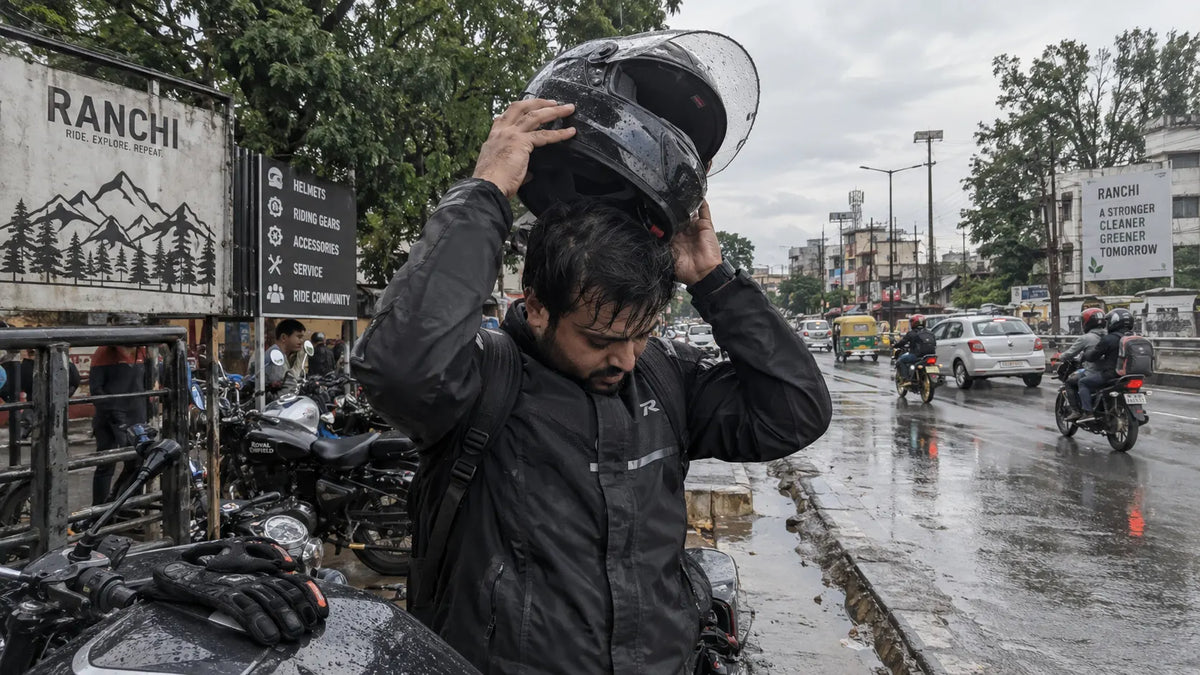
That Ranchi ride can feel fresh outside while your helmet tells a different story.
You leave home with a clean helmet, ride through traffic, sweat into the liner, and park the bike. Then you put it on again the next morning. Over time, the inside starts smelling stale.
If you've searched for a helmet cleaner Ranchi riders can use regularly, there's one distinction worth knowing first. Cleaning removes dirt, sweat, and grime. Hygiene targets the microbial buildup that can keep bringing the smell back.
Ranchi's weather and traffic make that distinction useful. The city receives substantial monsoon rainfall, while busy corridors can develop serious peak-hour congestion. Your helmet stays against your scalp through all of it.
- IMD climate normals put Ranchi's annual rainfall at 1,397.7 mm.
- A 2025 Ranchi traffic study recorded peak flow of 2,747 PCU.
- A 2020 helmet study recovered 392 bacterial isolates from 130 helmets.
- Use cleaning for buildup and hygiene care between deeper cleans.
Why does Ranchi's weather make helmet hygiene harder?
Ranchi's climate creates repeated wet-and-sweaty riding conditions, especially during the monsoon. IMD climate normals for 1981–2010 show 1,397.7 mm of annual rainfall and 75.2 rainy days. That moisture matters when your helmet liner doesn't dry fully.
India Meteorological Department climate normals for Ranchi show 1,397.7 mm of mean annual rainfall across 1981–2010. July averages 336.6 mm and 16.3 rainy days. For riders, repeated moisture can make proper drying between rides more important. Source: India Meteorological Department, Ranchi climatological table
Summer adds another problem. IMD's Ranchi climatological table gives May an average daily maximum of 36.8°C. April averages 35.6°C. A helmet traps heat close to your scalp, while sweat adds moisture to the liner.
That doesn't mean every damp helmet will develop harmful contamination. It means your liner gets more chances to collect sweat, skin oils, dust, and moisture.
So, "helmet cleaner" isn't the whole answer. Your routine needs two jobs: periodic physical cleaning and regular hygiene between those deeper cleans.
Our finding: Ranchi's helmet routine needs to account for moisture swings, not just hot days. A helmet can move from sweaty riding to damp storage within the same week.
When you finish a wet ride, don't seal the helmet inside a closed bag. Let the liner dry in a clean, ventilated place. Keep the shell out of harsh direct heat, and follow your helmet maker's care instructions.
Ranchi's IMD climate normals record 1,397.7 mm of annual rainfall, with July averaging 336.6 mm. The combination of rainfall and warm riding periods makes drying and regular helmet hygiene practical priorities. Source: India Meteorological Department, Ranchi climatological table, 1981–2010.
Learn the difference between helmet cleaning and deodorising.

What does Ranchi traffic do to your helmet routine?
Ranchi's traffic can stretch a short motorcycle trip into a long period of helmet-on time. A November 2025 transport study reported peak traffic flow of 2,747 passenger car units and a peak-hour factor of 0.97 on its study corridor.
A 2025 study of Ranchi's main-road congestion reported a peak flow of 2,747 passenger car units and a peak-hour factor of 0.97. The study linked peak-hour congestion with increased travel-time and fuel costs. Source: Indian Journal of Transport Engineering, 2025. Read the study
Traffic isn't a bacteria counter. It does, however, change how long your scalp stays enclosed inside the liner.
In 2025, local reporting also identified bottlenecks around Ratu Road, Lalpur, Kutchery, Kantatoli, Purulia Road, Siramtoli, Namkum, Kanke, and Main Road. Stop-start riding means your helmet stays on while your body keeps producing heat.
That matters for commuters. You might not notice the liner getting damp during the ride. You notice it later, when the helmet smells different.
For a daily rider, the practical response is simple. Give the liner time to dry, clean it according to the helmet maker's instructions, and use a rider-specific hygiene product between deeper cleans.
A 2025 Indian Journal of Transport Engineering study of Ranchi reported peak traffic flow of 2,747 passenger car units and a peak-hour factor of 0.97. Long, stop-start journeys keep a helmet against the scalp for extended periods, making drying and regular hygiene useful parts of a rider's routine.
Read why helmet hygiene matters to riders.
What are Ranchi riders already doing about helmet care?
Ranchi has an established motorcycle-touring culture, and local ride reports show riders using the city as a base for routes through Jharkhand. A Team-BHP ride report documented a 170 km Ranchi–Sikidiri–Gola–Rajrappa–Ramgarh–Ranchi loop.
A Team-BHP ride report published in 2012 documented a 170 km loop from Ranchi through Sikidiri, Gola, Rajrappa, and Ramgarh. The rider described scorching heat on the route. It shows how Ranchi also functions as a base for longer local motorcycle rides. Source: Team-BHP, 2012
That culture changes the helmet problem. Your helmet isn't only for a short office commute. It can stay on through a city ride, a highway stretch, a roadside stop, and the trip home.
Local ride reports also include routes toward Hirni Falls and Patratu Valley. These aren't hygiene studies, but they show the kind of riding environment your helmet can move through.
Dust, sweat, moisture, and repeated wear all end up sharing the same liner. Your helmet needs a routine that travels with you.
Our finding: A Ranchi rider can use the same helmet for short urban trips and longer Jharkhand routes. Your hygiene routine should work for both, without requiring a full wash after every ride.
Ranchi's motorcycle community includes both urban riding and longer routes around Jharkhand. A 2012 Team-BHP report documented a 170 km loop from Ranchi through Sikidiri, Gola, Rajrappa, and Ramgarh. Longer rides mean more repeated exposure to sweat, heat, dust, and moisture inside the same liner.
See another city-specific helmet hygiene example.
Is a helmet cleaner the same as a hygiene spray?
No. A cleaner and a hygiene spray do different jobs. Cleaning physically removes visible buildup. A hygiene spray is designed to manage the microbial activity that contributes to recurring odour between deeper cleans.
A 2020 study tested 130 motorcycle helmets and recovered 392 bacterial isolates plus 346 fungal isolates. Helmets that had never been washed showed higher bacterial and fungal growth than helmets that were washed or disinfected. Source: International Journal of Microbiology, 2020. Read the study
| What you need | Cleaning | Hygiene care |
|---|---|---|
| Remove visible dirt and residue | Yes | Not the main purpose |
| Manage microbial buildup | May help | Primary purpose |
| Use between deeper washes | Not always practical | Yes |
| Address recurring odour | Sometimes temporary | Designed for ongoing control |
The 2020 study found bacterial growth in 86.7% of helmets that had no reported hygienic practice. It also found fungal growth in 83.3% of those helmets. Those numbers come from one study in Nepal, so they shouldn't be treated as Ranchi prevalence.
The useful lesson is narrower. Helmet interiors need hygiene attention. Ignoring the liner isn't a neutral choice.
A 2020 International Journal of Microbiology study examined 130 motorcycle helmets and recovered 392 bacterial and 346 fungal isolates. Helmets with no reported washing or disinfection had higher microbial growth than frequently washed or disinfected helmets. The study supports regular helmet hygiene, not a Ranchi-specific contamination rate.
How should you use a helmet cleaner in Ranchi?
Start with physical cleaning when the liner needs it. Then use regular hygiene care to manage odour buildup between deeper cleans. Always follow your helmet manufacturer's washing and drying instructions.
- Remove the liner only if your helmet allows it.
- Wash removable padding according to the manufacturer's instructions.
- Let the liner dry completely before wearing the helmet.
- For between-clean hygiene, apply Hygena to the helmet liner as directed.
- Store the helmet somewhere ventilated instead of sealing it while damp.
Hygena is designed specifically for riding gear hygiene. Its current product page lists bacteriostatic technology, quick-drying use, and suitability for common helmet liner materials.
The product page currently lists the 100 ml bottle at ₹599. It recommends use before every ride and states that the formula works within about 10 seconds.
Our finding: The most useful Ranchi routine isn't "wash constantly." It's deeper cleaning when needed, followed by consistent hygiene care between washes.
Make helmet hygiene part of your next ride. Check Hygena Helmet Deodorant and build a quick interior-care step into your riding routine.
Hygena's current product page describes its 100 ml Helmet Deodorant as a bacteriostatic riding-gear hygiene spray. The page lists a ₹599 price, quick-drying use, and directions for regular helmet-liner application. Product claims should be understood as brand-provided information.

Frequently Asked Questions
Does Ranchi's monsoon make helmet smell worse?
It can make drying harder. IMD climate normals record 336.6 mm of mean rainfall in July and 319.1 mm in August. Keep the liner ventilated and dry, then use regular hygiene care between deeper cleans.
Where can I buy helmet cleaner Ranchi riders use?
For online purchase, Hygena's official product page lists its 100 ml Helmet Deodorant at ₹599. It's designed for riding-gear hygiene rather than exterior grime removal. Always check the latest product directions before use.
Is helmet cleaner enough to stop recurring smell?
Not always. Cleaning removes physical buildup, while recurring odour can involve microbial activity. A 2020 helmet study found higher microbial growth in helmets with no washing or disinfection practice.
How often should Ranchi riders clean a helmet liner?
Follow your helmet maker's instructions and clean when sweat or residue builds up. Between deeper cleans, regular hygiene care can help manage odour. Dry the liner fully after washing before wearing it again.
Can I use Hygena on my helmet liner?
Hygena's current product page says it's tested for common helmet types and liner materials. Use it as directed, allow the gear to dry properly, and follow your helmet manufacturer's care instructions.
Final word: clean the dirt, manage the hygiene
If you're searching for a helmet cleaner Ranchi riders can use, start by separating cleaning from hygiene.
Ranchi's rainfall, warm riding periods, and congested corridors can make helmet-on time sweaty and drying inconsistent. Local riding culture adds longer routes to the mix.
Clean your liner when it needs a deeper wash. Dry it properly. Then add a quick hygiene step between washes.
That's where Hygena fits. It's built around rider-specific hygiene and regular helmet-liner use.
Build helmet hygiene into your next Ranchi ride with Hygena.
For the science behind recurring helmet odour, read Why Helmet Hygiene Matters.
Sources
- India Meteorological Department, Ranchi climatological table, 1981–2010. IMD Ranchi. Retrieved September 17, 2026.
- Kumar, Rajeev; Singh, Ajai. "Assessment of Public Acceptance and Compliance with Traffic Congestion Pricing: A Case Study of Ranchi City, India." Indian Journal of Transport Engineering, 2025. IJTE. Retrieved September 17, 2026.
- Sapkota, Sanjeep et al. "Microbial Diversity and Antibiotic Susceptibility Pattern of Bacteria Associated with Motorcycle Helmets." International Journal of Microbiology, 2020. PMC. Retrieved September 17, 2026.
- Team-BHP, "My 1st Bull: Classic 500 Desert Storm," Ranchi route report, 2012. Team-BHP. Retrieved September 17, 2026.
- Hygena, Helmet Deodorant 100 ml product page. Hygena. Retrieved September 17, 2026.
Share:
Helmet Cleaner Shrinagar: What Actually Fixes Helmet Smell?
Helmet Cleaner Bhilai: What Riders Should Actually Use