
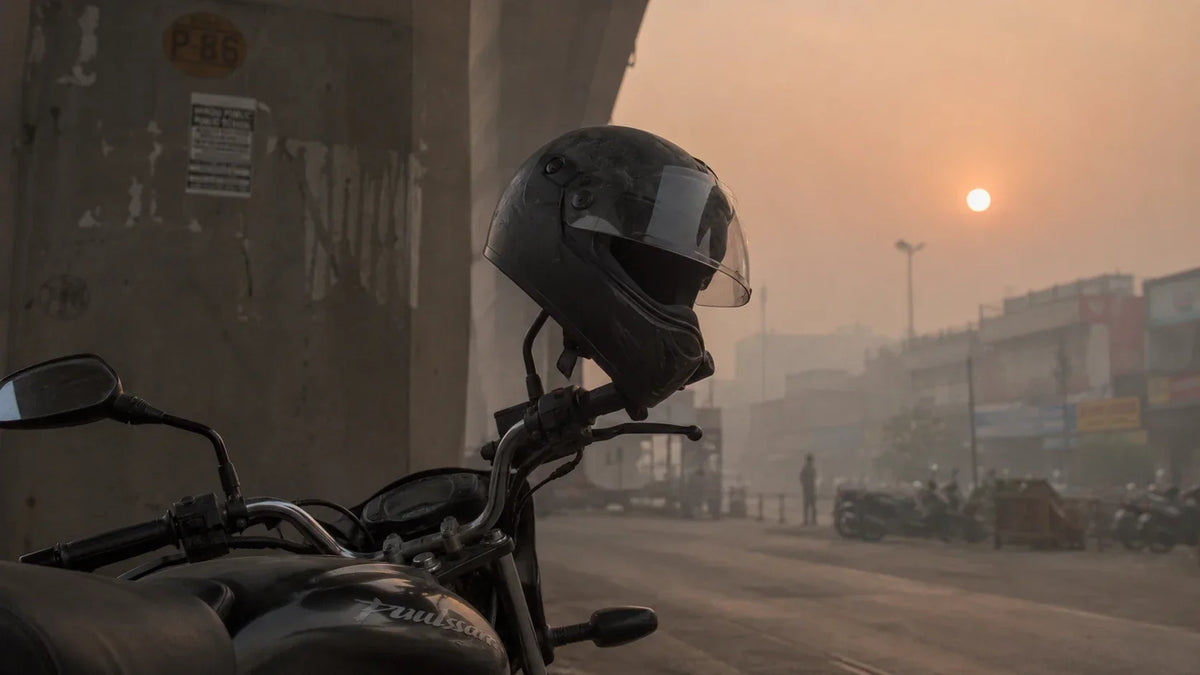
You're idling at an ITO signal and the AQI app on your phone just crossed 400 again.
Search "helmet cleaning spray Delhi" and you'll find dozens of options promising a fresher helmet. Almost none of them mention that your helmet is filtering the same hazardous air your lungs are.
Delhi's helmet problem isn't just sweat. It's smog trapped against a sweaty scalp for hours, in a city adding two-wheelers faster than almost anywhere else in India. Here's what's actually happening inside that liner, and why cleaning isn't the same as hygiene.
Rider Takeaways
- Delhi's post-stubble PM2.5 averaged 210 µg/m³ in December 2025, and vehicles cause 46% of the city's local pollution load. Source: CSE, December 2025.
- Delhi commuters lost 104 hours to traffic in 2025, with evening rush hour congestion at 107.4%. Source: TomTom Traffic Index, 2025.
- Two-wheelers now make up 67.65% of Delhi's 87.61 lakh registered vehicles. Source: Economic Survey of Delhi 2025-26.
- A cleaning spray lifts dust off the shell. Only a bacteriostatic spray like Hygena works on the bacteria living in the padding.
Why Does Delhi's Air Make Helmet Hygiene Harder?
Delhi doesn't just have bad air, it has some of the worst air of any major city on earth. On December 28, 2025, the AQI hit 530, officially "hazardous," delaying more than 150 flights at IGI Airport. Source: IQAir, December 2025.
It isn't only a winter spike. A CSE analysis found average PM2.5 actually rose after stubble-burning season ended, hitting 210 µg/m³ across December 1-28, 2025, a 29% jump from the stubble-heavy months before it. Source: Centre for Science and Environment, December 2025.
Quick Fact:
Vehicles cause nearly half, 46%, of the PM2.5 pollution generated locally within Delhi, the single largest local source category. Source: Centre for Science and Environment, "Beyond the Burn," December 2025
Vehicles cause nearly half, 46%, of the PM2.5 pollution generated locally within Delhi, the single largest local source category. Source: Centre for Science and Environment, "Beyond the Burn," December 2025
Every commute pulls that same particulate-heavy air through your visor gaps and into the liner. Combined with sweat from a sealed-face helmet, it builds a residue that plain cleaning wipes barely touch.
How Much Extra Sealed-Helmet Time Is Delhi Traffic Adding?
Delhi commuters lost 104 hours to congestion in 2025, over 5 hours more than in 2024, per the TomTom Traffic Index. Source: TomTom Traffic Index, 2025.
Evening rush hour is worse than the morning grind. A 10km ride takes nearly 32 minutes at an average of 18.9 km/h, with congestion levels crossing 107%. Source: TomTom Traffic Index, New Delhi report, 2025.
Quick Fact:
Delhi's evening rush hour hit a 107.4% average congestion level in 2025, with a 10km drive taking almost 32 minutes at 18.9 km/h. Source: TomTom Traffic Index, New Delhi, 2025
Delhi's evening rush hour hit a 107.4% average congestion level in 2025, with a 10km drive taking almost 32 minutes at 18.9 km/h. Source: TomTom Traffic Index, New Delhi, 2025
Every extra minute at a red light on Ring Road or ITO is another minute of smog-and-sweat exposure sealed inside the helmet. Delhi riders don't just sit in traffic longer, they breathe worse air while doing it.
What's Actually Growing Inside a Sweaty, Smog-Exposed Helmet?
A 2020 study swabbed 130 motorcycle helmets and recovered 392 bacterial isolates and 346 fungal isolates across seven genera. Staphylococcus aureus alone made up close to a quarter of the bacteria found. Source: Sapkota et al., International Journal of Microbiology, 2020.
Nearly 39% of those bacterial isolates were multi-drug resistant, and about a third of the Staph aureus samples tested positive for MRSA. That's what's sitting in the padding long after a ride ends.

A helmet cleaning spray is built to lift dust and grime off a shell or visor. It does nothing about what's multiplying in the foam, particularly when that foam never fully dries between smog-heavy commutes.
How Are Delhi's Two-Wheeler Numbers Making This Worse?
Delhi's vehicle count crossed 87.61 lakh as of March 19, 2026, up 7.93% from the year before. Two-wheelers drove that growth, now totalling 59,27,775 units, 67.65% of every registered vehicle in the city. Source: Economic Survey of Delhi 2025-26.
That's roughly 522 vehicles for every 1,000 residents, and most of them are scooters and motorcycles threading through the same congested, smog-heavy corridors every day.
Unique Insight
Our finding: Delhi riders already engineer around the pollution problem. A homegrown startup even built an air-filtering helmet years back. Almost nobody applies that same effort to what's growing inside a standard helmet's liner.
A Delhi-based startup, Shellios Technolabs, built a helmet with an embedded HEPA filter and blower fan that cuts pollutant exposure by more than 80% in testing. It even ships with an app that reminds riders when the helmet needs cleaning. Source: HinduPost, 2022.
That kind of engineering shows how seriously Delhi riders take the air outside their helmet. Almost nobody thinks about what's breeding inside it.
Is a Helmet Cleaning Spray the Same as a Hygiene Spray?
No, and this is exactly where a "helmet cleaning spray Delhi" search leads people astray. A cleaning spray is built to lift road dust, grime, and pollution residue off the outer shell.
A hygiene spray like Hygena works differently. It's bacteriostatic, meaning it stops odor-causing bacteria from multiplying in the padding in the first place, instead of just masking the smell they produce.
| Job | Cleaning Spray | Hygiene Spray (Hygena) |
|---|---|---|
| Removes visible smog dust and grime | Yes | No, not its job |
| Stops odor-causing bacteria multiplying | No | Yes, bacteriostatic formula |
| Used after every ride | Occasionally | Every ride |
Hygena is formulated with tea tree extract and natural antimicrobials, applied in seconds after a ride. In a city where the air itself is part of the problem, that daily habit matters more than another surface wipe.

Frequently Asked Questions
Does a helmet cleaning spray actually remove the bacteria causing helmet smell in Delhi?
Most cleaning sprays lift dust and grime, not bacteria. A 2020 study found Staph aureus in 22.7% of 392 bacteria isolated from motorcycle helmets. Source: Sapkota et al., 2020. A bacteriostatic spray targets that bacteria directly.
Why does my helmet smell worse in Delhi's winter than other months?
Delhi's post-stubble PM2.5 averaged 210 µg/m³ in December 2025. Source: CSE, December 2025. That particulate load mixes with trapped sweat inside a sealed helmet, giving bacteria more to feed on through winter.
How often should Delhi riders wash or sanitize their helmet interior?
Wash removable padding every two to three weeks, more often during peak smog season. Spray a bacteriostatic hygiene product like Hygena after every ride, since bacteria start multiplying within hours.
Where can I buy a helmet hygiene spray in Delhi?
Hygena ships across Delhi NCR through hygena.in, with cash-on-delivery available. It's built for the exact combination of pollution and traffic-hour sweat Delhi riders deal with daily.
Can a cleaning spray replace washing my helmet's padding?
No. A cleaning spray handles surface dust on the shell and visor. The padding needs a separate wash cycle plus a bacteriostatic spray between washes, where sweat and bacteria actually collect.
Conclusion
Delhi's helmets deal with a specific combination: an AQI that hit 530 in December 2025, 104 hours lost to traffic, and 59.27 lakh two-wheelers sharing the same smog-heavy roads. A cleaning spray addresses none of that.
Hygena does. It's a hygiene habit, seconds after every ride, that stops bacteria before it starts smelling, no matter what the AQI app says. Try it and see what an actually fresh helmet feels like in Delhi.
Sources
1. "Beyond the Burn: Delhi's Winter Smog Intensifies Even After Stubble Fires Fade," Centre for Science and Environment, December 31, 2025. Retrieved 2026-07-30.
2. "December 28, 2025: Delhi Among Top 10 Most Polluted Cities in the World," IQAir, December 28, 2025. Retrieved 2026-07-30.
3. "New Delhi Traffic Report," TomTom Traffic Index, 2025. Retrieved 2026-07-30.
4. "Delhi's Vehicle Count Hits 87.6 Lakh; 8% Rise in 2025-26," The Pioneer, citing Economic Survey of Delhi 2025-26, March 24, 2026. Retrieved 2026-07-30.
5. "Delhi-Based Startup Launches Anti-Pollution Helmet That Filters Air for Bike Riders," HinduPost, September 7, 2022. Retrieved 2026-07-30.
6. Sapkota, A. et al., "Microbial Diversity and Antibiotic Susceptibility Pattern of Bacteria Associated with Motorcycle Helmets," International Journal of Microbiology, 2020. Retrieved 2026-07-30.
Share:
Helmet Deodorant Spray Ahmedabad: Beat the Rush-Hour Stink
Helmet Cleaning Spray in Surat: Does It Actually Work?