
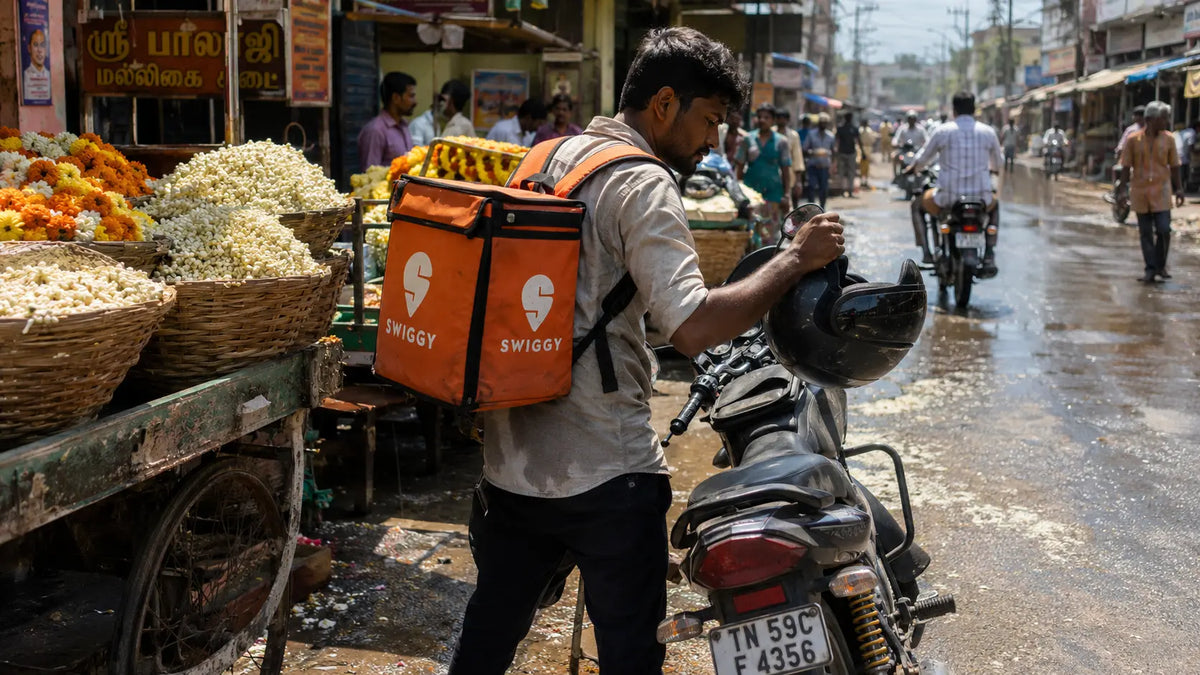
Simmakkal signal, 2pm, and the tar's gone soft under your tyres. Your helmet strap is already damp before you've even pulled away.
Madurai doesn't do mild heat. It's broken its own temperature records more than once. Every one of those degrees does something to the inside of your helmet, whether you notice it or not. Searching "helmet cleaner Madurai" usually means the smell has already shown up. Here's what's actually causing it, and why a wipe-down alone won't be enough.
Rider Takeaways
- Madurai hit 41.0°C on September 18, 2024, making it "the hottest place in India" that month and breaking its own all-time September record (Tamil Nadu Weatherman, via OneIndia, Sept 2024).
- Madurai logged 403 road fatalities in the first half of 2025 alone, roughly 4.66% of Tamil Nadu's statewide total (State Crime Records Bureau, via The South First, Dec 2025).
- Fast-growing bacteria can double in as little as 20 minutes inside the 4°C–60°C "danger zone," a range your helmet's interior sits well inside on most Madurai afternoons.
- A cleaner spray lifts dust and sweat film off the surface. It doesn't stop what's still multiplying in the foam underneath.
Why Does Madurai Keep Breaking Tamil Nadu's Heat Records?
Because it genuinely is the state's heat epicenter, not just a hot city among many. On September 18, 2024, Madurai touched 41.0°C. That's the hottest reading recorded anywhere in India that day, and its own all-time record for the month. Source: Tamil Nadu Weatherman via OneIndia, Sept 2024.
That wasn't a one-off spike either. The same city hit 40.8°C just two weeks earlier, on September 5. Even outside those record days, Madurai's year-round average sits at 28.2°C. May highs regularly touch 37.3°C, and only December offers any real relief, at 28.9°C. Source: Climate-Data.org, 1991-2020 averages.
Quick Fact:
Madurai's humidity swings from 52% in March to 77% in November, a 25-point jump, while its annual average temperature runs 28.2°C with May highs of 37.3°C. Source: Climate-Data.org, 1991-2020
Madurai's humidity swings from 52% in March to 77% in November, a 25-point jump, while its annual average temperature runs 28.2°C with May highs of 37.3°C. Source: Climate-Data.org, 1991-2020
A helmet parked in that heat for even a few hours isn't just warm. It's sitting inside conditions that actively favor bacterial growth, not just sweat production. That's a different problem than a monsoon city's soaked-liner story, and it needs a different fix.
Is Madurai Traffic Police Actually Cracking Down on Helmets?
Yes. Madurai City Traffic Police rolled out AI-based ANPR camera monitoring on key roads in June 2026. The system flags helmet, seatbelt and overspeeding violations. It followed a noticeable rise in congestion across commercial zones, school areas and busy junctions. Source: Thoonganagaram, June 2026.
The stakes behind that rollout are real. Madurai recorded 403 road fatalities in just the first six months of 2025. That's about 4.66% of Tamil Nadu's statewide total: 8,562 deaths across 34,611 accidents in that period. Source: The South First, citing State Crime Records Bureau, Dec 2025.
Statewide, two-wheelers accounted for 3,725 of those deaths. Separate SCRB data put helmetless two-wheeler fatalities at 803 for the same half-year. That's down nearly 38% from 1,297 a year earlier, a real sign enforcement is working. Source: IANS via Prokerala, Sept 2025.
Unique Insight
Our finding: Camera-driven helmet enforcement in a city already averaging over 37°C for half the year means more riders spending more hours a week sealed inside a hot helmet shell, not fewer. The crackdown fixes compliance. It does nothing about what's now multiplying inside the gear people are wearing more often.
What Actually Happens Inside a Helmet at 40°C?
Food-safety science has a name for the range where bacteria multiply fastest: the "danger zone." That's 40°F to 140°F, or roughly 4°C to 60°C. Inside that range, fast-growing bacteria like E. coli can double in number in as little as 20 minutes. Source: FoodDocs, food-safety industry resource, 2025.
A parked helmet in Madurai's May sun sits comfortably inside that same range, with 37.3°C ambient air trapped inside a sealed shell. Add sweat and skin oil from a rider's scalp, and bacteria get both the moisture and the heat they need. That's not a monsoon-humidity problem or a workshop-grease problem. It's a straightforward heat-and-time problem, and Madurai has more of both than most Indian cities.
Quick Fact:
Bacteria multiply fastest between 4°C and 60°C, the "danger zone," where fast-growing species can double in as little as 20 minutes. A helmet's interior on a Madurai afternoon sits well inside that range. Source: FoodDocs, 2025
Bacteria multiply fastest between 4°C and 60°C, the "danger zone," where fast-growing species can double in as little as 20 minutes. A helmet's interior on a Madurai afternoon sits well inside that range. Source: FoodDocs, 2025

How Do Madurai's Temple-City Riders Handle Helmet Sweat Today?
Mostly, they don't, because the city barely stops moving long enough to notice. Madurai's Mattuthavani flower market alone moves roughly 20 tonnes of jasmine and 100 tonnes of other flowers every single day. About 100 shops there do ₹50 lakh to ₹1 crore in daily turnover. Source: People's Archive of Rural India.
That's thousands of riders moving through the market lanes on two-wheelers before sunrise, through peak heat, and again at night. Add the Chithirai festival's Kallalagar procession, which drew lakh-plus devotees into the city in a single stretch. It's part of why Madurai earns its old nickname, Thoonga Nagaram: "the city that never sleeps." Sources: ETV Bharat, May 2025, Ancient Madurai.
A city running this close to around-the-clock leaves riders little natural downtime to air out gear, let alone clean it. The helmet just goes back on for the next run.
Unique Insight
Our finding: Madurai's "sleepless city" identity isn't just a tourism tagline. For riders moving flowers, running deliveries, or ferrying pilgrims at 2am and 2pm alike, it means the one thing every other city's helmet gets, a genuine overnight rest, almost never happens here.
Is a Helmet Cleaner the Same as a Helmet Hygiene Spray?
No, and the difference matters more in a city this hot. A cleaning spray is built to lift sweat film, dust and surface grime off the padding. It does that job well, and it's genuinely useful after a long ride.
What it isn't built for is stopping the bacteria still multiplying in the foam underneath. That matters most in a helmet that's spent the afternoon inside that 4°C-60°C danger zone. Cleaning removes what you can see. Hygiene addresses what's still growing after the surface looks fine.
Hygena isn't sold as a cleaner. It's a bacteriostatic hygiene spray built to stop odor-causing bacteria from multiplying in the padding. Use it after the visible sweat and dust is wiped off, not instead of it.
| What it does | Cleaner spray | Hygena (hygiene spray) |
|---|---|---|
| Removes sweat film, dust, visible grime | Yes | Not its job |
| Stops bacteria multiplying in foam | No | Yes, bacteriostatic |
| Best used | Right after a hot, sweaty ride | After cleaning, 3-4x a week |
What Actually Works for a Madurai Rider's Routine
Start simple: wipe sweat and dust off the shell and liner after a hot ride. Let the helmet dry somewhere shaded, not baking on the seat in direct sun, where it just re-enters the danger zone. Then use a bacteriostatic spray like Hygena a few times a week to handle what wiping alone can't.
A few sprays on the padding after your ride takes under a minute. It keeps working through a Madurai afternoon that's already hotter than most of the country. If your day runs from a dawn market run to a 2am festival crowd, your helmet needs a routine that survives both.

Frequently Asked Questions
Does Madurai's heat really make helmet bacteria multiply faster?
Yes. Fast-growing bacteria can double in as little as 20 minutes inside the 4°C-60°C "danger zone," and a parked helmet on a Madurai afternoon, with May highs of 37.3°C, sits well inside that range. Source: FoodDocs, 2025.
Is helmet enforcement actually stricter in Madurai now?
Yes. Madurai City Traffic Police launched AI-based ANPR camera monitoring in June 2026 specifically to catch helmet, seatbelt and overspeeding violations, following a rise in congestion across the city. Source: Thoonganagaram, June 2026.
Where can I get a helmet hygiene spray in Madurai?
Hygena ships across India, including Madurai, through hygena.in. It isn't sold as a cleaning product. It's a bacteriostatic spray meant to run alongside your normal wipe-down, not replace it.
I ride through the flower market or temple area daily. Should I clean my helmet differently?
Wipe dust and sweat off the shell and liner after every ride, same as anywhere else. Follow with a bacteriostatic spray on the padding. Madurai's near-constant heat gives bacteria more time to build up between cleanings than most cities allow.
How often should I clean my helmet if I'm riding through Madurai's peak summer?
Wipe the exterior and liner after every hot ride. For the interior padding, 3-4 sprays a week is a reasonable starting point when daytime highs are regularly crossing 35°C, adjusted based on how quickly your own helmet starts to smell.
Conclusion
Madurai's helmet problem starts with a simple fact: it's one of the hottest cities in India. Heat speeds up exactly the process that makes a helmet smell. A cleaning spray handles the sweat film and dust on the surface. It was never built to slow down what's multiplying in the foam underneath.
Wipe your helmet down after every ride, and let it dry somewhere shaded. Add a bacteriostatic spray like Hygena on the padding a few times a week. In a city that runs this hot and this close to around-the-clock, your helmet needs a routine built for both.
Sources
1. "Tamil Nadu Weather Update: Madurai Scorches At 41°C," OneIndia, citing Tamil Nadu Weatherman, Sept 2024. Retrieved 2026-08-21.
2. "Madurai Climate," Climate-Data.org, 1991-2020 averages. Retrieved 2026-08-21.
3. "Overspeeding and Unsafe Roads Behind Tamil Nadu's High Road Accident Toll," The South First, citing State Crime Records Bureau, 31 Dec 2025. Retrieved 2026-08-21.
4. "Stricter Helmet Checks Save Hundreds on Tamil Nadu Roads," IANS via Prokerala, 15 Sept 2025. Retrieved 2026-08-21.
5. "Madurai Police Launch AI-Based Traffic Monitoring," Thoonganagaram, 20 June 2026. Retrieved 2026-08-21.
6. "What Is the Temperature Danger Zone for Food?," FoodDocs, 2025. Retrieved 2026-08-21.
7. "Madurai, Its Market, and the Miraculous Malli," People's Archive of Rural India. Retrieved 2026-08-21.
8. "Chithirai Festival: Lord Kallalagar Enters Vaigai Amid Huge Crowd," ETV Bharat, 12 May 2025. Retrieved 2026-08-21.
9. "Why Madurai Is Called Thoonga Nagaram," Ancient Madurai. Retrieved 2026-08-21.
Share:
Helmet Cleaner Vadodara: What Actually Kills the Smell
Helmet Cleaner Trichy: Why Junction-City Commutes Need a Different Fix