
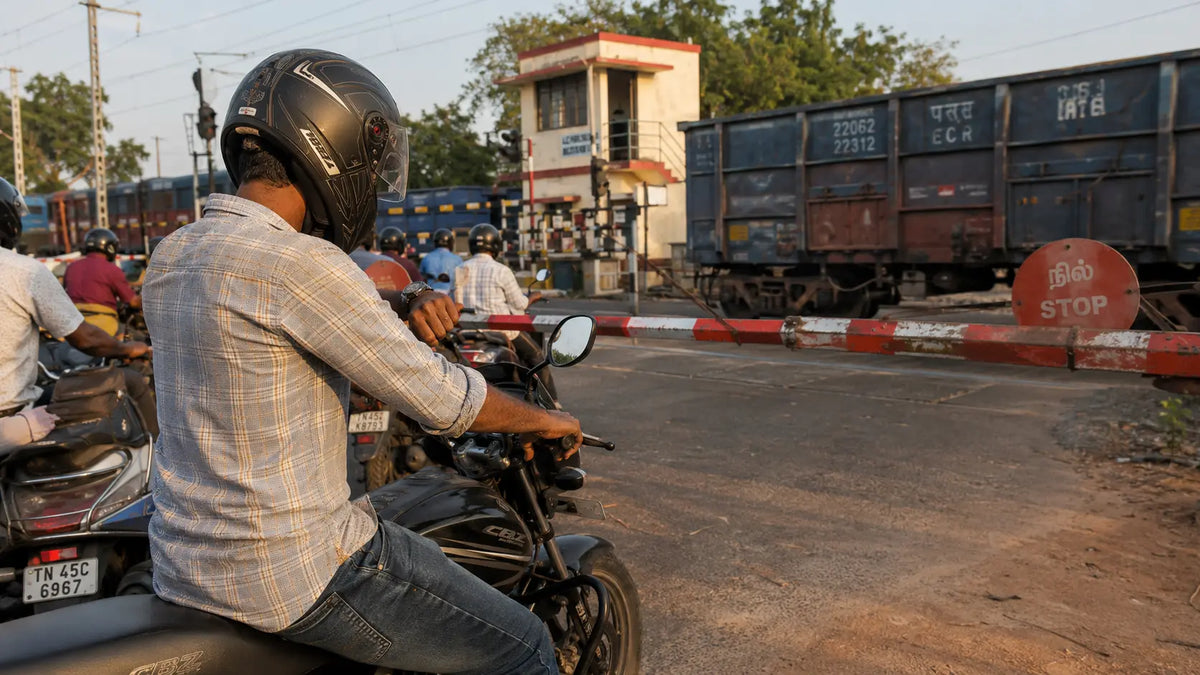
Barrier's down at the level crossing again. Helmet's on, engine's off, and you've got nothing to do but sweat into the padding for another few minutes.
Trichy riders lose more time to this than most Tamil Nadu commuters realize. That adds up to serious helmet-on time. It's exactly the kind of stretch that turns a slightly damp liner into a smell you can't ignore. Searching "helmet cleaner Trichy" usually means you've already noticed it. Here's what's actually happening inside your helmet, and why wiping it down only solves half the problem.
Rider Takeaways
- Trichy's average one-way commute runs 43.57 minutes, with a Traffic Index of 190.83. That's a long stretch of continuous helmet-on time for a Tier-2 city (Numbeo, data through Nov 2023).
- Humidity climbs to 70-75% from October through December, Trichy's northeast-monsoon window. Most helmet-hygiene advice assumes the rainy season is already over by then.
- A 2022 Tamil Nadu study found comfort and sweating is the single biggest reason riders skip wearing a helmet, cited by 52.2%. That's ahead of legislation and awareness combined.
- A cleaner spray clears dust off the shell. It doesn't touch the bacteria multiplying in a liner that never fully dries between rides.
Why Does a Trichy Commute Keep You in Your Helmet Longer Than It Should?
Because Trichy is built around junctions, not straight roads. Level crossings, the Central Bus Stand loop, and a road network that funnels Chennai, Madurai and Karur traffic through the same core, all of it adds up. Stop-start riding is the default here, not the exception.
Numbeo's traffic data puts Trichy's average one-way commute at 43.57 minutes, over an average distance of just 11.29 km. That gives it a Traffic Index of 190.83. Source: Numbeo, data through Nov 2023.
Quick Fact:
Trichy's average one-way commute is 43.57 minutes over just 11.29 km, giving it a Traffic Index of 190.83. Most of that time is spent stationary in a closed helmet, not moving through it. Source: Numbeo, Nov 2023
Trichy's average one-way commute is 43.57 minutes over just 11.29 km, giving it a Traffic Index of 190.83. Most of that time is spent stationary in a closed helmet, not moving through it. Source: Numbeo, Nov 2023
Covering 11 km in 43 minutes means you're barely moving most of the time. The airflow that's supposed to dry out sweat never really kicks in. So the liner stays warm and damp for the whole ride, instead of drying between short bursts of speed.
How Much Does Trichy's Humidity Actually Work Against You?
More than most riders expect, and not when they expect it. Trichy's humidity dips to a manageable 53% through the summer months. Then it climbs steadily from September and peaks at 75% in November. That's driven by the northeast monsoon, which soaks Tamil Nadu after the rest of India's rainy season has already ended.
May is the hottest month at 31.9°C. The city gets 823mm of rain a year, most of it concentrated in November's 182mm. Source: Climate-Data.org, 1991-2020 averages.
Quick Fact:
Tiruchirappalli's humidity rises from a summer low of 53% to a peak of 75% in November. November alone brings 182mm of rain, more than any other month of the year. Source: Climate-Data.org, 1991-2020
Tiruchirappalli's humidity rises from a summer low of 53% to a peak of 75% in November. November alone brings 182mm of rain, more than any other month of the year. Source: Climate-Data.org, 1991-2020
Unique Insight
Our finding: Most helmet-hygiene advice assumes the danger window is June to September, when the southwest monsoon hits most of India. Trichy runs on the opposite calendar. Its wettest, most humid stretch is October through December. That's exactly when a rider following generic "monsoon-proof by June" advice has already stopped paying attention.
Why Do So Many Trichy Riders Skip the Helmet When It's Humid?
Not carelessness. A 2022 study surveyed 358 Tamil Nadu two-wheeler riders. Comfort and sweating came out as the single biggest barrier to consistent helmet use, cited by 52.2% of respondents. That's ahead of legislative measures (38.5%) and awareness (34.4%) combined. Source: International Journal of Community Medicine and Public Health, 2022.
That discomfort isn't imagined. Trapped sweat inside a helmet liner is exactly the environment odor-causing bacteria need to multiply. The longer a helmet stays warm and damp, the worse both the smell and the itch get. A rider reaching for "helmet cleaner Trichy" is often really trying to solve that discomfort, not just the visible dust on the shell.
Quick Fact:
Among 358 Tamil Nadu two-wheeler riders surveyed, 52.2% named comfort and sweating as their top reason for skipping helmet use. That's more than legislative enforcement (38.5%) and awareness gaps (34.4%) combined. Source: IJCMPH, 2022
Among 358 Tamil Nadu two-wheeler riders surveyed, 52.2% named comfort and sweating as their top reason for skipping helmet use. That's more than legislative enforcement (38.5%) and awareness gaps (34.4%) combined. Source: IJCMPH, 2022
What Does Trichy's Century as a Railway Town Have to Do With Your Helmet?
More than you'd guess. Trichy's Golden Rock Railway Workshop was set up between 1926 and 1928, relocated from Nagapattinam. Its workforce grew from around 700 employees at the start to nearly 3,500 by 1947. Source: Journal of Advanced Research (JARJ), Dr. A. Akbar Hussain.
That growth is why Trichy became a major Southern Railway junction, connecting lines to Madras, Madurai, Tuticorin, Bangalore, Coimbatore and Mangalore. Generations of workers have commuted past the same level crossings and junction signals that still slow down every rider today. It's an old commuting pattern, one that predates the traffic jams by nearly a century.
Quick Fact:
Golden Rock Railway Workshop's staff grew from roughly 700 to nearly 3,500 between its 1926-28 founding and 1947. That growth cemented Trichy's identity as a Southern Railway junction town. Source: JARJ, Dr. A. Akbar Hussain
Golden Rock Railway Workshop's staff grew from roughly 700 to nearly 3,500 between its 1926-28 founding and 1947. That growth cemented Trichy's identity as a Southern Railway junction town. Source: JARJ, Dr. A. Akbar Hussain
Unique Insight
Our finding: Trichy's junction-city identity isn't a modern traffic problem. It's a century-old commuting pattern. A rider stuck at a level crossing today is repeating a wait that Golden Rock's workforce has dealt with since the 1920s. There are just more two-wheelers now, and a lot less patience for a smelly helmet.
Is a Helmet Cleaner Spray Enough for Trichy's Dust and Sweat?
Not on its own. A cleaning spray is built to lift road dust and visible grime off the shell and liner surface. That's genuinely useful after a dusty ride through a construction stretch or a level-crossing wait. But it isn't built to deal with bacteria that keep multiplying inside damp foam long after the surface looks fine.
That's the gap between cleaning and hygiene. Cleaning removes what you can see. Hygiene addresses what's still growing after the visible dust is gone. That's the actual source of the smell riders searching "helmet cleaner Trichy" are trying to fix.
Hygena isn't positioned as a cleaner. It's a bacteriostatic hygiene spray built to stop odor-causing bacteria from multiplying in the padding. Use it after your helmet's visible dust is wiped off, not instead of wiping it off.
| What it does | Cleaner spray | Hygena (hygiene spray) |
|---|---|---|
| Removes road dust, visible grime | Yes | Not its job |
| Stops bacteria multiplying in foam | No | Yes, bacteriostatic |
| Best used | After a dusty or rainy commute | After cleaning, 3-4x a week |

What Actually Works for a Trichy Rider's Routine
Two steps, done in this order, cover both the dust and the bacteria a Trichy commute leaves behind:
- Wipe road dust and grime off the shell and liner after your ride, especially through October-December when Trichy's northeast monsoon keeps everything damp. Let the helmet air out somewhere shaded, not sealed in a bike-top box.
- Add a bacteriostatic spray like Hygena on the padding a few times a week to handle what wiping alone leaves behind. A few sprays takes under a minute. It survives a 43-minute stop-start commute without needing a midway reapplication.

Frequently Asked Questions
Does Trichy's humidity make helmet smell worse than in drier Tamil Nadu cities?
Yes, especially October through December when humidity climbs to 70-75% during the northeast monsoon. That's a longer damp window than cities that only deal with the summer southwest monsoon. Source: Climate-Data.org, 1991-2020.
Why does my helmet still smell after I wipe it down after my Trichy commute?
Wiping removes surface dust, not the bacteria growing in the damp foam underneath. With a 43.57-minute average one-way commute, there's plenty of time for sweat to soak in before a wipe-down ever reaches it. Source: Numbeo, 2023.
Where can I buy a helmet hygiene spray in Trichy?
Hygena ships across India, including Trichy, through hygena.in. It's a bacteriostatic hygiene spray, not a cleaning product, meant to run alongside your normal wipe-down.
How often should I clean my helmet if I commute through Trichy traffic daily?
Wipe the shell and exterior after every dusty or rainy ride. For the interior padding, a hygiene spray 3-4 times a week is a reasonable starting point for a daily 43-minute commute. Adjust based on how quickly your particular helmet holds odor.
Is Trichy's October-December rain the real risk window for helmet bacteria?
Largely yes. Humidity peaks at 75% in November, and November alone brings 182mm of rain, more than any other month. That combination of heat and trapped moisture is exactly what lets odor-causing bacteria multiply fastest. Source: Climate-Data.org, 1991-2020.
Conclusion
Trichy's helmet problem isn't the same as a metro's. It's a 43-minute stop-start commute through a junction city. It's a humidity peak that arrives in November instead of July. And it's a documented, quantified discomfort barrier that keeps riders reaching for anything labeled "cleaner." A cleaning spray handles the road dust. It was never built to handle the rest.
Wipe the dust off after your ride, and let the helmet dry somewhere shaded. Use a bacteriostatic spray like Hygena on the padding to stop bacteria before the smell shows up. If you're riding Trichy's junctions and level crossings every day, your helmet needs both steps, not just one.
Sources
1. "Traffic in Tiruchirapalli (Trichy)," Numbeo, data through Nov 2023. Retrieved 2026-08-21.
2. "Tiruchirappalli Climate," Climate-Data.org, 1991-2020 averages. Retrieved 2026-08-21.
3. "Perceived Domains That Could Improve Helmet-Wearing Behavior Among Two-Wheeler Riders in Tamil Nadu," International Journal of Community Medicine and Public Health, 2022. Retrieved 2026-08-21.
4. "Development of Railways in Tiruchirappalli District," Dr. A. Akbar Hussain, Journal of Advanced Research (JARJ). Retrieved 2026-08-21.
Share:
Helmet Cleaner Madurai: Why Tamil Nadu's Hottest City Needs More Than a Wipe
Helmet Deodorant Spray Chennai: Why OMR Traffic Wrecks It