
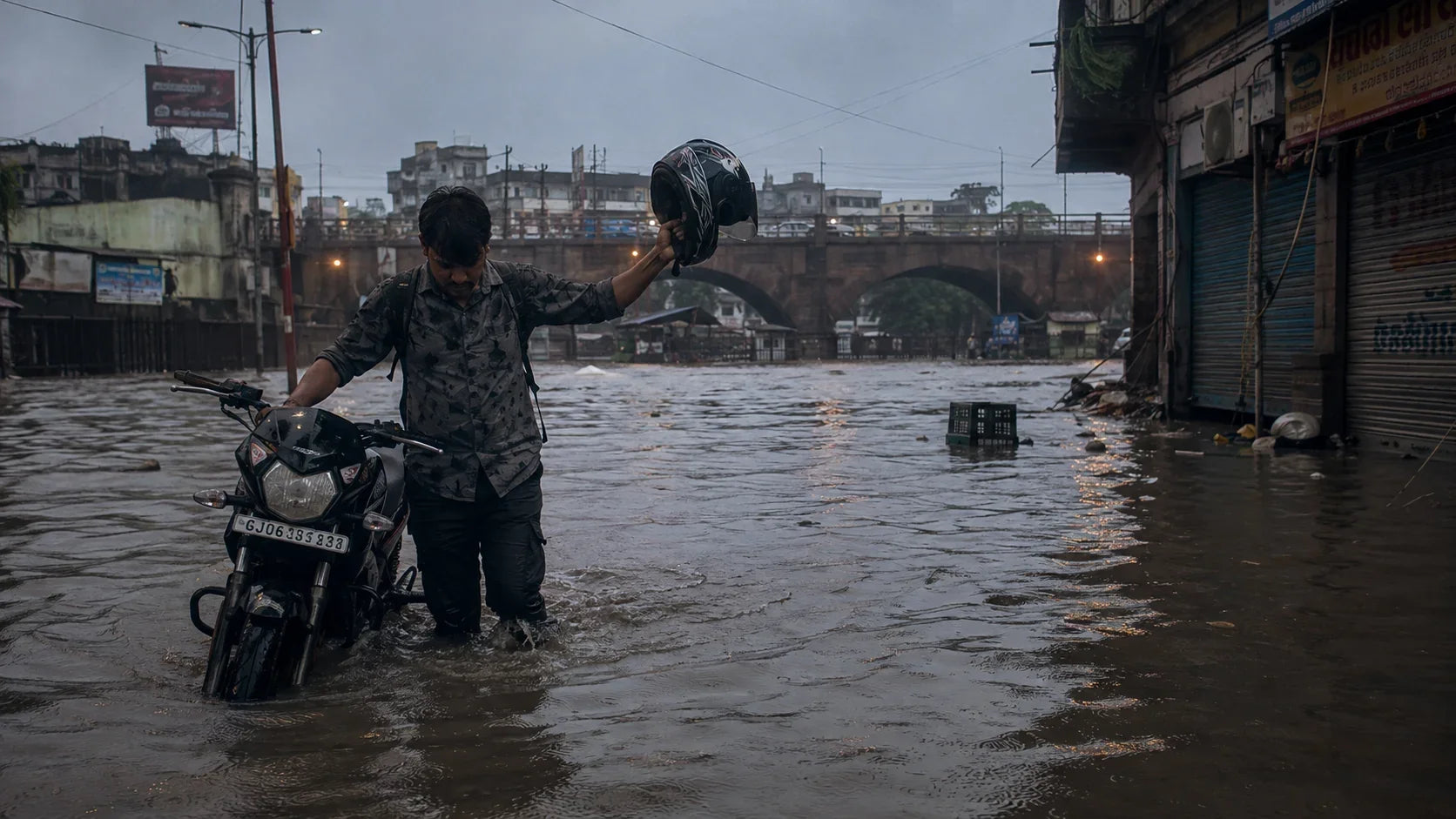
August 2024. Your bike stalls mid-road, water past the silencer, and you wade home carrying your helmet.
That's not a hypothetical for Vadodara riders. It happened to thousands when the Vishwamitri River flowed 9 feet above its danger mark. Even on an ordinary monsoon week, the same humidity that floods the streets is quietly soaking into your helmet's foam liner, and a quick wipe-down or "helmet cleaner" spray doesn't touch what's actually growing in there. This article breaks down why, and what does.
Rider Takeaways
- In August 2024, the Vishwamitri River hit 35 feet against a 26-foot danger mark, and riders abandoned bikes mid-road as water rose above the silencer (DeshGujarat, Aug 2024).
- Vadodara's humidity swings from 31% in March to 83% in August, a 52-point jump that keeps helmet liners damp for days (Climate-Data.org, 1991-2021).
- Since October 1, 2025, helmets are mandatory for every rider and pillion in Vadodara, backed by a ₹500 fine, meaning more helmets are on more heads, more often, than ever before (Vadodara Police, DeshGujarat 2025).
- A "helmet cleaner" wipes away grime; it doesn't stop the bacteria that actually cause the smell. That's a hygiene job, not a cleaning one.
Why Is Vadodara's Climate So Rough on Helmet Liners?
In 2024, Vadodara's Vishwamitri River rose to 35 feet against a 26-foot danger mark after nearly 12 inches of rain in a single day, and riders across the city abandoned their bikes when floodwater climbed past the silencer (DeshGujarat, August 27, 2024). That's the extreme end of what Vadodara's climate does to riders. The everyday version is quieter, but it never really stops.
Quick Fact:
Vadodara's average humidity swings from 31% in March to 83% in August, a 52-point jump, with July alone bringing 297mm of rain across 18 rainy days. Source: Climate-Data.org, 1991-2021
Vadodara's average humidity swings from 31% in March to 83% in August, a 52-point jump, with July alone bringing 297mm of rain across 18 rainy days. Source: Climate-Data.org, 1991-2021
A helmet liner that gets damp on a July ride doesn't fully dry before the next one. Foam padding traps that moisture close to your scalp for hours, and warm, wet, enclosed spaces are exactly where odor-causing bacteria multiply fastest. Wiping the outside down does nothing for what's happening inside the foam.
Unique Insight
Our finding: Vadodara's 2024 flood didn't just soak roads. It soaked the exact riders who commute daily, since two-wheelers made up most of the vehicles abandoned mid-flood, per on-the-ground DeshGujarat reporting. A submerged helmet liner needs longer than a rinse to actually dry out, which is precisely when bacteria get their best window to grow.

Vadodara's New Helmet Mandate Means More Riders Wearing Helmets Longer
From October 1, 2025, Vadodara Police made helmets mandatory for every two-wheeler rider and pillion, with a ₹500 fine for non-compliance and zero-tolerance enforcement, after a two-week grace period triggered by a citywide rush to buy helmets (DeshGujarat, September 15, 2025). That single rule change changed helmet hygiene habits across the city, whether riders noticed it or not.
Quick Fact:
Vadodara Police Commissioner Narasimha Komar first announced the mandatory helmet rule on August 9, 2025, for a September 15 start, then delayed strict enforcement to October 1 after a scramble at helmet shops and dealers across the city. Source: DeshGujarat, September 2025
Vadodara Police Commissioner Narasimha Komar first announced the mandatory helmet rule on August 9, 2025, for a September 15 start, then delayed strict enforcement to October 1 after a scramble at helmet shops and dealers across the city. Source: DeshGujarat, September 2025
A rider who bought a helmet in that last-minute rush and now wears it on every trip (school run, office commute, market visit) is putting far more hours into that helmet than someone who only wore one occasionally before. More hours on the head means more sweat, more humidity trapped inside, and less time for the liner to ever fully dry between rides.
Pillion riders face the same shift. Ask around any Vadodara riding group and you'll hear the same complaint: a helmet bought in a hurry, worn daily since, and already smelling worse than the rider expected this soon.
What's Actually Causing the Smell Inside Your Helmet
In 2025, researchers writing in the Indian Journal of Microbiology linked Staphylococcus hominis, a bacteria species common on human skin, directly to odor buildup on sweat-soaked fabric. The more that bacteria population grows, the stronger the smell gets, not the other way around.
That's the part most riders get backwards. Sweat itself is close to odorless. It's bacteria feeding on that sweat, in a warm, damp, enclosed helmet interior, that produces the smell. In Vadodara's monsoon months, when the liner barely dries between rides, that bacterial population never gets knocked back down. It just keeps compounding, ride after ride.
This is why airing your helmet out on the balcony for an hour doesn't fix much. Airflow can dry the surface, but it doesn't reach deep into the foam padding where bacteria are actually living and multiplying.
How Vadodara Riders Are Handling It Today
Vadodara's metro population crossed 2.425 million in 2025, a city that size runs almost entirely on two-wheelers for the daily commute, and the roads themselves are mid-transformation. In April 2026, the Godhra-Vadodara stretch of the Delhi-Mumbai Expressway opened to trial traffic, an eight-lane corridor meant to cut travel time and pull some of that load off the older highways riders use every day.
Quick Fact:
Vadodara's metro population reached roughly 2.425 million in 2025, and the Godhra-Vadodara section of the Delhi-Mumbai Expressway, an eight-lane access-controlled corridor, opened to trial traffic on April 13, 2026. Source: Macrotrends, 2025; DeshGujarat, April 2026
Vadodara's metro population reached roughly 2.425 million in 2025, and the Godhra-Vadodara section of the Delhi-Mumbai Expressway, an eight-lane access-controlled corridor, opened to trial traffic on April 13, 2026. Source: Macrotrends, 2025; DeshGujarat, April 2026
Most riders default to whatever's already at home: a splash of dettol diluted in water, a fabric freshener meant for clothes, or a "helmet cleaning spray" bought off a shop shelf without checking what it's actually formulated to do. None of these were built for a helmet liner, and none of them address bacteria specifically.
Unique Insight
Our finding: Vadodara's helmet-buying rush landed right at the tail end of monsoon, which means an unusually large share of the city's helmets are brand new, barely broken in, and already being ridden through the last humid weeks of the season, a combination that speeds up bacterial buildup faster than riders expect from a "new" helmet.
Helmet Cleaner or Helmet Hygiene: Which One Actually Stops the Smell?
Searching for a "helmet cleaner" in Vadodara usually turns up products built to remove dirt, grime, and visible stains, not bacteria. Cleaning and hygiene solve two different problems, and mixing them up is why so many riders keep re-cleaning a helmet that still smells.
A helmet cleaner isn't wrong to own. A genuinely dusty visor or dirty shell benefits from one. But if the goal is getting rid of smell, that's a bacteria problem, and it needs a product built to kill and suppress bacterial growth, not just lift grime off a surface.
The Fix: A Hygiene Routine Built for Vadodara's Humidity
Hygena's bacteriostatic helmet spray is built around this exact distinction. It doesn't mask odor the way a fabric freshener does. It targets the bacteria causing it, so the smell doesn't just come back in a day.
For a Vadodara rider, that means a helmet that survives a flooded commute, a full monsoon week, or a newly mandatory daily ride without turning into the thing you dread putting on. A few sprays after a wet ride, and the liner is protected before bacteria get the chance to establish themselves. No scrubbing, no soaking, no waiting for it to dry out on its own.
Try it: free shipping, COD available across Vadodara.

Frequently Asked Questions
Does Vadodara's humidity make helmet smell worse?
Yes. Vadodara's humidity climbs from 31% in March to 83% in August, a 52-point swing (Climate-Data.org, 1991-2021), and that extra moisture keeps helmet liners damp longer, giving odor-causing bacteria more time to multiply between rides.
Do I legally have to wear a helmet in Vadodara now?
Yes. Since October 1, 2025, Vadodara Police enforce mandatory helmets for both riders and pillions, with a ₹500 fine for non-compliance under a zero-tolerance policy (DeshGujarat, 2025).
Where can I buy helmet deodorant spray in Vadodara?
Hygena's bacteriostatic helmet spray ships across Vadodara with cash-on-delivery available, so you don't need to track down a specialty store. Order online and it reaches you directly.
Is a helmet cleaner the same as a helmet deodorant?
No. A helmet cleaner removes visible dirt and grime from the shell and visor. A bacteriostatic deodorant spray targets the bacteria inside the liner that actually cause odor. They solve different problems.
How often should I clean my helmet interior?
Riders in humid, monsoon-heavy cities like Vadodara should treat the liner after every wet ride, and at minimum twice a week during monsoon months, since damp foam left untreated gives bacteria a much wider window to grow.
Conclusion
Vadodara's climate and its new helmet mandate have combined to put more riders in helmets, for more hours, in more humidity, than the city has seen before. A helmet cleaner can handle the dust and grime on the outside, but the smell riders actually complain about comes from bacteria growing inside the liner, and that needs a hygiene product, not a cleaning one.
Hygena's bacteriostatic spray was built for exactly this gap. A few seconds after every ride, and the bacteria never get the foothold Vadodara's monsoon keeps trying to give them. Order online with COD available across the city.
Sources
1. "Vadodara flooded as Vishwamitri flows 9 ft above danger mark; waist-deep water in several areas," DeshGujarat, August 27, 2024. Retrieved 2026-08-10.
2. "How Vadodara Defied the Flood: Inside the Data-Driven Strategy That Tamed the Vishwamitri," Indian Masterminds, February 23, 2026. Retrieved 2026-08-10.
3. "Vadodara Climate (India)," Climate-Data.org, 1991-2021 dataset. Retrieved 2026-08-10.
4. "Vadodara Police Mandates Helmet for Both Rider & Pillion Rider from Sept 15," DeshGujarat, August 9, 2025. Retrieved 2026-08-10.
5. "Vadodara Police Delays Mandatory Helmet Rule Enforcement to October 1st," DeshGujarat, September 15, 2025. Retrieved 2026-08-10.
6. "Godhra-Vadodara Section of Delhi-Mumbai Expressway Opens to Traffic on Trial Basis," DeshGujarat, April 14, 2026. Retrieved 2026-08-10.
7. "Vadodara, India Metro Area Population 1950-2026," Macrotrends. Retrieved 2026-08-10.
8. Yan, H., Wu, Z. & Ye, F., "Association of Staphylococcus_hominis and Odor Production on Sweaty Polyester Sportswear," Indian Journal of Microbiology, published September 7, 2025. Retrieved 2026-08-10.
Share:
Helmet Cleaner Rajkot: Why Grease, Heat and Sweat Need Different Fixes