
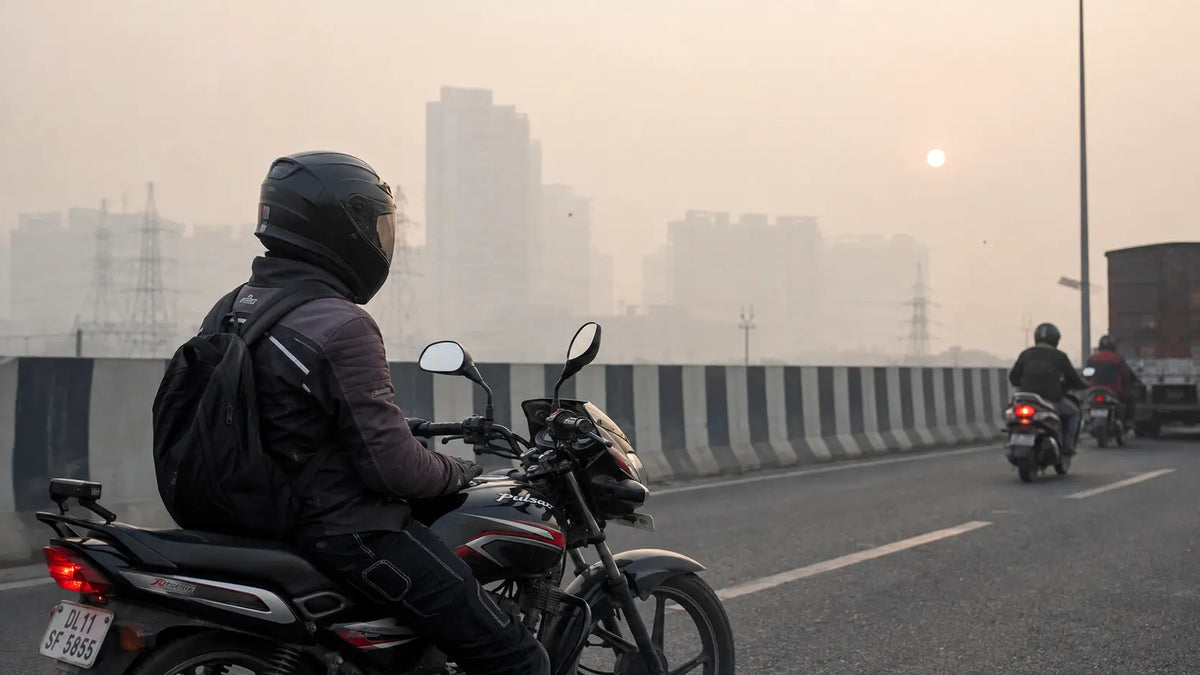
You crack your visor at a red light on the Delhi-Meerut Expressway and the smog rolls straight in.
Search "helmet cleaner Ghaziabad" and you'll land on sprays meant for scuffed shells and grimy visors. None of them explain why your helmet smells worse here than it did in a cleaner city, or what's actually building up inside the liner while you sit in traffic.
Ghaziabad ki hawa mein jo settle hota hai, wahi ab tumhare helmet ke andar bhi jama ho raha hai. This piece breaks down what the city's air, heat, and traffic really do to a helmet, and why wiping it down isn't the same as making it hygienic.
Rider Takeaways
- Loni, inside Ghaziabad, was the world's most polluted city in 2025, averaging 112.5 µg/m³ of PM2.5, over 22 times the WHO guideline. Source: IQAir World Air Quality Report, 2025.
- In November 2025, Ghaziabad was India's most polluted city that month, averaging 224 µg/m³, with 19 "Very Poor" air days. Source: CREA, December 2025.
- Ghaziabad's humidity swings from 25% in April to 67% in August, while daytime highs run 21°C to 41°C across the year.
- A cleaner wipes off soot and sweat residue. Only a bacteriostatic spray like Hygena stops the bacteria multiplying underneath it.
Why Does Ghaziabad's Air Make Helmet Hygiene Different Here?
Because the air itself is the problem, not just the sweat. Loni, a locality inside Ghaziabad, was the most polluted city on Earth in 2025, averaging 112.5 µg/m³ of PM2.5 across the year. That's more than 22 times the WHO's guideline of 5 µg/m³. Source: IQAir World Air Quality Report, 2025.
Ghaziabad as a whole city wasn't far behind, ranking 7th globally at 89.2 µg/m³. And in November 2025 alone, Ghaziabad topped India's own monthly rankings, hitting 224 µg/m³ with 19 "Very Poor" days and 10 "Severe" days. Source: CREA, December 2025.
Quick Fact:
Loni, in Ghaziabad, recorded the world's highest annual average PM2.5 in 2025 at 112.5 µg/m³, over 22 times the WHO's guideline of 5 µg/m³. Source: The Wire, citing IQAir World Air Quality Report, March 2026
Loni, in Ghaziabad, recorded the world's highest annual average PM2.5 in 2025 at 112.5 µg/m³, over 22 times the WHO's guideline of 5 µg/m³. Source: The Wire, citing IQAir World Air Quality Report, March 2026
Every ride here means breathing that air through a visor gap, and every ride means that same particulate matter settling into your helmet's foam padding alongside sweat. Wiping the outside doesn't touch what's collecting on the inside.
How Much Do Ghaziabad's Heat and Humidity Add to This?
Quite a lot, and on two separate schedules. Ghaziabad's humidity bottoms out at 25% in April, the driest month, then climbs to 67% by August as the monsoon sets in. Source: Weather and Climate, Ghaziabad, climate averages 1991–2020.
Daytime highs stretch from 21°C in January to 41°C in May, the city's hottest month. That heat pushes sweat production up inside a sealed helmet. Low April humidity dries that sweat fast, but bakes dust and soot straight into the padding instead of washing it out.
Quick Fact:
Ghaziabad's relative humidity ranges from 25% in April to 67% in August, with daytime highs from 21°C in January to 41°C in May. Source: Weather and Climate, Ghaziabad, climate averages 1991–2020
Ghaziabad's relative humidity ranges from 25% in April to 67% in August, with daytime highs from 21°C in January to 41°C in May. Source: Weather and Climate, Ghaziabad, climate averages 1991–2020
Then the monsoon flips the problem. Humidity climbs through July into an August peak, and a liner that dried out fine in April suddenly stays damp for days at a time. Add smog-season winters, when a still, cold layer of air traps pollution close to the ground, and Ghaziabad's helmets rarely get a real reset.
Unique Insight
Our finding: most helmet hygiene advice assumes sweat is the only thing building up inside. Ghaziabad riders are dealing with a second layer nobody talks about, fine particulate matter settling into the same padding, at some of the highest concentrations recorded anywhere on Earth.

What's Actually Multiplying Inside an Unwashed Helmet?
A 2020 study tested 130 motorcycle helmets and found something worth knowing before you reach for a wipe. Helmets that were never washed or disinfected showed 86.8% bacterial growth and 83.3% fungal growth, both higher than helmets cleaned on a regular schedule.
Shared helmets fared worse still, with 79.2% bacterial growth and 71.88% fungal growth. Source: Sapkota et al., International Journal of Microbiology, 2020. Staphylococcus aureus, a bacteria that can cause skin infections, was the single most common species recovered.
Quick Fact:
Never-washed helmets showed 86.8% bacterial and 83.3% fungal growth, while shared helmets showed 79.2% bacterial and 71.88% fungal growth, in a 2020 study of 130 motorcycle helmets. Source: Sapkota et al., International Journal of Microbiology, 2020
Never-washed helmets showed 86.8% bacterial and 83.3% fungal growth, while shared helmets showed 79.2% bacterial and 71.88% fungal growth, in a 2020 study of 130 motorcycle helmets. Source: Sapkota et al., International Journal of Microbiology, 2020
Wiping soot off the shell does nothing to these numbers. The bacteria and fungi are growing in the foam against your scalp, not on the visor you can see.
Does Ghaziabad's Traffic Add to Sealed Helmet Time?
Yes, even with a shiny new expressway running through it. The Delhi-Meerut Expressway cut travel time between the two cities from 2.5 hours to about 45 minutes when it opened, with a 100 km/h speed limit through Ghaziabad's semi-urban stretch.
That's the good news. The rest of Ghaziabad's roads still aren't fast. GT Road, NH-9, and the approach to UP Gate see the same stop-start congestion as the rest of Delhi NCR, a region the TomTom Traffic Index 2025 ranks among Asia's most congested. Every extra minute at a signal is another minute of sweat and smog building up inside a closed visor.
Quick Fact:
The Delhi-Meerut Expressway cut travel time between the two cities from 2.5 hours to about 45 minutes, with a 100 km/h speed limit through Ghaziabad's stretch, even as GT Road and NH-9 remain congested. Source: The Tribune, Delhi-Meerut Expressway opening report
The Delhi-Meerut Expressway cut travel time between the two cities from 2.5 hours to about 45 minutes, with a 100 km/h speed limit through Ghaziabad's stretch, even as GT Road and NH-9 remain congested. Source: The Tribune, Delhi-Meerut Expressway opening report
Unique Insight
Our finding: a faster expressway hasn't shortened Ghaziabad riders' real sealed-helmet time. It just moved the exposure from slow city roads to fast highway stretches where smog sits right at visor height.
Is a Helmet Cleaner Enough for Ghaziabad's Smog and Sweat?
No, and this is where most "helmet cleaner Ghaziabad" searches go wrong. A cleaner is built to lift dirt, soot, and grime off a surface you can see. A hygiene spray like Hygena is built to stop the bacteria and fungi multiplying in the padding you can't see.
Both jobs matter in a city this polluted. But they solve different problems, and treating them as the same thing is how Ghaziabad riders end up with a helmet that looks fine and still smells terrible by evening.
| Job | Helmet Cleaner | Helmet Hygiene Spray (Hygena) |
|---|---|---|
| Removes visible soot and dust | Yes | No, not its job |
| Stops odor-causing bacteria multiplying | No | Yes, bacteriostatic formula |
| Used between washes | Occasionally | Every ride |
Hygena is a bacteriostatic spray, not a cleaner. It's formulated with tea tree extract and other natural antimicrobials that stop bacterial growth at the source, in seconds, after any ride through Ghaziabad's smog or summer heat.
The Fix for Ghaziabad's Two-Layer Problem
Washing the liner deals with the soot and sweat you can see. That's step one, and it still matters, especially through smog season from October to January.
Spraying a bacteriostatic hygiene product between washes handles what a wash cycle alone can't keep up with, the bacteria rebuilding within hours of your next commute.

The routine that actually holds up in Ghaziabad:
- Wash the removable padding every two weeks, more often during smog season or peak summer heat.
- Spray a bacteriostatic hygiene product like Hygena after every ride, expressway or city street.
Frequently Asked Questions
Does Ghaziabad's pollution really make helmet smell worse than in a cleaner city?
Yes. Loni, in Ghaziabad, recorded the world's highest 2025 PM2.5 average at 112.5 µg/m³. Source: IQAir World Air Quality Report, 2025. That particulate matter settles into helmet padding alongside sweat, adding a second layer a cleaner-air city simply doesn't deal with.
Is a helmet cleaner enough for Ghaziabad's smog and dust?
No. A cleaner lifts visible soot and grime off the shell and visor. It doesn't touch the bacteria growing in the padding, which a 2020 study found in up to 86.8% of never-washed helmets tested.
How often should Ghaziabad riders clean their helmet during smog season?
Wash the removable padding every two weeks during October to January, when air quality is at its worst. Spray a bacteriostatic hygiene product like Hygena after every ride, since bacteria start multiplying within hours.
Where can I buy a helmet hygiene spray in Ghaziabad?
Hygena ships across Ghaziabad and the wider Delhi NCR region through hygena.in, with cash-on-delivery available.
Can I just use a helmet cleaner instead of washing the padding?
No. A cleaner handles surface soot on the shell. The padding still needs a separate wash cycle plus a bacteriostatic spray between washes, since that's where smog particles, sweat, and bacteria actually collect.
Conclusion
Ghaziabad's helmets deal with something most Indian cities don't: air pollution severe enough to make Loni the world's most polluted city in 2025, stacked on top of a 42-point humidity swing and stop-start NCR traffic. A cleaner spray addresses none of that.
Hygena does. It's not a cleaner, it's a hygiene habit, a few seconds after every ride that stops bacteria before it starts smelling, smog season or not.
Sources
1. "India is Sixth Most-Polluted Country, Loni in Ghaziabad is World's Most Polluted City: Report," The Wire, citing IQAir World Air Quality Report, March 24, 2026. Retrieved 2026-07-30.
2. "Ghaziabad in the National Capital Region was India's most polluted city in November 2025: CREA," Down To Earth, December 7, 2025. Retrieved 2026-07-30.
3. "Ghaziabad Humidity by Month," Weather and Climate, climate averages 1991–2020. Retrieved 2026-07-30.
4. Sapkota, A. et al., "Microbial Diversity and Antibiotic Susceptibility Pattern of Bacteria Associated with Motorcycle Helmets," International Journal of Microbiology, 2020. Retrieved 2026-07-30.
5. "Go from Delhi to Meerut in 45 Minutes as Expressway Opens for Public," The Tribune. Retrieved 2026-07-30.
Share:
Helmet Cleaner Aurangabad: Caves, Gates, and Bacteria
Helmet Cleaner Kolhapur: What the Monsoon Leaves Behind