
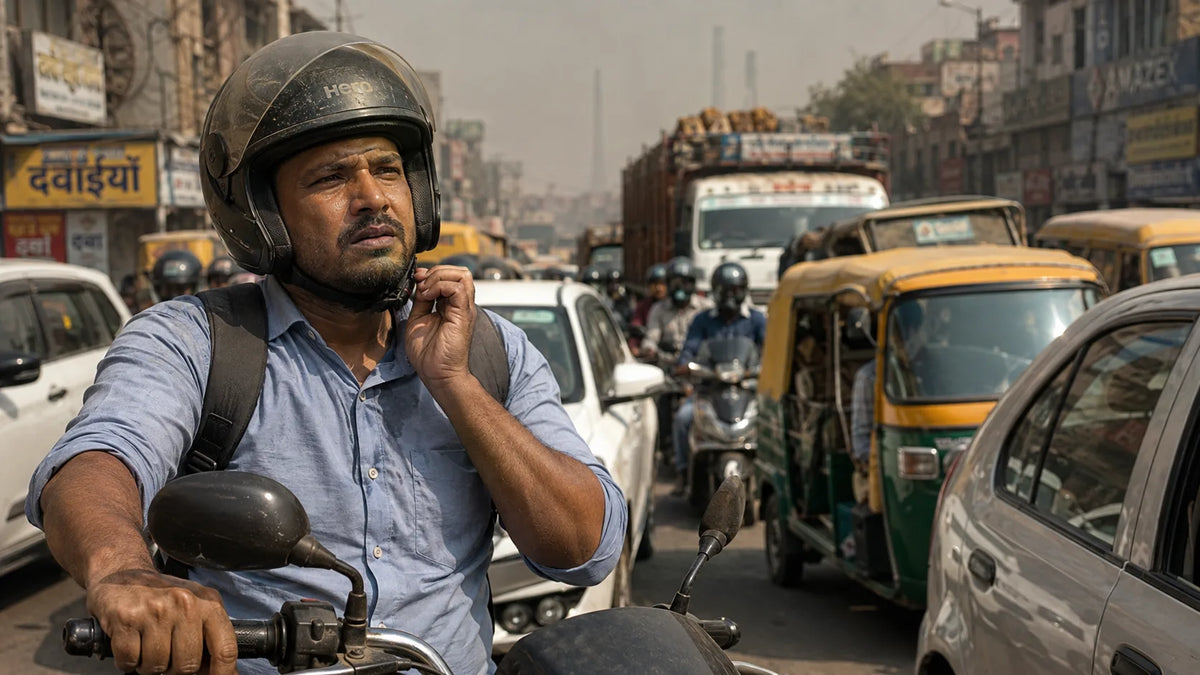
Stuck at a GT Road signal, helmet on for forty minutes straight.
That's a normal Tuesday for a lot of Kanpur riders. Between the humidity swings, the dust, and the traffic, your helmet is working harder here than in most Indian cities. Wiping down the shell doesn't touch what's building up inside the padding.
If you're searching "helmet cleaner Kanpur," here's the part most results skip: cleaning and hygiene aren't the same job. This piece breaks down why Kanpur is tougher on your helmet than most cities, and what actually solves it.
Rider Takeaways
- Kanpur's humidity swings from 30% in April to 81% in August. That 51-point jump speeds up bacterial growth inside a sealed liner (Climate-Data.org).
- A 2020 microbiology study found multidrug-resistant bacteria on 39.0% of tested motorcycle helmets (International Journal of Microbiology, 2020).
- Cleaning removes dust and grime. It doesn't kill the bacteria causing the smell, and that needs a hygiene routine, not a cleaner.
Why Does Kanpur's Air Make Helmet Smell Worse Than Sweat?
Kanpur's humidity swings hard across the year. It runs from 30% in April to 81% in August, a 51-point jump (Climate-Data.org, 1991-2020 averages). Layer that on top of the city's dust. Bacteria get exactly the warm, damp conditions they need to multiply fast inside a closed helmet.
Quick Fact:
Kanpur's relative humidity ranges from a dry-season low of 30% in April to a monsoon peak of 81% in August, with July alone bringing 299mm of rain. Source: Climate-Data.org, 1991-2020 averages.
Kanpur's relative humidity ranges from a dry-season low of 30% in April to a monsoon peak of 81% in August, with July alone bringing 299mm of rain. Source: Climate-Data.org, 1991-2020 averages.
The air itself isn't clean either. On August 25, 2026, IQAir recorded a "moderate" PM2.5 reading of 17.6 µg/m³ for Kanpur. That's still 3.5 times the WHO's annual safe guideline, on what counts as a good day (IQAir, live data).
The trend is improving. Kanpur's full-year average was 119.2 µg/m³ in 2017. By 2019, that had dropped to 48.5 µg/m³ (IQAir, historical data). Real progress. Still far from clean.
Unique Insight
Our finding: humidity and dust hit a Kanpur helmet from two directions at once — a wet liner from the monsoon swing, and a dust-caked shell from the air quality. Most cities in this series only deal with one of the two.
How Long Are You Really Wearing That Helmet in Kanpur Traffic?
Twenty-one of Kanpur's busiest intersections needed dedicated civil and traffic police posted in January 2025. That's on top of regular traffic staff (Amar Ujala, Jan 2025). Cross even two or three of these on your commute, and your helmet-on time runs well past a quick ride.
Quick Fact:
Kanpur police assigned civil police staff to 21 of the city's most congested intersections in January 2025 to relieve chronic traffic jams, on top of existing traffic personnel. Source: Amar Ujala, Jan 2025.
Kanpur police assigned civil police staff to 21 of the city's most congested intersections in January 2025 to relieve chronic traffic jams, on top of existing traffic personnel. Source: Amar Ujala, Jan 2025.
The stakes go beyond comfort. Kanpur logged 640 road deaths across 1,424 accidents in 2022. That's the 4th-highest toll among Indian cities over 10 lakh, behind only Delhi, Bengaluru, and Jaipur (MoRTH, reported Nov 2023). It's also a 7% jump from 598 deaths the year before.
Every one of those rides needed a helmet on for the full trip. Long helmet-on time isn't just uncomfortable in a city like this. It's the reason the padding stays damp long after you've parked.
What's Actually Growing Inside Your Helmet?
A 2020 microbiology study swabbed 130 motorcycle helmets. It recovered 392 separate bacterial isolates across seven genera (International Journal of Microbiology, 2020). Staphylococcus aureus was the single most common species, showing up in more than a fifth of all isolates tested.
Quick Fact:
Of the Staphylococcus aureus isolates recovered from tested helmets, 33.7% carried methicillin resistance, the same drug-resistant trait behind MRSA. Across every bacterial isolate in the study, 39.0% showed multidrug resistance. Source: International Journal of Microbiology, Sapkota et al., 2020.
Of the Staphylococcus aureus isolates recovered from tested helmets, 33.7% carried methicillin resistance, the same drug-resistant trait behind MRSA. Across every bacterial isolate in the study, 39.0% showed multidrug resistance. Source: International Journal of Microbiology, Sapkota et al., 2020.
None of this needs a factory or a flood to happen. It just needs warmth, moisture, and time — three things every Kanpur commute already provides through August.
Kanpur Riders Have Been Fighting Grime Longer Than Most
Kanpur earned the name "Leather City" for a reason. Jajmau's tannery cluster once employed 200,000 to 250,000 workers at its peak (Mongabay India, 2024). Around 215 tanneries still run today across Jajmau and neighbouring Unnao, most workers commuting by two-wheeler.
Quick Fact:
Kanpur's tanneries and other industries generate an estimated 64,000 tonnes of hazardous waste every year, including metals from leather, dye, and chemical processing. Source: Wikipedia, Kanpur, citing municipal pollution data.
Kanpur's tanneries and other industries generate an estimated 64,000 tonnes of hazardous waste every year, including metals from leather, dye, and chemical processing. Source: Wikipedia, Kanpur, citing municipal pollution data.
That waste doesn't stay contained to factory floors. Dust and residue travel on the wind and settle on every commuter's gear, tannery worker or not. It's part of why Kanpur riders have always treated helmet grime as routine, not an occasional problem.

Unique Insight
Our finding: a rider commuting past Jajmau picks up grime the same way a rider in a steel town does, except Kanpur adds tannery-linked chemical residue and dye particulate to the mix, not just soot.
Does a Helmet Cleaner Kill the Bacteria Causing the Smell?
No. Search "helmet cleaner Kanpur" and most results are polish, wipes, and sprays built for the outer shell. None of them touch the bacteria living inside your padding. That's a hygiene problem, not a dirt problem.
Cleaning removes what you can see: leather dust, road film, bug splatter on the visor. Hygiene kills the microorganisms causing odor, even when the helmet looks spotless. You can wipe a helmet down and it can still smell after one humid ride.
| What You Need | Helmet Cleaner | Hygena Hygiene Spray |
|---|---|---|
| What it removes | Dust, road film, bug splatter | Odor-causing bacteria |
| Where it works | Outer shell, visor | Inner padding, liner |
| Result | A visibly clean helmet | A bacteria-controlled, odor-free liner |
In Kanpur, that gap matters more than most places. Your visor picks up tannery dust and GT Road grit, and cleaning handles that part fine. But the sweat trapped in your liner needs something built to work on bacteria, not just grime.
The Fix: Bacteriostatic Protection Built for a City Like This
This is where Hygena comes in, not as a cleaner, but as a hygiene routine. Its bacteriostatic helmet spray stops odor-causing bacteria from multiplying at the source, instead of masking the smell after the ride.
A few sprays after a GT Road commute keep your liner in check between full washes. It's built for a city where humidity and dust work against you at once.
Hygena's spray is dermatologically tested, rated 4.8 stars, and used by 10,000+ riders across India. Add it to your after-ride routine, the same way you check tyre pressure.

Frequently Asked Questions
Does Kanpur's humidity make helmet smell worse?
Yes. Kanpur's humidity swings from 30% in April to 81% in August, a 51-point jump (Climate-Data.org). That kind of swing speeds up bacterial growth inside a sealed helmet liner, especially through the monsoon months.
Where can I buy a helmet hygiene spray in Kanpur?
Hygena's bacteriostatic helmet spray ships across India, including Kanpur, through hygena.in. It's a hygiene product, not a cleaning polish, so it targets bacteria rather than surface grime.
How is a helmet cleaner different from a helmet hygiene spray?
A cleaner removes visible dirt and dust from the shell and visor. A hygiene spray like Hygena's targets the bacteria inside the padding. That's true even on a helmet that looks clean.
How often should I treat my helmet padding in a city like Kanpur?
In a city like Kanpur, spray after every few rides. Don't wait for a smell to show up. A 2020 study recovered 392 bacterial isolates from just 130 tested helmets, several strains drug-resistant (International Journal of Microbiology).
Conclusion
Kanpur asks more of a helmet than most Indian cities. The humidity swings 51 points across the year. The air still runs past WHO limits on a moderate day. Traffic keeps your helmet on longer than you'd plan for. A wipe-down never stood a chance against all three.
A helmet cleaner handles the dust you can see. Hygena handles the bacteria you can't, with a bacteriostatic spray built for exactly this kind of ride. Add it to your routine, and let cleaning and hygiene finally do two separate jobs instead of one job badly.
Sources
1. "Kanpur Climate," Climate-Data.org, 1991-2020 averages. Retrieved 2026-08-25.
2. "Kanpur Air Quality," IQAir, live data and historical averages. Retrieved 2026-08-25.
3. "Relief From Traffic Jam: Civil and Traffic Police Will Manage Traffic at 21 Busiest Intersections," Amar Ujala, Jan 5, 2025. Retrieved 2026-08-25.
4. "Deaths in Road Accidents Are Highest in UP, Kanpur and Lucknow," citing Ministry of Road Transport and Highways data, reported November 2023. Retrieved 2026-08-25.
5. "Microbial Diversity and Antibiotic Susceptibility Pattern of Bacteria Associated with Motorcycle Helmets," International Journal of Microbiology, Sapkota et al., 2020. Retrieved 2026-08-25.
6. "Polluting Leather Industry Adopts Sustainable Practices to Reduce Environmental Footprint," Mongabay India, Aug 2024. Retrieved 2026-08-25.
7. "Kanpur," Wikipedia. Retrieved 2026-08-25.
Share:
Helmet Deodorant Spray Kolkata: Why Puja Season Needs It
Helmet Cleaner Lucknow: What Smog and Dust Do to Your Helmet