
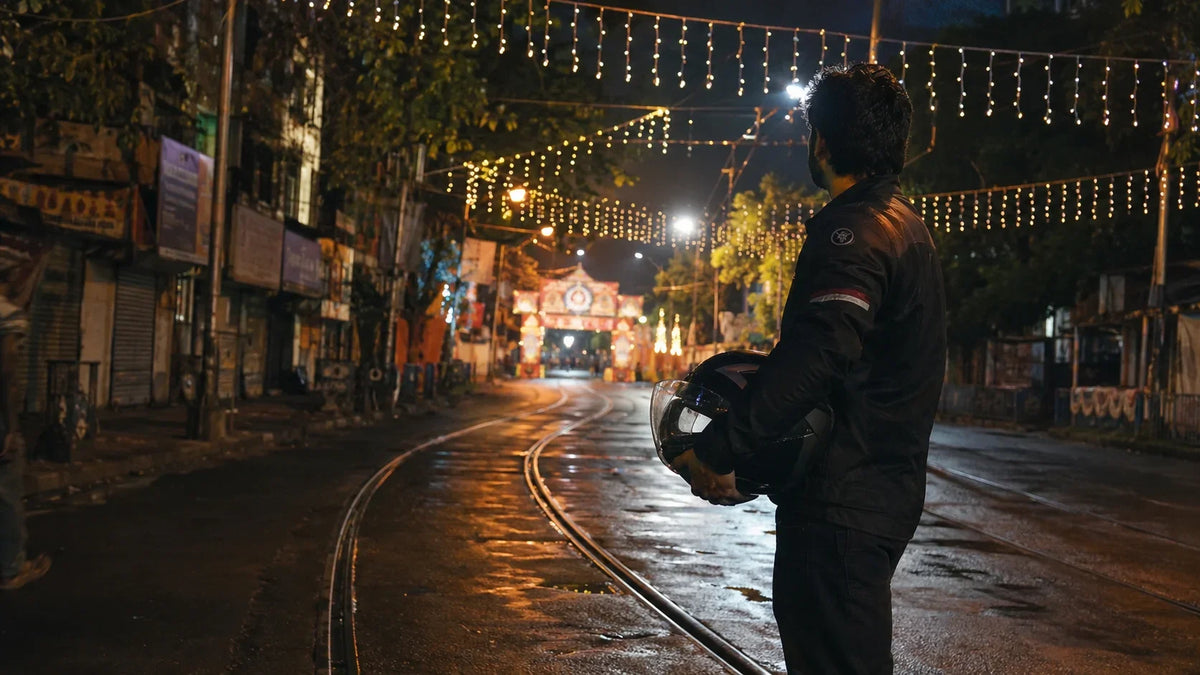
It's 11 pm during Puja week. You've hit four pandals already, helmet on for most of it. When you finally pull it off at home, the smell hits before your keys do.
That's not just sweat. Kolkata's humidity barely drops below 51%, even in its driest month. Your helmet has been sealed around a warm, damp scalp for hours. Bacteria don't need much more than that.
This guide breaks down exactly why Kolkata is tougher on your helmet than most Indian cities. You'll see what a helmet deodorant spray built for Kolkata needs to survive. And how to fix the smell without giving up your pandal-hopping nights.
Rider Takeaways
- Kolkata riders lost 150 hours to traffic congestion in 2025, up nearly 4 hours from 2024, per TomTom's Traffic Index.
- City humidity swings from 51% in March to 83% in July, a 32-point jump, per Weather and Climate data.
- A Kolkata-specific dermatophytosis (fungal skin infection) study found 57.27% of cases cluster in June to August, the same months your helmet stays sealed the longest.
- Durga Puja alone drives West Bengal's ₹46,000-50,000 crore puja economy across roughly 45,000 committees, per Deccan Herald, 2025, most of it reachable only by two-wheeler.
Why Does Durga Puja Pandal-Hopping Push Your Helmet to Its Limit?
Ask any Kolkata rider about their longest helmet stretch of the year. Most won't say a highway tour. They'll say Panchami night.
Durga Puja isn't a small local festival. It's a state-wide economic event, and most of its crowd moves by two-wheeler. Riders weave between one-way diversions from Deshapriya Park to Bagbazar Sarbojanin.
Quick Fact:
West Bengal's Durga Puja economy hit an estimated ₹46,000-50,000 crore in 2025, a 10-15% rebound, spanning close to 45,000 puja committees across the state. Source: Deccan Herald, 2025
West Bengal's Durga Puja economy hit an estimated ₹46,000-50,000 crore in 2025, a 10-15% rebound, spanning close to 45,000 puja committees across the state. Source: Deccan Herald, 2025
A Kolkata bike-touring guide to pandal-hopping recommends riding late evening or post-midnight to dodge the crowds. It flags one gear rule above everything else: keep your helmet on, even for a slow crawl through diversions.
That's three, four, sometimes five hours of a sealed helmet in a row, night after night for a week. Your scalp doesn't get a Puja break. Neither does whatever's growing inside the padding.
It's not only Puja season either. Kolkata's Robibar (Sunday) ride culture runs year-round. Clubs like Eastern Bulls gather Royal Enfield riders at Russell Street most Sundays. Rolling Wheels, running since 2005, plus groups like Kolkata Riders and MotoNomads, keep the city's touring calendar full most weekends.
Why Is Your Helmet On Longer in Kolkata Traffic Than You Think?
Even outside Puja season, Kolkata riders spend more helmet-on time than most people realize. TomTom's 2025 Traffic Index puts the city's average congestion at 58.9%. Evening rush hour stretches a 10 km ride to 44 minutes 27 seconds, at just 13.5 km/h.
Quick Fact:
Kolkata riders lost 150 hours to congestion in 2025, nearly 4 hours more than 2024. The worst single day, October 17, 2025, hit 88% average congestion and 148% at the evening peak. Source: TomTom Traffic Index, 2025
Kolkata riders lost 150 hours to congestion in 2025, nearly 4 hours more than 2024. The worst single day, October 17, 2025, hit 88% average congestion and 148% at the evening peak. Source: TomTom Traffic Index, 2025
Stop-and-go traffic means more than a longer commute. It's a longer sweat session under a sealed shell. And Kolkata has more two-wheelers fighting for the same road than almost any other Indian metro.
West Bengal transport and police figures, via Question of Cities, 2024, put vehicle density at roughly 2,448 per km. That's among the highest of any Indian metro. A 2021 SwitchON study found motorcycle and scooter counts jumped from 8,689 in 2013 to 66,038 by 2020-21.
Unique Insight
Our finding: a rider crawling through Kolkata's 96.5% peak-hour congestion loses more than time. They keep a warm, humid microclimate sealed around their scalp for nearly 45 minutes longer than a free-flowing commute would take.
Why Does Your Helmet Smell If It Isn't Just Sweat?
Sweat alone doesn't smell. Bacteria feeding on it does, and Kolkata's own dermatology data shows exactly when that risk peaks.
A study on dermatophytosis, commonly called Dadru or ringworm, tracked 103 patients across Kolkata over 18 months. It found 57.27% of cases were diagnosed between June and August, Kolkata's most humid stretch. The study linked the pattern directly to the city's heat and humidity.
Quick Fact:
Dermatophytosis affects roughly 15% of the general population, and a Kolkata-specific study of 103 patients found 57.27% of cases clustered in the June-August monsoon window, correlating with the city's heat and humidity. Source: Journal of Pharmaceutical and Scientific Innovation, 2020
Dermatophytosis affects roughly 15% of the general population, and a Kolkata-specific study of 103 patients found 57.27% of cases clustered in the June-August monsoon window, correlating with the city's heat and humidity. Source: Journal of Pharmaceutical and Scientific Innovation, 2020
That's not a helmet-specific study, but the mechanism is the same one at work inside your lid. Warm, damp, low-airflow conditions are exactly what fungal and bacterial organisms need to multiply on skin. That's true whether it's a scalp under a monsoon downpour, or one sealed inside foam padding for a 44-minute commute.
Does Kolkata's Monsoon Humidity Really Make It Worse?
Kolkata's relative humidity climbs from 51% in March, its driest month, to 83% in July, its wettest. That's a 32-point jump across the year, with an annual average of 69%.
Quick Fact:
Kolkata's humidity swings from 51% in March to 83% in July, a 32-point jump, with an annual average around 69%. Source: Weather and Climate, 1991-2020 averages
Kolkata's humidity swings from 51% in March to 83% in July, a 32-point jump, with an annual average around 69%. Source: Weather and Climate, 1991-2020 averages
That swing turned dramatic on September 23, 2025. A cloudburst dumped 332 mm of rain on Garia Kamdahari in five hours. Waterlogging persisted for three days across Bansdroni, Jadavpur, Gariahat and Behala.
Twelve people died in the flooding. Major roads including the Eastern Metropolitan Bypass and Central Avenue shut down, per Wikipedia's documented timeline.
A helmet that rode through that kind of rain didn't just get wet on the outside. Moisture works its way into the liner, and it doesn't dry out fast in 69% average humidity.

How Does Hygena Fit Into a Kolkata Rider's Routine?
None of this means giving up your Sunday rides or your Puja nights. It means treating your helmet's interior the way you'd treat anything else that sits warm and damp for hours.
Hygena's bacteriostatic spray uses tea tree extract and hydrogen peroxide to stop odor-causing bacteria from multiplying. It doesn't just mask the smell after it's already there. A few sprays after a ride, and it works through the humidity, not around it.
Bacteriostatic means a formula that stops bacteria multiplying, rather than killing them outright or covering up the smell. That's the mechanism doing the work here, not a fragrance.
A simple three-step routine covers most of Kolkata's riding conditions:
- Spray the interior padding after every ride that involves rain, heavy sweat, or more than an hour of stop-and-go traffic.
- Let the helmet air out for a few minutes before storing it, ideally somewhere it isn't sealed in a bag.
- During Puja week or any multi-hour pandal-hopping stretch, spray once before you start and again when you're home.
| Approach | What it actually does |
|---|---|
| Air-drying overnight | Reduces surface moisture but doesn't stop bacteria already multiplying in the padding. |
| Wiping with a cloth | Removes visible grime, moves moisture around, doesn't reach bacteria inside the foam. |
| Hygena bacteriostatic spray | Stops odor-causing bacteria from multiplying at the source, works through humidity rather than around it. |
It's built for exactly the kind of stretch Kolkata puts riders through. Think a 44-minute commute, a five-hour Puja crawl, or a Robibar ride that ends in a downpour near Rashbehari Avenue. Spray it in after you park, and it's ready for the next stretch, whatever the humidity does.

Frequently Asked Questions
Does Kolkata's humidity really make helmet smell worse than other cities?
Yes. Kolkata's relative humidity averages 69% year-round and peaks at 83% in July, well above drier cities. A local dermatology study found skin fungal infections cluster in exactly those humid months. Source: Weather and Climate.
Is it safe to keep a helmet on for hours during Durga Puja pandal-hopping?
Riding guides for Kolkata's pandal-hopping season recommend keeping your helmet on throughout, including slow one-way diversions. Safety-wise it's fine, but plan on the same helmet absorbing 3-5 hours of sweat a night for a week straight.
Where can I buy helmet deodorant spray in Kolkata?
Hygena's helmet deodorant spray is available online at hygena.in, and ships across Kolkata and the rest of West Bengal. You don't need to track down a specialty store near Gariahat or New Market.
How often should I spray my helmet during Kolkata's monsoon?
After every ride that involves rain or heavy sweat is safest, given the city's 83% peak humidity in July. On drier months, spraying after 2-3 rides is enough to keep bacteria from building up.
Does Hygena work if I share my helmet with a friend on weekend rides?
Yes. Spraying before and after a shared ride helps limit bacterial transfer between riders. That matters more in a city where 2,448 vehicles per km often means borrowing a friend's spare helmet on short notice. Source: Question of Cities, 2024.
Conclusion
Kolkata doesn't give your helmet an easy year. A 32-point humidity swing, 150 hours of stop-and-go traffic, and a Puja season with your lid sealed for hours. The conditions favor bacteria more than most Indian cities.
Air-drying and the occasional wipe-down were never built for that. A bacteriostatic spray like Hygena's is built for exactly that fight. A few sprays after any ride, and your helmet's interior gets a real chance against Kolkata's climate, Puja crowds included.
Sources
1. "Kolkata Traffic Report," TomTom Traffic Index, 2025. Retrieved 2026-08-24.
2. "Kolkata Humidity by Month," Weather and Climate, 1991-2020 averages. Retrieved 2026-08-24.
3. "September 2025 Kolkata Cloudburst," Wikipedia, documented from contemporaneous news reports, 2025. Retrieved 2026-08-24.
4. "West Bengal's 2025 Durga Puja Economy Rebounds by 10-15%," Deccan Herald, 2025. Retrieved 2026-08-24.
5. "Durga Puja on Wheels: Bike Guide to Pandal-Hopping in Kolkata," Bikewale Bhaiya. Retrieved 2026-08-24.
6. "Kolkata: When the Circle of Mobility Comes Back to Trams, Buses, and Ferries," Question of Cities, citing West Bengal transport department, Kolkata Police, and a 2021 SwitchON study, 2024. Retrieved 2026-08-24.
7. "Epidemiological Study on Dadru in Kolkata, West Bengal, India," Journal of Pharmaceutical and Scientific Innovation, 2020. Retrieved 2026-08-24.
8. "Sunday Rides, Biking Trails & Motovlogging: Join These Groups For Fun On A Bike," LBB. Retrieved 2026-08-24.
Share:
Helmet Cleaner Tirunelveli: One City, Two Monsoons
Helmet Cleaner Kanpur: Why Cleaning Isn't Enough