
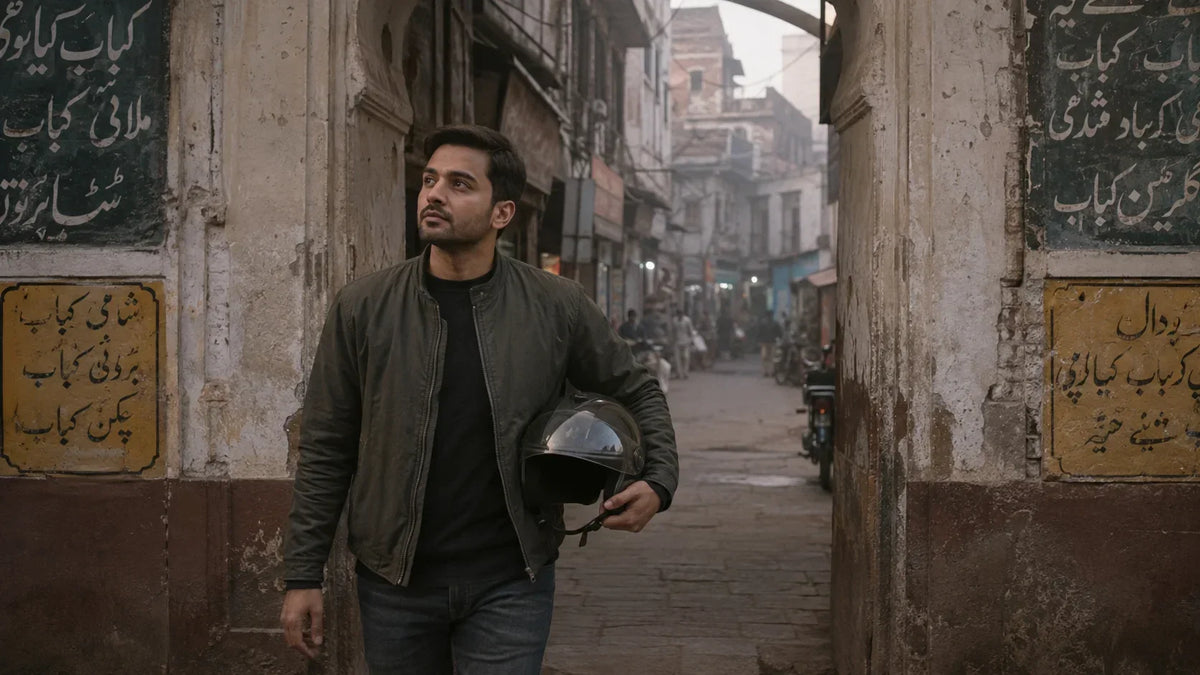
You're stuck at Charbagh crossing, engine off, helmet still buckled, the road ahead a wall of e-rickshaws that won't move. Twenty minutes pass before you're moving again.
That's a normal Tuesday in Lucknow. Every stalled minute adds dust, sweat, and smog to the padding pressed against your scalp. Searching "helmet cleaner Lucknow" usually means you've noticed the smell and want it gone. This article explains why Lucknow's air and traffic make it worse. Then it covers what actually kills the bacteria behind it.
Rider Takeaways
- Lucknow's annual AQI fell from 168 in 2020 to 115 in 2025. December 2020 still hit a punishing 305 (aqi.in).
- A Kigali study found commercial motorcycle helmets carried more bacteria than ATMs and public toilets (East African Medical Journal, 2014).
- More than 13 lakh vehicles have been registered in Lucknow since 2013, 90% of them private two-wheelers and cars (CEEW, citing MoRTH).
- Chowk's century-old kebab lanes keep riders helmeted for hours after dark, in some of the city's most humid, dust-heavy air.
Is Lucknow's Air Actually Getting Cleaner for Riders?
Lucknow's yearly average AQI dropped from 168 in 2020 to 115 in 2025, a real improvement. But that citywide average hides brutal single months. December 2020 averaged 305, "Very Poor" by India's own scale, while August 2022 averaged just 70.
That swing matters for your helmet. Dust and soot don't just sit on your visor. They settle into the foam padding every time you ride, and they don't wash out with a wipe-down.
Quick Fact:
Lucknow's PM2.5 hit 90.3 µg/m³ in 2019, over four times the WHO's annual guideline of 10 µg/m³, ranking the city 7th most polluted in India and 11th worldwide that year. Source: IQAir.
Lucknow's PM2.5 hit 90.3 µg/m³ in 2019, over four times the WHO's annual guideline of 10 µg/m³, ranking the city 7th most polluted in India and 11th worldwide that year. Source: IQAir.
Humidity swings hard too. It sits at 30% in April and climbs to 82% by August, a 52-point jump (Climate-Data.org). Temperatures range from a mild 14.9°C in January to 32.8°C in May. Annual average: 25.1°C. The city gets roughly 999mm of rain a year, most of it in July and August.
Dry, dusty summers followed by a damp, bacteria-friendly monsoon. Your helmet gets hit from both directions every single year.

How Long Does Lucknow Traffic Really Keep Your Helmet Sealed?
Lucknow has added more than 13 lakh vehicles since 2013. Ministry of Road Transport data cited by CEEW shows 90% of them are private, mostly two-wheelers and cars. Public transport hasn't kept pace at all.
Quick Fact:
Buses, autos, tempos, and 30,000+ e-rickshaws together make up less than 5% of vehicles on Lucknow's roads, yet carry 15 to 20% of daily commuters. The city runs 9 buses per lakh people against a national norm of 40. Source: CEEW, citing MoRTH and MoHUA.
Buses, autos, tempos, and 30,000+ e-rickshaws together make up less than 5% of vehicles on Lucknow's roads, yet carry 15 to 20% of daily commuters. The city runs 9 buses per lakh people against a national norm of 40. Source: CEEW, citing MoRTH and MoHUA.
Unique Insight
Our finding: a fleet that's under 5% of Lucknow's traffic is doing 3 to 4 times its fair share of the commuting work. Every gap it can't cover pushes another rider onto a two-wheeler, in stop-start traffic, helmet sealed shut through every e-rickshaw jam.
What's Actually Growing Inside Your Helmet?
A 2014 study out of Kigali compared bacterial contamination on commercial motorcycle helmets against public ATMs and public toilets. The helmets came out worse than both (East African Medical Journal). Researchers found Staphylococcus aureus, E. coli, Salmonella, Klebsiella, and Pseudomonas living in the padding.
That's not a Kigali problem. It's a shared-surface, sweat-and-warmth problem, and it applies to any unwashed helmet liner, anywhere.
In Lucknow, dust from stalled traffic and winter smog gives bacteria something extra to hold onto. Grit works into the foam and traps moisture against it, so the padding stays damp longer after every ride. Every day it stays damp is another day bacteria keep multiplying.
The same Kigali study found one thing that reliably worked: disinfecting the surfaces eliminated bacterial growth across the board. Wiping with a dry cloth or leaving the helmet to air out didn't do that job.
Chowk's Kebab Culture Keeps Your Helmet On For Hours
Lucknow riders don't just commute, they linger. The Chowk kebab lane, home to Tunday Kababi since 1905, still pulls riders in after dark for Galouti kebab. Legend says a toothless nawab demanded a kebab soft enough to eat without chewing, and the dish stuck.
Getting there means threading a helmet through some of Old Lucknow's narrowest lanes, past food stalls, foot traffic, and parked carts. A round trip often runs an hour or more, on top of whatever the day's commute already added.
Even the shop itself made news recently. In July 2026, a Waqf land dispute put the 120-year-old Chowk kebab institution back in headlines (India TV News). It's a reminder of how deep this evening ritual runs in the city's identity.
Unique Insight
Our finding: a Lucknow rider's helmet-on time isn't just the commute. Add a late kebab run through Chowk, and you're looking at 3 to 4 hours of sealed, humid contact with the same padding on a single evening, well past what a straight office commute alone would add up to.
Is a Helmet Cleaner the Same as a Helmet Deodorant?
Searching "helmet cleaner Lucknow" usually means one of two things. You want visible dust off the padding, or you want the smell underneath it gone. Those are different jobs, and most products only do the first one.
A cleaning spray lifts dirt and grime off the surface. It doesn't touch the bacteria living inside the foam, the actual source of the smell the Kigali study measured. Hygena is built for that second job. It's a bacteriostatic spray that stops odor-causing bacteria from multiplying, not a cleaner that just wipes the surface.
| What you need | Cleaning spray | Hygena helmet spray |
|---|---|---|
| Removes visible dust/grime | Yes | Not designed for this |
| Stops odor-causing bacteria | Not designed for this | Yes, bacteriostatic formula |
| Safe for daily use on padding | Depends on formula | Yes |
How Hygena Fits Into a Lucknow Rider's Routine
You can't control Lucknow's AQI or how long Charbagh stays jammed. You can control what happens inside your helmet during all that sealed, humid time.
A few sprays of Hygena's bacteriostatic helmet spray, before you ride or right after you park for the night, target the bacteria the Kigali study found. It's built to survive a full Charbagh crawl and still be working when you park outside Chowk for kebabs.

Frequently Asked Questions
Does Lucknow's dust make helmet smell worse than in less polluted cities?
Yes. Dust traps moisture inside foam padding, and damp padding is exactly where odor-causing bacteria multiply fastest. Lucknow's PM2.5 hit 90.3 µg/m³ in 2019, over 4 times the WHO guideline (IQAir).
Where can I buy helmet deodorant spray in Lucknow?
Hygena's bacteriostatic helmet spray ships across India, including Lucknow, through hygena.in. No local storefront is needed, it's a spray you keep on your bike or by your door.
How often should I use a helmet spray during Lucknow's monsoon?
Humidity climbs to 82% in August. Spraying after every ride during monsoon months keeps damp padding from turning into a bacteria breeding ground overnight.
Is a helmet cleaner enough, or do I need a deodorant spray too?
A cleaner handles visible dust. It doesn't stop the bacteria causing the smell. You need both jobs covered, cleaning for grime and a bacteriostatic spray like Hygena for the odor source.
Does washing helmet padding in water kill the bacteria?
Not reliably. The Kigali study found disinfecting, not just washing, eliminated bacterial growth on contaminated surfaces. Plain water alone often isn't enough.
Conclusion
Lucknow's air has genuinely improved since 2020, but December still turns brutal. Your commute through Charbagh or a late kebab run through Chowk still seals dust and sweat against your scalp for hours. A 2014 Kigali study found helmets can carry more bacteria than a public toilet. Lucknow's air and traffic don't make that easier.
A cleaner wipes off the dust. It won't touch what's living in the padding. Hygena's bacteriostatic spray targets that bacteria directly. It's built for the long, sealed, humid helmet-on time a Lucknow rider deals with every day. Try it before your next Charbagh crawl.
Sources
1. "Lucknow Air Quality Index (AQI): Real-Time Air Pollution," aqi.in, 2025. Retrieved 2026-08-25.
2. "Lucknow Air Quality Index (AQI) and India Air Pollution," IQAir, 2019 data. Retrieved 2026-08-25.
3. "Lucknow Climate," Climate-Data.org, 1991-2020 averages. Retrieved 2026-08-25.
4. "Solving Lucknow's Traffic Congestion Could Act as a Template for All the Large Cities of Uttar Pradesh," CEEW, 2022. Retrieved 2026-08-25.
5. Bavugirijala, J.B. et al., "Comparative Study on the Level of Bacteriological Contamination of Automatic Teller Machines, Public Toilets and Public Transport Commercial Motorcycle Crash Helmets in Kigali City, Rwanda," East African Medical Journal, Vol. 91, No. 12, December 2014. Retrieved 2026-08-25 via PubMed.
6. "Tunday Kababi History," tundaykababi.in. Retrieved 2026-08-25.
7. "Lucknow's Tunday Kababi Embroiled in Waqf Land Row," India TV News, July 31, 2026. Retrieved 2026-08-25.
Share:
Helmet Cleaner Kanpur: Why Cleaning Isn't Enough