
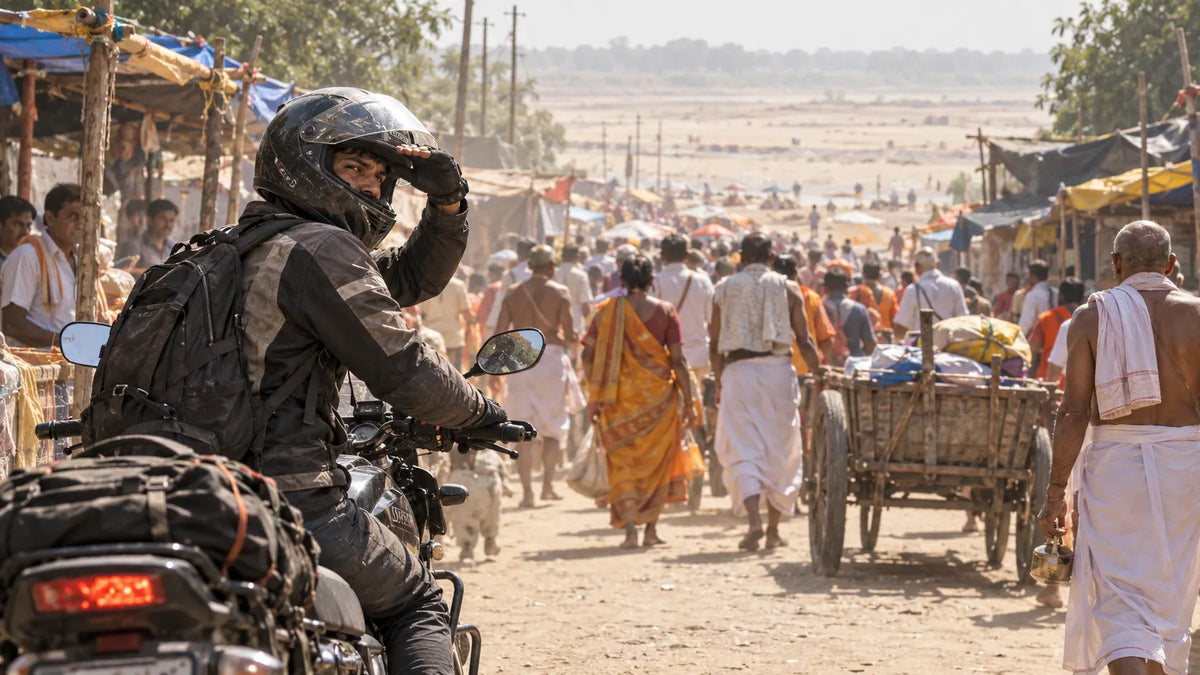
Your helmet has been sitting in Gaya's sun since morning. Now it feels like an oven.
Riders searching "helmet cleaner Gaya" are usually chasing one thing: a smell that got worse, fast. Gaya can hit 44°C by mid-May, and the instinct is to reach for a cleaner. That's not quite the right tool. This article explains why, using Gaya's own heat, crowds, and roads as proof.
Rider Takeaways
- Gaya hit 44.6°C in 2026, right where S. epidermidis (odor bacteria) grows best (Fournière et al., 2020).
- Pitru Paksha Mela puts 40,000-50,000 pilgrims on Gaya's ghats at once, and your helmet sits through hours of it.
- Cleaning and hygiene solve different problems. We explain which one you need.
- Hygena kills the bacteria causing the smell instead of masking it.
Why Does Pitru Paksha Mela Beat Up Your Helmet?
Every September, Gaya's ghats fill with pilgrims performing tarpan for their ancestors. Local administration arranges for 40,000 to 50,000 people to perform the ritual simultaneously along the riverbank. The 2025 Mela ran from September 6 to 21 (The Indian Awaaz, 2025).
If you ride through Gaya during this fortnight, you're not moving. You're inching through a procession, helmet on, engine idling. Sweat pools under the padding far longer than a normal commute.
Quick Fact:
Gaya's Pitru Paksha Mela draws tens of thousands of pilgrims to perform tarpan along the ghats each September, with organizers preparing for 40,000 to 50,000 simultaneous participants and a queue-based darshan system at Vishnupad Temple. Source: The Indian Awaaz, 2025
Gaya's Pitru Paksha Mela draws tens of thousands of pilgrims to perform tarpan along the ghats each September, with organizers preparing for 40,000 to 50,000 simultaneous participants and a queue-based darshan system at Vishnupad Temple. Source: The Indian Awaaz, 2025
Bodh Gaya adds a second, year-round crowd. Bihar logged 7.37 lakh foreign tourists in 2024, up from 5.47 lakh the year before (Patna Press, 2024). Experts credit renewed interest in the Buddhist circuit centered on Bodh Gaya. Many of those pilgrims travel in family groups on rented two-wheelers. They often share a single helmet between two or three people.
Unique Insight
Our finding: Gaya is one of the only cities in this series where two separate crowd events, a religious festival and year-round pilgrim tourism, both push riders into slow-moving, helmet-on traffic for hours at a stretch. That's double the sweat exposure most city commutes never see.

Why Does Gaya's Heat Turn Your Helmet Into an Oven?
Gaya hit 44.6°C on May 18, 2026, its hottest day that year. That's mild next to the district's 47.4°C record from May 29, 2024 (Patna Press, 2026). May stays the peak month, averaging a 39.3°C high across three decades of data (Climate-Data.org, 1991-2021 averages).
A retired geography professor quoted in local reporting points to two causes (Patna Press, 2026). Gaya's circular hill formations trap heat in a basin. The sandy Falgu riverbed soaks up sunlight all day and releases it well into the evening. Riders don't just feel the air temperature. They feel the ground giving it back.
Quick Fact:
Gaya's relative humidity swings from a dry 29% in April to a muggy 82% in September, a 53-point range, while May stays the hottest month at a 39.3°C average high. Source: Climate-Data.org, 1991-2021 averages
Gaya's relative humidity swings from a dry 29% in April to a muggy 82% in September, a 53-point range, while May stays the hottest month at a 39.3°C average high. Source: Climate-Data.org, 1991-2021 averages
The Real Reason Your Helmet Smells (It's Not Just Sweat)
Sweat itself doesn't smell. Bacteria on your scalp break it down. Staphylococcus epidermidis, one of the main culprits, grows best between 30°C and 37°C (Fournière et al., Microorganisms, 2020). Gaya's summer air alone sits inside that window for weeks. Add helmet padding and body heat, and you've built the bacteria's ideal home.
Heat and trapped moisture cause more than odor. Dermatology references describe how S. epidermidis and S. aureus form biofilms that physically plug sweat ducts. Skin affected by this carries three times the bacterial density of healthy skin nearby (Medscape/eMedicine, Levin, updated 2020). That's the mechanism behind the itchy, blocked-pore feeling under a helmet after a long ride.
Unique Insight
Our finding: Gaya's recorded temperature extremes, from a 22.6°C January average high to a 44.6°C May 2026 peak, mean your helmet's interior spends more months inside bacteria's preferred growth range than in almost any other city in this series.
Why Do Gaya's Roads Keep You in the Saddle So Long?
A 2022 survey of Bodhgaya town found just 0.27 vehicles per household. Only 20% of respondents owned a two-wheeler, and 66% owned a bicycle instead (Khurshid, Kushwaha & Kumar, JETIR, 2022). That sounds like light traffic. The same study found 77% of the local road network is kutcha, meaning unpaved, dusty, and slow going.
The riverbank route in front of Mahabodhi Temple was flagged as a chronic bottleneck. Over a third of commuters spend 21 to 30 minutes reaching work by vehicle (Khurshid, Kushwaha & Kumar, 2022). More than half said road widening is overdue because of tourist rush. Longer rides on unpaved roads mean more dust in the padding and more time for sweat to sit.
Quick Fact:
A 2022 Bodhgaya traffic survey found 20% of households own a two-wheeler, 77% of local roads are unpaved, and the riverbank stretch by Mahabodhi Temple is a recognized congestion point, with over half of residents calling for road widening due to tourist rush. Source: Khurshid, Kushwaha & Kumar, JETIR, 2022
A 2022 Bodhgaya traffic survey found 20% of households own a two-wheeler, 77% of local roads are unpaved, and the riverbank stretch by Mahabodhi Temple is a recognized congestion point, with over half of residents calling for road widening due to tourist rush. Source: Khurshid, Kushwaha & Kumar, JETIR, 2022
Is a "Helmet Cleaner" Really What You Need?
Cleaning removes dirt you can see. Hygiene stops bacteria you can't. A helmet cleaner wipes away dust from Gaya's kutcha roads. It doesn't stop S. epidermidis from multiplying once your helmet cools back down to its favorite 30-37°C range.
Hygena isn't a cleaner, and it won't polish your shell or scrub visible grime. It's a bacteriostatic spray built to stop the bacteria that actually cause the smell, which is a different job.
| What You Search | What It Actually Does | What It Doesn't Do |
|---|---|---|
| Helmet cleaner | Removes visible dirt, dust, and grime from padding or shell | Doesn't stop bacteria from regrowing |
| Helmet deodorant | Kills odor-causing bacteria at the source, prevents regrowth | Doesn't replace a full liner wash if it's visibly soiled |
How Hygena Fits Into a Gaya Rider's Routine
A few sprays before you head out, and Hygena keeps working. It survives a slow crawl behind a Pitru Paksha procession or a 30-minute stretch on a kutcha road. It's built to survive heat, not just mask it once you're already sweating.
After a ride through Gaya's peak heat, spray the interior and let it air for a few minutes. You've cut the bacteria load before it gets a head start overnight.

Frequently Asked Questions
Does Gaya's heat make helmet smell worse than other cities?
Yes. Gaya hit 44.6°C in May 2026, and odor bacteria like S. epidermidis grow best between 30°C and 37°C (Fournière et al., 2020). Your helmet interior spends more of the year in that range here than in cooler cities.
Is a helmet cleaner spray the same as a helmet deodorant?
No. A cleaner removes visible dirt and dust. A deodorant like Hygena kills the bacteria causing the smell. Gaya's dusty kutcha roads mean you may want both, for different reasons.
Where can I use helmet hygiene products during Pitru Paksha Mela?
Anywhere you're stationed for the fortnight. Pitru Paksha packs 40,000 to 50,000 pilgrims onto the ghats at once (The Indian Awaaz, 2025). Your helmet sits through long, sweaty, stop-start stretches that build up bacteria fast.
Why do Gaya's roads make helmet sweat worse?
77% of Bodhgaya's local roads are unpaved. The Mahabodhi Temple riverbank route is a known bottleneck too (Khurshid, Kushwaha & Kumar, 2022). Slower rides mean longer helmet-on time and more sweat against your scalp.
How often should I treat my helmet if I ride through Gaya's summer?
Spray after every long ride in peak heat, and always after a slow crawl through crowded routes. Bacteria don't wait for your weekly cleaning schedule, especially at 39°C-plus.
Conclusion
Gaya asks more of a helmet than most cities. It's hot enough to hit a 44.6°C record. It's crowded enough to trap you in a pilgrim procession for hours. It's dusty enough that 77% of local roads stay unpaved. All three push your helmet's interior straight into the range where odor bacteria thrive.
A cleaner handles the dust. It won't touch the bacteria. Hygena's bacteriostatic spray targets the actual cause, so your helmet stays wearable through a heat wave or a Mela crowd. Spray before you ride, spray after a long haul, and let the science do the rest. Explore Hygena's helmet hygiene range to build the habit into your next ride.
Sources
1. "Bihar: Pitru Paksha Mela 2025 Begins in Gaya," The Indian Awaaz, 2025. Retrieved 2026-09-08.
2. "Bihar Becomes Top Choice for Foreign Tourists, Surpasses Goa with Record 7.37 Lakh Visitors in 2024," Patna Press, 2025. Retrieved 2026-09-08.
3. "A Case Study on Traffic and Road Conditions in Bodhgaya," Khurshid, Kushwaha & Kumar, JETIR, 2022. Retrieved 2026-09-08.
4. "Bihar's 'Heat Bowl': Why Gaya Is Turning Into One Of India's Hottest Cities At 44.6°C," Patna Press, 2026. Retrieved 2026-09-08.
5. "Gaya Climate," Climate-Data.org, 1991-2021 averages. Retrieved 2026-09-08.
6. Fournière, M., Latire, T., Souak, D., Feuilloley, M.G.J., & Bedoux, G., "Staphylococcus epidermidis and Cutibacterium acnes: Two Major Sentinels of Skin Microbiota and the Influence of Cosmetics," Microorganisms, 2020. Retrieved 2026-09-08.
7. Levin, N.A., "Miliaria," Medscape/eMedicine, updated 2020. Retrieved 2026-09-08.
Share:
Helmet Cleaner Jalandhar: The Sports City's Real Fix
Helmet Cleaner Panipat: What GT Road Traffic Does to It