
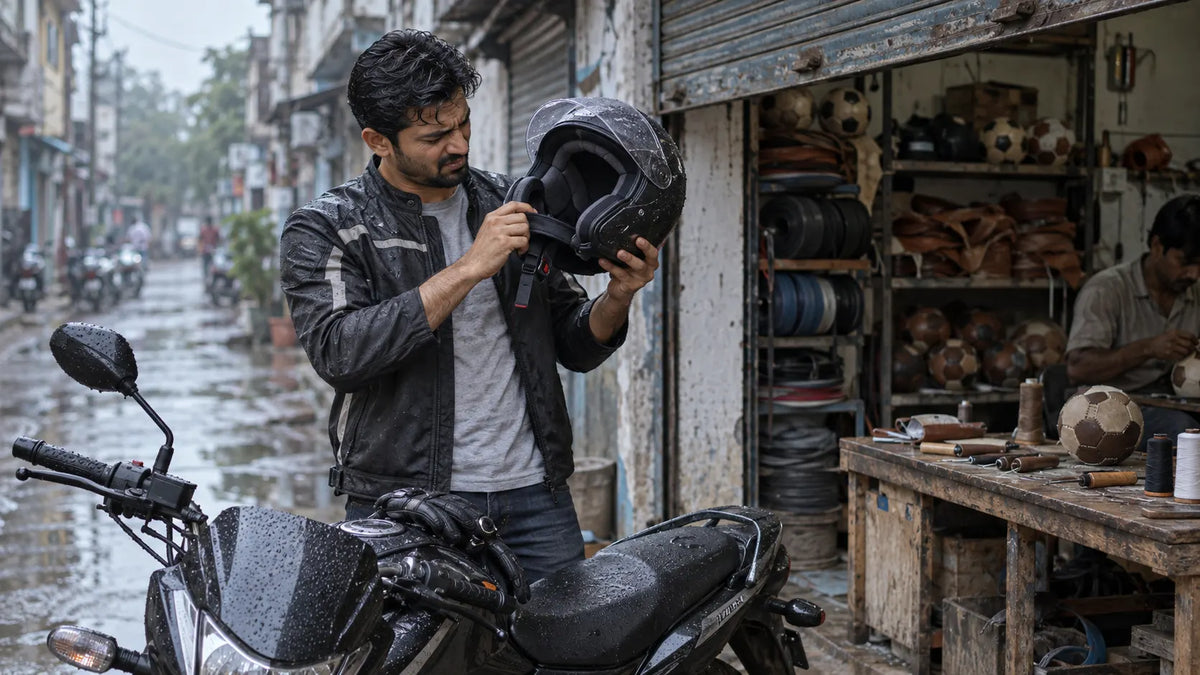
You're stuck at Jail Chowk again, engine idling, helmet sealed. By the time you're moving, your head is already damp. Search "helmet cleaner Jalandhar" and you'll find sprays, wipes, and DIY hacks. Almost none of them touch the actual problem.
This city runs on two-wheelers, workshop dust, and August humidity that climbs past 80%. Your helmet interior is dealing with all three at once. Here's what's really happening inside it, and what a helmet cleaner in Jalandhar actually needs to do about it.
Rider Takeaways
- Jalandhar traffic police still issued 54,930 challans in 2024. That's a commute dense enough to need 17 no-tolerance zones (The Tribune).
- Jalandhar's humidity swings from 34% in May to 82% in August, a 48-point jump. Sweat sits inside your helmet longer as a result (Climate-Data.org).
- A 2023 Scientific Reports study found "antibacterial" foam additives often stay trapped inside the material. They rarely reach the surface bacteria actually touch.
- Wiping your helmet down is cleaning. Killing the bacteria that cause the smell is a different job entirely.
Does Jalandhar's Traffic Crackdown Actually Cut Commute Sweat?
Short answer: not much. Jalandhar traffic police collected Rs 4.36 crore in fines from 54,930 challans through 2024. That's down from Rs 5.25 crore the year before, but still a lot of enforcement for one city.
Quick Fact:
Jalandhar police impounded 2,095 vehicles and marked 17 roads as no-tolerance zones in 2024. Four routes, including Adda Hoshiarpur and Jail Chowk, run one-way from 8 AM to 8 PM to manage the crush. Source: The Tribune, 2025.
Jalandhar police impounded 2,095 vehicles and marked 17 roads as no-tolerance zones in 2024. Four routes, including Adda Hoshiarpur and Jail Chowk, run one-way from 8 AM to 8 PM to manage the crush. Source: The Tribune, 2025.
Seventeen no-tolerance zones and 12-hour one-way restrictions don't happen in a city with light traffic. Commute through Jail Chowk or the Railway Station Road stretch. You're likely stuck in slow-moving, stop-start traffic for a real chunk of your ride.
That kind of ride means constant low-speed sweating inside a sealed helmet. There's almost no airflow to dry it out before your next ride.
Why Do Jalandhar's Sports-Goods Workshops Wreck Your Helmet Faster?
Jalandhar isn't just a Punjab city with heavy two-wheeler traffic. It's one of the world's sports-goods manufacturing hubs, and that history is written into its workshop lanes.
Quick Fact:
After Partition in 1947, skilled craftsmen from Sialkot resettled in Jalandhar and built its sports-goods trade from scratch. The city now has more than 100 major manufacturing units and roughly 20,000 small-scale workshops. Together they turn over close to Rs 450 crore a year. They export footballs, bats, and gloves to the UK, US, and Germany. Source: Jalandhar Web Portal, Sports Hub.
After Partition in 1947, skilled craftsmen from Sialkot resettled in Jalandhar and built its sports-goods trade from scratch. The city now has more than 100 major manufacturing units and roughly 20,000 small-scale workshops. Together they turn over close to Rs 450 crore a year. They export footballs, bats, and gloves to the UK, US, and Germany. Source: Jalandhar Web Portal, Sports Hub.
If you ride between these workshops daily, your helmet picks up rubber dust, leather trimmings, and stitching-room grit. That's on top of ordinary road pollution. Around 60% of what these units make is inflatable balls alone. That means a lot of rubber and synthetic dust near loading docks.
That dust settles into your helmet's foam liner the same way sweat does. It doesn't wash out with a quick wipe. It works into the padding and stays there.

Is Your Helmet's Padding Actually Fighting Bacteria?
Probably not as well as you'd hope. A 2023 study in Scientific Reports tested how E. coli grows on silicone and polyurethane foams, the same family of material used in helmet cheek pads and liners.
Unique Insight
Our finding: foams built with antibacterial additives don't always work better. Foam with activated carbon showed bacteria levels up to three times higher than untreated foam in the same study. Insoluble additives stay locked inside the material instead of reaching the surface where bacteria actually sit.
Tamm et al. published this in Scientific Reports in 2023. Water-soluble additives like tannic acid did slow bacterial growth, by leaching into the surface. Most padding materials aren't built that way.
Your helmet's foam padding was designed to absorb impact, not to fight bacteria. Treating it as if it's already doing that job is where most riders go wrong.
How Much Does Jalandhar's Monsoon Humidity Make It Worse?
A lot more than most riders realize. Jalandhar's relative humidity falls to 34% in May, its driest month. It then climbs to 82% in August, per long-term averages.
A 48-point humidity swing means the sweat sitting in your helmet during monsoon months has almost nowhere to evaporate to. It stays damp for hours after you've parked, which is exactly the environment bacteria need to multiply.
Is a Helmet Cleaner Spray in Jalandhar the Same as a Hygiene Spray?
No, and this is the mix-up behind most "helmet cleaner Jalandhar" searches. Cleaning removes visible dirt and dust. It doesn't kill the bacteria causing the smell.
| What You Need | Helmet Cleaner | Hygiene Spray |
|---|---|---|
| Removes visible dust and grime | Yes | Not the main job |
| Kills odor-causing bacteria | Rarely | Yes |
| Safe on foam padding daily | Depends on the formula | Yes, built for it |
Jalandhar's dust and monsoon humidity both call for a wipe-down now and then. But the smell that keeps coming back needs something else. It needs to kill bacteria at the source, not just clear dirt off the shell.
What Actually Fixes This for Jalandhar Riders
This is where Hygena comes in. It's a bacteriostatic spray built specifically for helmet interiors. Tea tree and neem kill odor-causing bacteria instead of just masking them.
A few sprays after a workshop-lane commute or a stop-start crawl through Jail Chowk stops that buildup before it starts. It survives Jalandhar's humidity because it treats the cause, not the smell.
Keep wiping down dust from workshop lanes if you like. Just don't expect that wipe to do the job a hygiene spray is actually built for.

Frequently Asked Questions
Does Jalandhar's humidity make helmet smell worse than drier Punjab cities?
Yes. Jalandhar's humidity climbs to 82% in August, a 48-point jump from May's 34%. That extra moisture keeps sweat inside your helmet damp for longer, giving bacteria more time to multiply. Source: Climate-Data.org.
Where can I buy a helmet hygiene spray in Jalandhar?
Hygena ships across Punjab, including Jalandhar, through hygena.in. You don't need a local store visit since it's a small bottle that fits in your tank bag or backpack.
Will cleaning wipes fix my helmet smell for good?
No. Wipes remove surface dust and grime, which helps against Jalandhar's workshop dust. They don't kill the bacteria living inside the foam padding, which is what actually causes recurring odor.
How often should sports-goods commuters use a helmet hygiene spray?
A few sprays after each ride through dusty workshop lanes works well. Daily use during Jalandhar's monsoon months keeps bacteria from building up while humidity stays above 70%.
Conclusion
Jalandhar's workshop dust, its 82% August humidity, and its stop-start traffic all push the same way. Your helmet interior stays damp and dirty longer than it should.
A helmet cleaner in Jalandhar clears the dust. It doesn't kill the bacteria causing the smell you actually notice. Hygena's spray does that job directly, built for exactly this kind of daily wear. Try Hygena's helmet hygiene spray and see what a real fix feels like after your next ride through the city.
Sources
1. "Sports Hub," Jalandhar Web Portal, Government of India. Retrieved 2026-09-08.
2. "Jalandhar Traffic Police Raked in Rs 4.36 Cr as Fine in 2024," The Tribune, 2025. Retrieved 2026-09-08.
3. "Jalandhar Climate Data," Climate-Data.org, 1991-2021 averages. Retrieved 2026-09-08.
4. Tamm, T. et al., "Microbial Growth and Adhesion of E. coli in Elastomeric Silicone Foams with Commonly Used Additives," Scientific Reports, Vol. 13, 2023. Retrieved 2026-09-08.
Share:
Helmet Deodorizer Thrissur: Why It Still Smells By Evening
Helmet Cleaner in Gaya: What Actually Kills the Smell